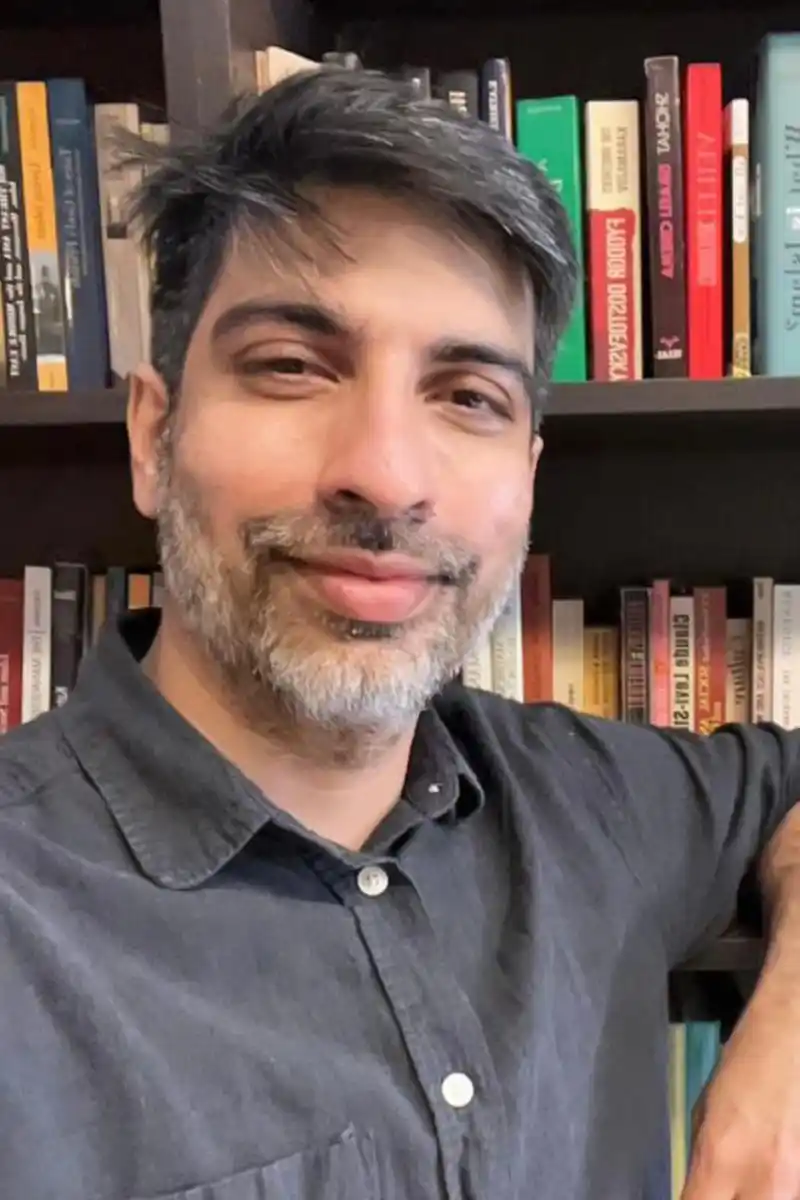
Arsalan Khan is Associate Professor in the Department of Anthropology at the University of Tennessee, Knoxville, where he joined in 2023. Previously, he taught at Union College in Schenectady, NY. He holds an M.A. and Ph.D. in Anthropology from the University of Virginia. His research specializes in the anthropology of Islam, examining intersections of ritual, gender, and ethics in Pakistan and South Asia. Current projects analyze: (1) Islamic piety movements like Tablighi Jamaat and their visions of moral order (explored in his 2024 Cornell University Press book The Promise of Piety ), and (2) climate justice politics in Karachi, focusing on Islamic conceptions of citizenship and moral responsibility during environmental crises. His scholarly publications demonstrate consistent focus on Islamic ethics, political anthropology, and Pakistani society, with recurring theoretical engagement with sovereignty, hierarchy, and religious modernity.
Dr. Patrick Gill-Tiney is an LSE Fellow in the Department of International Relations at the London School of Economics and Political Science. His work focuses on international order, major power relations, and the role of international institutions like the United Nations. He holds a DPhil from Oxford University, an MSc from UCL, and degrees from Oxford and the University of Maryland. His research explores the decline of interstate violence linked to liberal norms, the impact of subordinate monopolization on major power wars, and evolving UN peacekeeping norms. Previously, he was a Fixed-Term Lecturer at St John’s College, Oxford. He is a Fellow of the Higher Education Academy. Key research interests include international security, regime type effects on peace, and the functional role of international organizations. His work has been published in the Journal of Conflict Resolution.
Kiran Pedada is an Associate Professor of Marketing at the Asper School of Business, University of Manitoba, and holds the F. Ross Johnson Fellow and The Associates Fellow in Marketing and Inclusive Business. Previously, he was an Assistant Professor at the Indian School of Business (ISB) and a Visiting Scholar at the University of North Carolina. He has been recognized as ISB’s Teacher of the Year (2020 and 2021) and named a top MBA professor by BusinessBecause. His research focuses on marketing strategy, digital transformation, emerging markets, and inclusive business practices. Dr. Pedada earned his Ph.D. in Marketing from Texas Tech University, where he won the Helen Devitt Jones Excellence in Graduate Teaching Award. His doctoral work on international marketing alliances in emerging markets won the prestigious AMS Mary Kay Inc. Doctoral Dissertation Award. Before academia, he worked in management consulting and corporate strategy. Research Interests : Marketing strategy in digital environments Social and financial impact of marketing Global marketing expansion via digital ecosystems Emerging markets dynamics Brand competitiveness through digital orientation Key Contributions : His research has been published in top journals like Journal of Marketing Research and Journal of the Academy of Marketing Science. He co-authored cases on digital transformation for Harvard Business Publishing and serves on editorial boards of key marketing journals. His work has been featured in Forbes, Fortune, and CNN. Awards : AMS Mary Kay Inc. Doctoral Dissertation Award (2019) F. Ross Johnson Fellowship Teacher of the Year (ISB, 2020 & 2021) He actively advises on digital readiness of SMEs and ESG integration in alliances. His current projects explore metaverse applications and rural microentrepreneurship in India.
Stuart Hargreaves is an Associate Professor at the Faculty of Law , The Chinese University of Hong Kong . His research focuses on information and privacy law and constitutional law and legal theory , reflecting his prior legal practice and academic background. Education: SJD, University of Toronto (2013) BCL, Oxford University (2008) JD, Osgoode Hall Law School (2006) BA in Politics & Sociology, McGill University (2000) His work examines the intersection of artificial intelligence and legal education , with projects like “Teaching Avatars” using AI for educational content creation. He also investigates surveillance technologies , privacy law , and constitutional rights in the context of Hong Kong’s political and legal environment. Scientific Awards and Grants: CUHK Teaching Excellence Award (2017) CUHK Direct Grant for Research University Grants Committee Teaching Development Grant Research Grants Council General Research Fund Joseph-Armand Bombardier Canada Graduate Scholarship Google Policy Fellowship He has contributed to AI in legal pedagogy through multiple conference presentations (e.g., “Teaching Avatars” at the 2024 CUHK Teaching & Learning Innovation Expo) and serves on the Board of Advisors for Teach for Hong Kong . His external roles include journal reviewing and LAWASIA membership.
Professor Ida Koivisto from the Faculty of Law at the University of Helsinki specializes in administrative law, constitutional law, and global administrative law. Her research focuses on transparency in digital governance, automated decision-making in public administration, and the intersection of law with digital technology. Key research themes: Digital transparency, legal automation, EU administrative law Active in multidisciplinary projects like DARE (Digital Administration Redesigned for Everyone) and AlgoT (Algorithmic Transparency) Recent publications explore ethical dimensions of AI in governance, legal personhood in digital systems, and paradoxes of transparency. Her work appears in journals like Artificial Intelligence, Humans and the Law and Critical Analysis of Law . International collaborations include academic visits to the University of Toronto, University of Hong Kong, and European University Institute. She contributes to policy through expert statements for Finland's Constitutional Law Committee and other public institutions.
Lin Chen is the Chair Professor of Finance and Stelux Endowed Professor in Finance at the University of Hong Kong (HKU), serving as Associate Dean (Research and Knowledge Exchange) in the Faculty of Business and Economics. He holds a PhD from the University of Florida and has held academic leadership roles at HKU and Chinese University of Hong Kong (CUHK). His research focuses on financial technology, banking systems, corporate finance, and economic development, with notable contributions to understanding financial resilience during crises and institutional reforms. Educations: PhD/MBA in Finance from University of Florida, B.E. in Engineering from South China University of Technology Leadership roles: Associate Dean (HKU), Board Member of HKU-Standard Chartered FinTech Academy, Currency Board Committee member Research interests span financial innovation , banking competition , corporate governance , and ESG integration . Key projects include RGC Theme-based grants on FinTech stability/inclusion and HK's financial center development. His work is published in top journals like Journal of Financial Economics and Review of Financial Studies . He has advised major institutions including Hong Kong Monetary Authority, World Bank, and China Construction Bank. Awards include the Jensen Prize (2011), Nobel nomination (2016), and honorary professorships from Edinburgh and Berkeley. Grants coordination includes HK$24.4 million FinTech project (2020-2025) and leadership roles in research centers like HKU’s Financial Innovation & Development Centre. Active in editorial roles for Management Science and policy advisory groups. Media engagements include BBC, Bloomberg, and Harvard Law School forums. Current initiatives focus on Web3.0 development in HK and financial inclusion strategies.
Sunny Stalter-Pace serves as the Hargis Professor of American Literature in Auburn University's College of Liberal Arts, English Department. A specialist in modernist performance, literature, and urban space, she authored Imitation Artist: Gertrude Hoffmann's Life in Vaudeville and Dance (2020) and is currently completing a cultural history of the New York Hippodrome. Her work bridges academic research with public engagement through blogs, interviews, and collaborations with institutions like the Library of Congress. Her educational foundation includes: Ph.D. in English, Rutgers University (2007) M.A. in English, Rutgers University (2003) B.A. in English and French, Loyola University Chicago (1997), magna cum laude Stalter-Pace's research interrogates intersections of mobility, gender, and performance in 20th-century American culture. She examines how vaudeville, subway systems, and theatrical spectacles shaped public identity, with particular attention to women's experiences and spatial politics. Her methodology combines literary analysis, archival research, and visual studies to reveal how imitation and movement function as cultural forces. Current projects explore aquatic performances at the New York Hippodrome and the legacy of vaudeville producer Gertrude Hoffmann. Her 15 most recent publications demonstrate an evolving trajectory from subway systems ( Underground Movements , 2013) toward aquatic spectacles and vaudeville legacies, consistently centered on New York City's infrastructure. This body of work establishes mobility studies as a critical lens for understanding modernism, revealing how transportation networks and performance venues structured social interactions. Her interdisciplinary approach connects theater history, gender studies, and urban theory to uncover marginalized narratives in American cultural production. Key recognitions include: Harry Ransom Center Fellowship (2020) New York Public Library Short-Term Research Fellowship (2020) Alabama Humanities Foundation Grant (2014) College of Liberal Arts Excellence in Teaching Award nomination (2011) Multiple research fellowships from 2003-2017 Stalter-Pace has secured substantial funding for archival research through fellowships from the NEH, MLA, and university grants. She serves on Biographer’s International Organization's program committee and curated the 'Common Grounds' exhibition at Auburn's Jule Collins Smith Museum. Her teaching innovations include the first-year seminar 'Thinking Through the Arts' and courses on contemporary drama that integrate Hamilton into American literature pedagogy. As Book Review Editor for Transfers: Interdisciplinary Journal of Mobility Studies , she shaped scholarly discourse in mobility studies. Through her Hippodrome research blog and collaborations with the New York Public Library, Stalter-Pace transforms specialized scholarship into accessible public history. Her Library of Congress presentation on Albertina Rasch and the Hippodrome exemplifies her commitment to bridging academic research with community engagement, while ongoing interviews and blog posts extend her work beyond traditional academic boundaries.
Ruben Verborgh is a Professor of Decentralized Web Technology at the Ghent University – imec and a Visiting Fellow at the Oxford Martin School (University of Oxford). He leads the Internet Technology and Data Science Lab (IDLab) and co-founded the Solid platform with Tim Berners-Lee to re-decentralize the Web. His research focuses on Linked Data Fragments , a paradigm for Web-scale query execution, and explores decentralized data governance , user-controlled data ownership , and rule-based Web agents for policy enforcement. He has co-authored two books on Linked Data and contributed to over 250 publications. Recent articles highlight trends in decentralized data ecosystems , including ODRL policy interoperability , event notification systems , and personal data vaults . His work bridges Linked Data , hypermedia APIs , and privacy-preserving technologies . Verborgh collaborates with institutions like MIT, Oxford, and the European Commission, and advises companies through Inrupt . His labs ( IDLab , Solid Ecosystem ) focus on sustainable data-driven societies.
David Lillis is an Associate Professor in the School of Computer Science at University College Dublin (UCD). His research focuses on Natural Language Processing (NLP), Artificial Intelligence (AI), and their applications in legal and forensic contexts. He leads projects like CeADAR (Ireland’s Applied AI Center) and the Transpire project, collaborating with organizations such as Corlytics and the Department of Enterprise, Trade and Employment. He holds adjunct roles as a Guest Professor at Beijing University of Technology’s Data Mining and Security Lab and has been a Fulbright Scholar at the University of New Haven’s Cyber Forensics Research and Education Group. Education: B.A. (Hons) in Law and Accounting, University of Limerick Higher Diploma in Computer Science, UCD M.Sc., Ph.D. in Computer Science, UCD Professional Certificate in University Teaching & Learning, UCD Research Interests: Legal AI, digital forensics, machine learning, multi-agent systems, and information retrieval. Recent work includes NLP for regulatory analysis, crop yield prediction via neural networks, and AR-driven decision support systems. Grants & Projects: Principal Investigator: Transpire (AI Platform for Regulation) SFI Funded Investigator: CONSUS (Crop Optimization) PI: CeADAR Technology Centre Teaching roles include Deputy Programme Director for Software Engineering at Beijing-Dublin International College (BDIC) since 2014. Labs & Groups: UCD Forensics and Security Research Group, ML-Labs (SFI Centre for ML Training), and the Data Mining and Security Lab (BJUT).
John Armour is a Professor of Law and Finance at the University of Oxford, serving as Dean of the Faculty of Law and Chair of the Law Board. He holds fellowships at the British Academy and the European Corporate Governance Institute. His research focuses on integrating legal and economic analysis, particularly in corporate governance, financial regulation, and corporate insolvency law. He previously held roles at the University of Cambridge and has been a visiting scholar at institutions such as the University of Chicago and the Max Planck Institute. Armour’s educational background includes an MA and BCL from the University of Oxford and an LLM from Yale Law School. He has contributed to major policy projects for the UK government, the World Bank, and the European Commission. His editorial roles include Executive Editor of the Journal of Corporate Law Studies and Journal of Law, Finance and Accounting . Research Interests: Corporate law, financial regulation, insolvency frameworks, and the real-world economic impacts of legal changes. Policy Engagement: Advised UK regulators (BEIS, FCA) and international bodies on corporate governance and financial stability. Awards: Fellow of the British Academy and European Corporate Governance Institute. Armour teaches courses such as Company Law, Principles of Financial Regulation, and Comparative Corporate Law. His recent work explores climate-related corporate commitments and AI’s role in legal practice, including initiatives like the Unlocking the Potential of AI for English Law project.
René M. Stulz is the Everett D. Reese Chair of Banking and Monetary Economics at The Ohio State University's Max M. Fisher College of Business , where he also serves as Director of the Dice Center for Research in Financial Economics . He has held academic positions at MIT, University of Chicago, and University of Rochester. Ph.D., Massachusetts Institute of Technology Marvin Bower Fellowship (Harvard Business School) Doctorat Honoris Causa (University of Neuchâtel) Risk Manager of the Year (Global Association of Risk Professionals) His research spans corporate finance , financial institutions , and asset pricing , with recent work on unicorns , cyberattack economic impacts , and banking regulation . His articles show expertise in market volatility , governance , and financial globalization . Stulz has won multiple scientific awards and served as editor of the Journal of Finance and Journal of Financial Economics . He consults for the IMF , World Bank , and major financial institutions , and has testified in federal/state courts .
Jeanna Matthews is a Full Professor of Computer Science at Clarkson University and an affiliate at Data and Society. She holds a PhD from UC Berkeley (1999) and teaches courses ranging from operating systems to cybersecurity. Her research focuses on algorithmic transparency, AI ethics, and societal impacts of automated systems. Matthews is a prominent ACM leader, serving on multiple committees including the Technology Policy Subcommittee on AI Accountability. She has pioneered work on forensic software analysis in criminal justice systems and delivered DEF CON presentations on virtualization security and adversarial testing. Awards include ACM Distinguished Speaker and Fulbright Specialist roles. Her work emphasizes open-source tools and critical thinking in education, extending to global service learning programs in the Dominican Republic and Brazil. Education: PhD in Computer Science (UC Berkeley, 1999), B.S. in Math/Computer Science (Ohio State, 1994), B.A. in Spanish (SUNY Potsdam, 2016). Research Interests: Cybersecurity vulnerabilities, algorithmic accountability frameworks, automated decision systems in justice contexts, and ethical AI design. Recent projects include investigating bias in DNA forensic software through a Brown Institute grant and analyzing political polarization on social platforms. Awards & Recognition: ACM Distinguished Speaker (2018-present) Fulbright Specialist (2018-present) 2018-2019 Brown Institute Magic Grant ACM SIGOPS Chair (2011-2015) ACM Special Interest Group Governing Board Chair (2016-2018) Teaching & Outreach: Designed courses integrating open-source tools and critical inquiry, including abroad programs in Mexico, Brazil, and the Dominican Republic. Advocates for lifelong learning strategies and questioning underlying assumptions in computing systems. Key Projects: Forensic Software Accountability: Examining discrepancies in DNA analysis tools Algorithmic Transparency: Frameworks for auditing automated systems Cybersecurity Education: Adversarial testing methodologies for justice software
Edward Muir is the Clarence L. Ver Steeg Professor in the Arts and Sciences and Charles Deering McCormick Professor of Teaching Excellence at Northwestern University, with joint appointments in the Department of History and Italian Studies at Weinberg College of Arts and Sciences. His academic journey includes a B.A. from the University of Utah (1969), an M.A. (1970), and Ph.D. (1975) in Modern European History from Rutgers University, including a Semester in Italy Program at Syracuse University (1967). Muir's research explores the intersection of ritual, violence, and power in Renaissance Europe, with emphases on Italian history, microhistory, and cultural anthropology. His work examines civic ceremonies, gender exclusion, and the sociopolitical underpinnings of early opera. Key themes include the anthropology of Venice, religious processions, and community formation in pre-modern societies. His scholarly publications reveal a consistent focus on Renaissance cultural practices, Venetian society, and methodological innovations in microhistory. Recent works analyze opera's emergence in 17th-century Venice, anti-war movements, and gendered public spaces, blending archival rigor with interdisciplinary theory. Awards and Honors: Herbert Baxter Adams Prize (1982) Two-time Howard R. Marraro Prize winner (1982, 1993) Andrew W. Mellon Foundation Distinguished Achievement Award (2010, $1.5 million) Fellow, American Academy of Arts and Sciences (2014) Charles Deering McCormick Professorship for Teaching Excellence (2006) Muir has held major administrative roles including Department Chair at Northwestern and LSU, co-directed the Graduate Program in Italian Studies, and served on editorial boards for journals like the American Historical Review . He mentors through graduate programs but no specific student advisees are listed.
Katrin Bromber is a German Researcher at the Centre for Modern Oriental Studies in Berlin, where she has led the research group "Progress and its Discontents: Ideas, Practices, Materiality" since 2014. Her career spans senior research roles at ZMO and academic teaching positions at the University of Vienna. Nationality: German. Language skills: Native German, fluent English/Swahili, moderate Amharic, good reading knowledge in French/Russian, basic Tigrinya. Habilitation (2009–): African Studies, University of Vienna PhD (1993): African Linguistics, University of Leipzig MA (1988): Swahili Studies, University of Leipzig Katrin Bromber's research interrogates intersections of body politics , sports history , Swahili linguistics , and Ethiopian modernity . Her work traces how physical culture, media representation, and colonial/imperial narratives shape national identities across Africa and Asia. Current focus: "Progress" as contested concept in Ethiopian and Gulf urbanism. Key article trends reflect her translocal methodology: 2017 studies on Ethiopian stadiums and fitness culture ; 2014-2013 publications analyzing East African military press , sports branding in the Gulf , and Swahili poetry ; 2007-2000 works on colonial linguistic politics , Indian Ocean slavery , and German colonial Swahili promotion . Recurring sub-fields: body as political text, translocal modernity, media historiography. Scientific Awards: Research Grant of the Berlin City Council (1999-2000): Gendered Slavery study Service to the Scientific Community: Chairwoman, Academic Association for Horn of Africa Studies (2012–) Editorial Advisory Board - Stichproben. Vienna Journal of African Studies (2015–) Editorial Advisory Board - Studies of Department of African Languages and Cultures (2015–) Teaching Experience: Textlinguistics, Mediacommunication, African Linguistics, Swahili (elementary/advanced), Swahili Literature, Swahili in Arabic Script at Leipzig, Humboldt-Berlin, Free Berlin, and Vienna universities Anthropology of the Body at Mekelle University Summer School Field Research: Tanzania (1993-2003): Swahili Poetry, Intellectual History Kenya (2005): Indian Ocean WW2 UAE/Bahrain (2009): Sports and Body Cultures Ethiopia (2009-2015): Sports, Body Politics
Jim Rogers is an Associate Professor and Chair of PhD Studies at the School of Communications, Dublin City University. His research focuses on media and cultural industries, music, and copyright, with an emphasis on the digital transformation of the music industry, global strategies, and policy implications. He has authored and edited multiple books and articles on topics such as the evolution of performing rights organizations, the audio-visual nexus, and Ireland's music industry success. Rogers has presented at international conferences across Europe, Africa, Asia, and the Americas, engaging with issues like intellectual property, creative destruction, and cultural policy. His work bridges academic theory and industry practice, addressing the intersection of technology, law, and cultural production.