Dr. Toshiyuki Nakamura is a Lecturer at the School of Culture, History & Language at The Australian National University. With a PhD in Applied Linguistics from Monash University, his research focuses on second language acquisition, particularly examining language learning motivation, multilingual identity, self-concept in language learning, and Japanese language education. His work often bridges sociocultural theory with practical educational applications. His scholarly activities include: Published studies in Japanese Studies and System journals Research exploring motivational frameworks in Australian and Korean contexts Application of Bakhtinian concepts to speech genre analysis in language acquisition Recent publications demonstrate consistent engagement with multilingual identity formation (73% overlap across works) and motivational dynamics (61% coverage). Despite limited citation counts (highest: 29 citations for 2019 study), his research outputs show sustained scholarly contribution from 2015-2024, including a 2019 monograph with Bloomsbury Publishing. Key research themes: Dialogic approaches to language motivation Self-image construction in multilingual contexts Speech genre analysis in educational settings Cross-cultural comparisons of language learning experiences Japanese language education in non-native contexts Life domain theory in second language acquisition
Dr. Gábor Pintér holds dual academic appointments as Assistant Professor at Károli Gáspár Reformed University's Faculty of Humanities and Social Sciences (Department of Japanology) and as Associate Professor at Kobe University's School of Languages and Communication. Born in Hungary in 1977, he earned his MA (2005) and PhD (2008) in Linguistics from Kobe University, Japan, with a dissertation on asymmetrical segment distributions in Japanese. His research focuses on three interconnected domains: phonological theory (especially Japanese phonology), experimental phonetics, and applications of automatic speech recognition in language education. Specific interests include vowel devoicing patterns, prosodic perception in L2 learners, phonotactic constraints, and diachronic sound changes in Japanese. Pintér actively contributes to international research collaborations, including the JSPS-funded project 'Stochastic & theoretical phonological research' and serves as chair of the Phonology Association in Kansai (PAIK). His 15 most recent publications demonstrate methodological diversity, combining theoretical linguistics with computational approaches and experimental studies, primarily focused on Japanese phonetics and speech technology applications. Professional memberships include board positions in The Phonological Society of Japan and memberships in the International Speech Communication Association and Association for Laboratory Phonology.
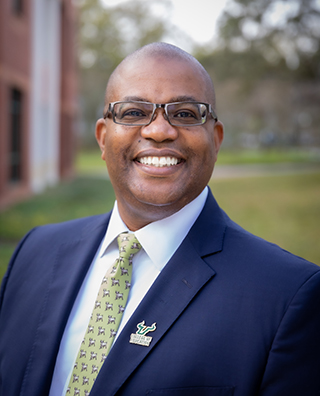
R. Anthony Rolle is a Professor at the University of South Florida’s College of Education, specializing in the Department of Leadership, Policy, and Lifelong Learning. He previously served as Dean of the USF College of Education from 2021 to 2024, and earlier as Dean at the Alan Shawn Feinstein College of Education & Professional Studies at the University of Rhode Island, as well as in leadership roles at the University of Houston and Texas A&M University. Dr. Rolle is a nationally recognized scholar in K-12 education finance and economic policy , known for developing models measuring school system effectiveness and efficiency . His work spans special needs education funding , educational productivity , and policy reform , with a focus on international collaboration and community partnerships. Scientific Awards & Affiliations: President, National Education Finance Academy Distinguished Research Fellow, Shanghai Academy of Education Sciences Research Fellow, National Education Policy Center (Education and Public Interest Center & Education Policy Research Unit) Editorial/Advisory Board Member, multiple national education associations
Associate Professor Sunny-Boy Ahmar Mahboob is a distinguished linguist at the University of Sydney, where he serves as Degree Coordinator for the Master of Crosscultural and Applied Linguistics program within the Department of Linguistics, Faculty of Arts and Social Sciences. With extensive experience in applied linguistics and language education, Dr. Mahboob has established himself as a leading expert in World Englishes, TESOL, and language variation research, both nationally and internationally. Dr. Mahboob's educational background includes: BA from Karachi MA from Karachi MA from Indiana University MEd from Sydney PhD from Indiana University (2003) Dr. Mahboob's primary research focuses on language variation in global contexts, with particular attention to World Englishes, the NNEST (Non-Native English Speaking Teachers) movement, language policy, and decolonial approaches to linguistics. His work critically examines how language policies and practices affect educational outcomes and social justice, especially in postcolonial contexts like Pakistan and the Middle East. He pioneered 'appliable linguistics' - an approach that bridges theoretical linguistics with practical applications in education and policy, emphasizing the need for linguistic theories to address real-world problems. His recent publications reveal a strong trajectory toward decolonial linguistics, with increasing focus on subaltern perspectives, environmental connections to language diversity, and critical examinations of colonial legacies in language education. Dr. Mahboob's work consistently addresses power dynamics in language teaching and the need for more inclusive approaches that value linguistic diversity across educational contexts from primary schools to universities. Dr. Mahboob has received numerous prestigious awards: 2019: Australia's Research Field Leader in English Language and Literature (The Australian's Research magazine) 2012: Fellow of the National Talent Pool; President's Programme for Highly Qualified Overseas Pakistanis 2006: Faculty of Arts and Social Sciences Teaching Award, University of Sydney 2005: Teaching Initiative Award and Fellow of the Association of Pacific Rim Universities 2004: ECU Research and Creativity Award 2002: 'Distinguished President Award' from INTESOL, Indianapolis As an academic mentor, Dr. Mahboob supervises research students including Ruohong CAO (Developing Mandarin Learning Materials for Young Learners in Australia through Positive Discourse Analysis) and Tracy GAO (Evaluating Chinese Language Textbooks: A Sociosemiotic Perspective). His editorial work includes serving as Editor of TESOL Quarterly (2014-2017) and Associate Editor for multiple linguistics journals. Dr. Mahboob has secured significant research funding for projects including the SLATE (Scaffolding Literacy in Academic and Tertiary Environments) project and indigenous language funding initiatives in Australia. Dr. Mahboob founded and leads the International Free Linguistics Conference series, which has become an important platform for critical and alternative approaches to linguistics. His 'SLATE project' focuses on genre-based pedagogy for academic writing, and he actively collaborates with researchers across multiple continents through the World Englishes research network. His recent work increasingly explores the connections between language diversity and environmental sustainability, positioning linguistic ecology as a critical component of broader ecological concerns.
Garreth Tigwell is an Assistant Professor in the School of Information at RIT, co-directing the CAIR Lab with Dr. Kristen Shinohara. His research focuses on accessibility in digital design, particularly for disabled users, addressing challenges faced by novice and expert creators. His work spans topics like accessible prototyping tools, cultural considerations in design, and inclusive mixed reality interfaces. Education: BSc in Psychology, University of Dundee, 2012 MSc (Distinction) in User Experience Engineering, University of Dundee, 2014 PhD in Human-Computer Interaction (HCI), University of Dundee, 2019 Research Interests: Designing accessible digital systems for blind, deaf, and low-vision users Adaptable user interfaces for mixed reality and textured surfaces Cultural dimensions in accessibility pedagogy Authentication methods for visually impaired users Articles Trends: Recent work emphasizes AR/VR accessibility, cultural design frameworks, and haptic authentication. His studies often involve collaborations with global researchers and industry partners. Awards: Best Paper (MobileHCI 2022) CHI Honorable Mention (2023, 2024) NSF-funded research projects Advising & Grants: Active in mentoring graduate students and securing grants. His lab focuses on born-accessible AI tools and inclusive design education. Teaches courses like HCI Research Methods and Future Interactions. Labs/Teams: Co-leads the CAIR Lab, which develops technologies to bridge accessibility gaps in digital design and prototyping.
Tracey Lavalette is a Research Fellow and PhD candidate at the University of Oslo's Department of Teacher Education and School Research, affiliated with the Faculty of Educational Sciences. Her research focuses on educational sociology and social inequality in schools, with a particular emphasis on equity-oriented teacher noticing. She holds a Master's in Pedagogy (2023) and has extensive prior experience as a teacher in lower secondary education and adult education (2014–2021). Education Background: Master's in Pedagogy (2023), University of Oslo Practical-Pedagogical Education with Norwegian and Social Studies Didactics (2014), University of Oslo Research Interests: Tracey investigates how teachers develop equitable practices through noticing and pedagogical reflection. Her work integrates sociological perspectives to address systemic educational inequalities, particularly in teacher training and curriculum design. She advocates for inclusive methodologies that bridge theory and practice in educational settings. Key Contributions: Her recent publications (2024) synthesize literature on equity-oriented teacher noticing, emphasizing its role in fostering inclusive classrooms. These studies highlight methodological innovations in scoping reviews and literature analysis. Professional Background: Doctoral Research Fellow since [start year not specified] Prior teaching roles: Norwegian/social studies teacher (secondary education) and educator for Norwegian language learners in vocational programs
Prof. Maosong Sun is a Professor at the Department of Computer Science and Technology, Tsinghua University, China. He holds additional leadership roles including Executive Vice Dean of the Institute for Artificial Intelligence and Deputy Director of the National Engineering Laboratory for Cyberlearning and Intelligent Technology. His research focuses on natural language processing (NLP), artificial intelligence, machine learning, and computational education. He leads interdisciplinary projects in computational humanities, knowledge graphs, and MOOC platforms like XuetangX, which has over 58.8 million registered learners. Key contributions include pioneering work in Chinese NLP tools, poetry generation systems like Jiuge, and large-scale research initiatives funded by Chinese and Singaporean programs. Awards include the Tsinghua University Education Award (2019) and the National Outstanding Practitioner Award (2007). Established NLP and Computational Humanities & Social Sciences Lab (2008) Co-director of the Joint Research Center for Extreme Search (2011-present) Over 200 publications with 11,000+ citations (h-index 47)
Bruna Damiana Heinsfeld serves as Assistant Professor of Learning Technologies within the Department of Curriculum & Instruction at the University of Minnesota's College of Education and Human Development. Her research critically examines the intersections of technology, society, and education through the lens of Critical Studies of Education and Technology (CSET), with emphasis on power dynamics and social justice implications. Her academic credentials include: Ph.D. in Interdisciplinary Learning and Teaching (Learning Design and Technologies concentration) from UTSA M.A. in Education (Digital Languages, Media and Education concentration) from PUC-Rio, Brazil Multiple Postgraduate Certificates from Brazilian institutions: Media Discourse Analysis, Ontology and Epistemology, Philosophy/Sociology/Social Sciences, and Distance Learning Management B.A. in English Language and Literature from UERJ, Brazil Dr. Heinsfeld's research program centers on critical discourse analysis of educational technology narratives across corporate, policy, and educational contexts. She investigates how technological discourses are constructed and operationalized, particularly regarding digital equity, participatory exclusion, and the sociopolitical dimensions of technology adoption. Her methodological approach combines Critical Discourse Analysis (CDA) with critical pedagogy to unpack ideological, cultural, and economic factors shaping educational technology implementations. She examines epistemological foundations of technological beliefs and challenges neoliberal narratives in EdTech through rigorous deconstruction of policy documents and marketing materials. Analysis of her recent publications (2019-2023) reveals consistent focus on corporate influence in educational technology, with particular attention to Google and Microsoft's marketing narratives, pandemic-era remote learning disparities, and Latinx student experiences. Her work demonstrates how technological solutions often reinforce existing inequalities through participatory exclusion mechanisms, while her policy analyses expose contradictions between equity rhetoric and actual implementation. Recurring methodological threads include discourse analysis of educational landscape reports and critical examination of public policy frameworks. No scientific awards were documented in the provided materials. As an advisor, Dr. Heinsfeld cultivates a supportive environment grounded in social justice principles, emphasizing critical consciousness development and student autonomy. Her advising philosophy centers on accessible feedback, interdisciplinary exploration, and preparation for meaningful societal engagement. She teaches foundational courses including CI 4311W Technology and Ethics in Society (examining algorithmic bias, privacy concerns, and AI ethics) and CI 8147 Critical Discourse Analysis in Educational Research (focusing on language-power dynamics in educational contexts). While specific research laboratories aren't detailed, her collaborative work spans international contexts with Brazilian institutions and U.S. colleagues, particularly evident in joint publications with researchers like V. Marone and M. Pischetola. Her research trajectory indicates ongoing critical engagement with emerging technologies like AI in education policy, as evidenced by upcoming 2025 conference presentations.
Satoshi Miyazaki is a Professor at Waseda University's Graduate School of Japanese Applied Linguistics and affiliated with the Faculty of International Research and Education . With a Ph.D. from Monash University, his work bridges Japanese language education, second language acquisition, and cross-cultural communication. Education Background: Doctor of Philosophy (Japanese Applied Linguistics) - Monash University (1997) Graduate School of Japanese Applied Linguistics - Waseda University (1982) Research Interests focus on Japanese language pedagogy, natural acquisition mechanisms, and interactional strategies for non-native learners. His innovative use of Eye Mark Recorders (EMR) and Event-Related Potentials (ERP) has advanced understanding of cognitive processes in language learning. Recent Articles (2011-2001) reveal trends in Japanese language education reform, cross-cultural learning challenges, and technology-enhanced teaching methods. Key themes include correctional language programs for foreign inmates, immersion environments, and brain processing studies using advanced neuro-linguistic techniques. Research Projects have received continuous funding from Japan Society for the Promotion of Science, including prison language education programs, foreign care worker competence frameworks, and EMR-based lecture comprehension analysis. His work extends to international collaborations with institutions in Australia, the U.S., and Europe.
Rita Aiello is an Adjunct Associate Professor in the Department of Psychology at New York University's College of Arts & Science. Her research focuses on the cognitive and perceptual processes involved in musical listening, with particular emphasis on neuroaesthetics, music learning, and memory. She holds an Ed.D. from Columbia University and has held faculty positions at institutions including the Juilliard School and the Manhattan School of Music. Her work bridges music theory, cognitive science, and education, with a lifelong background as a classical pianist. Education: Columbia University (Ed.D.), Manhattan School of Music (M.M., B.M.), Conservatorio San Pietro a Maiella (Diploma in Music Theory) Certifications: Kodály and Orff Methods Her research explores how musical training influences cerebral dominance, the relationship between mental representations and emotional responses to music, and the cognitive underpinnings of musical memory. She has published widely on topics ranging from musical expectation to pedagogical strategies for memorization. Recent work investigates evolutionary perspectives on singing and the psychological mechanisms behind musical communication. Publications reflect interdisciplinary engagement with music's structural rules, metaphorical dimensions, and its role in human cognition. While no specific grants or awards are listed, her extensive international teaching experience includes visiting roles at institutions in Rome and Lugano, Switzerland, and an honorary appointment at Columbia University's Teachers College.
Kendall King is a Professor of Multilingual Education and Associate Dean for Graduate Education and Faculty Development at the University of Minnesota , College of Education and Human Development. With expertise in sociolinguistics and language policy, they coordinate the undergraduate TESL minor and lead research projects funded by the U.S. Department of Education through CARLA. B.A. Psychology, University of California, Santa Barbara (1991) M.S. TESOL, University of Pennsylvania (1993) Ph.D. Educational Linguistics, University of Pennsylvania (1997) Their research focuses on second language learning , bilingualism , and equity , particularly in contexts involving minoritized languages and immigrant/refugee populations. They examine how family and school practices influence language use and academic success, with a strong emphasis on native language literacy as a pedagogical resource. Recent publications analyze neoliberal influences on language policies, including critiques of state seals of biliteracy and bilingual parenting frameworks. Their work has shaped Minnesota's LEAPS Act (2014), promoting multilingual approaches for English learners. Collaborative studies with Martha Bigelow highlight literacy development in newcomer students. Scientific Awards: Distinguished Scholarship and Service Award (AAAL, 2024) Linda Duttenhaver Distinguished Alumni Award (UC Education Abroad, 2023) ACTFL Research Priorities Initiative (2019) Helen C. Bailey Alumni Award (2016) Imagine Fund Annual Award (UMN, 2014) CEHD Summer Research Award (UMN, 2012) King emphasizes responsive advising and co-publishing with PhD students, supporting their participation in conferences and departmental intellectual life. They co-lead initiatives to expand multilingual recognition through state biliteracy seals.
Kashif Raza is a Postdoctoral Fellow at the Department of Educational Studies (EDST) within the Faculty of Education at the University of British Columbia (UBC). His research focuses on multilingual education, TESOL (Teaching English to Speakers of Other Languages), language policies, and systemic issues in education, such as racism and immigration integration. He examines topics like racialized voter behavior, institutional racism in educational leadership, and the role of language in immigrant integration. His work often intersects with critical race theory, sociolinguistics, and policy analysis. Raza’s research spans diverse contexts, including Canadian, Gulf, and South Asian educational systems. He has explored challenges faced by immigrant professionals in healthcare, the impact of digital networks on political engagement, and the design of multilingual curricula. His contributions also include practical guidance for scholars, such as advice on publishing and navigating language policies in higher education. While his profile does not explicitly list educational credentials, his articles indicate deep engagement with global educational challenges. He has collaborated on projects addressing pandemic-era language education and climate action through EDST’s initiatives. No awards or grants are mentioned in the provided texts.
Jeff MacSwan is a Professor of Applied Linguistics and Language Education at the University of Maryland's College of Education, with affiliations in the Department of Linguistics and the Maryland Language Science Center. He also holds a joint appointment in Neuroscience and Cognitive Science. His research focuses on bilingualism, codeswitching, and their implications for educational policy, particularly for multilingual students. MacSwan has authored and edited seminal works, including Grammatical Theory and Bilingual Codeswitching and Codeswitching in the Classroom . He serves as editor of the International Multilingual Research Journal and has contributed to national committees such as the National Academies' study on Dual Language Learners. MacSwan received the 2021 AERA Lifetime Achievement Award and Leadership through Scholarship Award for his transformative work in bilingual education theory and practice. His advocacy challenges language-deficit perspectives, emphasizing translanguaging as a pedagogical asset. MacSwan's interdisciplinary approach bridges linguistics, education, and cognitive science. His lab addresses policy-relevant research on language assessment validity and equitable educational practices for linguistic minorities. He collaborates with institutions like the National Education Policy Center, advancing evidence-based policies for multilingual learners.
Dr Melanie Cooke is a Senior Lecturer in ESOL and Applied Linguistics at King's College London, working within the School of Education, Communication and Society and the Centre for Language, Discourse and Communication. She has been with King's since 2003, following prior teaching experience teaching EFL in Spain and ESOL to adult migrants in London. Cooke serves as convenor of the Hub for Education and Language Diversity (HELD), a collaboration between the Centre for LDC and English for Action, and co-organized the ESRC-funded 'Queering ESOL' seminar series. Her research focuses on teaching and learning in adult ESOL classrooms in the UK, particularly examining the social and political contexts of migrant language education. Cooke's work explores linguistic citizenship, participatory pedagogy in ESOL, and the relationship between language education and citizenship policies. She has made significant contributions to understanding how language is used as a political tool in immigration policy and integration debates. Her recent publications demonstrate a consistent focus on linguistic citizenship, with major works including 'Localising linguistic citizenship in England' (2024), 'Working papers for a more open academy' (2023), and 'Brokering Britain, Educating Citizens' (2019) with Rob Peutrell. These works explore the intersection of language education, migration policy, and citizenship frameworks. Elsevier Outstanding PhD Thesis Prize for Exceptional Doctoral Work (2016) Cooke teaches across multiple programs including BA English Language & Linguistics, MA Applied Linguistics and ELT, MA Language and Cultural Diversity, and MA TESOL. Her courses cover sociolinguistics, qualitative research methods, language and migration, and communicative language teaching. She also actively supervises PhD students in areas related to ESOL teaching and learning, language and citizenship, and language and migration. Notably, Cooke maintains active engagement with ESOL practice, regularly teaching in an ESOL class in East London that uses the participatory ESOL approach, creating a valuable connection between her research and practice.
Dr. Jingyun Wang is an Assistant Professor in the Department of Computer Science at Durham University. Previously, she held an Assistant Professor position at Kyushu University, Japan. Her primary affiliations include the Centre for Neurodiversity & Development and the Artificial Intelligence and Human Systems Group (AIHS), as well as the Pedagogical Innovation in Computer Science Group (PICS). She is a Fellow of the Higher Education Academy and has led or contributed to research projects funded by JSPS, JST, NICT, Innovate UK, and industry partners. Her research focuses on AI-driven educational technologies, including AI-based feedback systems, computational thinking education, game-based learning, and ontology techniques. She actively contributes to editorial boards (e.g., Computers & Education: Artificial Intelligence ) and serves as a conference chair for AIED, ICCE, and LTLE. Current research includes adaptive learning systems for mathematics education, serious games for cybersecurity training, and visualization tools for e-learning. Her scientific contributions span over 50 peer-reviewed publications, with recent work emphasizing learning analytics, multimodal systems, and digital health interventions. She advises multiple PhD students and mentors in professional recognition pathways. Key projects include developing the BETTER speech training system, the MEMORABLE cybersecurity game framework, and ontology-based language learning platforms.