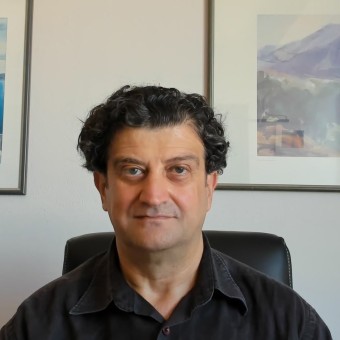
Thomas Spyrou is an Assistant Professor in the Department of Product and Systems Design Engineering at the University of the Aegean. He holds a Physics degree from the National and Kapodistrian University of Athens and a PhD in Decision Support Systems - Artificial Intelligence from the University of the Aegean. His research focuses on Information Systems, Design Methodologies, and Sustainability, with an emphasis on Decision Support Systems, Simulation, and Cybernetics. Key affiliations include the Department of Product and Systems Design Engineering at the University of the Aegean, where he has contributed to curricula development and interdisciplinary projects. His work spans design theory, digital tools for art and sustainability, and systems thinking applied to creative processes. Research interests include Design Support Systems, Biomimetic Service Design, and the integration of tacit knowledge into design frameworks. His recent projects involve tools like DDArtS for street art creation and Spyractable for tangible user interfaces. Over 50 publications highlight his contributions to design, technology, and cybersecurity.
Dimitrios Tsoumakos serves as an Associate Professor of Big Data Management Systems at the School of Electrical and Computer Engineering of the National Technical University of Athens (NTUA) where he also directs DBLab, the Knowledge and Database Systems Laboratory. His academic career spans over two decades with significant contributions to large-scale data management and distributed systems. Diploma in Electrical and Computer Engineering from NTUA (1999) M.Sc. in Computer Sciences from University of Maryland (2002) Ph.D. in Computer Sciences from University of Maryland (2006) Professor Tsoumakos' research focuses on the intersection of big data management, cloud computing, and distributed systems. His work addresses fundamental challenges in large-scale data processing, including wavelet synopses for data summarization, vector embedding frameworks for analytics operators, multi-engine analytics systems, and cloud application deployment with failure recovery mechanisms. His research consistently bridges theoretical algorithms with practical implementations for real-world data challenges. His publication record demonstrates consistent innovation from early work on P2P data management systems through to current research on vector embeddings and deep reinforcement learning for cloud autoscaling. Recent work shows a clear progression toward content-based analytics, multi-dataset integration, and intelligent resource management in heterogeneous environments. Best Paper Runner Up Award at SSDBM 2019 Best Paper Award at CCGrid 2013 Professor Tsoumakos has secured substantial research funding through multiple European projects including RELAX (2023-2027), HiDALGO2 (2023-2026), DAPHNE (2021-2024), and previous initiatives like HiDALGO, TraMOOC, ASAP, CELAR, ARCOMEM, and GREDIA. These projects reflect his leadership in big data analytics, cloud computing, and distributed systems research. As director of DBLab, Professor Tsoumakos oversees research on the Knowledge and Database Systems Laboratory, which has produced significant work on analytics operators, multi-engine resource scheduling (IReS platform), cloud elasticity (TIRAMOLA), and RDF data management (H2RDF+). The lab maintains strong industry connections and has developed multiple open-source tools for big data analytics.
Zhenjiang Hu is a Chair Professor and Dean of the School of Computer Science at Peking University. He serves as Director of the Programming Languages Laboratory and has held significant academic positions including Professor at the National Institute of Informatics and University of Tokyo. BS and MS from Shanghai Jiaotong University (1988, 1991) PhD from University of Tokyo (1996) Lecturer/Assistant Professor at University of Tokyo (1997) Associate Professor at University of Tokyo (2000) Full Professor at National Institute of Informatics (2008) Full Professor at University of Tokyo (2018-2019) Professor Hu's research primarily focuses on programming languages and software engineering, with special emphasis on functional programming, bidirectional transformation, and software adaptation. His work explores transformational programming approaches for automatic program optimization, systematic parallelization of sequential programs, efficient manipulation of structured documents, and bidirectional model transformation for software development. His research has significantly advanced the field of bidirectional programming, developing foundational theories and practical applications that enable more reliable and maintainable software systems. His recent publications demonstrate a strong trajectory in bidirectional programming, program synthesis, and graph processing. The research shows increasing sophistication in handling program transformations, with growing emphasis on practical applications in software engineering contexts. His work increasingly integrates formal methods with practical programming language design, creating systems that maintain theoretical soundness while addressing real-world software development challenges. The research spans multiple venues including top conferences like PLDI, POPL, ICFP, and OOPSLA, reflecting its broad impact across programming language research. Fellow of JFES (Japan Federation of Engineering Society, 2016) ACM Distinguished Scientist (2016) Member of Academia Europaea (2019) IEEE Fellow (2020) Member of Engineering Academy of Japan (2020) Professor Hu actively mentors students and has welcomed excellent candidates to join his group through Peking University's International Elite PhD Program and Boya Postdoctoral Fellowship Program. He serves on numerous program committees for major conferences including PLDI, POPL, ICFP, and OOPSLA, and holds editorial positions for prestigious journals such as Journal of Functional Programming and Science of Computer Programming. His leadership extends to conference organization, having served as PC Chair for CNCC 2024 and General Co-Chair for SoICT 2019. As Director of the Programming Languages Laboratory at Peking University, Professor Hu leads a research team focused on advancing programming language theory and practice. His lab has developed influential frameworks like BiGUL for bidirectional programming and Fregel for graph processing. The laboratory maintains strong international collaborations and contributes to both theoretical foundations and practical implementations in programming languages and software engineering.
Nikolaos Samaras is a Full Professor at the Department of Applied Informatics, School of Information Sciences, University of Macedonia in Thessaloniki, Greece. He has been serving as director of the Computational Methodologies & Operations Research (CMOR) Laboratory since April 2016. His academic career includes positions as Assistant Professor (2007-2012) and Lecturer (2003-2007) at the same institution, and earlier as an adjacent Lecturer at the Technological Institute of Western Macedonia (1998-2000). Dr. Samaras earned his Diploma in Applied Informatics from the University of Macedonia in 1996 and his Ph.D. in Applied Informatics from the same university in 2001. His educational background forms the foundation for his extensive research in computational optimization and operations research. Professor Samaras's research focuses on the interface between computer science and operations research, with particular expertise in linear and nonlinear optimization, network optimization, integer optimization, and scientific computing including HPC and GPU programming. His work has resulted in the development of new algorithmic families for optimization problems, efficient GPU implementations of the revised simplex algorithm, and novel algorithms and software for operations research. His research spans theoretical algorithm development, practical implementation, and real-world applications across various engineering and scientific domains. His extensive publication record includes over 35 journal papers in prestigious venues such as Computers and Operations Research, European Journal of Operational Research, and Journal of Artificial Intelligence Research, more than 85 conference papers, and four textbooks (two in English and two in Greek). His work has been recognized through citations and the Thomson ISI/ASIS&T Citation Analysis Research Grant in 2005. ACM Senior Member (2016) Thomson ISI/ASIS&T Citation Analysis Research Grant (2005) Editorial board member of Operations Research: An International Journal Reviewer for numerous top journals including Mathematical Programming Computation and European Journal of Operational Research Professor Samaras has supervised four current Ph.D. students working on hybrid simplex algorithms, large-scale optimization using Apache Hadoop, algorithmic procedures in matrix theory, and smoothed complexity analysis. He has successfully guided five Ph.D. students to completion, including Nikolaos Ploskas who won the 2014 HELORS Doctoral Dissertation Award. Additionally, he has supervised 45 master's theses and 84 bachelor's theses. His research group has secured funding from diverse sources including the European Union, Greek Secretariat of Research and Technology, and industry partners like Veltio Greece LTD. The Computational Methodologies & Operations Research (CMOR) Laboratory, which he directs, focuses on developing and implementing optimization algorithms with applications in transportation, energy systems, and business process design. The lab has produced notable software tools including Euclides and Visual LinProg, which have educational applications in linear programming.
Christos Tryfonopoulos is an Associate Professor and Head of the Department of Informatics & Telecommunications at the University of the Peloponnese, where he leads the Software and Database Systems (SoDa) Lab. His academic career spans prestigious institutions including the Max-Planck Institute for Informatics in Germany, where he led the P2P and Information Management research area from 2006-2009, and the Technical University of Crete, where he completed his PhD and MSc degrees. His research interests focus on information management, distributed systems, digital libraries, and data/user anonymity. His work bridges theoretical foundations with practical applications across diverse domains including environmental monitoring, cybersecurity, cultural heritage, and medical informatics. He has developed innovative frameworks for pollution prediction, cyber-threat intelligence, and academic expertise mapping that demonstrate the interdisciplinary nature of his research. Professor Tryfonopoulos has published over 80 papers in top-tier journals and conferences including TOIS, TKDE, SIGIR, and SIGMOD. His recent work shows a strong trend toward applying machine learning techniques to information management problems, with publications spanning environmental science, cybersecurity, and bibliometrics. His research group has developed several significant tools including VeTo+ for expert set expansion, inTIME for cyber-threat intelligence, and Hydria for cultural heritage analytics. Candidate for best research paper in ESWC 2016 conference Honorable mention for best poster (3rd place) in ESWC 2012 conference Award as Distinguished Scientist Excelling in Research Abroad (2008) Best student paper award in ECDL 2005 conference Heraclitus PhD fellowship from Greek Ministry of Education (2002-2005) National Scholarship Foundation of Greece (IKY) scholarship (1998) Professor Tryfonopoulos has supervised 5 PhD students (3 in progress), 19 MSc students, and 31 BSc students. He has led or participated in 13 competitive EU and national research projects including ENIRISST+ for shipping and transport infrastructure, WeCare for student support structures, and FORESIGHT for cybersecurity simulation. His current research focuses on intelligent infrastructure for transportation logistics, cyber-threat intelligence systems, and educational technologies for data science.
Michael Eichberg is a Professor at Technische Universität Darmstadt, Germany, where his work centers on software engineering, static analysis, programming languages, and secure software development tools. He is the principal architect of the OPAL framework for Java bytecode analysis and has an extensive publication record spanning PLDI, ICSE, ESEC/FSE, ISSTA, ASE, FSE, SOAP, and other premier venues. Research Interests: Static program analysis and its scalability to real-world code bases Software security, particularly cryptographic API misuse and Android app repackaging detection Concurrent and parallel programming models, including deterministic concurrency in Scala Software architecture conformance, drift and erosion detection, and rule reuse Development of open extensible tools and frameworks (OPAL, LectureDoc, QScope, Sextant, XIRC, IRC) Publication Trends: His recent work (2015-2022) demonstrates a strong focus on empirical evaluation of static analysis techniques, modular composition of analyses, and security-related program understanding. Key themes include unsoundness in call graph construction, purity and immutability analyses, parallelization of static analyses, and large-scale studies of cryptographic API misuse. Tools & Frameworks: OPAL – A flexible Java bytecode analysis and manipulation framework (core developer until 2019) LectureDoc 2 – Web-based lecture material authoring and presentation system QScope – Open extensible metrics framework for modern software projects Sextant – Eclipse-integrated software exploration tool XIRC/IRC – Frameworks for enforcing system-wide properties and architectural constraints
Professor Chatziantoniou Damianos holds a position at the Athens University of Economics and Business (AUEB) within the Department of Management Science and Technology (DMST), School of Business. He earned a B.Sc. in Applied Mathematics from the National & Kapodistrian University of Athens (1991), M.Sc. from New York University's Courant Institute of Mathematical Sciences, and a Ph.D. from Columbia University. His research focuses on big data systems, business intelligence, query processing, and real-time data analysis, with contributions influencing commercial database systems like Microsoft SQL Server and Oracle. As Director of AUEB's Master’s program in Business Analytics and Big Data, he previously served as an Assistant Professor at Stevens Institute of Technology (1997–1999). His industry collaborations include co-founding Panakea Software and VoiceWeb SA, and consulting roles at Aster Data Systems (now Teradata). He leads big data projects for companies like Cosmote, Piraeus Bank, and HEDNO. His research has been published in top venues including VLDB, ICDE, and SIGMOD, emphasizing practical applications in large-scale analytics and OLAP systems. He advises on strategic partnerships for the MSc program and maintains an active role in academic administration, including steering committees and quality assurance initiatives.
Tsichlas Kostas serves as an Associate Professor in the Department of Computer Engineering and Informatics at the University of Patras, Greece, within the Division of Applications and Foundations of Computer Science. His research spans fundamental and applied computing domains with active involvement in the ML@Cloud laboratory. His expertise centers on algorithmic innovation across multiple dimensions: Memory-optimized algorithms for primary/secondary storage systems Distributed environment data structures and computational geometry Physics-informed computing and complex network analysis Specialized domains including alphanumeric and graph algorithms Recent publication trends (2022-2025) demonstrate concentrated research in historical graph management systems, temporal network analysis, and physics-computing intersections. Key contributions include vertex-centric partitioning strategies, temporal community detection frameworks, and machine learning applications for energy data motif discovery. He maintains active laboratory affiliations with the LARGE-SCALE CLOUD DATA MACHINE LEARNING WORKSHOP (ML@Cloud lab), Combinatorial Algorithms Laboratory, and Distributed Systems and Telematics Laboratory, contributing to Greece's computational research infrastructure.
Nikolaos Pelekis is a Professor at the Department of Statistics and Actuarial Science, School of Finance and Statistics, University of Piraeus, where he teaches courses in Data Science, Data Management, Information Systems, and Computer Programming. He has been actively involved in both undergraduate and postgraduate education, offering specialized courses such as "Statistical Data Mining Methods" in the Applied Statistics Master's program and "Big Data Management" in the Cybersecurity and Data Science postgraduate program. Born in 1975, Professor Pelekis earned his Bachelor's degree in Computer Science from the University of Crete (1998), followed by an MSc in Information Systems Engineering (1999) and a PhD in Moving Object Databases (2002) from UMIST University in the United Kingdom. His educational background laid the foundation for his distinguished career in data science and database management. Professor Pelekis' research spans multiple domains within data science and database management, with particular emphasis on mobility data analytics. His work focuses on data mining, big data management and analytics, with special attention to location and motion data including trajectories of moving objects. He has made significant contributions to spatial and spatiotemporal database management, moving object database systems, privacy-preserving data mining, and OLAP analysis. His research bridges theoretical foundations with practical applications, particularly in maritime and transportation domains. An analysis of Professor Pelekis' recent publications reveals a strong trend toward maritime data analytics and vessel traffic prediction. His work increasingly focuses on applying machine learning techniques to maritime trajectory data, developing systems for collision risk assessment, vessel location forecasting, and maritime route prediction. The research demonstrates a progression from foundational database management techniques to sophisticated analytics for time-critical mobility forecasting, with applications in aviation and maritime domains. Five best research paper awards 1st & 3rd place in the SemEval-2017 competition 3rd place in the ACM SIGSPATIAL Cup 2016 competition Best paper award at ACM SIGSPATIAL'14 (Path-based Queries on Trajectory Data) Best paper award at ER'13 (Baquara: A Holistic Ontological Framework for Movement Analysis with Linked Data) Best application paper award at ICDM'09 (Clustering Trajectories of Moving Objects in an Uncertain World) Ralf H. Güting best research paper award at SSTD'21 (A Novel Indexing Method for Spatial-Keyword Range Queries) Best Demo Paper award at SSTD'21 (MaSEC: Discovering Anchorages and Co-movement Patterns on Streaming Vessel Trajectories) Professor Pelekis has been actively involved in advising and research funding acquisition. He has participated in over 10 European and National Research and Development projects as principal investigator or key researcher. His leadership extends to directing research laboratories and coordinating large-scale collaborative projects. As co-founder of the Data Science Lab - DataStories at the University of Piraeus, he has mentored numerous researchers and students. His research has been supported by prestigious funding programs including Horizon Europe, Horizon 2020, and national research initiatives. Professor Pelekis co-founded and leads the Data Science Lab - DataStories at the University of Piraeus, which comprises 9 faculty members from 4 different Departments along with experienced and young researchers. He previously served as Head of Research for the Information Management Lab (InfoLab) at the Department of Informatics, University of Piraeus (2005-2014). His current research team is actively engaged in multiple European projects including "DAT.AI – Energy-efficient AI-ready Data Spaces" and "EMERALDS – Extreme-scale Urban Mobility Data Analytics as a Service," focusing on cutting-edge applications of data science in maritime and urban mobility contexts.
Andreas Boudouvis is a Professor at the National Technical University of Athens (NTUA), School of Chemical Engineering, in the Department of Analysis, Design and Development of Processes and Systems. He served as Rector of NTUA from October 2019 until November 2023 and previously as Dean of the Chemical Engineering School from March 2013. His research focuses on computational transport phenomena and fluid mechanics with applications in chemical vapor deposition, multiscale modeling, and reduced-order modeling techniques. His research aims at investigating causes and illuminating mechanisms of engineering systems based on first principles. His work emphasizes computational analysis of transport phenomena, particularly examining viscous, gravitational, interfacial, and electromagnetic forces in flow and transport systems. Boudouvis employs advanced computational methods including Galerkin/finite element methods and numerical linear algebra techniques for large-scale scientific computing. His recent publications demonstrate a strong focus on hybrid equation-based and data-driven computational workflows for industrial deposition processes, population balance modeling for pharmaceutical applications, and multiscale analysis of chemical vapor deposition systems. His research group has produced numerous PhD and graduate theses spanning computational mechanics, fluid dynamics, and materials processing. Scientific Awards: 2024 Award for Excellence in Academic Teaching from the Foundation for Research and Technology-Hellas Professor honoris causa of the University of West Attica (2023) Boudouvis has supervised over 40 doctoral and graduate students whose work has received numerous awards including the Léopold Escande Prize for best PhD theses. His research group maintains strong international collaborations with institutions including Johns Hopkins University, University of Luxembourg, and Institut National Polytechnique de Toulouse. His work bridges fundamental computational methods with practical industrial applications, particularly in materials processing and chemical engineering systems.
Vassilios V. Dimakopoulos is a Professor of Parallel Processing at the Department of Computer Science and Engineering, University of Ioannina, Greece. He has been affiliated with the university since 1998, initially as an adjunct professor and later as a regular faculty member. Currently, he serves as the Dean of the School of Engineering and Chairman of the Technical Council of the University of Ioannina. His academic journey includes a Diploma in Computer Engineering from the University of Patras (1990), and M.A.Sc. and Ph.D. degrees in Electrical and Computer Engineering from the University of Victoria, Canada (1992 and 1996, respectively). His research focuses on parallel and distributed systems, parallel programming models, systems software, computer architecture, embedded systems, and performance analysis. He has held administrative roles such as Deputy Chairman of the Department (2014–2017) and Director of Graduate Studies (2016–2020). His contributions include pioneering work on OpenMP runtime systems, adaptive scheduling for embedded multicore architectures, and probabilistic search protocols in dynamic networks. Dimakopoulos is a member of the IEEE and the Technical Chamber of Greece. His work emphasizes bridging compiler design, runtime systems, and hardware constraints to optimize parallel computing efficiency. Recent research trends include hybrid OpenMP-MPI offloading strategies, adaptive task scheduling in heterogeneous environments, and fog computing cost modeling. His administrative leadership spans multiple institutional committees, reflecting his dual role as an academic leader and researcher. His research group collaborates on projects involving high-performance numerical optimization, task-based global optimization for protein folding, and embedded systems integration.
Professor Gizopoulos Dimitris is a faculty member at the Department of Informatics and Telecommunications, National and Kapodistrian University of Athens. His research focuses on advanced topics in computer architecture, reliability engineering, and hardware security. With a strong emphasis on fault tolerance and computational integrity, his work addresses critical challenges in modern computing systems such as silent data corruptions, GPU reliability, and RISC-V cloud ecosystems. Key research interests include microarchitecture-level analysis, cross-layer system reliability assessment, and energy-efficient computing. His contributions span fault propagation modeling, hardware-software co-design for resilience, and innovative approaches to detecting silent errors in CPUs and GPUs. He actively participates in large-scale projects like NEUROPULS and Vitamin-V, advancing secure neuromorphic architectures and open-source cloud infrastructure. Recent publications highlight trends in silent data corruption quantification, GPU vulnerability analysis, and energy-efficient RISC-V designs. His work bridges theoretical models with practical implementations, emphasizing real-world validation through frameworks like gem5 and fault injection experiments. Despite no listed advisees or grants in current records, his research collaborations and project leadership position him at the forefront of next-generation computing reliability. Labs and teams associated with his work include the Vitamin-V virtual environment development team and the NEUROPULS consortium for secure neuromorphic accelerators. These initiatives reflect his commitment to advancing both theoretical and applied aspects of dependable computing systems.
Isambo Karali is an Assistant Professor in the Department of Informatics and Telecommunications at the National and Kapodistrian University of Athens, a position she has held since November 2007. Prior to this, she served as a Lecturer at the same department from September 1999 to November 2007. Her academic career spans over three decades with significant contributions to knowledge representation, uncertainty reasoning, and semantic web technologies. Dr. Karali's educational background includes: PhD in Informatics (1995) from the University of Athens MSc in Computer Science (1988) from University College, University of London Bachelor of Mathematics (1986) from the Department of Mathematics, University of Athens Dr. Karali's research focuses on Knowledge Representation and Reasoning with Uncertainty, Artificial Intelligence, Logic Programming, and Object-Oriented Programming. She has made significant contributions to applying Dempster-Shafer theory for handling uncertainty in Semantic Web applications. Her work bridges theoretical foundations of logic programming with practical applications in knowledge representation, particularly in distributed and heterogeneous environments. She has supervised numerous PhD and master's theses in these areas. Her recent publications demonstrate a strong trend toward integrating uncertainty reasoning with Semantic Web technologies, particularly using Dempster-Shafer theory and fuzzy logic. Her work addresses challenges in managing imprecise and uncertain information in large-scale knowledge systems, with applications in recommendation systems, news analysis, and semantic search. The interdisciplinary nature of her research connects artificial intelligence, knowledge representation, and web technologies to solve complex information management problems. Dr. Karali has been actively involved in research funding and collaboration: Principal Investigator for "Handling uncertainty in data intensive applications on a distributed computing environment (cloud computing)" under the "Thalis" Program Scientific Responsible for "Artificial Intelligence and Logic Programming Techniques for Knowledge on the World Wide Web" at the National and Kapodistrian University of Athens Scientific Responsible for "Semantic Web and Logic Programming - Application to Guided Search" at the National and Kapodistrian University of Athens Participant in multiple EU research projects including MISSION, COSMOS, ADDSIA, PARACHUTE, APPLAUSE, and EDS As an educator, Dr. Karali has taught core undergraduate courses including Object-Oriented Programming and Logic Programming, as well as graduate courses on Knowledge Technologies and Artificial Intelligence. She has supervised numerous PhD and master's students, with a focus on uncertainty reasoning, semantic web technologies, and logic programming applications. Her mentorship extends to student competitions, including guiding the Department's team in the Microsoft ImagineCup 2009. Dr. Karali has also contributed to the academic community through service activities, including membership on program committees for conferences like IEEE ICTAI, reviewer for prestigious journals, and organizational roles in academic events. From 2000 to 2012, she was responsible for the Department's website, contributing to its architecture design and system development.
Manolis G.H. Katevenis is a Professor at the Department of Computer Science, University of Crete, and the founder and Head of the Computer Architecture and VLSI Systems (CARV) Laboratory at the Institute of Computer Science (ICS), Foundation for Research and Technology – Hellas (FORTH) in Heraklion, Crete, Greece. He has held academic positions since 1986 and played a pivotal role in establishing the Computer Science Department at the University of Crete. His research spans computer architecture, interconnection networks, VLSI systems, and high-performance computing, with a strong focus on scalable, low-power, manycore systems and RISC-V. He has led numerous European R&D initiatives, including serving as Coordinator of the ExaNeSt project. PhD in Computer Science, University of California, Berkeley (1983) MSc in Electrical Engineering and Computer Science, University of California, Berkeley (1980) Diploma of Electrical Engineering, National Technical University of Athens (1978) Manolis Katevenis's research focuses on advancing scalable system architectures for high-performance and big data computing. His work in computer architecture includes RISC-V, exascale computing, and manycore systems. He has made foundational contributions to interprocessor communication, particularly through remote-write, remote-DMA, and remote-enqueue mechanisms, and has pioneered innovations in interconnection networks and low-latency network interfaces. His research integrates hardware and software co-design to optimize performance, energy efficiency, and scalability in large-scale computing systems. The recent publications highlight a strong trend in exascale computing, interconnection networks, and FPGA-based prototyping of manycore systems. His work emphasizes scalable, low-power architectures, with recurring themes in congestion management, fair scheduling, crossbar design, and hardware-software integration for HPC. The articles span high-impact journals such as IEEE/ACM Transactions on Networking, IEEE Micro, and Computer Networks, reflecting sustained contributions to computer architecture and networking. ACM Doctoral Dissertation Award (1984) David J. Sakrison Memorial Prize (1983) IBM PhD Fellowship (1981–1983) Greek State Fellowship (1973–1978) Stelios Pichoridis Award for Outstanding University Teaching (2015) Member of Academia Europaea (elected 2012) Award by the Secretary General of the Region of Crete (2003) IEEE Milestone recognition for the RISC Project (2015) Manolis Katevenis has supervised over 50 graduate theses and mentored many prominent Greek computer architects, including recipients of the ACM Maurice Wilkes Award. He has served as Principal Investigator or co-PI in over 30 R&D projects with a total budget exceeding 18 million euros, including major European initiatives such as ExaNeSt (which he coordinated), EuroEXA, EcoScale, SARC, ENCORE, and multiple HiPEAC Network of Excellence projects. His leadership extends to project coordination, architectural design, FPGA prototyping, and systems software development. Katevenis founded and leads the CARV Laboratory at FORTH-ICS, a major research team with 80–100 members focused on computer architecture and VLSI systems. The lab has spun off the Distributed Computing Systems (DCS) Laboratory and is central to European exascale computing efforts, including participation in the European Processor Initiative. CARV has developed large-scale prototypes such as the 768-core ExaNeSt system and the Formic FPGA platform for manycore research.
Georgios Kargas serves as a Professor in the Department of Water Resources Management within the School of Environment and Agricultural Engineering at the Agricultural University of Athens (AUA). His academic profile centers on advanced irrigation engineering, soil physics, and hydrodynamics of porous media, with particular expertise in drainage system design, soil salinity assessment, and sensor-based soil moisture monitoring. His research interests focus on hydrodynamic characteristics of porous media , precision irrigation systems , and soil-water-electrical conductivity relationships . Current work emphasizes developing novel infiltration equations for furrow irrigation, validating low-cost sensor platforms for soil monitoring, and creating EU-wide soil salinity mapping frameworks using machine learning. His experimental approach bridges laboratory measurements with field applications, particularly in Mediterranean agricultural contexts. Analysis of his 15 most recent publications (2023-2025) reveals dominant trends in sensor technology validation (TEROS/WET sensors), advanced infiltration modeling consistent with Philip theory, and large-scale soil salinity mapping using EU databases. Key subfields include subsurface drainage equation development, LoRa-based monitoring systems, and electrical conductivity compensation methods for dielectric sensors. Professional contributions include editorial review work for Sensors (2021), Water (2016), and Sustainability (2017) journals, though no specific scientific awards are documented in available sources. Teaching responsibilities encompass core undergraduate and postgraduate courses including Hydrodynamic Characteristics of Porous Media , Special Topics in Soil Physics , and Irrigation-Drainage Systems Design , with consistent focus on Water Resources Management specialization. His instructional approach integrates theoretical principles with practical system design applications across 8th-9th semester curricula.