Susanne Duek is a Professor at Karlstad University's Department of Swedish, specializing in multilingual education, language policy, and immigrant integration in schools. Her work focuses on how educational policies are implemented in linguistically diverse settings, particularly regarding Swedish as a second language and digital literacy practices. Her research explores topics such as: Educational policy reforms and their classroom enactment Identity construction through multilingual digital practices Challenges faced by students with immigrant backgrounds Leadership strategies for inclusive education Recent studies include analyses of smartphones in secondary classrooms, Nordic post-pandemic educational values, and principals' perspectives on evidence-based schooling. She frequently collaborates with colleagues like Anna Lindholm and Birgitta Ljung Egeland on issues of language diversity and literacy. No scientific awards were explicitly mentioned in available texts. Her work emphasizes practical implementation gaps between policy and classroom realities, particularly in multilingual contexts.
Simone Ferlin is an Adjunct Senior Lecturer at Karlstad University and a Senior Performance Engineer. She holds a PhD in Computer Science from Simula Research Lab and Universitetet i Oslo (2017), focusing on robustness in multipath transport protocols like MPTCP. Her research spans network performance, security, and congestion control in mobile/5G networks and the Internet. She collaborates actively with academia and industry, co-supervising students in areas such as edge computing, container orchestration, and distributed systems. Affiliations: Department of Informatics, Karlstad University; Red Hat Research; Ericsson R&D. Education: PhD (2017), Simula/UiO; Master’s and Undergraduate studies emphasized networking and electronics. Her work includes projects like AIDA (AI-driven edge networking) and DRIVE (latency-sensitive mobile services). She has published over 50 papers on topics like QUIC, eBPF, and containerized microservices. Awards include the Best Paper at IEEE ICIN 2021 and ANRP 2025 Prize. Teaching responsibilities include Future Internet Design and Service Quality . Advising spans 15+ students across institutions like TU Berlin, KTH, and Unifesp. She chairs conferences (e.g., ACM SIGCOMM 2025) and serves on editorial boards (IEEE Communications Magazine). Key interests: network observability, low-latency protocols, and sustainability in networking.
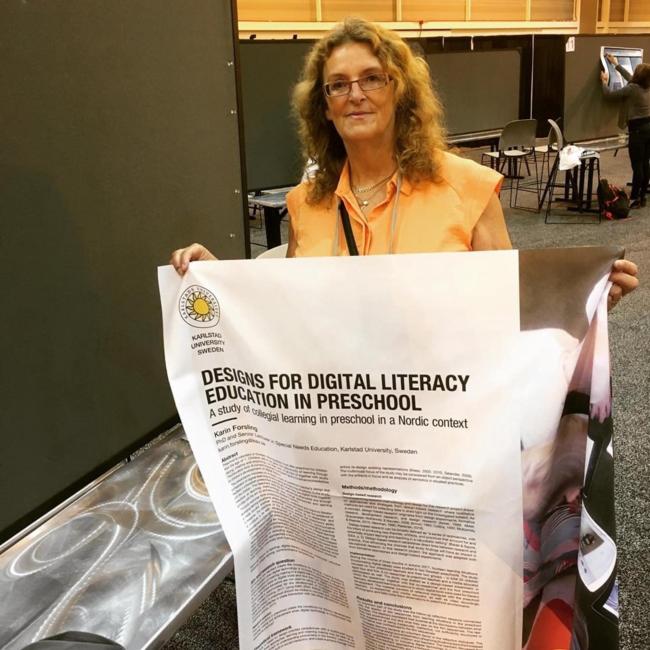
Karin Forsling is a researcher at Karlstad University, focusing on literacy practices, digital learning, and inclusive education in Swedish preschool and primary school contexts. She collaborates extensively with colleagues like Catharina Tjernberg on interdisciplinary projects, emphasizing teacher collaboration and educational design. Key Research Areas: Digital literacy, multimodal writing instruction, inclusive pedagogy, and teacher professional development Collaborations: Active participation in studies involving diverse literacy practices and digital competence in early childhood education Recent Publications: Investigate digitalization strategies, supportive teaching practices, and literacy scaffolding in preschools and lower primary schools Contact: karin.forsling@kau.se
Kent Fredholm is a researcher at Karlstad University, specializing in applied linguistics and educational research. His work focuses on language revitalization, particularly of Ladino (Judeo-Spanish), and the role of technology in language learning. He leads projects funded by the Centre for Language and Literature Education (CSL), investigating Ladino teaching methods and student experiences. His research also explores machine translation's impact on language acquisition and digital writing strategies. Academic awards include the Royal Swedish Academy's 2020 prize for outstanding teaching and the European Language Label. Fredholm teaches language pedagogy and Spanish linguistics, and collaborates with the NatMin research network on minority languages. His projects often involve international partnerships, such as studies on intercultural dialogue among student teachers. Research Projects: Ladino revitalization, Sephardic language preservation, machine translation effects in education Awards: 2020 Royal Swedish Academy Prize, European Language Label Teaching: Spanish linguistics, teacher education courses on ethics and pedagogy Affiliations: CSL, UNDIG (Digitalization of Education), VIDA seminar
Maj Stenmark serves as Associate Professor at Lund University's Faculty of Engineering, Department of Computer Science, with cross-appointments in Children Cardiology and Robotics and Semantic Systems. They are actively involved in multiple research initiatives including the LTH Engineering Health profile area and LU's Natural and Artificial Cognition profile. Stenmark's research focuses on human-robot interaction, specifically simplifying robot task programming for intelligent systems. Their work bridges computer science and medical applications, with emphasis on surgical robotics and vision-based tracking systems. Current projects include CAISA (Collaborative Artificial Intelligent Surgical Assistant) in partnership with Skåne University Hospital's Children's Heart Center and robotics companies Cognibotics and Cobotic. Analysis of recent publications reveals strong trends in medical robotics applications, particularly vision-based surgical assistance systems. Their work combines computer vision, language models, and behavior trees to create robotic surgical assistants, with growing emphasis on dual-arm robot programming using deep learning models with language and vision instructions. Stenmark actively supervises researchers including H. Ismail and E. Ertürk, and participates in major funding initiatives including WASP and Vinnova competence centers. Their research receives support from Swedish Government Agency for Innovation Systems (Vinnova) and the ELLIIT initiative. They lead the development of robotic scrub nurse technology through vision tracking of surgical hand and instrument motions, and manage infrastructure related to The Tissue Bank in Lund. Stenmark also engages in knowledge transfer through NEXTG2COM workshops and media appearances discussing AI applications in pediatric heart surgery.
Denis Michael Searby is a Professor at Stockholm University's Department of Romance and Classical Studies. His academic work focuses on the study of Romance languages and classical literature and culture within the humanities faculty. Professor Searby's research interests span across Romance Linguistics , Classical Philology , Latin Language and Literature , French Language and Literature , Italian Language and Literature , and Comparative Literature . His scholarly work contributes to our understanding of the historical development of Romance languages from their Latin roots and their cultural contexts throughout history. Based in Room B 448 at Universitetsvägen 10 B (floors 4 and 5) and 10 C (floor 5), Professor Searby maintains an active academic presence at Stockholm University. He can be contacted via email at denis.searby@su.se or by telephone at 08-16 30 44 for academic inquiries and collaborations.
Tony Lindgren is an Associate Professor at the Department of Computer and Systems Science, Stockholm University, affiliated with the Data Science Research Group and Natural Language Processing Research Group. His work bridges data science and NLP , focusing on interpretable models, constraint programming, and predictive maintenance systems. Research interests include: Machine Learning for explainability and fairness Constraint Programming in maintenance optimization Natural Language Processing for risk analytics and troubleshooting Recent publications demonstrate trends in multi-objective optimization (2025 satellite scheduling), conformal prediction (2024 CoPAL), and fault detection (2024 Automotive Nowcasting). His work often integrates domain-specific constraints with scalable algorithms across applications like food safety and autonomous vehicles. Software tools developed by Lindgren include: Example-based Feature Tweaking Rule Indexing Frameworks His research groups focus on AI-driven decision support for high-stakes domains, combining technical innovation with societal impact considerations.
Mathias Ekstedt is a Professor of Industrial Information and Control Systems at KTH Royal Institute of Technology in Stockholm, Sweden. Affiliated with the Software Systems Architecture and Security (SSAS) research group under the Division of Network and Systems Engineering in the Department of Computer Science, School of Electrical Engineering and Computer Science (EECS). He holds a Ph.D. (2004) and M.Sc. (1999) from KTH. Co-founder of foreseeti (acquired by Google in 2022) Director of KTH's Master Programme in Cybersecurity Member of the Digital Futures research center's Trust Working Group Affiliated with Center for Cyber Defense and Information Security (CDIS) Ekstedt's research focuses on information security and cybersecurity integrated with software/systems architecture modeling and analysis . His work emphasizes probabilistic attack/defense graphs for system-of-systems security evaluation, particularly in SCADA and Industrial Control Systems within power infrastructure. He has developed the Meta Attack Language (MAL) and collaborated extensively with the power industry. Recent research trends (2022-2025) include: Threat modeling languages for ICT and power systems Probabilistic attack graph applications in energy flexibility markets and smart cities Software Bill of Materials (SBOM) challenges in Java ecosystems Dynamic attack graph generation and lazy evaluation techniques Cyber-physical security for low-voltage grids and substation automation Ekstedt supervises 17 Ph.D. students (11 as main supervisor, 6 as co-supervisor) and has mentored numerous postdocs. He leads major projects like the SSF project CHAINS (software supply chain security) and coordinates initiatives within SweGRIDS , HONOR , and SOCCRATES .
Karl de Fine Light is an Associate Professor of Ethics and Technology at Chalmers University of Technology's Science, Technology and Society division. He specializes in the ethical implications of technology in urban development and public decision-making, with a focus on social sustainability and artificial intelligence applications. Co-developer of courses on technology and ethics Member of CHAIR management team Active in Tracks program for interdisciplinary research His research areas include: Procedural justice in public AI governance Ethics of urban design (hostile/architectural ethics) Sustainability definitions and assessment frameworks Generative AI policy in higher education Equity in solar energy development Recent projects: Rättvis solenergi (2023-2025) - Evaluating fairness in solar park distribution Rättvisa och skälighet (2022-2023) - Framework for equitable water/sewage cost allocation
Reto Weber is a Lecturer in Technology at Chalmers University of Technology, specializing in Maritime Studies . With a professional background as a sea captain and pilot on the Swedish west coast, he brings practical maritime expertise to his academic work in bridge simulators and e-navigation systems. Education : Sea Captain's Degree, Master's from World Maritime University (Switzerland, England, Sweden) Affiliations : Chalmers University, Lighthouse - Swedish Maritime Competence Center, Swedish Transport Administration (Trafikverket) His research focuses on maritime navigation systems , particularly examining human factors in automated environments. Key areas include: Algorithmic decision support in maritime traffic Collision avoidance mechanisms Impact of automation on vessel traffic services Development of web-based simulation tools Route exchange protocols and e-navigation solutions Remote ship monitoring ergonomics Reto's publications reveal trends in SMART ship technologies and Lighthouse projects , emphasizing the integration of artificial intelligence with traditional maritime practices. His work spans simulation-based training tools, COLREG compliance, and physics-informed machine learning architectures for wind propulsion optimization. As an examiner for courses like MManeuvering and Navigation in Confined Waters and Bridge Service , he bridges academic research with practical maritime education through Chalmers' Full Mission Bridge Simulator . Collaborations with institutions like Lighthouse and Trafikverket demonstrate his commitment to advancing maritime safety and efficiency through technology.
Amin Jalali is an Associate Professor of Computer and Systems Sciences at Stockholm University, specializing in business process modeling, analysis, and management. He is affiliated with the Department of Computer and Systems Sciences within the Faculty of Social Sciences, where he serves as a board member and manages three graduate courses: Business Process Design and Intelligence, Business Process and Case Management, and Data Warehousing. Institution: Stockholm University Department: Department of Computer and Systems Sciences (DSV) Research Groups: Natural Language Processing Research Group and PRECIS (Process, Requirements, Enterprise, Capability, Information Systems modelling) His research focuses on business process analysis through model-based and data-driven techniques, with particular emphasis on process simulation, process mining, event knowledge graphs, and object-centric process mining. He has led numerous research projects across healthcare, education, and finance domains. His work includes significant contributions to the development of NLP methods involving large language models, with focus on privacy, explainability, and domain adaptation. Jalali's research output shows a strong trend toward practical applications of process mining techniques, particularly in healthcare contexts like drug-drug interaction analysis and elderly care. More recently, his work has expanded into blockchain applications for fraud detection, motor imagery signal classification, and advanced object-centric process mining approaches. His publications span both theoretical contributions to business process management frameworks and practical implementations in real-world settings. He has extensive industry experience in designing and implementing Business Intelligence and Big Data Analytics solutions, which informs his academic work and teaching approach. His research has been published consistently from 2012 through 2024, demonstrating sustained scholarly productivity in his field. Dr. Jalali has contributed significantly to the development of tools and libraries for process mining, including the dfgcompare library for process variant analysis and implementations for object-centric process mining. His work bridges academic research with practical applications, particularly evident in healthcare projects like the DDIs-Graph system for identifying drug-drug interactions.
Linda Forssman is an Associate Professor and researcher in developmental psychology at Uppsala University's Department of Psychology, Division of Developmental Psychology. She works at the Uppsala Child & BabyLab, where she conducts research on how young children perceive and interact with their world, and how different experiences shape the development of cognitive, social and linguistic skills during early childhood. Dr. Forssman's research focuses on developmental psychology with particular emphasis on early language acquisition, cognitive development, social development, and infant cognition. Her work explores how various experiences shape children's development across multiple domains, with special attention to vulnerable populations and intervention strategies. She employs methodologies including eye-tracking, longitudinal studies, and randomized controlled trials to investigate fundamental developmental processes. Her recent publications show strong trends in cross-cultural developmental research, early language intervention, social cognition in infants, and the impact of socioeconomic factors on child development. Her work spans multiple methodologies from laboratory experiments to field studies in diverse cultural contexts, including research conducted in rural Malawi. Dr. Forssman has secured significant research funding as Principal Investigator and Co-Investigator on numerous projects. Her major grants include: Promoting Children's Early Language Development in Socioeconomic Disadvantaged Areas (PI, Marcus and Amalia Wallenberg Foundation, €312,200, 2025-2029) How does preschool quality relate to children's learning outcomes? (PI, Swedish Institute for Educational Research, €454,000, 2022-2024) The Impact of Book-Sharing on Infant Language and Cognition (PI, Riksbankens Jubileumsfond, €362,000, 2019-2022) Nordic evidence based high quality early childhood education and care research network (Co-I, Swedish Research Council, €102,500, 2023-2026) She is actively involved with the Uppsala Child & BabyLab, a research environment focused on infant and child development using advanced methodologies including eye-tracking. Her work bridges basic developmental research with practical applications for early childhood education and intervention programs, particularly those targeting children in socioeconomically disadvantaged areas.
Eva Österlind is a Professor at Stockholm University's Department of Teaching and Learning, leading the Drama for Learning research group - Sweden's premier drama research environment. Her work focuses on integrating drama/theatre pedagogy with sustainability education and social change initiatives across Nordic educational systems. Stockholm University, Department of Teaching and Learning Research Group: Drama for Learning Academic Focus: Drama Pedagogy, Sustainability Education Global collaborations: Athens, Helsinki, Stockholm drama workshops Her research explores drama's unique capacity to bridge emotional and cognitive learning barriers, particularly in sustainability education. Recent publications analyze drama workshops' effectiveness in fostering interconnectedness and perspective expansion through embodied, collective practices. Comparative studies across Nordic countries reveal institutional challenges in establishing drama as an autonomous research discipline. Eva's 15+ recent publications examine drama's role in civic education, health promotion, and curriculum reform. Key themes include Theatre of the Oppressed's potential for social transformation, arts-based sustainable development strategies, and the interplay between educational context and learning outcomes in drama interventions. While specific scientific awards aren't documented in the provided texts, her work has been featured in international conferences and publications including Research in Drama Education and Education Sciences . She emphasizes collaborative teaching approaches between subject specialists and drama pedagogues for maximizing educational impact.
Lisa Gustavsson is an Associate Professor in the Department of Linguistics at Stockholm University, where she conducts cutting-edge research on early language acquisition and forensic phonetics. She is affiliated with the Stockholm Babylab, a research group dedicated to studying infant language development through multiple parallel projects and international collaborations. Her research interests focus on early language acquisition, specifically examining speech processing, speech production, and communicative interaction in infants, with particular attention to the acoustic characteristics of speech signals. She also investigates forensic phonetics, exploring speaker identification and profiling techniques for forensic investigations, and how speaker recognition relates to fundamental phonetic processes. Her work bridges theoretical linguistics with practical applications in understanding how infants acquire language. Analyzing her recent publications reveals consistent themes in infant language development research. Her work demonstrates a strong focus on how hyperarticulation in child-directed speech affects language learning, the development of tone perception across different language environments, and the role of social and emotional factors in language acquisition. Her research spans multiple methodologies including behavioral experiments, cross-linguistic comparisons, and neuroscientific approaches to understanding speech processing. Gustavsson leads several significant research projects including Learning First Words (L3WO), which investigates hyperarticulation's effect on infant word recognition; The Effect of Hyperarticulation on Early Language Development (HELD); Distributional Learning: Domain-specificity and the impact of social cues (DIDI); Learning Tones: The influence of pitch accent language experience on lexical tone perception (LETO); Parent Affect in Language Learning (PALL); SoundStart; and the CAPSL-project on statistical learning and auditory predictability. As part of the Stockholm Babylab, Gustavsson works within a collaborative research environment that employs multimodal approaches to study language acquisition longitudinally through parent-child interactions. Her work contributes significantly to our understanding of the complex processes involved in how infants learn language, with implications for both theoretical linguistics and practical applications in speech therapy and language education.
Martin Sjölund is an Associate Professor at Linköping University's Department of Computer and Information Science (IDA), part of the Software and Systems (SAS) division. His work focuses on software engineering and cyber-physical systems, with a specialization in Modelica compiler development and open-source simulation tools. He contributes to the OpenModelica project, advancing compiler frameworks, integration with Julia, and standardization efforts. Research interests include compiler design, formal methods, and domain-specific languages. Recent work emphasizes modular compiler architectures, structural variability handling, and interoperability between Modelica and other systems like Julia and Python. He has co-authored over 30 peer-reviewed publications since 2017, with a focus on compiler optimization, co-simulation, and educational applications of Modelica. As part of the SAS division, he collaborates with researchers like Lena Buffoni, Adrian Pop, and Peter Fritzson on projects funded by the MODPROD Center and other initiatives. His contributions to open-source tools have been recognized through conference proceedings and industry partnerships.