Anders Björn is a Professor at the Department of Mathematics (MAI) at Linköping University (LIU), affiliated with the Analysis and Mathematics Education (ANDI) division. His research focuses on Nonlinear Potential Theory , particularly p-harmonic functions , quasiminimizers , and Newtonian Sobolev spaces in metric spaces. He co-leads the research group in this area and contributes to Analysis on Metric Spaces . He teaches undergraduate and graduate courses, including Real Analysis and Functional Analysis . Organizational Roles: Organizer of the Mathematical Colloquium, Local Representative for Svenska Matematikersamfundet (Swedish Mathematical Society). Editorial Work: Former Technical Editor for Acta Mathematica (2004–2015) and Arkiv för Matematik (1993–2015), both published by Institut Mittag-Leffler. His research explores foundational questions in mathematical analysis, blending pure mathematics with interdisciplinary applications. He emphasizes understanding properties of solutions to differential equations in general settings, akin to constructing an 'identikit' of mathematical phenomena. His work is published in collaboration with the ANDI group, and he actively engages in promoting mathematics through outreach and academic service.
Joacim Hansson is a Professor of Library and Information Science at Linnaeus University, Sweden. He teaches at doctoral and master's levels in Library and Information Science and the Digital Humanities program. His research focuses on Knowledge Organization (classification research), Document Studies (digital representation of cultural heritage), and Library Research (institutional identity of libraries). He is affiliated with the Centre for Digital Humanities and the Critical Knowledge Organization Research Group. He serves on editorial boards for journals like Journal of Librarianship and Information Science and is a Senior Associate Fellow at the International Institute of Hermeneutics. His work explores the intersection of classification systems, cultural heritage, and political influences on libraries. He has led projects such as 'Cultivating Information, Organizing Culture' and contributes to initiatives like EUniWell (European University for Well-Being). His publications analyze topics like bibliographic classification's societal role, public libraries in political turmoil, and Jewish library systems' philosophical foundations. He has authored books including Dewey och de svenska biblioteken and De ordnade böckernas folk . His research underscores libraries' democratic roles and the ethical dimensions of information organization. Education: Holds a PhD in Library and Information Science from Gothenburg University (1999) and a licentiate in library studies (1998). His doctoral work examined Swedish library classification systems' societal discourses. Grants and Projects: Leads the 'Cultivating Information' project and contributes to the ReSource graduate school on digital source criticism. Collaborates internationally on classification and cultural heritage digitization.
Maja Elmgren is a Senior Lecturer in Physical Chemistry and Educational Developer at Uppsala University's Department of Chemistry and Faculty of Science and Technology. Since 2009, she has directed the Council for Educational Development (TUR), focusing on academic leadership, chemistry education, and scholarly teaching. Her research spans physical chemistry, chemistry/physics education, and higher education development. Research Interests: Leadership in higher education and doctoral assessment Educational expertise in academia Student learning in thermodynamics and kinetics Chemistry education through international cooperation Quantum mechanics conceptualization Thermal phenomena visualization via infrared cameras Article Trends: Recent publications highlight interdisciplinary learning (chemistry-mathematics), assessment reform in doctoral education, student-centered pedagogy, and technological tools in science education. Subfields include mathematical modeling, entropy understanding, and VR-funded projects on science teacher roles. Scientific Awards: Medal for Merit from Uppsala Science and Technology Student Union (2011) Distinguished Teaching Award from Uppsala University (2001) Academic Roles: Director, Council for Educational Development (TUR) since 2009 Author of "Academic Teaching" (2018) and "Universitetspedagogik" (2016) International collaborations with IUPAC and VR-funded projects Specializes in entropy/thermodynamics education and infrared camera applications
Malena Janson is a Lecturer at the Department of Child and Youth Studies , Stockholm University , specializing in children's culture and moving image media. Her work spans teaching, research, and public engagement across multiple disciplines. Swedish Film Institute network member for film educational research Steering group member of BIN Norden (Nordic children's culture network) Co-editor on multiple children's culture anthologies Research Focus : Historical and contemporary children's film/TV aesthetics Child figure functions in moving images Child-animal relationships in media Narrative liminality and phantasmagoria Norm criticism in visual culture Adaptation and transmediality Recent Publications address Swedish children's cinema history, Bergman film analysis, and media's role in shaping democratic citizenship. Articles since 2022 explore posthumanist narratives and eco-activism in children's television. Teaching Materials developed for Swedish Film Institute include guides for films like Heartstone , Your Name , and Matilda , emphasizing aesthetic learning and critical thinking.
Mojtaba Moazen is a PhD student and researcher at the Division of Theoretical Computer Science , part of KTH Royal Institute of Technology in Sweden. He is actively involved in the WASP – Wallenberg AI, Autonomous Systems and Software Program and the NEST CyberSecIT project, focusing on securing IoT applications and software supply chains. His work bridges academic research with critical real-world cybersecurity challenges. Education: PhD (ongoing) in Theoretical Computer Science, KTH Royal Institute of Technology Master of Science in Information Technology, Sharif University of Technology Bachelor of Science in Computer Engineering, K. N. Toosi University of Technology Research Interests: Mojtaba specializes in software security , IoT security , and software supply chains , with a focus on developing robust security mechanisms for emerging technologies. His recent publications highlight advancements in Android malware detection and continuous integration testing. Courses Assisted: Applied Cryptography (DD2520) Computer Security (DD2395) Internet Programming (DD1386) Language-Based Security (DD2525) Programming Techniques (DD1310)
Fredrik Sandin is a Professor in the Department of Computer Science, Electrical and Space Engineering at Luleå University of Technology, where he leads the Machine Learning research group with approximately thirty members. His work focuses on neuromorphic technologies and the intersection of machine learning with computational physics to solve challenging real-world interaction problems. He coordinates the 'Teknisk fysik och elektroteknik' program at LTU and has been instrumental in establishing neuromorphic research activities at the university. Luleå University of Technology, Department of Computer Science, Electrical and Space Engineering Member of WASP (Wallenberg AI, Autonomous Systems and Software Program) and ELLIS (European Laboratory for Learning and Intelligent Systems) Coordinator of Neuromorphic Innovation Platform Sweden with KTH, Lund University, Uppsala University, FOI, ABB, Ericsson, and SAAB Fredrik earned his PhD in Physics from Luleå University of Technology in 2007, with thesis work focusing on dense states of matter in neutron stars. His academic journey began with an MSc diploma work in ATLAS at CERN in 2001, followed by postdoctoral research in computational physics at IFPA in Belgium (2008-2009) and brain-like computing at EISLAB with Prof. Jerker Delsing (2010-2011). Professor Sandin's research interests center around neuromorphic technologies, particularly neuromorphic computing and spiking neural networks. He investigates sensor/detector and intelligent systems co-design where constraints like energy, power, latency, and dynamic range challenge conventional digital approaches. His work spans mixed-signal neuromorphic circuits, algorithms, and systems, as well as machine learning projects involving industrial data and collaboration. He has been a key figure in establishing neuromorphic research at LTU, supported by The Kempe Foundations, particularly through the 2014 Gunnar Öquist Fellowship. His recent publications demonstrate a strong interdisciplinary focus spanning quantum phase transitions, particle physics detector optimization, renewable energy materials, and the integration of large language models into control systems. This diverse portfolio reflects his approach connecting machine learning with fundamental physics and practical engineering applications, particularly in neuromorphic computing and intelligent systems design, with emphasis on solving real-world problems through co-design of hardware and algorithms. Gunnar Öquist Fellowship Award and 3 MSEK grant from The Kempe Foundations ISSP award for an Original Work in Theoretical Physics (signed by Prof. 't Hooft and Prof. Zichichi) New-Talents award for original work in theoretical physics at the International School of Subnuclear Physics in Erice Professor Sandin has supervised numerous PhD students working on topics ranging from neuromorphic TinyML to materials for neuromorphic computing, privacy-preserving machine learning at the edge, and intelligent fault diagnosis. He has secured substantial research funding from various sources including Vinnova, ÅForsk, Kempe Foundations, WASP-WISE, and EU programs like ECSEL JU Arrowhead Tools and ITEA3 AutoDC. His current major projects include the Neuromorphic Innovation Platform Sweden and several initiatives focused on neuromorphic condition monitoring and computing, with total funding exceeding 30 MSEK in the past five years. He leads the Machine Learning group at LTU, which collaborates extensively with industry partners including ABB, Ericsson, SAAB, SKF, and RISE. The group is active in developing neuromorphic technologies for wireless sensor networks, condition monitoring systems, and next-generation intelligent systems that address energy, power, and latency constraints that challenge conventional digital approaches.
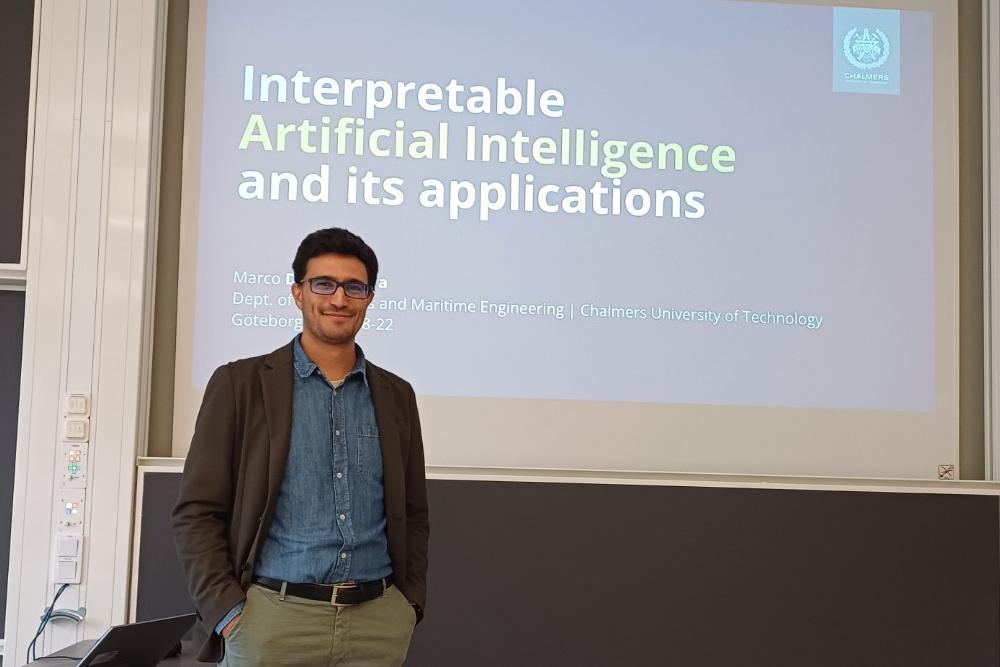
Marco L. Della Vedova is a Senior Lecturer in Applied Artificial Intelligence at Chalmers University of Technology, Sweden. He works in the Vehicle Engineering and Autonomous Systems division within the Department of Mechanics and Maritime Sciences, as part of Prof. Mattias Wahde's research group. Since 2025, he has served as Director of the Data Science and AI master's programme (MPDSC) at Chalmers, where he teaches courses including Introduction to Artificial Intelligence and Digitalization in Sports. Dr. Della Vedova earned his academic foundation at the University of Pavia, Italy, where he completed his BSc (2006), MSc (2009), and PhD (2013) in Computer Engineering. His doctoral research focused on "Real-Time Physical Systems and Electric Load Scheduling" under Prof. Tullio Facchinetti. During his PhD studies, he spent a year at U.C. Berkeley hosted by Prof. Francesco Borrelli at the Model Based Predictive and Distributed Control Lab. His research spans multiple AI domains with a strong emphasis on interpretability. Dr. Della Vedova develops interpretable methods for conversational AI, naturalness evaluation of forests using canopy height models, and geospatial applications. His work bridges theoretical AI with practical societal benefits, particularly in environmental monitoring, transportation systems, and orienteering. He has previously contributed to cloud computing, hate speech detection, and cyber-physical energy systems, demonstrating his interdisciplinary approach to AI research. Dr. Della Vedova's publication record reveals a consistent trajectory of impactful research across multiple domains of artificial intelligence. His recent work shows a strong focus on interpretability in AI systems, with significant contributions to natural language processing, geospatial analysis, and causal inference. The research demonstrates both theoretical depth and practical applications, particularly in environmental monitoring and social media analysis. His methodology often combines traditional machine learning approaches with novel interpretability techniques, creating bridges between complex AI systems and human understanding. Dr. Della Vedova has received several prestigious recognitions for his work: Best PhD thesis award from the Order of the Engineers of Bergamo (2013) Italian champion of Il Cervellone (2012) Top Italian performer in IEEEXtreme 6.0 programming competition (148th overall globally, 2012) Premio Arturo Schena award from Fondazione Credito Valtellinese (2010) With over 50 students supervised through bachelor's and master's theses, Dr. Della Vedova has established himself as a dedicated mentor in the AI community. His current PhD students include Minerva Suvanto working on interpretable NLP and Vivien Lacorre developing AI for railway infrastructure inspection. His supervision spans diverse topics from forest naturalness evaluation to hate speech detection and transportation optimization. Beyond formal supervision, he actively contributes to educational initiatives including serving as Director of Chalmers' Data Science and AI master's program and developing innovative teaching methods that connect theoretical concepts with real-world applications. Dr. Della Vedova is deeply embedded in both academic and professional communities. He leads the Applied Artificial Intelligence research group at Chalmers while maintaining strong connections with European research networks through projects like the ERASMUS+ EUrienteering initiative. His interdisciplinary approach is reflected in collaborations across computer science, environmental science, and social sciences. Notably, he applies his AI expertise to orienteering both as a researcher developing localization methods and as a licensed Event Advisor for the International Orienteering Federation, demonstrating how his professional and personal interests converge in innovative ways.
Mattias Villani is Professor of Statistics at Stockholm University, specializing in Bayesian statistics and machine learning. He obtained his PhD in Statistics from Stockholm University in 2000 and has held positions at Sveriges Riksbank and Linköping University. Villani develops computationally efficient Bayesian methods for inference, prediction and decision-making with flexible probabilistic models. Research Interests: His work spans Bayesian computation (MCMC, HMC, variational inference), machine learning (Gaussian processes, mixture models), and applications in neuroimaging, transportation, and econometrics. Research focuses on scalable Bayesian methods for large datasets and complex models. Publication Focus: Recent articles concentrate on Bayesian neuroimaging analysis, transportation network modeling, and efficient MCMC algorithms. Methodological innovations in subsampling techniques for large-scale Bayesian computation represent a significant research trend. Student Advising: Supervises PhD students in statistical methodology development and applications. Current research groups focus on spatiotemporal modeling, locally stationary processes, and neuroimaging statistics.
Elizabeth Rhoads is a Senior Lecturer and Researcher at the Centre for East and South-East Asian Studies, Lund University, under The Joint Faculties of Humanities and Theology. She is also a member of the LU Profile Area on Human Rights, reflecting her deep engagement with human rights issues in Southeast Asia. Her work is interdisciplinary, bridging law, anthropology, geography, and urban studies. Education: PhD in Law, King's College London (Dickson Poon Fellow) M.A. in Human Rights Law, SOAS A.B. in Anthropology, Bryn Mawr College Her research focuses on citizenship, displacement, property relations, and minority-state dynamics in Myanmar and Indonesia. She employs a multidisciplinary approach combining legal history, legal anthropology, and urban studies to examine how law shapes everyday life in contexts of political upheaval and marginalization. Her fieldwork in Myanmar and Indonesia includes work on land disputes, transitional justice, women’s political participation, and violent extremism. The analysis of her recent publications reveals a consistent focus on legal and social exclusion in Southeast Asia, particularly around citizenship and urban informality. Her work often explores how legal frameworks produce statelessness, displacement, and spatial violence, especially in Myanmar. She frequently collaborates with local organizations and researchers, emphasizing participatory and ethical research practices during crises. Her publications span journal articles, reports, book chapters, and reviews, with increasing attention to post-coup dynamics and community resilience. Scientific Awards and Honors: Dickson Poon Fellow, King's College London Blakemore-Freeman Fellowship for advanced Burmese language study British Academy Co-Investigator and Post-Doctoral Fellowship Elizabeth Rhoads is actively involved in advising and research grants. She is currently leading a Swedish Research Council-funded project on citizenship and displacement in Myanmar in collaboration with a Burmese organization. She is also a Co-Investigator on the EU-funded EUVIP project under Horizon Europe, examining the EU’s role in the Indo-Pacific. She serves on the editorial board and as Guest Editor for Jurnal HAM , contributing to academic discourse on human rights in the region. She has been involved in collaborative research networks focusing on spatial violence, urban informality, and legal pluralism in Southeast Asian cities. Her work emphasizes community-based and interdisciplinary methodologies, often co-producing knowledge with local actors. She contributes to public engagement through web publications and digital storytelling, such as the 'Yangon Stories' initiative.
Tobias Dalberg is a Senior Lecturer at Uppsala University's Department of Pedagogy, Didactics and Educational Sociology, with research focusing on sociology of education, social stratification, and higher education policy. His work examines gender differentiation in course selection, curricular blind spots, and historical transformations in academic disciplines. Contact: tobias.dalberg@edu.uu.se | Personal Website Research: Utilizes graph theory, natural language processing, and geometric data analysis for educational pathway studies Current research areas include: Gendered patterns in major selection and course enrollment Educational policy analysis (1950-2020) Academic field institutionalization processes Disciplinary legitimacy struggles (1935-1980) Recent publications (2021-2024) reveal trends in: Higher education marketization and gender segregation Curriculum structure impacts on student trajectories Disciplinary evolution in social sciences and humanities Assessment consistency in educational evaluation As member of international research collaborations, Dalberg works with networks studying educational stratification and transnational academic markets. His methodological contributions include applications of network analysis for studying epidemic spread in educational contexts.
Nadeem Abbas is a Senior Lecturer at the Department of Computer Science and Media Technology, Faculty of Technology, Linnaeus University, Sweden. He earned his PhD in Computer and Information Science from Linnaeus University and has been working with software systems since 2001. His primary research interests include Self-Adaptive Software Systems, Dynamic Software Product Lines, Software Reuse, Requirements Engineering, Software Architecture and Design, and Architectural Analysis and Reasoning. He is actively involved in multiple research groups including: AdaptWise - focusing on foundations and engineering of self-adaptive software systems Engineering Resilient Systems (EReS) Research Lab - investigating system resilience Smart Industry Group (SIG) - an interdisciplinary group focusing on production and product innovation His recent publications show a strong trend in self-adaptive systems with expansion into health inequality research and environmental monitoring applications. His work bridges theoretical software engineering with practical industrial applications, particularly evident in his survey of industry practices in self-adaptation. Nadeem teaches several courses including: 1DV532 - Starting Out with Java 1DV533 - Structured programming with C++ 1DV534 - Object-Oriented Programming with C++ 2DV600 - Foundations of Software Technology 4DV610 - Adaptive Software Systems 2DV604 - Software Architectures 1DV607 - Object-Oriented Analysis and Design using UML He currently supervises multiple research projects related to self-adaptive systems, architectural analysis tools, and health inequality mitigation through digital solutions. His research portfolio demonstrates strong connections between academic research and practical industry applications, particularly in software architecture and adaptation techniques.
Malin Tväråna is a Senior Lecturer at Stockholm University in the Department of Teaching and Learning . Her expertise lies in Social Science Education and Civics Education , with a focus on developing critical reasoning and digital literacy skills. Specializes in citizenship education and education development research Projects on visual literacy and critical digital literacy Collaborates with Uppsala University on subject-specific methods Malin employs Phenomenography , Variation Theory , and Activity Theory in her work. Her research includes: Designing teaching for critical analysis of fairness and justice Progression models in samhällsanalytiskt tänkande (social science analytical reasoning) Empirical studies across primary, middle, and upper secondary education She is actively involved in: Editorial board of Skola och Samhälle journal Board member of the Society for Educational Development Research
Åsa Maria Wikforss is a Professor in Theoretical Philosophy at Stockholm University, specializing in intersections of philosophy of language, mind, and epistemology. Her research focuses on semantic externalism, content externalism, and normativity of meaning, with significant grants from the Swedish Research Council and Bank of Sweden Tercentenary Foundation. Ph.D., Columbia University (1996) Docent, Stockholm University (2002) Research interests include challenges to semantic normativity, self-knowledge, and knowledge resistance. She critiques Kripke-Putnam theories of natural kind terms and develops 'reason-providing functionalism' for belief characterization. Key publications address transparency of content, semantic externalism, and belief justification Organized international workshops on internalism/externalism and Wittgenstein/Davidson Scientific awards include: Swedish Research Council grants (2007-2010, 2013) Bank of Sweden Tercentenary Foundation grant (2004-2006) Project leadership in CCCOM and Eurounderstanding initiatives She supervises doctoral students and has co-led Nordic graduate seminars on epistemology and philosophy of mind. Her popular science work addresses knowledge resistance, pseudoscience, and self-knowledge in media debates.
Yvonne Hallesson is an Associate Professor and Senior Lecturer in Swedish at Uppsala University's Department of Nordic Languages, where she serves as Director of Studies for postgraduate education. Her research centers on subject literacy, focusing on students' reading and writing development through school texts across disciplines. Her academic qualifications include: Associate Professor of Swedish, Uppsala University (2021) Senior Lecturer in Swedish Language, Uppsala University (2019–present) Senior Lecturer in Didactics with focus on Swedish, Uppsala University (2016–2019) PhD in Language Didactics, Stockholm University (2015) Licentiate in Educational Science, Stockholm University (2011) Master of Education in Swedish and English, Stockholm University of Education (1999) Hallesson investigates the relationship between language and learning, particularly how students develop subject-specific literacy through text work in social sciences and other disciplines. Her research examines reading comprehension strategies, writing development, and the integration of national minority languages in educational contexts. She analyzes how text properties affect learning across different school subjects and student demographics. Her recent publications reveal consistent focus on subject literacy development, with particular attention to reading comprehension in social sciences and representation of national minority languages in textbooks. Her work demonstrates strong methodological emphasis on discourse analysis and classroom-based research, often involving collaborative teacher-researcher partnerships to bridge theory and practice. Hallesson supervises doctoral students including Jim Stefansson (main supervisor) and Linnea Wenell (assistant supervisor), and mentors numerous graduate students. She has secured significant research funding from the Swedish Research Council for projects including "Läsmetoder under lupp" (2022) and the current "Building subject knowledge in text" (2025-2027). She actively contributes to academic governance as board member of the Department of Nordic Languages and the research network SMDI, and coordinates Uppsala University's subject didactic network for Swedish and Swedish as a second language. She also represents the Swedish Teachers' Association in the Language Care Group.
Bruno Debaenst is a Senior Lecturer in Legal History and Associate Professor at the Department of Law, Faculty of Law, Uppsala University, where he has been based since 2018. A Belgian (Flemish) scholar, he brings a comparative perspective to his work, focusing on both Belgian and Swedish legal history. His academic training spans history (1999), law (2003), and criminology (2006), and he practiced as a lawyer in Ghent from 2003 to 2008. His research is centered on the history of social law, with a particular emphasis on the juridification of workplace accidents in 19th-century Belgium, the development of modern welfare states, and the role of international organizations as catalysts for legal change. He also explores broader themes such as Belgian legal culture, language in nation-building, and the digital revolution from a legal historical viewpoint. The most recent publications highlight a diverse range of interests, from the artistic representation of industrial disputes and the history of environmental law in Stockholm, to the epistemic communities that preceded the ILO and the 1974 Swedish Constitution. His work often bridges comparative and transnational perspectives, analyzing legal developments across Europe and beyond. Bruno Debaenst is deeply committed to teaching, offering courses in legal history, comparative legal history, and legal futurology, and supervising numerous student theses. He has also led a popular doctoral course on legal history for PhD students in law. His international collaborations include work with the Centre d'histoire judiciaire in Lille, France.