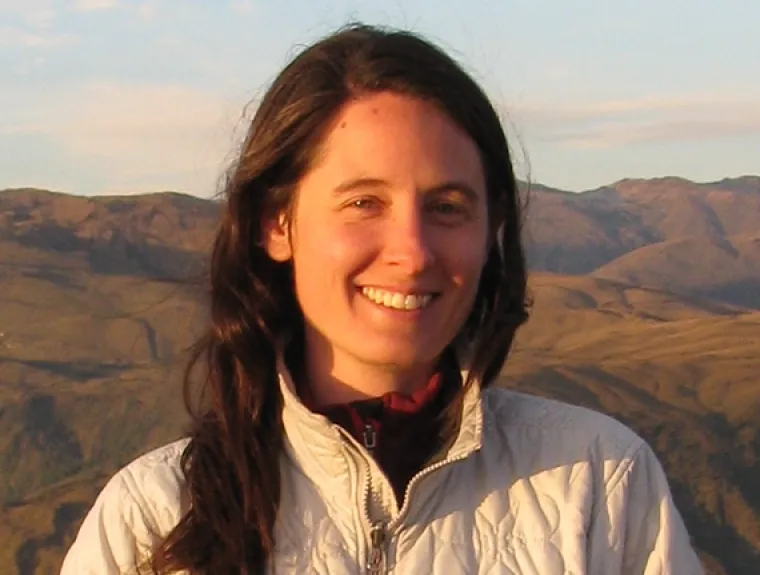
Rachel Gallery is an Assistant Professor at the School of Natural Resources and the Environment, University of Arizona, specializing in soil microbial ecology, biogeochemical cycles, and climate change impacts. Her research spans diverse ecosystems including alpine forests, semi-arid regions, and tropical alpine páramos, with a focus on microbial responses to disturbances like wildfire, drought, and climate warming. Research Themes : Microbial community dynamics, carbon cycling, mineral weathering, critical zone science, and ecosystem resilience. Methodological Focus : Integration of field measurements, genome-resolved metagenomics, remote sensing, and modeling approaches to understand soil processes. Recent work highlights seasonal snowmelt effects on microbial activity, novel applications of the MIMICS model, and soil connectivity mechanisms. While her publications emphasize collaborations through CZNet and Critical Zone Observatories, no specific advising or grant details are listed in the provided data.
Associate Professor In-Young Yeo is a distinguished academic at the University of Newcastle's School of Engineering, where she serves as an Associate Professor in Civil, Surveying, and Environmental Engineering. With over 15 years of academic experience, she previously held positions at Ohio State University, Cornell University, and University of Maryland. Her work focuses on the critical intersection between landscapes and water resources, using sophisticated remote sensing and modeling tools to improve natural resource management and sustainability. Her research spans the nexus of land and water systems where human and physical systems interact. She pioneers integrative approaches using remote sensing, in-situ data, and process-based models to understand emergent land surface properties and hydrologic processes. Her work addresses water cycle changes across scales, soil moisture-stream flow connectivity, soil and water quality implications of conservation practices, and optimal land use management strategies for environmental sustainability under climate change pressures. Professor Yeo's publication record demonstrates a clear trajectory toward more sophisticated multi-sensor integration approaches and practical applications for agricultural water management. Her recent work increasingly combines machine learning with traditional remote sensing methods, focusing on soil moisture profiling, wetland dynamics monitoring, and developing integrated systems for resource management decision support. Her scientific contributions have been recognized with numerous prestigious awards: 2024 Best Research Paper of 2024, The Soil and Water Conservation Society 2021 Science Note - USDA NRCS Conservation Effects Assessment Project 2018 International Research Visiting Fellowship, University of Newcastle 2017 Women in Research Fellowship, University of Newcastle 2009 Editor's Highlights - AGU Geophysical Research Letters Professor Yeo actively mentors graduate students and offers PhD scholarship opportunities focused on land surface variables and ecosystem health monitoring. She has secured significant research funding from diverse sources including ARC, NASA, NOAA, USDA, Soil CRC, and Sydney Water. Her collaborative approach has led to leadership roles in international research initiatives including NASA-LCLUC and NASA-GRACE programs, the G20 initiative for agricultural monitoring, and the CRC for High Performance Soils. She leads a dynamic research team collaborating with Soil CRC, CSIRO, Australian Universities, and international space agencies. Her work with the US Conservation Effects Assessment Project (CEAP) and US Environmental Protection Agency has been particularly influential in demonstrating the effectiveness of conservation practices for improving soil productivity and water quality. She serves on the educational committee with the Surveying & Spatial Sciences Institute (SSSI) NSW and has contributed significantly to program development at the University of Newcastle.
Tirtha Banerjee is an Associate Professor in the Department of Civil and Environmental Engineering at the Samueli School of Engineering, University of California, Irvine. He leads the Boundary Layers and Turbulence (BLT) Lab, focusing on atmosphere-ecosystem interactions through turbulence and eddy motions. His research spans atmospheric boundary layer dynamics, wildfire behavior, and fluid dynamics in natural environments. Education: Ph.D., Environmental Science, 2015, Duke University B.S., Civil Engineering, 2011, Jadavpur University Banerjee’s research investigates scalar, momentum, and energy exchanges between the atmosphere and ecosystems (land, vegetation, water) using theoretical, numerical, and experimental approaches. Key areas include turbulent fluid dynamics , wildfire-atmosphere interactions , and vegetation-atmosphere coupling . His recent publications analyze firebrand kinematics, turbulence anisotropy, and WRF model performance during wildfires. His lab has received recognition from major institutions, including support from Los Alamos National Laboratory. Notable awards include the Chick Keller Postdoctoral Fellowship (2017) and Director’s Fellowship (2018) at LANL. He also serves as Associate Editor for Earth Systems and Environment (Springer).
Dr. Aaron Greenville is a Senior Lecturer in Spatial Agricultural and Environmental Sciences at the School of Life and Environmental Sciences, University of Sydney. He leads the Ecosystem Dynamics Lab and holds memberships in the Sydney Environment Institute, Sydney Institute of Agriculture, and the Charles Perkins Centre. His interdisciplinary work bridges ecology, environmental science, and technological innovation to address critical environmental challenges facing Australia and the global community. Aaron's research program centers on three interconnected themes: ecosystem responses to climate change, species interactions (particularly competition and predation), and technology applications for ecological monitoring. His climate change research investigates non-linear species responses to environmental shifts with special attention to fire regime alterations. In species interaction studies, he examines how climate modifies competitive and predatory dynamics across spatial and temporal scales. His technology-focused work pioneers the use of open-source hardware (Raspberry Pi and Arduino platforms) to develop reproducible environmental monitoring systems. Recent publications reveal a strong emphasis on post-megafire ecosystem recovery, climate change impacts on biodiversity, and innovative technological approaches to ecological monitoring. His work increasingly integrates large-scale, interdisciplinary methodologies combining field observations with advanced statistical and computational techniques. There's a clear trajectory toward addressing the ecological consequences of Australia's 2019-2020 megafires and developing practical conservation solutions. Scientific recognition includes: Threatened Species Recovery Hub Cat Team finalist in the 2020 Eureka Awards Australian Mammal Society President's Early Researcher Award (2019) Ecological Society of Australia Members' Service Prize (2018) Lyne Award from the Australian Mammal Society (2013) As an academic advisor, Aaron has mentored numerous honors students on projects spanning wildlife monitoring technologies, fire ecology, and conservation applications. His teaching portfolio includes core ecology units (BIOL3007, BIOL3009), Environmental GIS (ENVX3001, which he coordinates), and specialized statistical workshops for ecological research. Major research funding includes ARC grants and partnerships with government agencies investigating biodiversity responses to environmental change. The Ecosystem Dynamics Lab employs a holistic approach to ecosystem function, integrating vertebrate, invertebrate, and plant studies. The lab is recognized for developing open-source technological solutions for ecological monitoring, creating custom environmental sensors with reproducible workflows. Current projects include the ARC DARE Training Centre, DigiFarm (digitally enabled agricultural ecosystems), and research on pasture resilience to extreme drought events.
Professor Geoff Cary serves as Associate Director (Research) at the Fenner School of Environment & Society at The Australian National University (ANU). With a PhD in Ecology from ANU and a Bachelor of Applied Science (Environmental Biology) with Honors from the University of Technology Sydney, he has established himself as a leading researcher in fire ecology and management. Geoff's research spans landscape-scale fire simulation, fire ecology across multiple biological scales, house loss in wildland fires, and laboratory fire behavior experimentation. He has developed expertise in modeling fire regimes under climate change and co-led an international group of landscape-scale wildland fire simulation modelers. His work bridges fundamental ecological research with practical fire management applications. Analyzing his publication record reveals a consistent focus on fire behavior prediction, fire ecology, and fire management. His recent work increasingly incorporates remote sensing technologies, climate modeling, and interdisciplinary approaches that connect fire science with Indigenous knowledge systems and wildlife conservation. His research demonstrates a progression from theoretical fire ecology to applied fire management solutions. Geoff has served in significant leadership roles including Associate Director (Higher Degree Research) and membership on multiple committees including the Fenner School Executive Committee and College of Systems and Society research committee. He was Associate Editor (2002-2023) and remains on the Editorial Advisory Committee for the International Journal of Wildland Fire. Professor Cary has supervised 23 Higher Degree Research scholars (18 completed PhD, 3 current PhD, 2 completed MPhil) and 19 Honours scholars, with his students publishing approximately 30 journal articles from their thesis research. His teaching portfolio includes 'Fire in the Environment' and contributions to courses on climate change, environmental policy, and sustainability. His research is organized through multiple projects including 'Re-emergence of First Nations burning in contemporary grassy woodlands,' 'ANU-Optus Bushfire project: Evaluation of Fire Detection Techniques,' and 'Analysis of ACT LiDAR remote sensing for bushfire fuel characteristics.'
Brygg Ullmer is a Professor at Clemson University's School of Computing and Chair of the Human-Centered Computing Division. He leads the Tangible Visualization group, focusing on Tangible User Interfaces (TUIs) Computational Genomics Interactive Computational STEAM Rapid Physical/Electronic Prototyping Computationally-Mediated Art and Design His work bridges physical and digital domains, with applications in K-12 education, high-performance computing, and culturally-rooted design. Research trends from his 15 most recent articles show a focus on Generative AI for cyberphysical systems Shape-changing interfaces Token+Constraint interaction models Genomics data visualization Hybrid tangible-gestural interfaces Multi-display collaboration These span both theoretical and applied work in computer science, biology, and design. Ullmer has held significant roles including Postdoctoral work at Zuse Institute Berlin Associate Professor at Louisiana State University (CCT & Computer Science) Visiting Lecturer at Hong Kong Polytechnic University Contributions to IBM Systems Journal and special editions of Springer's Personal and Ubiquitous Computing He has also co-edited journal special issues and served on conference committees. His scientific contributions include co-invented U.S. patents (6164541, 6263507, 6259441) related to Invisible hyperlinking Audiovisual data browsing Digital video time-shifting These patents reflect early innovations in tangible interface technology that have influenced modern interactive systems.
Neda Yaghoobian is an Associate Professor in the Department of Mechanical Engineering at Florida A&M University-Florida State University (FAMU-FSU), associated with the Geophysical Fluid Dynamics Institute. She holds a Ph.D. from the University of California, San Diego, and has held postdoctoral positions at the University of Maryland and Johns Hopkins University. Her research focuses on environmental thermo-fluid dynamics, including land-atmosphere interactions, boundary layer meteorology, urban microclimates, fire dynamics, and energy efficiency. She leads the Environmental Thermo-Fluid Dynamics (ETFD) Lab, exploring multiscale phenomena such as firebrand transport, urban heat island mitigation, and natural structures' thermal functions. Dr. Yaghoobian teaches advanced courses in turbulent flow, aerodynamics, and numerical methods. She is an NSF CAREER awardee and actively mentors graduate and undergraduate students. Her work integrates computational fluid dynamics (CFD), large-eddy simulations (LES), and energy balance models to address challenges in wildfire safety, sustainable urban design, and bio-inspired engineering. She collaborates on projects like the 'Complex-environment Temperature and Moisture Predictor (CeTMP)' and investigates thermal functions of termite mounds. Key research areas include: Urban microclimatology and heat island mitigation strategies Firebrand transport dynamics in wildland-urban interfaces Diurnal effects on building energy use and urban pollution Thermal modeling of complex fuels and fire behavior prediction Bioinspired design of natural structures like termite mounds She has supervised numerous students and contributed to over 50 peer-reviewed publications. Her lab actively recruits graduate students with backgrounds in CFD and fluid dynamics.
Dr. Mark Thyer is an Associate Professor in Civil and Environmental Engineering at the University of Adelaide, affiliated with the School of Architecture and Civil Engineering under the Faculty of Sciences, Engineering and Technology. His research focuses on enhancing hydrological, environmental, and water resource models through physical-statistical approaches. He specializes in flood/drought risk assessment, predictive uncertainty quantification, and behavioral water use modeling for urban water management. Dr. Thyer has over 17 years of research experience and is internationally recognized for his work on Bayesian approaches to quantify uncertainty in hydrological predictions. He has authored over 30 journal papers in top-tier water resources journals and secured research grants totaling over $5 million. His collaborations include institutions like CSIRO, the Australian Bureau of Meteorology, and the Goyder Institute for Water Research. Key contributions include leading the eWater CRC project to develop the Behavioral End-Use Stochastic Simulator (BESS) for household water use modeling, integrated into eWater’s Urban Developer tool. He also serves as an Associate Editor for the Australian Journal of Water Resources and reviews for top international journals and ARC grants. His recent work emphasizes seamless subseasonal streamflow forecasting, probabilistic modeling of ephemeral catchments, and smart stormwater storage systems to mitigate urban flooding. He actively engages in consultancy for water authorities, including Hunter Water Corporation and the Wimmera Mallee Pipeline Project.
Ramesh Glückler is a Postdoctoral Researcher at the Alfred Wegener Institute (AWI), Helmholtz Centre for Polar and Marine Research in Potsdam, Germany, and a visiting researcher at the Institute of Tibetan Plateau Research, Chinese Academy of Sciences. His work focuses on reconstructing long-term environmental and climatic changes, particularly boreal wildfire regimes using sedimentary proxies like charcoal and molecular biomarkers. He explores fire-vegetation interactions through ecological modeling and investigates human dimensions of fire dynamics. Education: PhD in Geography/Geoecology (University of Potsdam, 2024), with expertise in paleoenvironmental reconstruction and spatially explicit modeling. Research involves collaborations across multiple institutions, including field expeditions in Siberia and the Austrian Alps. Research Interests: Wildfire regimes, paleoclimatology, boreal ecosystems, permafrost-lake dynamics, and human-environment interactions. Utilizes interdisciplinary methods combining sediment coring, isotopic analysis, and computational modeling. Key Projects: Holocene fire reconstructions in Siberia, LAVESI-FIRE model development, and collaborations on permafrost thaw lake systems. Active in international conferences like PAGES and EGU, with 17+ presentations since 2020. Awards: Heinrich Award (Paleoclimate Dynamics), Short-term Fellowship from Chinese Academy of Sciences. Data & Outreach: Deposits data in PANGAEA and Zenodo. Engages in science communication through blogs and public talks, emphasizing wildfire impacts in Arctic regions.
Michelle Farrell is an Assistant Professor in Physical Geography specialising in Quaternary Science at Coventry University's Centre for Agroecology, Water and Resilience. She holds a PhD from the University of Hull (2009) and a BSc (Hons) in Environmental Science from the University of Wales (2003). Her research focuses on human-environment interactions, particularly using pollen analysis to explore Holocene environmental changes and their societal impacts. She has conducted postdoctoral work at Queen's University Belfast (ERC-funded FRAGSUS project) and contributed to projects like the Bay of Ireland palaeolandscape assessment and Thorne/Hatfield Moors reconstructions. Her work addresses climate change, biodiversity conservation, and flood management through palaeoenvironmental data, while refining pollen analysis models for diverse environments. Education: PhD: University of Hull (2005-2009) BSc: University of Wales (2000-2003) Key Projects: CU/Trailblazer: Waterborne pollen transport model (2023-2027) Anthropogenic Heathlands: disturbance ecologies (2020-2025) Thorne/Hatfield Moors Hidden Landscapes (2017-ongoing) Research Themes: Human-environment feedback mechanisms Pollen-based vegetation reconstruction Palaeoenvironmental data applications Her recent work emphasizes improving pollen dispersal models and addressing contemporary environmental challenges through historical ecological insights. She actively collaborates across institutions and has presented at international conferences on topics like heathland conservation and palaeolandscape reconstruction.
Brad Sion is an Assistant Research Professor specializing in Geomorphology at the Desert Research Institute's Reno Campus within the Earth and Ecosystem Sciences Division. He holds a PhD (2018), MS (2015), and BS (2012) in Hydrology and Geology from New Mexico Institute of Mining and Technology and College of Charleston. His research interests focus on soil geomorphology , applied soils research , and arid land processes , with particular expertise in geochronology , pedology , and Quaternary geology . He leads projects analyzing soil-landform relationships to infer landscape characteristics for applications including vehicle trafficability , climate change impacts on landscape stability , and predictive soil property mapping . Recent research trends show extensive collaboration with U.S. Army research groups on terrain analysis , mobility modeling , and environmental characterization . His technical reports and peer-reviewed publications emphasize soil strength measurement , thermal inertia analysis , and multi-environment analogs for military operations. Key collaborative projects include: Military mobility modeling in cold regions and arid environments Fire-affected soil property analysis Development of predictive soil-landform frameworks Integration of geospatial technology for terrain analysis
Michele Day is a Courtesy Faculty member in the Department of Forest Ecosystems & Society at Oregon State University’s College of Forestry. Her research focuses on wildfire ecology, disturbance dynamics, and spatial modeling of forest management strategies. She holds a B.A. in Biology from Bates College (1996) and an M.S. in Botany/Plant Pathology from Oregon State University (2005). Her work integrates ecological, social, and economic dimensions of wildfire management. Key research interests include fire regime modeling, invasive species impacts, and optimizing fuel treatment networks. She has developed tools like the Fireshed Registry and ForSys planning system to enhance wildfire risk mitigation and restoration planning. Recent studies address cross-boundary wildfire exposure, climate change vulnerability, and socio-ecological tradeoffs in forest governance. Her publications span high-impact journals such as Landscape Ecology , Environmental Research Letters , and Forests , with a focus on wildfire transmission dynamics, restoration prioritization, and stakeholder collaboration. She collaborates with the USDA Forest Service and international teams in Greece to advance fire-adapted forest management strategies.
Brent Ewers serves as Professor and Department Head in the Department of Botany within the College of Agriculture and Natural Resources at the University of Wyoming. His leadership spans academic administration and active research in plant physiological ecology. His educational background includes a BS in Forest Biology (minor in Botany) from Colorado State University (1995), followed by MS and PhD in Ecology from Duke University (1997, 1999), and a Post-Doctoral Fellowship in Forest Ecology at the University of Wisconsin-Madison (1999-2002). Ewers' research focuses on plant controls over energy and mass flows from cellular to landscape scales, with particular expertise in plant biophysics, ecohydrology, and disturbance ecology. His lab employs diverse methodologies including gas exchange measurements, isotope ratio analysis, sap flux monitoring, micrometeorology, remote sensing, and process-based modeling across ecosystems ranging from crops to forests and grasslands. Current projects investigate fire impacts on boreal carbon cycles, bark beetle-fungal interactions in Rocky Mountain forests, and drought adaptation genetics in Brassica crops. His publication portfolio demonstrates significant contributions to understanding ecosystem responses to climate change and disturbances, with recent work emphasizing transdisciplinary approaches to water resource challenges in western headwaters regions through initiatives like the Wyoming Anticipating the Climate-Water Transition (WyACT) project. Ewers actively mentors students through courses including LIFE 1010 General Biology and BOT 4730/5730 Plant Physiological Ecology, while directing the Ewers Lab which maintains active GitHub repositories for data processing (Chimney-Park-Reprocessing), field instrumentation (Snowy-Range-Logger-Code), and modeling frameworks (TREES_Py_R, brassicaDroughtBN).
Dr. Amelie Jeanneau is a Grant-Funded Researcher (A) at the University of Adelaide, affiliated with the School of Architecture and Civil Engineering within the Faculty of Sciences, Engineering and Technology. She specializes in spatiotemporal modeling applied to environmental challenges such as bushfire risk, natural hazards, urban planning, and soil erosion. Her research emphasizes collaboration with stakeholders like farmers and local governments to translate scientific insights into practical solutions. Dr. Jeanneau is eligible to supervise Masters and PhD students as a co-supervisor. Her research interests focus on modeling complex environmental systems, including wildfire dynamics, fuel management strategies, erosion processes, and the integration of GIS and remote sensing technologies. Recent work highlights innovative approaches to quantify wildfire likelihood, assess regional wildfire risk using earth observation data, and develop decision-support frameworks for natural hazard mitigation. Notable contributions include studies on climate change impacts on bushfire risk, wind erosion modeling in agricultural zones, and the application of novel indices for multi-scale wildfire analysis. Her interdisciplinary approach bridges technical expertise with real-world policy and management applications, aiming to enhance environmental resilience and sustainable practices. Dr. Jeanneau’s current projects involve advancing computational methods for burn probability estimation, optimizing fuel management strategies, and enhancing soil erosion prediction through integrated modeling frameworks. She actively engages in academic collaborations and contributes to the broader discourse on environmental risk reduction and sustainable land management.
Professor Nick Kettridge is a faculty member at the University of Birmingham , serving as Head of the School of Geography, Earth and Environmental Sciences . He holds a PhD in Geography (2005) and a BSc in Geography (2002) from the University of Sheffield. Education: PhD Geography, University of Sheffield (2005) BSc Geography, University of Sheffield (2002) His research focuses on ecohydrology , particularly the resilience of peatland ecosystems to natural and anthropogenic disturbances . He investigates how climate change , wildfires , and droughts affect ecosystem services and hydrological processes . His work spans hydrological modeling , carbon cycling , and environmental disturbance in temperate and boreal landscapes . Recent publications analyze fuel moisture dynamics , peatland restoration strategies , fire-climate linkages , and hydrological responses to extreme events . Keywords include Wildfire Science , Peatland Hydrology , Climate-Water Interactions , and Ecosystem Resilience . Contact: n.kettridge@bham.ac.uk | Twitter: @nkettridge | Research Portal: Link