- Matrix Theory
- Graph Theory
- Spectral Graph Theory
- +۷ مورد دیگر
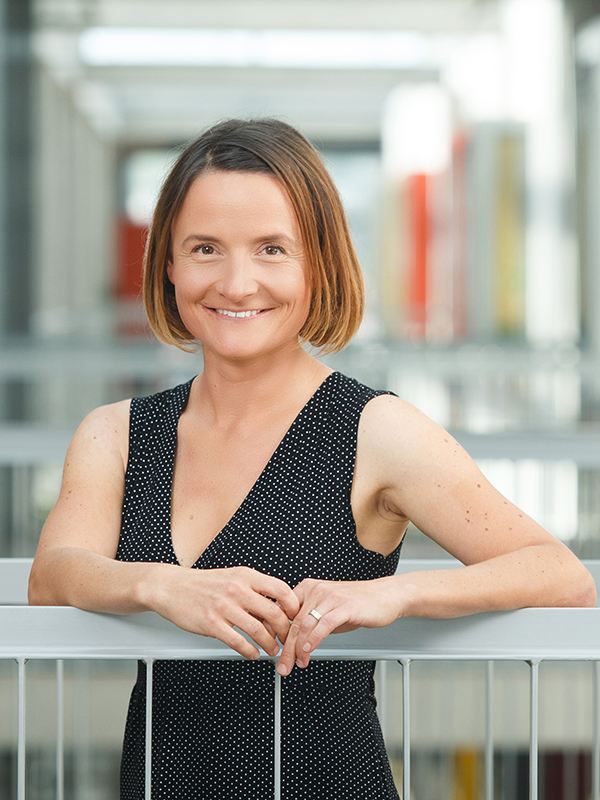
Polona Oblak serves as a Full Professor at the Faculty of Computer and Information Science, University of Ljubljana, where she is an integral member of the Laboratory for Mathematical Methods in Computer and Information Science. Her teaching responsibilities span foundational courses including Linear Algebra, Mathematical Modelling, and multiple levels of Mathematics instruction, reflecting her dual expertise in theoretical mathematics and computational applications. Her research centers on advanced Matrix Theory and Graph Theory, with pioneering contributions to Spectral Graph Theory and Inverse Eigenvalue Problems. She investigates structural properties of commuting matrices, nilpotent matrix centralizers, and tropical semiring algebra, extending theoretical frameworks to practical applications in computer vision and statistical analysis. Recent interdisciplinary projects like "DeepBeauty" demonstrate her ability to bridge pure mathematics with industry-relevant solutions in fashion technology. Analysis of her 15 most recent publications (2021-2025) reveals a dominant focus on spectral graph phenomena, particularly the inverse eigenvalue problem across diverse graph structures including trees, block graphs, and unicyclic graphs. Her work on tropical matrix factorization (e.g., Faststmf algorithm) provides efficient computational tools for sparse data, while theoretical breakthroughs like the "liberation set" concept redefine boundaries in spectral graph theory. This research trajectory shows increasing integration of algebraic methods with machine learning applications. Professor Oblak has secured substantial research funding through the Slovenian Research Agency (ARRS) and international collaborations, including the ongoing "Computer Vision" program (2019-2024) and bilateral projects with Bosnia and Herzegovina on nilpotent orbits. Her leadership in computationally intensive statistical methods (2016-2019) and deep generative models for the beauty industry (2020-2023) demonstrates consistent ability to translate theoretical advances into funded research initiatives, though specific student supervision details remain unlisted in available sources. Within the Laboratory for Mathematical Methods in Computer and Information Science, she contributes to a synergistic research environment where algebraic techniques directly inform computational solutions. Her work on Laplacian-integral graphs and tropical factorization algorithms exemplifies the laboratory's mission to develop mathematical foundations for next-generation information systems, with recent outputs showing heightened emphasis on algorithmic efficiency for real-world data challenges.