Dr Catherine Kontz is a London-based composer and professor at the Royal College of Music, specializing in nonlinear forms, visual/spatial elements, and musical theatricality in contemporary composition. She serves as a Doctoral Supervisor and is currently an artist-in-residence at King's College London's Engineering Department. Born 1976 BMus (Hons), MMus, PhD from Goldsmiths Her research spans: Audio technology applications in composition Multimedia operatic productions Site-specific sound installations Interdisciplinary collaboration strategies Cultural synthesis in musical theatre Temporal experimentation in performance Her work has been performed by prestigious ensembles and artists including Solistes Européens Luxembourg, BBC Scottish Symphony Orchestra, ensemble recherche, Exaudi, and Naomi Woo. Current projects include collaborative research with Professor Zoran Cvetkovic exploring audio technologies and human intelligence processes. Notable achievements: Shortlisted for Quattropole Music Prize Commissioned for European Capital of Culture program Doctoral research connecting Deleuzian theory with mime opera Regular Tête-à-Tête opera festival participant Director of multimedia opera productions Academic contributions include: Supervising doctoral composition students Developing interdisciplinary research projects Teaching contemporary composition techniques Creating large-scale collaborative works Advancing audio technology applications Mentoring emerging composers
Ricardo Atienza Badel is an Associate Professor in the Department of Art and Media at Aalto University, Finland, specializing in the intersection of sound, space, and media practices. His research portfolio includes: Sound Art and Experimental Composition Acoustic Design for Emergency Vehicles Geolocated Sound Installations Spatial Audio and Auralization Phenomenological Sound Studies Media Art and Intermedia Practices Recent publications (2021-2025) reveal a consistent investigation into how sound shapes human experience across physical environments—from ambulance sirens to GPS-based artworks—and theoretical frameworks connecting sound, space, and embodiment. His collaborative work bridges artistic innovation with technical acoustic research, particularly in emergency vehicle sound design and immersive sonic environments.
Kıvanç Tatar is an Assistant Professor in Interactive AI at Chalmers University of Technology, Sweden. His work bridges Music, Artificial Intelligence, Interactive Arts, and Virtual Reality, creating multimodal AI systems for performances, immersive environments, and generative art. Exhibited globally at events like Ars Electronica (2017, 2020) and Rio Olympics 2016 Founder of the AI in Computational Arts, Music, and Games research group Projects integrate AI with movement computation, VR, and livecoding His research focuses on musical AI , interactive systems , and creative algorithms , with applications in real-time performance, environmental art, and robotics. Recent projects include Koami 2025 (upcoming livecoding), Latent Timbre Synthesis (2021), and Brush of AI (2020 NFT series). Key Collaborations : A.I.D (Istanbul), Gold Saucer (Vancouver) Exhibition Highlights : CHI 2018, Mutek Montreal 2018, Contemporary Istanbul PlugIn 2019
Jonas Fritsch is an Associate Professor at the IT University of Copenhagen, affiliated with the Media, Art & Design School and the Center for Climate IT. He leads the Affective Interaction & Relations (AIR) Lab and serves as Principal Investigator (PI) for major projects like the VELUX-funded TRACE initiative (2023-2027) and the DFF-funded VOCAL project (2022-2025). His research focuses on affective interaction design, particularly in healthcare, emotional design, and the integration of cultural theory into HCI. Research Interests: His work explores affective healthcare design, embodied interaction, and interdisciplinary design methodologies. Recent projects include developing tools for patient-centered care, synthetic voice design frameworks, and affective engagement in extended reality (XR). Notable collaborations span Denmark and international partners, emphasizing human-technology relationships in care practices. Key Projects: TRACE investigates emerging human-technology interactions in care practices, while VOCAL explores novel vocal imaginaries through voice design. He has secured grants totaling over 8.5 million DKK, demonstrating impact in both academic and applied domains. Labs & Teams: As head of the AIR Lab, he fosters collaborative research on affective technologies. Media contributions include public installations like UDREDNING, which engages audiences in diagnostic processes through XR. He actively participates in conferences and review committees, emphasizing interdisciplinary dialogue in design and technology.
Professor Sigi Torinus is an esteemed faculty member at the University of Windsor's Faculty of Arts, Humanities, and Social Sciences, holding dual affiliations with the School of Visual Arts and Department of Music. Recognized for her innovative teaching, she received the 2021 Alumni Award for Distinguished Contributions to University Teaching. Her artistic practice focuses on interdisciplinary multimedia works, often collaborating with the Noiseborder Ensemble to create immersive sound, video, and performance installations. Key projects include the Homstal album launch (2024), Berlin Festival of Lights projections (2014), and In/fuse series performances blending live music with digital media. Research interests center on the intersection of technology and art, emphasizing real-time data mapping, spatial audio, and generative art. She actively mentors student projects in digital media through courses like 'Digital Media and Interactivity,' showcasing student works in curated exhibitions. Collaborations with matralab and Noiseborder Ensemble highlight her commitment to cross-disciplinary artistic exploration.
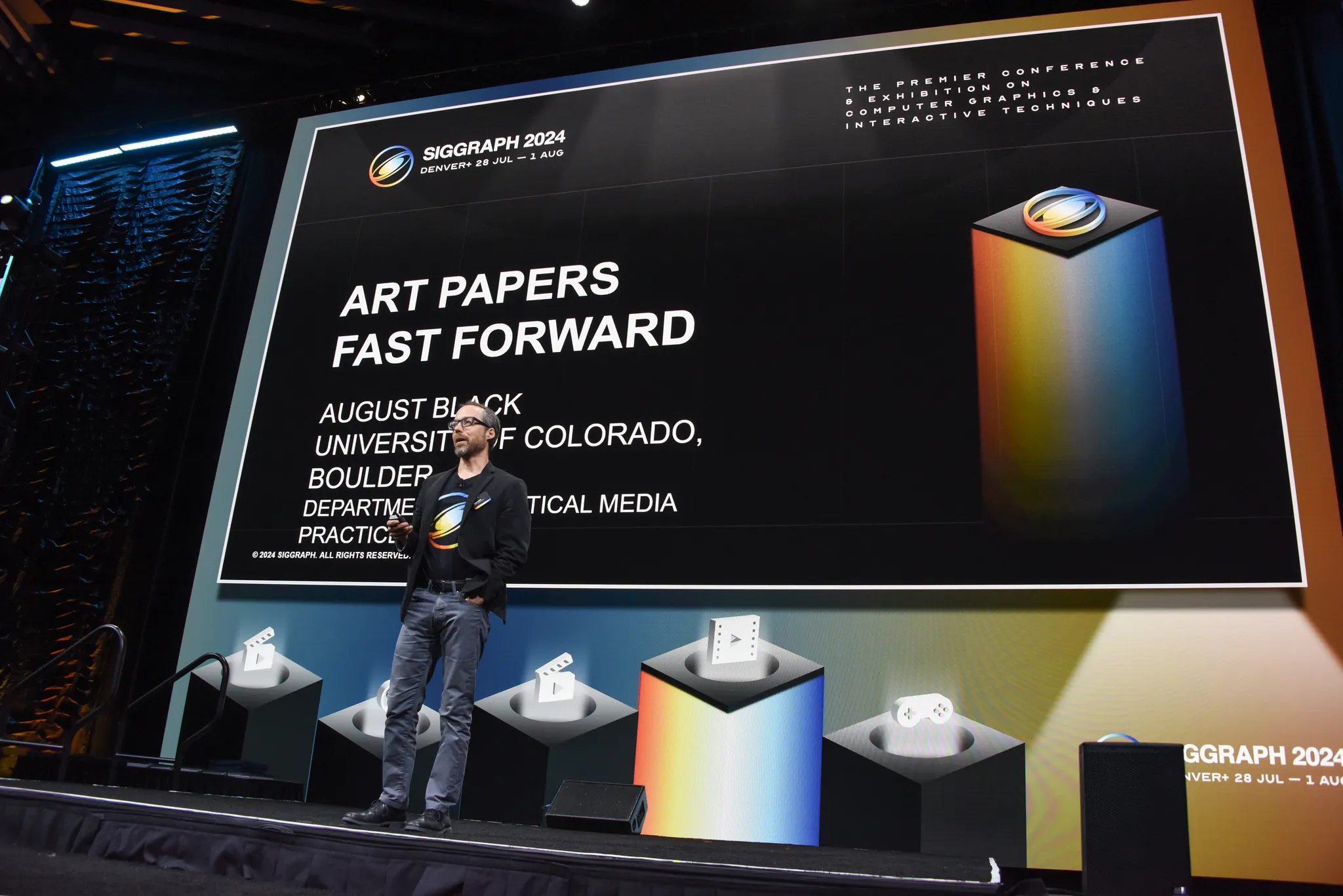
August Black is an Assistant Professor in the Department of Critical Media Practices at the University of Colorado Boulder. As a hybrid practitioner of art, design, and engineering, he creates experimental spatial and acoustic systems by building custom technological artifacts. His work critically engages techno-social systems through live networked audio, user-generated content, and immersive installations. BFA, Syracuse University MS & PhD, UC Santa Barbara (NSF IGERT Fellow) His research explores the intersection of philosophy of technology, software studies, and AI ethics. Current projects investigate global networking for hyper-local communication, while past work includes networked radio systems and generative audio-visual platforms. He has taught at UC Santa Barbara, University of San Francisco, and CU Boulder. Recent projects include Pulse Memorial (2024), a mobile multichannel memorial system, and Audio Compost (2022), a virtual frippertronic loop project. His work often incorporates WebRTC, FM radio integration, and participatory frameworks across digital and physical environments. NSF IGERT Fellow Black has advised PhD candidate Nima Bahrehmand and collaborated with institutions like ORF Kunstradio, Ars Electronica Futurelab, and Cycling '74. His practice includes software development (janode library for Janus WebRTC), hardware engineering, and exhibitions at festivals including Ars Electronica and SIGGRAPH.
Owen Chapman is a Professor in Sound Production and Scholarship at Concordia University's Department of Communication Studies. His work bridges sound art, research-creation, and mobility studies, focusing on the role of sound in everyday life through electronic composition, app design, and site-specific installations. He collaborates internationally with artists like Peter Sinclair and Vivek Venkatesh, producing projects such as Selfie Orchestra and Landscape of Hate/Hope that engage with critical issues around technology, disability, and media literacy. Research interests include: Sound studies and sonic cartography Mobile media and locative technology Research-creation methodologies Dub music's influence on contemporary sound art Disability studies in digital environments Interactive 3D audiovisual spaces His publications and projects have been funded by the Canada Council, FRQ-SC, and SSHRC. Chapman co-created the AudioMobile app for GPS-tagged sound recordings and has exhibited extensively in international festivals and symposia. He contributes to academic discourse through peer-reviewed journals and editorial roles, notably as Managing Editor for Wi: Journal of Mobile Media (2014-2018). Chapman's performances span improvisational electronic music, DJ/VJ sets, and multimedia installations. Key collaborations include: Selfie Orchestra (with Peter Sinclair) Landscape of Hate/Hope (with Vivek Venkatesh) Research with Milieux Institute for Arts, Technology and Culture
Dominick M Rivers serves as Assistant Professor of Digital Art in the Department of Art & Design at Indiana State University's College of Arts & Sciences. His academic role centers on bridging historical media techniques with contemporary digital practices through teaching and creative research. His educational background includes a Master of Fine Arts (M.F.A.) from Indiana University (2023) with a major in Fine Arts, establishing foundational expertise in experimental media creation. Rivers' research investigates the materiality of obsolete technologies through lenses of sustainability and cultural preservation. His work explores analog-digital hybridity in moving image art, sound design, and alternative photographic processes, with particular emphasis on Czech New Wave Cinema influences and public access television legacies. Current projects examine how obsolete media formats inform contemporary digital art practices within globalized cultural contexts. Recent scholarly output reveals consistent exploration of signal manipulation and sustainability, demonstrated through optical sound experimentation, festival curation, and conference presentations addressing alternative processes in moving image creation. His work connects technical innovation with ecological consciousness across multiple media platforms. Bloomington Arts Projects Grant, Bloomington Arts Commission (2025) Rivers actively secures external funding for creative projects, currently serving as Principal Investigator for two Bloomington Arts Commission grants: a $3,000 Arts Project Grant (2025-present) and a $2,000 Artist Advancement Grant (2025-2027). These funds support his experimental work in obsolete technology repurposing and community-based digital art initiatives.
Dr. Eve Klein is an Associate Professor and Senior Lecturer in Music Technology and Popular Music at The University of Queensland (UQ) School of Music. She leads a research cluster in interactive composition, focusing on virtual/augmented reality works and guiding postgraduate composers. Her work bridges classical music traditions with digital innovation, addressing themes like gender in technology, identity, and participatory cultures. Dr. Klein holds a PhD in Music and Sound and has pioneered immersive art music experiences for festivals such as MONA FOMA and VIVID Sydney. Her artistic works include Vocal Womb (a laryngoscopy-based opera exploring voice and power) and City Symphony (an AR soundwalk overlaying Brisbane’s CBD). She is a recipient of the 2023 Art Music Award for Experimental Practice and the IASPM 2016 Open Publication Prize. Her research spans music technology curriculum design, future work skills in the arts, and epistemic fluency through transdisciplinary collaboration. She co-founded the Touch Ensemble, a technology-focused performance group collaborating with engineering students. Dr. Klein’s work frequently addresses social justice themes, including gendered violence and climate change. Education: PhD in Music and Sound Awards: 2023 Art Music Award, IASPM 2016 Prize, UQ Program Innovation Award Her articles critically examine virtual orchestras’ impact on classical norms, while her creative works challenge traditional performance boundaries. Klein collaborates internationally with festivals, scientists, and NGOs to create transformative cultural projects.
John Supko is an Associate Professor of Music and Theater Studies at Duke University's Trinity College of Arts & Sciences. He also serves as Core Faculty in Innovation & Entrepreneurship and previously held roles like Interim Director of the PhD Program in Computational Media, Arts & Culture. Educated at Indiana University (B.Mus., 2002), Princeton University (M.F.A., 2005; Ph.D., 2009), he specializes in generative music that blends human creativity with algorithmic processes. His research explores intersections of chance, traditional notation, and real-time score generation. Notable projects include s_traits (a generative environment based on Bill Seaman’s text) and USINE (a 24-hour work combining ensemble and algorithmic electronics). His work has been hailed as 'spellbindingly beautiful' and 'hypnotic' for its fusion of sound, text, and technology. Recent artistic works include Time Becomes Again (2024) and Crossed Shadows (2024), emphasizing algorithmic innovation. Awards include the Hunt Family Publication Award (2013) and the Leo Kaplan Award (2008). Teaching spans composition, generative media, and arts entrepreneurship, reflecting his commitment to interdisciplinary creativity. Supko’s collaborations extend to computational media and experimental performance, with works exhibited globally. His lab focuses on using technology to disrupt conventional musical frameworks, advocating for 'exuberant rule-breaking' in artistic exploration.
Wesley Goatley is an Acting Programme Director of Interaction Design and Visual Communication at the London College of Communication (LCC), part of University of the Arts London. With a doctorate in Creative and Critical Practice from the University of Sussex, he is a critical artist and researcher whose work examines Artificial Intelligence technologies and their relations to society, geopolitics, and the climate crisis. Goatley's research interests focus on critical data aesthetics, the sociopolitical implications of AI, and speculative futures. His work investigates how art practice can intervene and explore AI technologies, emphasizing their ecological impact and the myths they represent. He creates installations, performances, and films that expose the hidden mechanisms of AI listening, smart devices, and surveillance technologies, often using deconstructed synthetic voices to highlight their non-human nature. His artistic outputs form a cohesive body of work that critically examines the relationship between humans and AI. Through soundtracked speculative fiction, interactive installations, and performance art, Goatley explores alternative futures where AI is banned, forgotten, phased-out, or surpassed. His works consistently address themes of climate crisis, e-waste, surveillance, and the geopolitical forces behind seemingly friendly consumer technologies. EMARE/EMAP residency prize with Impakt Festival (2017) Goatley has presented his work internationally at venues including Eyebeam in New York, Berghain in Berlin, The Nam June Paik Art Center in Seoul, and the Victoria & Albert Museum in London. His installations have been commissioned by organizations including Tactical Tech Berlin, Science Gallery London, and the Bridging Responsible AI Divides (BRAID) Programme. He has also consulted for organizations such as BBC R&D and the University of the Creative Arts, London. Goatley maintains an active presence in the critical AI community, having given talks at international events such as Milan Design Week, Global Art Forum Singapore, CTM Festival Berlin, and the European Data Forum in Eindhoven. His work bridges artistic practice with critical theory, creating tangible experiences that make abstract technological systems visible and critique-able.
Jonas Braasch is a Professor at Rensselaer Polytechnic Institute's School of Architecture and Associate Director for Research at the Experimental Media and Performing Arts Center (EMPAC). He teaches in the Graduate Program in Architectural Acoustics and leads research on collaborative virtual reality, binaural hearing, auditory modeling, and sensory substitution devices. His work has been funded by NSF, NSERC, and European agencies, and he holds dual PhDs in Electrical Engineering/Information Science and Musicology. His research integrates acoustic virtual reality systems, immersive museum soundscapes, telematic music, and assistive instrument design. Recent publications focus on networked immersive environments, spatial audio techniques, museum acoustics classification, and innovations in wind instrument design for accessibility. Publications emphasize the application of deep learning to acoustic prediction and multisensory integration.
Kevin Sweet is an Assistant Professor of Design and Interactive Arts: Immersive Experience at the University of Texas at Dallas, affiliated with the Harry W. Bass Jr. School of Arts, Humanities, and Technology. His work bridges art, science, and technology to explore possibilities for social transformation through creative play. Sweet's practice spans digital media, performance, virtual reality, and community-based projects that address social justice issues and interdisciplinary collaboration. Education PhD in Emergent Technologies and Media Art Practices, University of Colorado Boulder (2022) MFA in Film/Video, Massachusetts College of Art and Design (2012) BA in Film Studies, Keene State College (2009) Research Focus Sweet's research centers on narrative refiguration through embodied creative play at intersections of art, science, and technology. His work explores how digital media can address systemic inequities, preserve cultural heritage, and create new communal storytelling forms. Recent projects focus on community media labs, ancestral land rights, and speculative methodologies challenging anthropocentric narratives. He investigates how virtual and augmented reality can be leveraged for social justice and community empowerment, as evidenced by his ongoing work with high school students in San Luis, Colorado. His practice demonstrates a commitment to using art and technology as tools for community engagement and historical preservation. Publication Trends Sweet's creative output shows a clear trajectory from traditional film and video toward increasingly complex interdisciplinary projects. His early work focused on material properties of analog media (like 'Intervals'), while recent projects integrate virtual reality, AI, and community-based practices. His publications reveal a pattern of ambitious cross-disciplinary collaborations, from partnerships with astrophysicists in 'Sound Planetarium' to community-based projects like 'La Sierra' addressing systemic inequities. There's a consistent evolution toward more socially engaged work addressing land rights, historical memory, and non-human agency. Professional Activities Faculty board member, UTD Student Media Operating Board President of the Board of Directors, Denver Digerati 501(c)(3) (2022-2024) Co-Principal Investigator, Sound Planetarium (astrophysics and art collaboration) Head of Creative Development, JoyceStick (VR adaptation of James Joyce's Ulysses) Former Director of Media, Guestbook Project (international peacebuilding organization) First Artist in Residence, Institute of Liberal Arts at Boston College Labs and Community Engagement Sweet has developed community media labs, partnering with History Colorado to build a local media lab in San Luis, Colorado. This initiative creates critical digital arts curriculum for high school students, empowering them to become authors of their community's history. His collaborative work involves interdisciplinary teams spanning artists, scientists, community organizers, and educators working on issues of land rights, historical memory, and cultural preservation.
Richard Savery is an Honorary Research Fellow at Macquarie University's Faculty of Arts, affiliated with the Performance and Expertise Research Centre and the Centre for Applied Artificial Intelligence. His work bridges artificial intelligence, robotics, and music, focusing on creative interactions and trust-building through robotic musicianship. He holds a PhD in Music Technology from Georgia Institute of Technology (2021) and a Master's from UC Irvine. Key roles include developing the NSF-funded Keirzo rapping/drumming robot and publishing the edited book Sound and Robotics (2023). Research interests include emotional musical prosody, human-robot collaboration, and robotic performance. Notable projects include Shimon the singing robot and IVF sonification. Awards include a GANG Award (2015) for game audio. Active in interdisciplinary collaborations, he has composed music for films, ads, and video games, including Gunman Taco Truck and Gathering Sky . His work spans academic grants ($800k NSF-NRI grant), industry partnerships, and public installations like the Un[contained] Arts Festival's beehive exhibit. Over 50 publications highlight his contributions to robotics, music tech, and AI ethics.
Dr. Philippe Pasquier is a Professor at Simon Fraser University's School of Interactive Arts and Technology, where he directs the Metacreation Lab for Creative AI. His research-creation program integrates scientific research on generative AI and machine learning with artistic practice in computer music and interactive art. Research focuses on creative AI systems for artistic tasks, including multi-track music composition (Calliope), timbre synthesis, visual synthesis (Autolume), and cross-modal generation. Applications span creative software tools, interactive installations, and audiovisual performances studied through HCI methodologies. Publications demonstrate consistent innovation in generative systems, with recent work exploring controllable music generation (MIDI-GPT), GAN-based visual synthesis, and evaluation frameworks for creative AI. Artistic works have been exhibited globally at venues including Ars Electronica, Centre Pompidou, and ZKM. Secured research funding from NSERC, SSHRC, CFI, and international agencies. Founded key academic initiatives including the International Workshop on Musical Metacreation (MUME), Movement and Computation conference (MOCO), and chaired ISEA2015. Teaches creative AI, sound design, and interdisciplinary computing approaches.