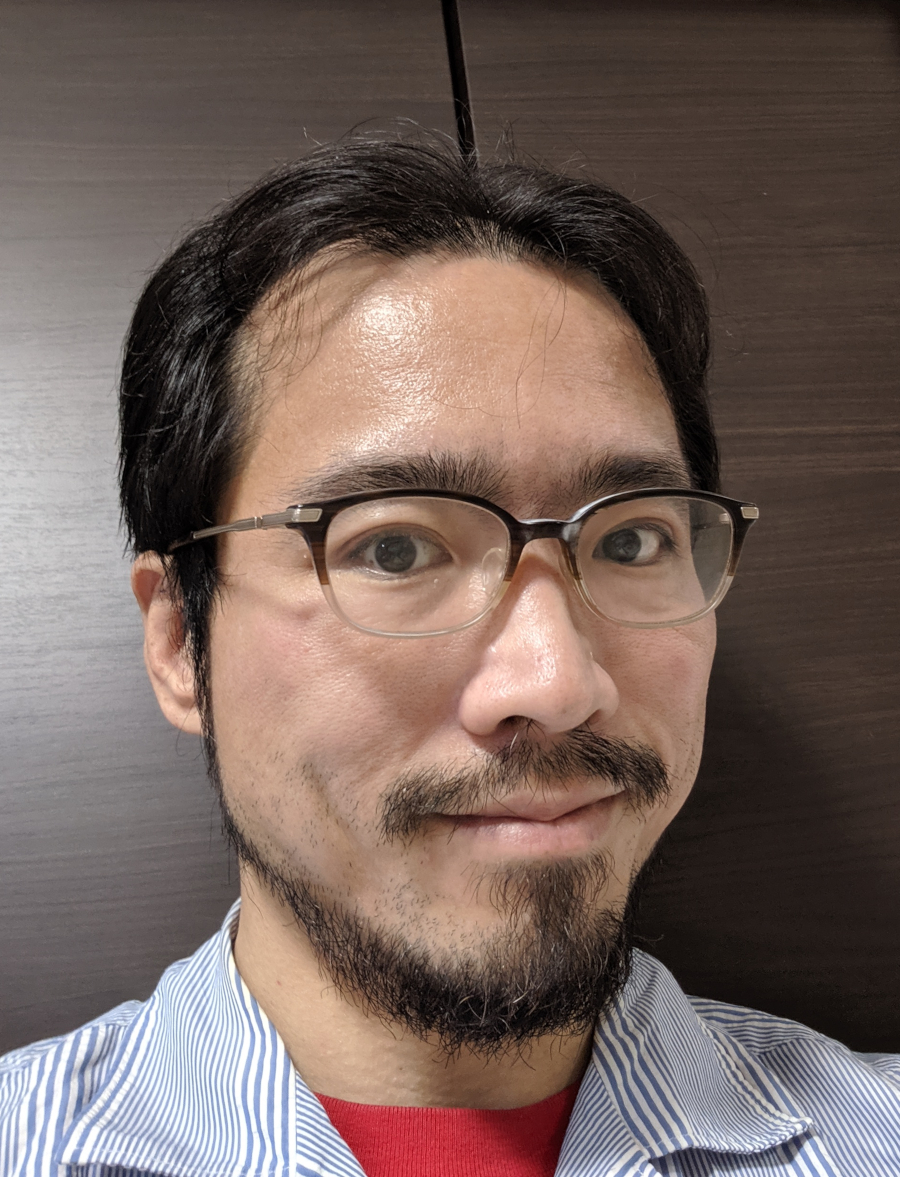
Katahira Kenji is an Associate Professor at the School of Humanities and Social Sciences , Osaka University, with research spanning music psychology , emotion physiology , and Kansei informatics . His work bridges Cognitive neuroscience Human-computer interaction Design psychology Key research themes include flow experiences , emotional piloerection , and nonverbal communication in musical ensembles . He developed EEG-based flow state measurement 3D shape evaluation models Emotional response frameworks for sound and design His scientific contributions include Good Design Award (2014) ICMPC10 Travel Award (2008) Multiple best paper awards from Japanese academic societies Recent projects focus on Neural basis of voluntary piloerection Physiological measurement systems for peak experiences Kansei evaluation models for textures and 3D designs with grants from the Japan Society for the Promotion of Science.
Dr. Masato Inoue is a Professor at the Faculty of Science and Engineering , School of Advanced Science and Engineering at Waseda University. He holds a Doctor of Medical Science from Kyoto University. Education: 2003 - Kyoto University Graduate School of Medicine 2003 - Kyoto University His research spans multiple disciplines at the intersection of Medical Informatics , Bioinformatics , and Statistical Mechanics . Key areas include: Medical Imaging : Developing Bayesian super-resolution algorithms and Prior Ensemble Learning for improved MRI reconstruction Voice Analysis : Creating innovative voice quality quantification systems for clinical diagnostics Genetic Analysis : Advancing haplotype inference methods and gene network modeling Signal Processing : Applying statistical mechanics to diverse problems from coding theory to neuroscience His recent publications (2021-2012) demonstrate consistent contributions to medical imaging algorithms , voice disorder classification , and genetic data analysis . Notable collaborations include work with Kyoto University researchers , Swedish medical institutions , and cross-disciplinary teams in bioengineering.
Masato Uchida is a Professor at the School of Fundamental Science and Engineering, Waseda University, with a focus on information security and network systems. His career spans roles at Chiba Institute of Technology and Kyushu Institute of Technology, and he holds degrees in Engineering from Hokkaido University. Education: Master of Engineering (Hokkaido University, 2001), Doctor of Philosophy (Hokkaido University, 2005) His research interests include network security, peer-to-peer systems, machine learning for cybersecurity, and traffic analysis. His work addresses anomaly detection, malware classification, and resource allocation fairness in networks. Recent publications analyze adversarial machine learning, cloud service abuse, and domain parking security. Uchida's articles demonstrate expertise in cybersecurity, network modeling, and data science. He has received multiple awards for research excellence, including IEEE Outstanding Paper Awards and IEICE Communications Society honors. His leadership in committees like the Ministry of Internal Affairs and Communications' technical task forces highlights his policy influence. Scientific Awards: Outstanding Paper Award, IEEE International Conference on Teaching, Assessment, and Learning for Engineering (2020) MWS Outstanding Paper Award, Computer Security Symposium (CSS 2020) IEICE Activity Contribution Award (2016) Best Poster Award, SCIS & ISIS (2014) IEICE Network Systems Research Award (2012) He advises students in cybersecurity and collaborates on projects involving traffic load balancing, Android malware analysis, and cloud security. His professional memberships include IEEE, ACM, and the Information Processing Society of Japan.
Keiko Homma is a Professor at the Graduate School of Fundamental Science and Engineering , Waseda University, with a career focused on Rehabilitation Engineering , Health Care Engineering , and Robotics . She previously served as a Senior Researcher at the National Institute of Advanced Industrial Science and Technology (AIST) from 2018 to 2023. Research Areas : Robotics, Mechatronics, Safety Engineering, Welfare Technology Grants : Multiple Japan Society for the Promotion of Science (JSPS) grants for studies on passive motion devices and assistive robotics Her work addresses assistive robotics for elderly care, including safety evaluation tools, IoT-integrated orthotic devices, and humanoid robotic simulators. She has collaborated across disciplines with institutions like AIST and TOTO, emphasizing trustworthy AI and human-centered design . Her research integrates sensor systems , biomechanical analysis , and ethical frameworks for robotic applications in healthcare. Professional Memberships: IEEE Japanese Society for Wellbeing Science and Assistive Technology Society of Biomechanisms Japan Japan Society for Precision Engineering
Ippei Obayashi is a Professor at Okayama University's Center for artificial intelligence and mathematical data science, with a visiting professorship at Tohoku University's Advanced Institute for Materials Research (AIMR). His academic career spans prestigious institutions including RIKEN, Tohoku University, and Kyoto University, where he earned his Doctor of Science degree. Okayama University, Center for AI and Mathematical Data Science, Professor (2021-present) RIKEN, Center for Advanced Intelligence Project, Researcher (2018-2021) Tohoku University, Institute for Advanced Materials Science, Associate Professor (2018) Tohoku University, Advanced Institute for Materials Science, Assistant Professor (2015-2018) Kyoto University, Research Fellow (2010-2015) Educational Background: Kyoto University, Graduate School of Science, Department of Mathematics and Mathematical Analysis (2006-2010, Doctoral) Kyoto University, Graduate School of Science, Department of Mathematics and Mathematical Analysis (2004-2006, Master's) Kyoto University, Faculty of Science (2000-2004, Bachelor's) Professor Obayashi's research focuses on topological data analysis (TDA) , particularly persistent homology and its applications, alongside dynamical systems theory. His work bridges pure mathematics with practical applications in materials science, where he has developed innovative methods to analyze complex material structures. He has made significant contributions to understanding magnetic materials, amorphous structures, and crystal formation through topological approaches, often integrating machine learning techniques with traditional mathematical analysis. His research has practical implications for energy materials, battery technology, and materials characterization. His publication record demonstrates a strong trend toward applying topological methods to solve real-world materials science problems, with increasing integration of machine learning techniques. Recent work shows sophisticated applications of persistent homology to analyze neutron scattering data, magnetic properties, and structural characteristics of materials, reflecting his ability to translate abstract mathematical concepts into practical analytical tools. Scientific Awards: JCS-JAPAN Excellent Paper Award, Ceramic Society of Japan (2020) 11th Sakuramai Research Encouragement Award, RIKEN (2020) Japan Society for Industrial and Applied Mathematics Best Author and Best Paper Awards (2017) 6th Fujiwara Hiroshi Mathematical Sciences Encouragement Award (2017) AIMR International Symposium Best Poster Award (2017) Professor Obayashi actively mentors graduate students through Okayama University's Graduate Student Program and leads research initiatives including the Japan Society for Industrial and Applied Mathematics Topological Data Analysis Research Group, which he chairs. His research is supported by multiple competitive grants, including Japan Society for the Promotion of Science (JSPS) funding for projects on mathematical data science and topological structure analysis. He collaborates extensively with researchers across disciplines, particularly in materials science and engineering. He is affiliated with the Center for artificial intelligence and mathematical data science (Angels) and the Cyber-Physical Engineering Informatics Research Division (Cypher) at Okayama University, where he leads efforts to develop and apply topological data analysis methods to complex scientific problems. His laboratory focuses on creating practical software tools like HomCloud for persistent homology analysis, bridging the gap between theoretical mathematics and applied scientific research.
Keiichi Muramatsu is Associate Professor (tenure-track since 2025) at Waseda University’s Global Education Center, Japan. Holding a Doctor of Human Sciences from Waseda, he has successively served as Assistant Professor at Saitama University and as part-time Lecturer at Bunkyo University. He is an active member of the Japan Society of Kansei Engineering, the Japanese Society for Artificial Intelligence and the Color Society of Japan. Education: Doctoral Program, Human Sciences, Waseda University (2009-2014) Master’s Program, Human Sciences, Waseda University (2007-2009) Bachelor, Department of Human Informatics and Cognitive Sciences, Waseda University (2003-2007) Research interests: Muramatsu integrates Kansei informatics and soft computing to quantify human emotional and aesthetic responses. His work spans colour-emotion modelling for lighting and butterfly aesthetics, bio-signal driven emotion recognition using chaotic fingertip plethysmography, and gait classification via deep learning for personalised rehabilitation and stumble prevention. He also develops ontological frameworks to share emotional knowledge across educational and product-service system design domains. Publication trends: Across 62 Scopus papers (h-index 7), Muramatsu’s recent outputs demonstrate a convergence of affective engineering and AI: convolutional networks visualise gait features for training feedback, neural predictors estimate learner states in intelligent tutoring systems, and psychophysiological models link colour, fragrance and 3-D sound to emotional dimensions. Studies consistently combine subjective evaluations with objective indices such as fNIRS, skin conductance and chaotic exponents. Grants & industry links: He has led JSPS KAKENHI grants and internal Waseda special research projects, collaborated with Toyota on driver affective scales, and contributed to exoskeleton development with Saitama medical device firms. His work on LED automotive lighting and mobility-scooter stress evaluation reflects ongoing industry knowledge transfer. Advising & labs: While specific student names are not disclosed, Muramatsu supervises graduate research on gait-assistive devices, emotion recognition wearables, and ITS architectures within the Global Education Center’s interdisciplinary environment.
Professor Shigeru Fujimura is affiliated with Waseda University as a faculty member of the Faculty of Science and Engineering , specifically in the Graduate School of Information, Production, and Systems . With a PhD in Engineering from Waseda University, his research focuses on intelligent informatics and system engineering , particularly in scheduling, optimization, and human-robot collaboration. His research spans multiple domains including: Deep Reinforcement Learning for combinatorial optimization Energy-efficient manufacturing systems Multi-agent collaboration frameworks Augmented Reality interfaces IoT business modeling Recent publications demonstrate expertise in graph neural networks , particle swarm optimization , and generative adversarial networks applied to industrial problems. He has received multiple awards including the Invention Encouragement Prize (2003) and IEEJ Paper Presentation Award (1994) .
Xin Qi is an Assistant Professor (non-tenure-track) at the School of International Liberal Studies, Faculty of International Research and Education, Waseda University. He holds a Doctor of Engineering degree from Waseda University (2019) and previously studied at Hangzhou Dianzi University (2009-2013). His educational background includes: Doctor of Engineering, Waseda University (2014.09-2019.09) Bachelor's degree, Hangzhou Dianzi University (2009-2013) Dr. Qi's research focuses on the intersection of artificial intelligence and network technologies. His primary research areas include Intelligent Informatics, with specific interests in Artificial Intelligence applications for security systems, IoT infrastructure, and Information-Centric Networking. His work bridges theoretical computer science with practical applications in public safety, disaster management, and secure communications. His research demonstrates strong interdisciplinary connections between computer science, electrical engineering, and practical security applications. Analysis of Dr. Qi's publication record (44 papers with 557 Scopus citations and h-index of 12, or 757 Google Scholar citations with h-index of 15) reveals a strong focus on practical applications of AI and blockchain technologies. His most recent work (2023-2024) centers on latency compensation in remote monitoring systems, GNSS spoofing detection using machine learning, and AI-based security screening systems. Earlier work (2021-2022) shows significant contributions to ledger-based point transfer systems for LPWAN networks and image processing techniques for secure data transmission. His research demonstrates a consistent trajectory toward solving real-world problems in security, networking, and IoT applications. Dr. Qi is an active member of professional organizations including the Institute of Electronics, Information and Communication Engineers and IEEE. His research is supported by multiple projects including "Low latency interactive zero latency video/Somatic integrated network" (2022-2024), "Dynamic Secure Network for Traffic and Logistics" (2021-2023), and "Lightweight distributed ledger technology authentication system for LPWA" (2020-2022). These projects reflect his focus on practical applications of his research in real-world scenarios, particularly in disaster management and secure communications infrastructure. He has received consistent research funding that supports both theoretical development and practical implementation of his work. Dr. Qi also contributes to educational initiatives at Waseda University, teaching courses including Data Structure and Algorithms, Human-Technology Interface, and Computerized Society, where he bridges theoretical computer science with practical applications for undergraduate students.
Tota Suko is an Associate Professor at the School of Social Sciences, Waseda University, specializing in statistical learning theory and business analytics. With a Ph.D. in Engineering from Waseda University, Dr. Suko leads the Suko Seminar (Management Science Seminar) where students learn to solve business problems using mathematical and management science approaches, primarily through data science techniques including statistical analysis and machine learning. Dr. Suko's research spans multiple domains in statistics and data science. His primary interests include Bayesian statistics, statistical learning theory, business statistics, data mining, and information theory. He has developed methods for analyzing survey data with selection bias, detecting poor responses in questionnaires, and parameter estimation in regression models. His work bridges theoretical statistics with practical applications in business analytics, e-commerce, and even nanotechnology through collaborations with physics researchers. Dr. Suko's recent publications demonstrate a strong trend toward practical applications of statistical methods. His work on generative AI for criminal case law analysis shows innovative application of AI in legal domains, while his research on questionnaire quality control addresses fundamental issues in survey methodology. He has also made significant contributions to theoretical aspects of statistical learning, particularly in the areas of label noise, selection bias, and parameter estimation under non-ideal data conditions. Japan Society for the Promotion of Science Grants-in-Aid for Scientific Research projects Waseda Data Science Consortium industry-academia collaborations Research on nanoscale semiconductor prediction models Development of methods for low-quality data analysis Dr. Suko actively supervises both undergraduate and graduate students through the Suko Seminar. Students work on individual or team projects, participate in data analysis competitions, and present their research at academic conferences. He has developed educational approaches including full-on-demand content for data science education and modularized online statistical teaching materials. Dr. Suko leads the Suko Seminar (Management Science Seminar), which actively collaborates with companies and research institutions. His research team works on diverse projects including analysis of purchasing and browsing histories on e-commerce sites, prediction modeling for nanoscale conduction, and development of methods for low-quality data analysis. The seminar emphasizes both theoretical understanding and practical application of data science techniques to solve real-world business problems.
Takahiro Uchiya serves as Professor at Nagoya Institute of Technology, holding dual appointments in the Department of Information Engineering within the Faculty of Engineering and the Information Technology Center. His academic leadership spans agent-oriented knowledge engineering and intelligent informatics, with recent focus on disaster response robotics and multi-agent systems development. Uchiya completed his academic foundation at Tohoku University through a rigorous progression: Bachelor of Engineering, Faculty of Engineering (1999) Master of Information Science, Graduate School of Information Science (2001) Doctor of Information Science, Graduate School of Information Science (2004) His research centers on agent-oriented knowledge representation, problem solving, and acquisition techniques, with significant extensions into cyber society software platforms and social knowledge applications. Recent investigations reveal a pronounced shift toward practical disaster management solutions, including robot-guided evacuation systems and BLE-based positioning technologies. This trajectory demonstrates consistent innovation in translating theoretical multi-agent frameworks into real-world emergency response tools. Uchiya's scientific contributions have earned recognition including the BWCCA2024 Best Paper Award and IEEE CES West Japan Chapter Young Researcher Award. His award portfolio spans both Japanese and international venues, reflecting broad scholarly impact. Through committee roles in the Information Processing Society of Japan and Institute of Electronics, Information and Communication Engineers, Uchiya actively shapes academic discourse. His societal engagement manifests in developing voice dialogue systems for elderly care and robotics programming workshops for schoolchildren, bridging academic research with community needs through events like Science Agora 2018.
Tengfei SHAO is an Assistant Professor (non-tenure-track) at Waseda University's Global Education Center and Researcher at the Institute of Data Science. His academic journey includes a Doctorate in Engineering from Waseda University's School of Creative Science and Engineering, completed in March 2025. 2022.04 - 2025.03: Doctorate at Waseda University, School of Creative Science and Engineering, Management Systems Program 2020.04 - 2022.03: Master's studies at Waseda University Dr. SHAO's research centers on network science applications across diverse domains. His primary interests include Complex Systems, Network Analysis, and Social Systems Engineering, with particular focus on second-hand luxury market dynamics, AI ethics education, and sentiment analysis. His work frequently employs network motifs as analytical tools to uncover hidden patterns in consumer behavior, market trends, and social interactions. He has developed innovative approaches to analyzing e-commerce versus brick-and-mortar retail environments, particularly in the luxury goods sector. His publication record reveals a consistent trajectory of interdisciplinary research spanning computer science, economics, and social sciences. His most recent work integrates multimodal learning with sentiment analysis, medical image segmentation techniques, and advanced network analysis methodologies. The trend shows increasing sophistication in applying network science to real-world business problems, particularly in the luxury market sector. Association for Computing Machinery (ACM) member since 2024 Institute of Electrical and Electronics Engineers (IEEE) member since 2024 計測自動制御学会 (SICE) member since 2022, serving on Social Systems Committee since 2024 人工知能学会 (JSAI) member since 2022 電子情報通信学会 (IEICE) member since 2022 情報処理学会 (IPSJ) member since 2020 At Waseda University's Global Education Center, Dr. SHAO teaches multiple programming courses including Basic AI Programming, Introduction to Python Programming, Database Management, and Fundamentals of Information Science across different quarters. His teaching portfolio demonstrates expertise in foundational computer science education for international students. His research methodology consistently applies network science principles to diverse domains, creating bridges between technical analysis and practical business applications, particularly in understanding consumer behavior in digital marketplaces.
Goki Yasuda is an Associate Professor at the Center for Data Science, Waseda University. His research spans statistical science, intelligent informatics, and machine learning, with specialized interests in label noise robustness, semi-supervised learning, and asymptotic analysis of algorithms. He teaches extensively in data science education, including courses like 'Statistics Literacy', 'Data Analysis with Python', and 'Modeling for Data Science' through Waseda's Global Education Center. His research explores foundational machine learning challenges, including: Theoretical analysis of classification under label noise conditions Performance limits of semi-supervised learning with unlabeled data Bayesian inference for misspecified probabilistic models Algorithm optimization for real-world data imperfections Publications demonstrate a strong emphasis on theoretical machine learning (75% of recent work) with secondary focus on applied signal processing for video coding (25% of earlier publications). Research consistently employs statistical methods to address data quality issues in learning systems. He leads research projects including: 'Developing machine learning algorithms for low-quality data' (2022) 'Research on machine learning from data of various quality' (2019) 'Performance evaluation of prediction in half-ranked learning' (2018)
YOSHINAGA, Jun serves as a Senior Researcher holding the academic rank of Associate Professor at the Advanced Collaborative Research Organization for SmartSociety, an institution dedicated to interdisciplinary research for next-generation societal infrastructure. His position reflects active engagement in academic research within this specialized organization. Dr. Yoshinaga's research spans critical domains including Smart Society frameworks, Internet of Things integration, Artificial Intelligence applications, Sustainable Development strategies, Urban Informatics, and Cyber-Physical Systems. His work focuses on technological solutions for societal challenges, particularly in urban environments and resource optimization, leveraging cross-disciplinary approaches to advance smart community development. According to Scopus metrics (downloaded September 4, 2025), he maintains an active publication record with 43 papers, 260 citations, and an h-index of 9, demonstrating consistent scholarly contribution in these evolving research areas.
Shintaro Uchiyama serves as a Research Associate at Waseda University's Faculty of Human Sciences since April 2025. Previously, he held positions as a Part-time Lecturer at National Institute of Technology, Toyota College (2021-2024) and teaching assistant roles at Toyohashi University of Technology. His academic foundation includes Bachelor's and Master's degrees in Engineering from Toyohashi University of Technology, completed in 2020 and 2022 respectively. Bachelor of Engineering (2020), Toyohashi University of Technology Master of Engineering (2022), Toyohashi University of Technology Graduate Coursework Completed (2025), Toyohashi University of Technology Uchiyama's research focuses on educational technology innovation, particularly in generative AI applications for learning support systems and flipped classroom methodologies. His work bridges speech recognition technologies with educational applications, developing systems that enhance student engagement through immediate feedback mechanisms and annotation tools. Current projects include STEAM learning environments using XR technology and learning behavior analysis systems for correspondence high schools. His publication record demonstrates consistent output in educational technology conferences and journals, with recent work emphasizing large language models for educational feedback and mixed reality applications. Research trends show progression from foundational VR/Hololens educational tools (2018) toward sophisticated AI-driven learning systems (2023-2025), maintaining focus on practical classroom implementation. 特別研究報告会最優秀特別研究発表賞 (Toyohashi University, 2022) 優秀講演賞 (ATS2020 Symposium, 2021) Rinnai Scholarship Foundation Award (2022) Japan Student Services Organization Half-Repayment Exemption (2022) Multiple student support awards from Toyohashi University (2021-2022) Uchiyama actively contributes to educational research through JSPS-funded projects including 'Establishing STEAM learning environments utilizing generative AI' (2024-2029) and 'Learning behavior analysis for correspondence high schools' (2025-2027). His committee work includes publicity chair roles for International Conferences on Advanced Informatics. Professional memberships span the Japanese Society for Information and Systems in Education and Japan Society for Educational Technology since 2019-2020.
SAKAUE Fumihiko is an Associate Professor at the Faculty of Engineering, Department of Information Engineering at Okayama University. He holds a Doctor of Engineering degree from Okayama University, awarded in 2006. His research focuses on innovative computer vision and computational photography techniques, aiming to develop novel methods for 3D measurement and real-time motion analysis without relying on conventional cameras or computers. His work integrates light-ray processing and spatiotemporal modulation to enhance visual information extraction and has contributed significantly to fields such as pattern recognition and imaging systems. Education background includes graduation from Okayama University's Faculty of Engineering in 2001, followed by earning his Doctor of Engineering degree from the same institution in 2006. His research interests span several key areas in informatics and engineering, including: Perceptual information processing for dynamic visual analysis Computer vision applications in 3D reconstruction and motion capture Computational photography techniques for advanced imaging systems Pattern recognition methodologies in unstructured environments Development of light-based measurement systems without conventional sensors Integration of light projection and observation for real-time data interpretation SAKAUE has received numerous awards, including: MIRUインタラクティブ発表賞 (2024) Best student paper award at International Workshop on Frontiers of Computer Vision (2022) Best paper award at INTERNATIONAL WORKSHOP ON ADVANCED IMAGE TECHNOLOGY (2022) MIRU2018長尾賞 (2018) 山下記念研究賞 (2018) CGVI研究会優秀研究発表賞 (2017) ICPR Best Student Paper Award (2016) MIRUインタラクティブ発表賞 (2019) MRU2016インタラクティブ発表賞 (2016) In terms of advising, SAKAUE has guided notable students including Toshiki Kamiya (recipient of 2022 Best Student Paper Award) and Yuma Nishikawa (2024 Best Student Paper award recipient). He has secured multiple grants from the Japan Society for the Promotion of Science (JSPS), including a 2020-2023 grant focused on 3D motion visualization through spatiotemporal light-ray integration, and a 2016-2019 grant on 5D light field display technologies. Additional funding includes a 2022-2025 project with Aichi Prefecture for AI-driven textile inspection systems. SAKAUE collaborates with interdisciplinary research teams at Okayama University, focusing on developing innovative imaging systems and sensorless vision technologies. His work often involves partnerships with industry through patents and applied research projects, such as the 'Position Measurement Device' (2016) and 'Three-Dimensional Information Presentation Device' (2014), demonstrating practical applications of his theoretical research.