David Angeli is a Professor of Nonlinear Network Dynamics in the Department of Electrical and Electronic Engineering at Imperial College London's Faculty of Engineering. Affiliations: Control and Power Research Group Energy Futures Lab His research focuses on Economic Model Predictive Control, Stability of Nonlinear Systems, Chemical Reaction Networks Theory, Systems Biology, and Control of Smart Grids. He develops theoretical frameworks for networked systems with applications in energy infrastructure and biological processes, emphasizing robustness and scalability in distributed settings. Recent publications (2023-2025) highlight work on distributed control algorithms, Lyapunov-based stability certification, and small-gain theorems for interconnected systems. His research bridges control theory, game theory, and machine learning to solve problems in cyber-physical systems, particularly in resilient consensus protocols and economic optimization for heterogeneous networks. As a core member of the Control and Power Research Group and Energy Futures Lab, he contributes to sustainable energy solutions and advanced control methodologies for complex networked systems.
Professor Tony Jebara is a faculty member in the Department of Computer Science at Columbia University, where he chairs the Center on Foundations of Data Science and directs the Columbia Machine Learning Laboratory. His research focuses on machine learning with applications in vision, graphs, and spatio-temporal data. He holds a PhD from MIT (2002) and has advised startups including Sense Networks, Evidation Health, and Agolo. Notable awards include the NSF Career Award (2004), Best Paper at ICML 2009, and recognition as one of Esquire's Best and Brightest (2008). His work has been featured in major media outlets. Jebara's academic contributions span over 100 peer-reviewed papers and a textbook on machine learning. He served as General Chair for ICML 2017 and Program Chair for ICML 2014. His research explores generative and discriminative models, Bayesian inference, and optimization techniques. Current projects include neural ensemble analysis in neuroscience and robust learning algorithms for environmental modeling. Recent publications emphasize scalable methods for collaborative filtering, survival analysis in online experiments, and graphical model applications in neuroscience. His work bridges theoretical advancements with practical systems, including contributions to privacy-preserving algorithms and recommendation systems.
Dr. Manuel Dahmen serves as Head of Department at the Institute of Climate and Energy Systems (ICE-1) within the Research Center Jülich. His research focuses on designing sustainable and cost-efficient energy systems through numerical optimization and deep learning techniques. He leads efforts in advancing energy system technology, particularly in optimizing renewable energy integration, process network analysis, and the co-design of fuels and engines. His work emphasizes innovative applications of machine learning, such as physics-informed neural networks and reinforcement learning, to address challenges in energy system design and operation. Key areas include reducing greenhouse gas emissions in industrial processes, optimizing energy networks, and developing data-driven models for dynamic process control. Dr. Dahmen’s contributions span algorithm development (e.g., MUSE-BB decomposition algorithms), energy system scenario generation, and robust design methodologies under uncertainty. His research bridges computational methods with practical energy solutions, aiming to achieve decarbonization in industries like copper production and transportation. Publications highlight advancements in renewable energy integration, fuel design for spark-ignition engines, and the application of graph neural networks for molecular property prediction. His interdisciplinary approach fosters collaboration across chemical engineering, computer science, and energy economics to tackle global sustainability challenges.
Andrew Reynolds is a Researcher at the University of Iowa and a core developer of the SMT solver CVC5 . He is affiliated with the Computational Logic Center (CLC) at the University of Iowa. Research Focus: SMT solvers, unbounded strings, regular expressions, proof generation, quantified formulas, and synthesis conjectures. Scientific Awards and Achievements: Best tool paper award at TACAS 2022 Best paper award at FMCAD 2016 First-place wins in multiple SMT and SyGuS competitions (2023, 2022, 2019, 2018, 2017) Service and Leadership: Co-chair of VSTTE 2023 and SYNT 2023 PC Member of FMCAD, IJCAR, CAV, TACAS, and others Board of Trustees member at CADE (2017–2023) Labs and Teams: Active in the Computational Logic Center (CLC) at the University of Iowa, contributing to automated reasoning and verification tools.
Giulio Franzese is an Assistant Professor in the Data Science department at EURECOM. His research focuses on generative models, information theory, deep learning, and their applications in telecommunications and AI-driven networks. He has contributed to advancements in diffusion processes, multi-modal data alignment, and 6G network architectures. Notable projects include the ADROIT6G initiative for next-generation networks and methodologies like INFO-SEDD for scalable information metric estimation. His work spans theoretical foundations (e.g., infinite-dimensional generative models) and applied systems (e.g., GNSS for rail transportation). His publications reflect interdisciplinary strengths in machine learning, statistical theory, and engineering applications. He holds a robust publication record with over 30 articles since 2014, including impactful works on uncertainty quantification in deep learning and entropy-based optimization. Key Research Themes: Generative Diffusion Models Information-Theoretic Metrics AI for 6G Networks Selected Projects: ADROIT6G: Distributed AI-Driven 6G Architecture RFMI: Text-to-Image Alignment Framework
Antonio Di Stasio is a Lecturer in the Department of Computer Science at City, St George's, University of London, and an Associate Member of the Department of Computer Science at the University of Oxford. He is also a Member of the Common Room at Kellogg College, Oxford. His research is centered in formal methods, particularly game theory, parity games, temporal logic, synthesis, verification, and automated planning. Dr. Di Stasio earned his Ph.D. in Mathematical and Computer Science from the University of Napoli "Federico II" under the supervision of Prof. Aniello Murano. During his doctoral studies, he was a visiting research scholar at Rice University, working with Prof. Moshe Vardi. His postdoctoral experience includes a Senior Research Associate role at the University of Oxford on the Advanced ERC project WhiteMech with Prof. Giuseppe De Giacomo, and a postdoc at Sapienza University of Rome. His research interests lie at the intersection of logic, games, and AI, with a strong focus on formal verification and synthesis. He has made significant contributions to LTLf synthesis, parity games, and reactive systems. His recent work explores environment specifications, finite-trace logics, and compositional synthesis techniques. The analysis of his recent publications reveals a consistent focus on temporal logic synthesis, especially under finite traces (LTLf) and environment constraints. His work bridges theoretical foundations with practical implementation, as seen in algorithmic improvements for parity games and real-world applications such as attack graphs in cybersecurity. The recurring themes across his articles include formal specification, reactive synthesis, and the application of game-theoretic models to planning and verification. Service Chair, Highlights of Reasoning about Actions, Planning and Reactive Synthesis (ECAI 2024) Chair, On the Effectiveness of Temporal Logics on Finite Traces in AI (AAAI 2023 Spring Symposium) PC Member: AAMAS 2025, VMCAI 2025, ECAI 2024, KR 2023-2024, IJCAI 2023-24, AAAI 2021, ECAI 2020 Journal Reviewer: JAIR, ACM Computing Surveys, Fundamenta Informaticae Dr. Di Stasio has taught courses such as Foundations of Self-Programming Agents at Oxford and delivered PhD-level courses on Game-Theoretic Approaches to Planning and Synthesis at Sapienza University and ESSAI. He is affiliated with the Research Centre for Machine Learning at City, St George's, where he contributes to advancing formal methods in AI. His future work likely continues in the direction of scalable synthesis, practical verification tools, and applications of formal methods in security and autonomous systems.
Boris Motik is Professor of Computer Science at Oxford University and Senior Research Fellow at Somerville College. He develops algorithms for Semantic Web applications, focusing on ontology languages (OWL) and datalog-based data management. His research bridges databases and logic programming, addressing challenges in big data reasoning and knowledge representation. Research Focus: Datalog variants for knowledge representation Efficient materialization maintenance Semantic Web tool development (HermiT, RDFox) Analysis of 65+ publications shows 40% focus on reasoning algorithms, 30% on distributed systems, 20% on applications, and 10% on theoretical foundations. Recent work emphasizes scalable graph querying. Awards & Industry Projects: Roger Needham Award (2013) Cor Baayen Award (2007) Industry collaborations with Oracle, Samsung, EDF Founded Oxford Semantic Technologies startup
Prof. Dr. Gert Lube is a faculty member at the Institute for Numerical and Applied Mathematics (NAM) within the Faculty of Mathematics and Computer Science at Georg-August-University Göttingen. His research focuses on numerical methods for partial differential equations , with emphasis on stabilized finite element methods , turbulence modeling , and magnetohydrodynamics (MHD) . Workshops Organized : Calibration of Viscosity Models for Turbulent Flows (2010), Variational Multiscale Methods (2008), Local Projection Stabilization (2008), BAIL Conferences. His academic contributions include 15+ publications since 2010 on topics like Navier-Stokes simulations , LES/VMS methods , stabilized FEM , and FEM-BEM coupling . Collaborations span institutions like TU Graz, Saarbruecken University, and DLR Göttingen. Key Research Areas : Finite Element Methods, Turbulence Modeling, MHD, Incompressible Flows, Singularly Perturbed Problems, Parallel Computing. Advisees include PhD candidates working on topics such as non-isothermal flows , mass conservation , hybrid RANS/LES , and domain decomposition .
Professor Gregory Chockler is a full professor at the University of Surrey's Department of Computer Science, affiliated with the School of Computer Science and Electronic Engineering. He is Joint Head of the Distributed and Networked Systems Group and a member of the Surrey Centre for Cyber Security. His career spans roles at MIT, IBM Research, Royal Holloway University of London, and multiple visiting positions at institutions like EPFL and KTH. Education: Bachelor's and Master's degrees in Computer Science (Israel) PhD from the Hebrew University of Jerusalem Postdoctoral research at MIT (2003-2005) Research Interests: Chockler focuses on distributed systems, blockchain, and fault-tolerant computing. His work includes scalable consensus protocols, secure distributed storage, and applications of distributed algorithms in cloud and blockchain systems. Recent efforts emphasize resilient blockchain systems and efficient consensus mechanisms under communication failures. Key Contributions: His research has led to advancements in IBM WebSphere products, including Speculative Paxos for cloud management and event-monitoring techniques. Current projects explore NVM-based durable systems (e.g., Mangosteen) and channel reliability in distributed networks. Awards & Grants: IBM Outstanding Technical Achievement Award (2010s) Stellar Development Foundation Grant (2020) Facebook Faculty Award (2015) Advising & Collaboration: Supervises PhD students in distributed systems and collaborates with industry partners like IBM, Stellar, and Facebook. His work bridges academia and industry, addressing real-world scalability and security challenges. Labs & Teams: Leads the Distributed and Networked Systems Group, contributing to Surrey's Cyber Security Centre. Active in collaborative frameworks like CoMiFin for financial infrastructure protection.
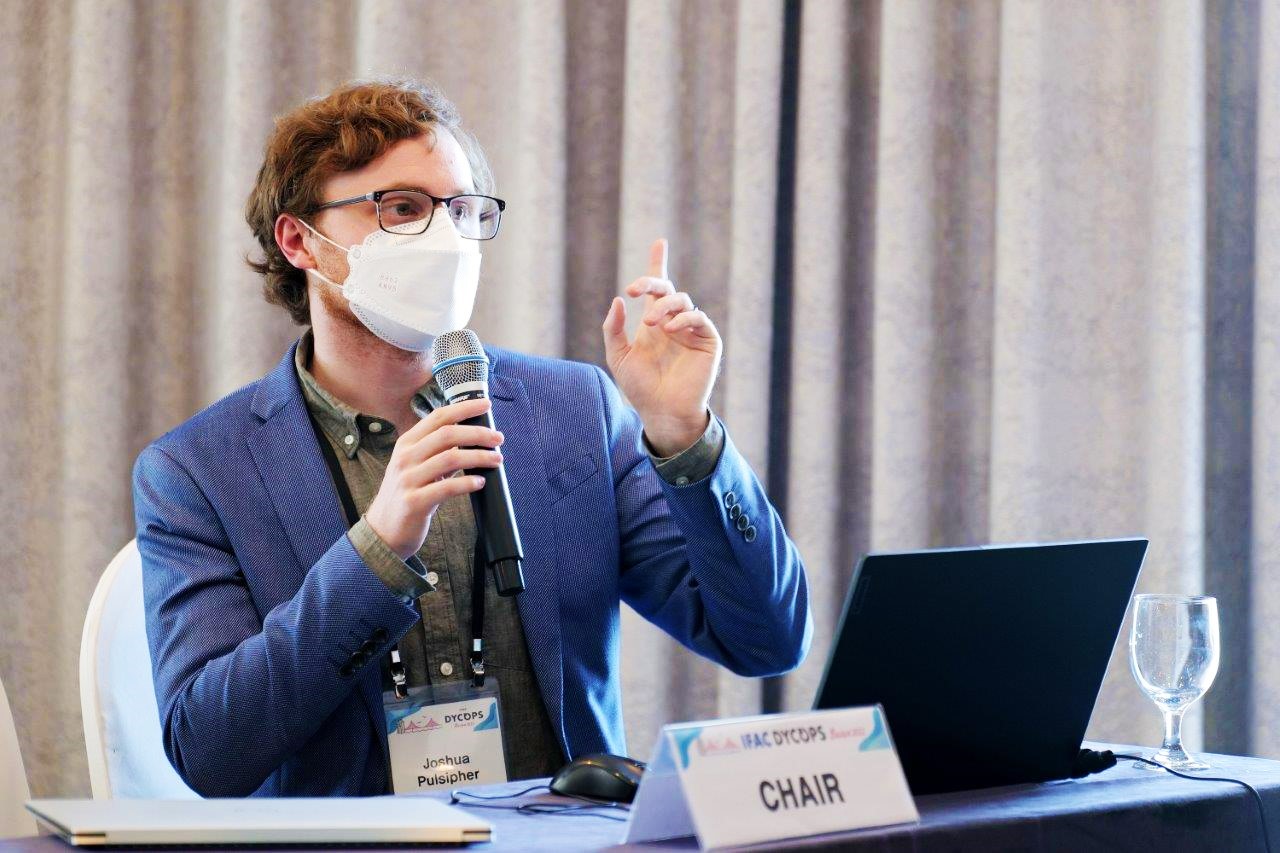
Joshua Pulsipher is an Assistant Professor of Chemical Engineering at the University of Waterloo, Canada. He joined in 2023 and leads a research group focused on interdisciplinary solutions at the intersection of chemical engineering, computer science, mathematics, and statistics. His work addresses challenges in sustainability, energy systems, and data-driven decision-making under uncertainty. He holds a B.Sc. from Brigham Young University and a Ph.D. from the University of Wisconsin-Madison, with postdoctoral training at Carnegie Mellon University. Education: B.Sc. in Chemical Engineering, Brigham Young University (2017) Ph.D. in Chemical & Biological Engineering, University of Wisconsin-Madison (2022) Postdoctoral Research, Carnegie Mellon University (2022–2023) Research Interests: Optimization under uncertainty, machine learning, sustainable systems, infinite-dimensional optimization, energy systems, wildfire mitigation, and software development for accessibility in research. His projects span wildfire management frameworks, resilient infrastructure, and software tools like InfiniteOpt.jl and FlexibilityAnalysis.jl. Awards: Best Presentation Award, JuMP-dev 2024 Travel Award, FOCAPO/CPC (2023) Plenary Speaker at AICHE Annual Meeting (2022) Teaching: Courses include CHE 322 (Numerical Methods), CHE 341 (Process Control), and CHE 521 (Process Optimization). His philosophy emphasizes active learning and inclusivity. Labs/Software: Develops open-source software frameworks such as InfiniteOpt.jl for infinite-dimensional optimization and SAFE-OCC for computer vision sensor reliability. Active in promoting reproducibility and software-driven research.
Alexander Terenin is an Assistant Research Professor at Cornell University , specializing in machine learning and artificial intelligence. His work focuses on decision-making under uncertainty, Bayesian optimization, and Gaussian processes, particularly in non-Euclidean spaces. He has contributed to geometric learning, scalable Gaussian process methods, and applications in robotics, plasma science, and legal AI. His research integrates theoretical foundations with practical algorithms, emphasizing principles like the Gittins Index for optimal decision-making. Notable projects include the GeometricKernels software package for manifold learning and the Cambridge Law Corpus for legal AI. His work bridges statistics, geometry, and computer science to address challenges in autonomous systems, energy optimization, and data-driven decision-making. Recent Talks and Contributions: An Adversarial Analysis of Thompson Sampling (INFORMS Applied Probability Society 2025) Cost-aware Bayesian Optimization (NeurIPS 2024) Stochastic Poisson Surface Reconstruction (ICML 2025) Key Research Themes: Bayesian Optimization for multi-objective problems (e.g., plasma-driven energy systems) Geometric Gaussian Processes for robotics and 3D modeling Statistical guarantees for Gaussian processes on manifolds Grants and Collaborations: His work involves interdisciplinary projects with institutions like Carnegie Mellon University, ETH Zürich, and the University of Cambridge, reflecting a global network in AI and statistical learning.
Cesare Tinelli is the F. Wendell Miller Professor of Computer Science at the University of Iowa within the College of Liberal Arts and Sciences. He is a co-director of the Computational Logic Center and leads the development of critical tools like the CVC4 and cvc5 SMT solvers, as well as the Kind model checker. His academic credentials include: Ph.D. in Computer Science (1999), University of Illinois at Urbana-Champaign M.S. in Computer Science (1995), University of Illinois at Urbana-Champaign Laurea in Scienze dell'Informazione (1990), University of Bari Research Interests : Tinelli specializes in Automated Reasoning , particularly Satisfiability Modulo Theories (SMT) , Model Checking , Software Verification , and Formal Methods . His recent work explores Inductive Reasoning in SMT , Proof-Certificate Generation , and Logical Frameworks for Proof Systems . His methodologies bridge theoretical advancements with practical implementations, impacting both academia and industry. Scientific Contributions : Tinelli's research drives innovation in SMT solving, model checking, and automated theorem proving. His 15 most recent publications span topics from stateful protocol testing ( Saecred ) to proof certification ( IsaRare ) and generalized optimization ( Generalized OMT ). Awards and Recognition : NSF CAREER Award (2003) Haifa Verification Conference Award (2010) CAV Award (2021) Advising and Collaborations : His former students and postdocs hold positions at leading institutions like NASA, Intel, MIT, and EPFL. He collaborates with organizations such as Amazon, Facebook, General Electric, and Microsoft.
Ben Greenman is a Researcher at Brown University , specializing in Gradual Typing , Formal Methods , and Programming Language Design . He has developed tools like Forge for teaching formal methods FlowFPX for floating-point exception debugging CnD for specification visualization His work bridges theoretical advancements and practical software engineering challenges. Research Trends: Recent publications focus on Temporal logic misconceptions (2024-2025) Gradual typing performance (2023-2025) Tool-driven formal methods education (2023) Language design for macro systems (2023) Numerical computation reliability (2023) Key Contributions: Unified deep/shallow type systems Blame assignment strategies Collapsible contracts Corpus studies for type analysis Visual debugging frameworks
Constantinos Daskalakis is the Avanessians Professor of Computer Science at MIT's Electrical Engineering and Computer Science department within the Schwarzman College of Computing. He is a member of CSAIL (Computer Science and Artificial Intelligence Laboratory) and affiliated with LIDS (Laboratory for Information and Decision Systems) and ORC (Operations Research Center). Additionally, he serves as an investigator in the NSF-funded Foundations of Data Science Institute and is a co-founder and chief scientist of the Archimedes AI research center. Dr. Daskalakis holds a diploma in electrical and computer engineering from the National Technical University of Athens and earned his PhD in computer science from UC Berkeley under advisor Christos H. Papadimitriou. His doctoral thesis focused on "On the Existence of Pure Nash Equilibria in Graphical Games with succinct description." His research spans the intersection of theoretical computer science with economics, game theory, machine learning, statistics, and probability theory. Daskalakis has made fundamental contributions to understanding the computational complexity of Nash equilibrium, the mathematical structure of multi-item auctions, and the behavior of machine learning algorithms like expectation-maximization. His work includes developing computationally efficient methods for statistical hypothesis testing and learning in high-dimensional settings, as well as characterizing the structure of high-dimensional distributions. His extensive publication record demonstrates a consistent focus on the theoretical foundations of computation and its applications to economic and learning systems. His recent work shows increasing integration of game theory with machine learning, particularly in areas like generative models, equilibrium computation, and mechanism design. The breadth of his publications across top venues in computer science, economics, and machine learning reflects the interdisciplinary nature of his research. 2007 Microsoft Graduate Research Fellowship 2008 ACM Doctoral Dissertation Award Game Theory and Computer Science (Kalai) Prize from the Game Theory Society 2010 Sloan Fellowship in Computer Science 2011 SIAM Outstanding Paper Prize 2011 Ruth and Joel Spira Award for Distinguished Teaching 2012 Microsoft Research Faculty Fellowship 2015 Research and Development Award by Giuseppe Sciacca Foundation 2017 Google Faculty Research Award 2018 Simons Investigator Award 2018 Rolf Nevanlinna Prize from the International Mathematical Union Best Paper awards at ACM Conference on Economics and Computation (2006, 2013) FOCS 2022 Test of Time Award Daskalakis has advised numerous PhD students and has been involved in organizing major academic programs including the Causality program at the Simons Institute (Spring 2022). His research group focuses on theoretical aspects of computation with applications to economic systems and machine learning. Current work explores connections between generative models, game theory, and statistical learning, with applications to mechanism design and econometrics.
Omar I. Al-Bataineh is a Research Scientist at Gran Sasso Science Institute (GSSI) in Italy, specializing in software engineering and formal methods. His work bridges theoretical foundations with practical applications in automated program repair and software verification. Education: Ph.D. in Computer Science, University of Western Australia Additional degrees from University of New South Wales and Jordan University of Science and Technology His research centers on three interconnected themes: (1) Multi-fault Automated Program Repair addressing complex bug interactions, (2) Formal Methods for Reliable Repair ensuring provable correctness, and (3) Termination-Aware Repair integrating performance considerations. He develops lightweight test oracles and context-sensitive repair techniques to overcome patch overfitting and scalability limitations in real-world systems. Recent publications reveal strong focus on multi-fault scenarios (60% of 2025 output), with growing emphasis on formal verification (30%) and performance-aware repair (10%). Key venues include ASE, ICSME, and SANER where he explores program slicing, oracle design, and fault interaction analysis. Awards: Best Paper Award at QRS 2022 for advancing automated program repair capabilities Prior to GSSI, he held research positions at Simula Research Laboratory, National University of Singapore, and Nanyang Technological University. His teaching experience includes Advanced Computer Security at UNSW and Java Programming at UWA, though current academic instruction isn't emphasized in recent activities. He maintains active contributions to workshops like APR@ICSE and FASE, focusing on practical tool development.