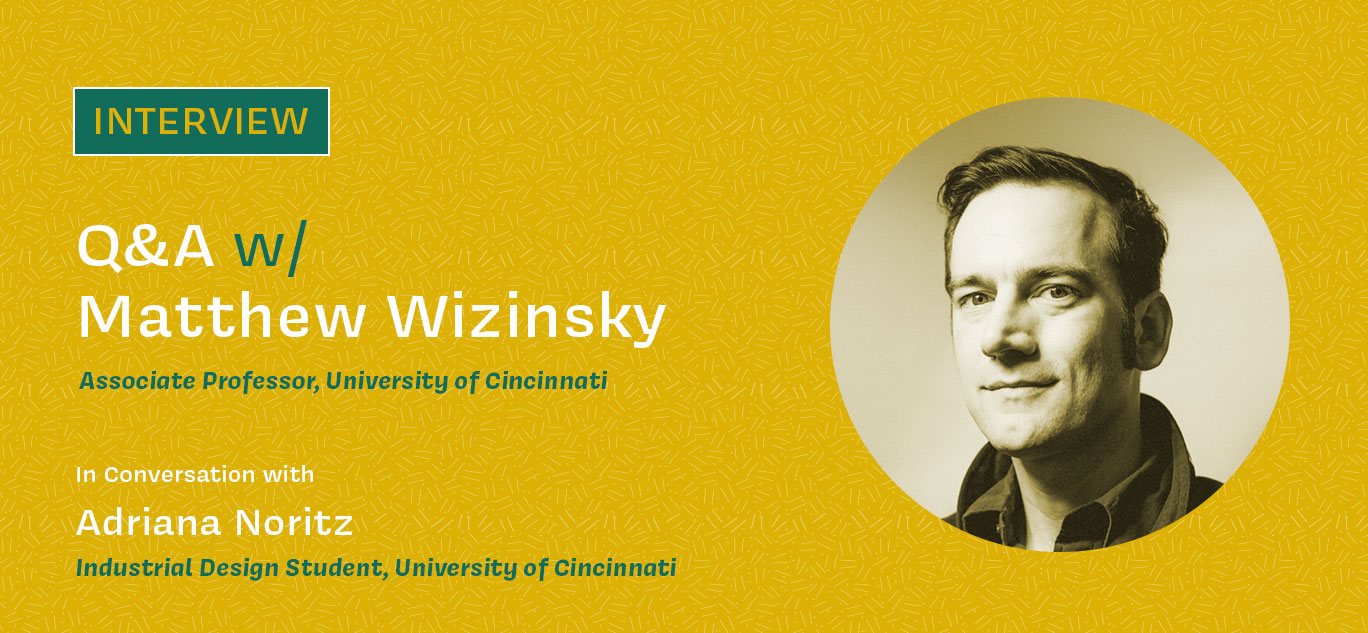
Matthew Wizinsky is an Associate Professor at the Ullman School of Design, University of Cincinnati, operating the independent design consultancy Studio Junglecat. His work bridges graphic design, interaction design, exhibition design, participatory design, and speculative design. His research focuses on applying participatory design methods to community-engaged projects exploring contemporary urban conceptions, socio-technical challenges, and future speculations for "the city." Notable projects include collaborative public history work with HIV survivors and the "Speculative City" studio examining urban transformation through weak signals of change. Wizinsky's teaching philosophy emphasizes cultural awareness through discovery-based learning, using topics like childhood poverty in Cincinnati to help students confront structural and individual cultural differences organically. His research examines design's evolving core competencies amid expanding specializations like service design and systemic work. As a practitioner-educator, he leverages design skills for interdisciplinary collaborations in architecture and humanities, creating books, exhibitions, and films. His career transitioned from a decade of professional design practice to academia after witnessing student transformation in his first teaching experience.
Amanda M. Durik is a Professor and Department Chair in the Department of Psychology at Northern Illinois University (NIU). Her research focuses on optimal motivation , task engagement , and how social, situational, cognitive, and developmental factors influence interest and achievement. She earned her B.S. in Psychology and Sociology from Centre College (1995) and her Ph.D. in Psychology from the University of Wisconsin-Madison (2003). Research Themes : Motivation, task values, utility interventions, stereotype threat, and cross-cultural motivational patterns. Grants : Multiple funded projects from the National Science Foundation, James S. McDonnell Foundation, and U.S. Department of Education. Teaching : Offers courses in social psychology, motivation, and group processes at both undergraduate and graduate levels. Her work bridges educational psychology and developmental science , emphasizing how mental representations of tasks and contexts mediate goal adoption and value perception. She has also examined longitudinal trends in children's interest development and gendered influences on academic choices. Scientific Awards : Excellence in Undergraduate Teaching Award Recent Publications highlight interdisciplinary approaches to understanding how self-generated utility value , cultural context , and social categories like gender and ethnicity shape educational outcomes and persistence in STEM and literacy fields.
Lihua Lei is an Assistant Professor of Economics at Stanford Graduate School of Business (GSB) and holds a courtesy appointment in the Department of Statistics at Stanford University. He earned his Ph.D. in Statistics from UC Berkeley (2019) under advisors Peter Bickel and Michael Jordan, followed by postdoctoral work at Stanford's Statistics Department with Emmanuel Candès. Current affiliations: Stanford GSB, Department of Statistics, and Institute for Economic Policy Research (SIEPR) Previous training: UC Berkeley (Ph.D.), Carnegie Mellon University (undergraduate) His research spans causal inference, conformal inference, and high-dimensional statistics, with a focus on methodology development and theoretical guarantees. Key contributions include adaptive false discovery rate control and conformal prediction frameworks. Recent publications appear in Annals of Statistics , Journal of the Royal Statistical Society , and SIAM Journal on Optimization . Collaborators include prominent researchers like Emmanuel Candès, Michael Jordan, and Peter Bickel. He has received teaching awards as Graduate Student Instructor and develops R packages for methodological implementations including adaptMT and mkn .
Rachel Alison Adcock is an Associate Professor of Psychiatry and Behavioral Sciences, Neurobiology, and Psychology and Neuroscience at Duke University. She is also a Faculty Network Member of the Duke Institute for Brain Sciences, an Affiliate of the Center for Brain Imaging and Analysis, and a Member of the Center for Cognitive Neuroscience since 2007. Ph.D. and M.D. in Neurobiology from Yale University (1999) Undergraduate degree in psychology from Emory University Psychiatry residency training at Langley Porter Psychiatric Institute at UC-San Francisco Postdoctoral research at UC-SF, San Francisco VA Medical Center, and Stanford Dr. Adcock's research program focuses on understanding how brain systems for motivation support learning and using mechanistic understanding of how behavior changes biology to develop new therapies for early interventions for mental illness. Her work integrates cognitive neuroscience, psychology, and neurobiology to investigate how motivational states influence memory formation, decision-making processes, and risk perception. She employs advanced neuroimaging techniques, particularly real-time fMRI neurofeedback, to explore dopaminergic networks and their role in cognitive processes. Her recent publications (2021-2025) demonstrate a strong concentration on motivational states, memory formation, risk perception (particularly related to the pandemic), event segmentation, and the neural mechanisms underlying learning and decision making. Several studies examine how instructed motivational states bias reinforcement learning and memory formation, while others investigate curiosity dynamics and information seeking. Her work also addresses practical applications, such as improving risk perception during the pandemic through interactive tools. Sloan Research Fellowship-Neuroscience from Alfred P. Sloan Foundation (2008) NARSAD awards 2012 National Academy of Sciences Seymour Benzer Lectureship 2015 ABAI BF Skinner Lectureship Dr. Adcock has secured substantial funding for her research, serving as principal investigator or co-investigator on numerous grants from NIDA, NIMH, NSF, and private foundations. Her current grants include the Neurobiology Training Program (2024-2029), Duke-NCCU Interdisciplinary Postdoctoral Training Program in Child Psychiatric and Neurodevelopmental Conditions (2024-2029), and Duke University Psychiatry Physician-Scientist Residency Training Program (2024-2029). These projects support doctoral and postdoctoral training in neuroscience, psychiatry, and related fields, reflecting her commitment to mentoring the next generation of researchers. Dr. Adcock leads the Motivated Memory Lab at Duke University, where she and her team investigate the neural mechanisms underlying motivation, memory, and decision making. Her lab has made significant contributions to understanding how dopaminergic systems support learning and memory formation, particularly through the use of real-time fMRI neurofeedback techniques. The lab's work bridges basic cognitive neuroscience with clinical applications, particularly in the areas of mental health interventions and risk perception.
Hiroaki Matsunami is a Professor of Molecular Genetics and Microbiology at Duke University, holding the Minnie Geller Distinguished Professorship in Genetics. He also serves as Professor of Neurobiology, Professor of Cell Biology, Member of the Duke Cancer Institute, Faculty Network Member of the Duke Institute for Brain Sciences, and Associate of the Duke Initiative for Science & Society. His research has significantly advanced our understanding of chemosensory mechanisms at the molecular level. Dr. Matsunami earned his Ph.D. from Kyoto University (Japan) in 1996 and has since established himself as a leading expert in chemosensation research. His academic journey spans multiple departments reflecting the interdisciplinary nature of his work bridging genetics, neuroscience, and molecular biology. Dr. Matsunami's laboratory investigates the molecular mechanisms underlying chemosensation (taste and smell) in mammals, focusing on G-protein coupled receptors (GPCRs). His team explores how tens of thousands of chemicals interact with over one thousand chemosensory receptors, how information is coded in sensory cells and the brain, and the mechanisms underlying development and regeneration of sensory cells. Their work has identified key receptor families for bitter and sweet compounds and elucidated the genetic basis for individual differences in taste and smell perception. Analysis of Dr. Matsunami's extensive publication record reveals a consistent focus on odorant receptor structure and function, with an increasingly sophisticated approach incorporating structural biology, computational modeling, and advanced genomic techniques. His recent work demonstrates significant progress in understanding the molecular basis of odor discrimination, receptor trafficking mechanisms, and the evolutionary adaptations of chemosensory systems across species. AAAS Fellow (2012) Minnie Geller Distinguished Professor in Genetics Dr. Matsunami leads multiple major research initiatives including 'Mechanisms of Odor Detection and Discrimination' (2025-2030) and 'STRUCTURAL DYNAMICS IN HUMAN ODORANT RECEPTOR FUNCTION' (2023-2028). His laboratory has developed innovative methods for studying odorant receptors, including heterologous expression systems and targeted transcriptomics approaches to map olfactory receptor expression in the brain. His work bridges basic science with potential clinical applications for sensory disorders. Dr. Matsunami directs a multidisciplinary research team at Duke that combines molecular biology, genome informatics, and genetic approaches to investigate taste and smell mechanisms. His laboratory has made significant contributions to understanding receptor trafficking through proteins like RTP1S, the structural basis of odor recognition, and the genetic variations that underlie individual differences in sensory perception across human populations.
Fashina Aladé is an Assistant Professor in the Department of Advertising & Public Relations at Michigan State University, with a courtesy appointment in Human Development and Family Studies. Her work bridges media effects, developmental psychology, and early childhood education to study children's learning from educational media. PhD in Media, Technology, & Society from Northwestern University MA in Communication from Ohio State University BA in Communication from University of Pennsylvania Her research focuses on: STEM learning through media Gender and racial representation in children's programming Parental mediation of technology AI applications for early education Social-emotional learning in TV programs Her recent publications examine topics like parental attitudes toward school-issued tablets, counter-stereotypical STEM media effects, and touchscreen interactivity in preschool education. Articles span journals including Media Psychology, Computers & Education, and Sustainability. Scientific recognition includes: Top paper awards from International Communication Association Top paper awards from Association for Education in Journalism and Mass Communication NSF grant for STEM media engagement research (2022) Grant to study inclusivity in PBS children's programming (2022) As a community-engaged scholar, Dr. Aladé collaborates with GBH Kids and Detroit Public Television to evaluate educational programming and outreach initiatives. She also develops professional resources for educators and media creators through workshops and tip sheets.
Amy E. Booth is a Professor at Vanderbilt University’s Peabody College, Department of Psychology & Human Development, with a research focus on early emerging variability in school readiness, particularly language and science domains. She previously held faculty positions at the University of Texas at Austin and Northwestern University, including roles as Professor, Associate Professor, and Assistant Professor. Ph.D. in Developmental Psychology, University of Pittsburgh M.A. in Developmental Psychology, University of Virginia Sc.B. in Psychology, Brown University Her research explores causal reasoning, vocabulary gaps, and scientific literacy in young children, supported by major NSF grants like Science Sprouts 2.0 and Assessing the Viability of AIDA . Her work examines how causal information, parental interactions, and socioeconomic status influence early learning. Recent publications highlight her contributions to understanding causal stance as a predictor of scientific literacy, with keywords spanning Developmental Psychology, Cognitive Development, and Educational Research. Her awards include the Clarence Simon Award for Outstanding Teaching and being named a Fellow of the Association for Psychological Science. Ph.D. Students: Jihye Bae, Margaret Shavlik, Aubry Alvarez, Gwendolyn Fiske Grants: Multiple NSF and Spencer Foundation awards totaling over $2 million Service: Director of Psychology & Human Development Child Studies Group, NSF panelist, and editorial roles in Child Development and Developmental Science
Amalia Di Girolamo is an Assistant Professor in Experimental Economics at the Department of Economics, Birmingham Business School, University of Birmingham. She joined the department in September 2013 after completing a two-year Marie Curie Post-Doctoral Fellowship at Durham University. Her academic journey includes a PhD from the University of Rome 'Tor Vergata' where she spent three academic years at the Economics Department of the University of Chicago as a Fulbright Doctoral Visiting Student Researcher. Dr. Di Girolamo holds a PhD in Economics from the University of Rome 'Tor Vergata' (2010), an MSc in Economics from Pompeu Fabra University (2005), and a BSc in Economics from the University of Roma Tre (2004). Her educational background reflects a strong foundation in economic theory and methodology that supports her experimental approach to research. As an experimental and behavioural economist, Dr. Di Girolamo's research primarily focuses on decision-making under risk. Her work investigates how financial literacy influences individual choices through field and lab experiments, and examines gender differences in risk and competitive behaviors. Her research spans the Economics of Uncertainty and Information, Behavioural and Experimental Economics, Applied Microeconomics, and Public economics, contributing significantly to understanding how individuals process information and make economic decisions in uncertain environments. Her publication record demonstrates a consistent focus on experimental economic methods applied to diverse contexts including education, family dynamics during crises, child development, and entrepreneurship. The trajectory of her work shows increasing interdisciplinary collaboration, particularly with psychologists and sociologists, while maintaining strong methodological rigor in experimental design. Fulbright Doctoral Visiting Student Researcher at University of Chicago Marie Curie Post-Doctoral Fellowship at Durham University Dr. Di Girolamo serves as Programme Director for the BSc in Economics at the University of Birmingham. Her research collaborations span international institutions, reflecting the global relevance of her work on decision-making under uncertainty. While specific laboratory facilities aren't mentioned in the provided text, her experimental research methodology suggests active involvement in laboratory-based economic experiments, likely through the university's experimental economics facilities.
Prof. Dr. Ewa Dąbrowska holds the Alexander von Humboldt Professorship in the Chair of Language and Cognition at Friedrich-Alexander University Erlangen-Nürnberg. Her research spans cognitive linguistics, language acquisition, and individual differences in linguistic knowledge. Research Interests : Formulaic language in L1 acquisition and adult language processing The nature of linguistic generalizations through chunk-based grammar Individual differences in grammatical and lexical knowledge among native and L2 speakers Intersections of literacy, language structure, and cognitive fluency Scientific Awards & Funding : Alexander von Humboldt Foundation grant for a 5-year project on individual differences AHRC-funded corpus-experimental study on complex syntactic constructions Team Members : Dr. Miguel Llompart Garcia, Elodie Winckel, Ashley Blake, Magdalena Grose-Hodge, Panagiotis Kenanidis, Leonarda Prela, Richenda Wright.
Assoc. Prof. Ayşe Nur Kutluca Canbulat is a faculty member at Akdeniz University, Faculty of Education, Department of Classroom Teaching since 2019. She previously held the position of Assistant Professor at the same institution from 2013-2018 and served as a Research Assistant at Bolu Abant İzzet Baysal University (2002-2013). Her work focuses on elementary education, writing instruction, language learning, and teacher training . Doctorate: Curriculum and Instruction, Bolu Abant İzzet Baysal University (2010) Masters: Classroom Teaching, Bolu Abant İzzet Baysal University (2004) Bachelors: Classroom Teaching, Bolu Abant İzzet Baysal University (2002) Her research examines student writing anxiety, digital writing, bilingual education, and teacher self-efficacy . Recent publications analyze immigrant students' language attitudes, music's impact on writing fluency, and self-regulated writing processes. She has supervised 12 postgraduate theses on topics like virtual reality in writing education and multilingual students' language skills. Scientific Contributions: Recipient of TÜBİTAK Bilim Teşvik Ödülü (2012) 43 WoS publications, 5 H-Index (WoS), 6 H-Index (Scopus)
Amy Bacon is an Associate Professor in the Neuroscience department at Bradley University, where she has been employed since 2011. She teaches courses such as Principles of Psychology, Abnormal Psychology, and Psychology of Learning. Ph.D. in Clinical Psychology from the University of Arkansas Pre-Doctoral Clinical Internship at the Medical University of South Carolina B.A. from the University of Texas at Austin Dr. Bacon’s research focuses on the interplay between anxiety, stress, and substance use, particularly investigating alcohol use as a mechanism for managing social stress and the heightened vulnerability of individuals with social anxiety to develop alcohol dependence. Her work employs diverse methodologies, including surveys, cognitive tasks, and in-vivo experiments with alcohol and stress induction. Recent publications highlight trends in alcohol consumption patterns, stress-induced drinking, and the role of social anxiety in hazardous drinking behaviors. Her studies often integrate clinical psychology frameworks with behavioral medicine approaches.
Robert G Morrison is an Associate Professor of Psychology and Neuroscience at Loyola University Chicago, where he also serves as the Undergraduate Program Director. His research focuses on cognitive neuroscience, particularly analogical reasoning, executive functions, emotional processing, and media effects. He directs the Cognitive and Affective Neuroscience (CAN) Lab and has been a faculty member at Loyola since 2009, advancing from Assistant to Associate Professor. Dr. Morrison earned his PhD in Cognitive Neuroscience from UCLA, followed by a postdoctoral fellowship at Northwestern University's Cognitive Neuroscience Laboratory. His research employs diverse methodologies including EEG/ERP brain imaging, brain stimulation (tACS/tDCS), neuropsychology, and computational modeling. He investigates how humans think, with specific interests in analogical reasoning, executive functions, emotion-cognition interactions, and creativity. His research program spans developmental and aging populations, examining cognitive processes in children, young adults, and older adults. Current projects explore how structural information is recognized and used, how emotions impact cognitive control, and how world knowledge interacts with rational thinking. He has published extensively in top journals and co-edited the Oxford Handbook of Thinking and Reasoning. Dr. Morrison has received numerous awards including the Edwin T. and Vivijeanne F. Sujack Award for Teaching Excellence and the Langerbeck Award for Undergraduate Research Mentoring. His recent work shows increasing focus on neural mechanisms of analogical reasoning, emotional processing, and the impact of media exposure on cognitive control. As an educator, he teaches courses including Behavioral and Cognitive Neuroscience, Lab in Experimental Psychology, and Psychology of Creativity. He has mentored numerous undergraduate and graduate students, with many co-authoring publications. His lab (CAN Lab) conducts research on cognitive and affective neuroscience, particularly focused on analogical reasoning and executive functions.
Dr. Eugene McSorley is a Professor in the Department of Psychology within the School of Psychology and Clinical Language Sciences at the University of Reading. His research program integrates cognitive psychology, neuroscience, and visual perception through advanced eye-tracking methodologies. With over 40 publications spanning two decades, he maintains active collaborations across psychology, geoscience, and clinical disciplines. His research focuses on the cognitive mechanisms underlying visual attention and oculomotor control. Key areas include: Saccadic eye movement programming and inhibition Interactions between visual attention and decision-making Effects of uncertainty and emotional content on gaze behavior Applications in art perception and risk communication His work demonstrates how motivational relevance and contextual factors guide visual exploration across diverse domains. Recent publications reveal evolving research trajectories toward uncertainty processing in geoscience communication and clinical applications of eye-tracking. His 2023-2025 work examines how expertise modulates visual attention during uncertainty interpretation, while clinical studies investigate intolerance of uncertainty's impact on threat-related gaze patterns. This demonstrates consistent methodological innovation applied to both fundamental cognitive questions and real-world contexts. Professor McSorley maintains extensive interdisciplinary collaborations, particularly with researchers at Reading's Department of Meteorology (e.g., Charlton-Perez, Williams) and clinical psychology groups. His work bridges basic oculomotor research with applications in art cognition, anxiety disorders, and scientific communication.
Steven J. Karau serves as the Gregory A. Lee Professor of Management in the Department of Management within the College of Business at Southern Illinois University Carbondale. He earned his Ph.D. in Social Psychology from Purdue University in 1993 and has established himself as a leading scholar in organizational behavior and social psychology with over 60 publications and more than 18,000 citations. Dr. Karau's research focuses on group dynamics, motivation losses and gains in groups (particularly social loafing), gender differences in leadership, personality and individual differences in organizational contexts, and ethical issues in management. His work spans both theoretical contributions and empirical investigations, with special emphasis on how individuals function within group settings. He has made significant theoretical contributions as co-developer of the Collective Effort Model of individual motivation on group tasks (with Kip Williams) and Role Congruity Theory of prejudice toward female leaders (with Alice Eagly). Analysis of Dr. Karau's recent publications reveals a continued focus on group processes and organizational behavior, with increasing attention to knowledge sharing dynamics, leadership effects across organizational levels, and the impact of psychological factors on workplace behavior. His research integrates social psychological theory with organizational applications, demonstrating the practical relevance of psychological principles in business contexts. His work on social loafing has received significant media coverage including from the Wall Street Journal and ABC News 20/20. Dr. Karau teaches courses in organizational behavior, managerial ethics, research methodology, human resources, strategic management, and entrepreneurship. His research has been cited over 18,000 times according to ResearchGate metrics, demonstrating significant impact in his fields of study. Before joining Southern Illinois University Carbondale, he taught at the University of Toledo, Clemson University, and Virginia Commonwealth University.
Liss Kerstin Sylvén is a Senior Researcher at the Department of Education and Special Education, University of Gothenburg. Her work focuses on Content and Language Integrated Learning (CLIL) and extramural English exposure in Swedish educational contexts. Academic affiliations: University of Gothenburg Supervision: Main supervisor for Clara Palm and Marta Segura Hudson; assistant supervisor for Jessica Nilsson Dr. Sylvén investigates second language acquisition dynamics, particularly how English is used as a medium in non-language subjects and its informal presence in children's lives through media and technology. Her research spans motivation, individual differences, and vocabulary development in multilingual environments. CLIL pedagogy Extramural English exposure Young learner linguistics Technology-mediated language learning Curriculum integration Vocabulary assessment Recent publications analyze CLIL's cross-curricular applications, digital learning trends, and early English exposure patterns. Her 2024 project Young Swedes and English (Swedish Research Council-funded) examines English literacy in 3-7-year-olds via digital and social contexts.