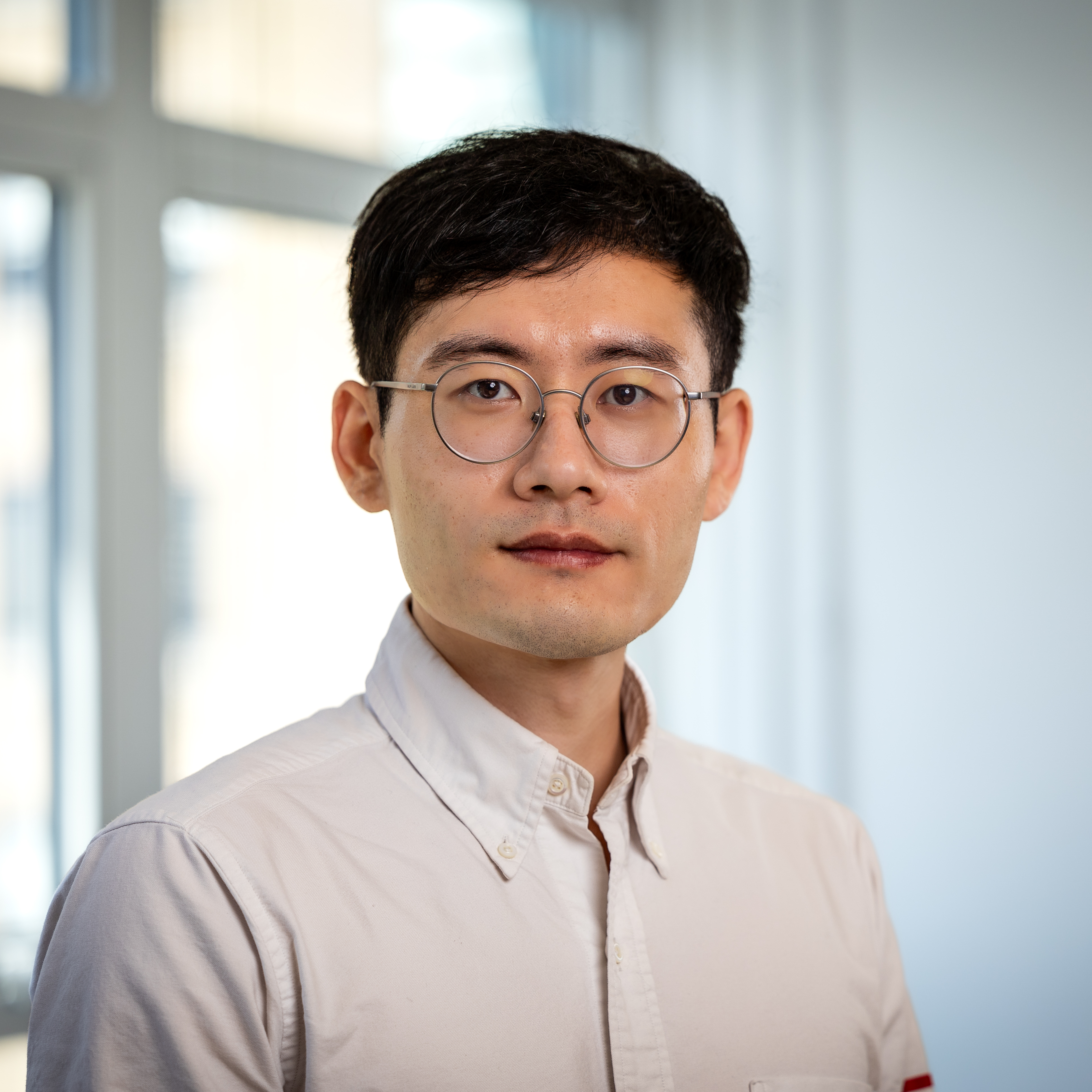
Dr. Yu Liang is a Lecturer at the Department of Information Technology and Electrical Engineering at ETH Zürich. His research focuses on advancing computer vision and machine learning techniques, particularly in video generation, image restoration, and event-based systems. He specializes in developing innovative frameworks for tasks like motion-aware video synthesis, low-light image enhancement, and diffusion models applied to multimedia processing. Key research interests include hierarchical information flow architectures, transformer-based networks, and scalable solutions for real-world imaging challenges. His work emphasizes practical applications of generative models and cross-modal fusion techniques to achieve high-quality visual outputs. Dr. Liang has contributed extensively to the field through publications on topics such as Fractal-IR for image restoration, Uni3C for 3D-enhanced video generation, and event-based frame interpolation. His research often bridges theoretical advancements with practical implementations, addressing issues like temporal coherence, motion deblurring, and adaptive illumination estimation. Although no specific academic awards are listed, his prolific publication record (over 20+ papers since 2019) highlights his active role in the academic community. His work has led to impactful datasets like Lsdir and frameworks like SwinIR, demonstrating strong contributions to both methodology and infrastructure in computer vision.
Sio Kei Im is an active researcher with a focus on computer science, machine learning, and human-computer interaction. His recent work spans multiple domains including image processing, quantum computing, and virtual reality. Publications address advanced data augmentation (LogicMix), multi-modal quantum watermarking (MMQW), and efficient neural decoding algorithms (TRHyper). Research interests include time series optimization, dialogue summarization, and haptics in VR environments. Collaborations with experts in linguistics, electrical engineering, and software development indicate interdisciplinary expertise. Key contributions involve adaptive algorithms for AI model protection, speaker recognition systems, and real-time 3D rendering techniques.
Yucheng Xie is a Tenure-track Assistant Professor in the Graduate Department of Computer Science and Engineering at Yeshiva University, affiliated with the Katz School of Science and Health. He holds a Ph.D. in Electrical and Computer Engineering from Purdue University and a Master’s in Computer Science from Stevens Institute of Technology. His research focuses on Security in Machine Learning/AI Systems , Smart and Mobile Healthcare , and Mobile Computing and Sensing . Notable contributions include non-invasive wireless sensing via mmWave and Wi-Fi signals for health monitoring, adversarial attacks on activity recognition systems, and secure mobile deep learning. His recent articles explore topics like contactless human concentration monitoring, palm-based authentication, and environment-invariant eating behavior tracking. These works highlight innovations in mmWave technology, cybersecurity for AI systems, and healthcare applications. Awards : Best Paper Runner-up (IEEE Conference on Communications and Network Security, 2024) Best Paper Runner-up (IEEE International Conference on Computer Communications and Networks, 2022) Best Paper Award (EAI International Conference on IoT Technologies for HealthCare, 2019) While no advising or grant details are provided, his work emphasizes practical applications of wireless sensing and secure AI systems. No specific lab affiliations are mentioned, though his research often involves interdisciplinary collaboration.
Adjunct Professor Shuai Wan is affiliated with the School of Engineering at RMIT University (City Campus, Australia). His research focuses on computer vision, machine learning, 3D point cloud compression, neural video coding, and remote sensing . Key contributions include lightweight deep learning frameworks for image/video compression, spatio-temporal context models for point clouds, and adaptive quantization techniques. Research Outputs Insights : Wan’s work spans 2024–2025 , emphasizing end-to-end deep learning solutions for challenges in Exemplar-based colorization with semantic attention Rendering-oriented 3D point cloud compression Slimmable video codecs with variable bitrate G-PCC standard enhancements for quantization and entropy coding Adversarial example detection in remote sensing Technical Domains : His articles intersect artificial intelligence, signal processing, and computer graphics , with applications in cloud gaming, SAR systems, and industrial data compression. Methods include transformers, attention networks, and 3D convolutional architectures .
Dr. Quoc Cuong Ngo is a Research Fellow in the School of Engineering at RMIT University, specializing in biomedical engineering and machine learning applications in healthcare. His research focuses on neurological disorders, particularly Parkinson’s disease, using advanced techniques such as facial expression analysis, speech assessment, and EEG signal processing. He also investigates medical imaging for conditions like leg ulcers and sleep apnea, contributing to automated diagnostic tools and healthcare technology innovations. Active in supervision, he mentors students on projects involving AI-based clinical symptom analysis and biometric authentication. His work bridges computer science and medicine, emphasizing interdisciplinary collaboration. Notable projects include developing NeuroDiag software for handwriting-based Parkinson’s diagnosis and pioneering chatbot-driven vocal screening systems. Despite no explicitly listed awards, his extensive publication record highlights contributions to medical diagnostics and biomedical engineering.
Rafael Barea Navarro is a Professor in the Department of Electronics Technology at the University of Alcalá. His research focuses on biomedical engineering, autonomous systems, robotics, artificial intelligence, and driver safety. He leads the Biomedical Engineering Research Group (GIB) and the Robótica de Servicios y Tecnologías para la Seguridad Vial (Robesafe) group. His work bridges AI applications in medical diagnostics (e.g., multiple sclerosis via OCT) and advanced autonomous vehicle technologies, including motion prediction, reinforcement learning, and real-time safety systems. Education: PhD in Electronics from the University of Alcalá (2001), with a thesis on EOG-based human-computer interfaces for mobility assistance. His research spans over 50 peer-reviewed articles since 2000, emphasizing practical applications in healthcare and robotics. Key research themes include: 1) AI-driven medical diagnostics; 2) autonomous vehicle control systems; 3) sensor fusion for navigation; and 4) driver attention monitoring. His work integrates robotics, computer vision, and biomedical signal processing. Publications emphasize interdisciplinary approaches, with recent work combining OCT and explainable AI for early disease diagnosis, and hybrid reinforcement learning frameworks for urban autonomous driving.
Hulya Yalcin is an Assistant Professor in the Department of Mechanical Engineering at Istanbul Technical University. Her research focuses on artificial intelligence applications in robotics, computer vision, and precision agriculture. She leads projects in musculoskeletal modeling, plant phenology monitoring, and assistive technologies for elderly care. Her work contributes to UN Sustainable Development Goals related to innovation, health, and sustainable agriculture. Key projects include using deep learning for crop yield estimation and developing exergaming systems to improve elderly health. She has authored 52 research outputs and secured funding for initiatives like AISENSE (EU-funded exergames) and plant classification via computer vision. Publications span robotics control, medical engineering, and agricultural informatics. Notable contributions include knee orthosis gait learning via deep reinforcement learning and low-resource Turkish speech recognition improvements. As Principal Investigator, she manages projects on plant classification using CNNs, drone-based depth mapping, and multimodal assisted living systems. Her research bridges AI with practical applications in healthcare, agriculture, and robotics.
Hans-Peter Seidel is a leading academic in computer graphics, serving as Director of the Max Planck Institute for Informatics and Full Professor at Saarland University since 1999. Previously held roles include Full Professor at University of Erlangen (1992–1999) and Assistant Professor at University of Waterloo (1989–1992). Holds a PhD in Mathematics (1987) and Habilitation in Informatics (1989) from University of Tübingen. Research focuses on 3D image analysis, digital geometry processing, visual computing, and free viewpoint rendering. Key achievements include pioneering work in surface editing, motion capture, and multi-view video processing. Has organized major conferences like Eurographics and SIGGRAPH, serving as editor for journals including IEEE TVCG and Computer Aided Geometric Design. Recipient of the Eurographics Distinguished Career Award (2012), Gottfried Wilhelm Leibniz Prize (2003), and numerous fellowships. Led initiatives such as the Cluster of Excellence on Multimodal Computing and Interaction (M2CI) and the Max Planck Center for Visual Computing and Communication (MPC-VCC). Active in academic leadership roles including Eurographics Chair and DFG committees. Publications span over 30 SIGGRAPH and 50 Eurographics contributions, with an h-index of 62 and 14,000+ citations. Recognized as a top-cited researcher in computer graphics. Current research explores advanced visualization techniques and geometric modeling innovations.
Aly A. Farag is a Professor of Electrical and Computer Engineering at the University of Louisville, where he founded the Computer Vision and Image Processing (CVIP) Laboratory. His research focuses on imaging science, computer vision, and biomedical imaging, with applications in cancer detection and medical visualization. He has authored over 350 technical papers and two upcoming textbooks. Dr. Farag holds patents in imaging technologies and has led projects funded by NSF, DoD, NIH, and industry. Educations: B.S. in Electrical Engineering, Cairo University, 1976 M.S. in Bioengineering, University of Michigan, 1984 M.S. in Biomedical Engineering, Ohio State University, 1981 Ph.D. in Electrical Engineering, Purdue University, 1990 Research Interests: Scene analysis, multimodal imaging reconstruction, statistical segmentation, and biomedical visualization. His work has advanced tubular topology visualization, colon segmentation, and lung nodule analysis. Collaborations span medical institutions and federal agencies. Awards: 2002 University Scholar designation for technical achievements. Served as associate editor for IEEE Transactions on Image Processing and general co-chair of IEEE ICIP-09. Grants & Advising: Principal investigator on NSF/NIH-funded projects. Advised 15 PhD and 26 MS students, trained 10 postdocs, and introduced new ECE curriculum topics. Labs/Teams: CVIP Lab pioneers innovations in medical imaging and AI-driven diagnostics. Active in interdisciplinary teams for STEM education engagement metrics.
Dr Shahnewaz Ali is a Postdoctoral Fellow in the Faculty of Engineering's School of Electrical Engineering & Robotics at Queensland University of Technology (QUT). He is affiliated with the Centre for Robotics and holds a PhD from QUT and an MSc in Computer Engineering from Politecnico di Milano. His research focuses on the intersection of robotics, artificial intelligence, and biomedical applications, emphasizing wearable technology, surgical robotics, and sensor systems. Key research interests include AI-driven medical imaging, robotic surgery systems, and biomarker detection using wearable devices. His work spans sensor technologies for robotics, real-time surgical scene analysis, and predictive performance monitoring. Recent projects include developing a wearable monitoring system for stress biomarkers and advancing arthroscopic surgical techniques through 3D mapping and deep learning. Education: PhD, Queensland University of Technology MSc (Computer Engineering), Politecnico di Milano Dr Ali's publications cover topics like surgical scene restoration, microRNA-based performance prediction, and sensor development for medical robotics. His research bridges engineering and healthcare, aiming to enhance diagnostic accuracy and robotic surgical precision. Collaborations include multidisciplinary teams at QUT and international institutions.
Prof. Lena Maier-Hein is a full professor at Heidelberg University and managing director of the National Center for Tumor Diseases (NCT) Heidelberg. She leads the division of Intelligent Medical Systems (IMSY) at the German Cancer Research Center (DKFZ) and oversees the cross-topic program 'Data Science and Digital Oncology'. Her research focuses on machine learning in biomedical imaging, particularly surgical data science and computational biophotonics. She chairs the Surgical Data Science initiative and serves on editorial boards for journals like Nature Scientific Data and IEEE TPAMI. Her awards include the 2024 German Cancer Award, 2013 Heinz Maier-Leibnitz Prize, and European Research Council grants. She advocates for trustworthy AI in healthcare, co-developing frameworks like Metrics Reloaded and TRIPOD+ AI. Her work bridges academic, clinical, and industrial sectors through initiatives like the FeTS challenge. Key contributions include advancing photoacoustic imaging, surgical AI systems, and validation methodologies. She emphasizes ethical AI deployment and interdisciplinary collaboration to address clinical challenges.
Thomas Bourgeron is a Professor and head of the Human Genetics and Cognitive Functions Unit at the Institut Pasteur in Paris, France. His research integrates psychiatry, neuroscience, and genetics to investigate the causes of autism spectrum disorders (ASD) and improve clinical management. He leads a multidisciplinary team and numerous international research initiatives. Institut Pasteur, Paris Human Genetics and Cognitive Functions Unit Principal Investigator, EU-AIMS, PARIS Study, Phelan-McDermid Syndrome Project His research focuses on identifying genetic mutations linked to ASD, particularly in synaptic genes (NLGN, SHANK, CNTN) and the melatonin pathway affecting sleep. His team employs high-throughput genomics, brain imaging (MRI, EEG), mouse models, and human iPSCs to study functional impacts and develop therapeutic strategies. He emphasizes data sharing and open science through tools like GeneTrek and GRAVITY. His recent publications reveal genetic heterogeneity in autism, brain connectivity patterns, and phenotypic stratification using electrophysiology and behavioral analysis. His work bridges molecular mechanisms with clinical manifestations, aiming to identify common pathways for targeted interventions. Phenotypic effects of genetic variants in autism Genetic correlates of phenotypic heterogeneity Stratification of autistic phenotypes using EEG Functional impact of SHANK3 mutations Proteomic analysis of the pineal gland in autism Thomas Bourgeron mentors numerous PhD students, postdoctoral researchers, and engineers. He collaborates with leading institutions and clinicians, including Professor Christopher Gillberg at the University of Gothenburg. His lab is actively recruiting in human genetics and neuroimaging. He contributes to public education through lectures, open-access tools, and outreach initiatives like the CléPsy platform and educational videos for families of autistic children.
Dan Casas is a Senior Applied Scientist at Amazon in Seattle and an Associate Professor (Profesor Titular) on leave from King Juan Carlos University in Spain. His research spans the intersection of Computer Graphics, Computer Vision, and Machine Learning with a focus on 3D reconstruction, modeling, and animation of virtual humans and clothing. He has authored over 40 high-impact publications in top venues including SIGGRAPH, CVPR, and NeurIPS, and holds 3 international patents. Dr. Casas received his M.Sc. degree (2009) from Universitat Autònoma de Barcelona (Spain), including a research visit at Carnegie Mellon University. He earned his Ph.D. in Computer Graphics (2014) from the University of Surrey (UK), supervised by Prof. Adrian Hilton. He completed postdoctoral research at the University of Southern California's Institute for Creative Technology (2014-2015) and the Max Planck Institute in Saarbrücken (2015-2016). His research interests center on creating realistic virtual humans and digital clothing through advanced techniques in computer vision and machine learning. Casas has pioneered methods for 3D reconstruction of humans and garments from video input, physics-based simulation of soft-tissue deformations, and data-driven approaches to character animation. His work bridges the gap between theoretical computer graphics and practical applications in virtual reality, digital fashion, and immersive communication. Analysis of his recent publications reveals a consistent focus on human digitization, with increasing emphasis on machine learning approaches. His work has evolved from traditional computer graphics techniques toward neural representations and diffusion models, particularly in the areas of 3D garment simulation and human avatar creation. The trend shows growing integration of physics-based modeling with data-driven approaches to achieve both realism and computational efficiency. Marie Skłodowska-Curie Individual Fellowship (2015) FBBVA Leonardo Fellowship (2021) Medal from the Royal Academy of Engineering of Spain for Young Researcher Award (2023) i3 certification (outstanding researcher) from Spanish Ministry of Universities (2022) Winner of 2021 IEEE Retail Digital Transformation Grand Challenge Multiple Outstanding Reviewer Awards at top conferences (CVPR, BMVC, 3DV) Dan Casas has successfully advised multiple PhD students including Suzanne Sorli, Cristian Romero, Raquel Vidaurre, and Igor Santesteban (now at Meta Reality Labs), with several ongoing students including Melania Prieto-Martin, Gonzalo Gómez-Nogales, and Andrés Casado-Elvira. He has secured significant research funding as Principal Investigator, totaling over €1.2 million from Spanish Ministry of Science projects, EU H2020 programs, and industry fellowships including the FBBVA Leonardo Fellowship. His leadership extends to conference organization as Area Chair for ICCV 2023 and General Chair for ACM i3D 2020. Dr. Casas leads research in digital human modeling with applications in virtual reality, fashion technology, and immersive communication. His team develops advanced techniques for creating personalized 3D avatars from minimal input (like smartphone videos), addressing challenges in geometry, appearance, and physical simulation of virtual humans and their clothing.
Shrisha Bharadwaj is a Doctoral Researcher at the Max Planck Institute for Intelligent Systems working within the Perceiving Systems group under supervision of Prof. Dr. Michael Black and Dr. Victoria Fernandez-Abrevaya. She began her Ph.D. in September 2024 after completing an internship with the same group starting September 2022. Her research spans several key areas in visual computing: Modeling realistic textures from sparse inputs 3D reconstruction of static environments Generative approaches to relighting Neural rendering without explicit geometry modeling Video diffusion applications for physical property manipulation Shrisha completed her Master's in Machine Learning at the University of Tübingen, where she worked with Prof. Andreas Geiger at the Autonomous Vision Group on improving radiance field reconstruction using depth information. Her recent publications demonstrate significant contributions to SIGGRAPH Asia and ACM Transactions on Graphics, particularly in creating efficient, relightable 3D avatars and novel approaches to single-image relighting. Her work shows a consistent trajectory toward solving complex vision and graphics problems using minimal input data, with practical applications in digital content creation, virtual reality, and augmented reality systems.
Jaime S. Cardoso is a prominent researcher at the University of Porto and Institute for Systems and Computer Engineering, Technology and Science (INESC TEC) in Portugal. His extensive publication record spanning two decades demonstrates his leadership in computer vision, medical image analysis, and pattern recognition. His research primarily focuses on applying artificial intelligence to healthcare challenges, particularly in medical imaging and diagnostics. Cardoso's research interests center on explainable AI for medical applications, biometrics, and computer vision. His work bridges the gap between theoretical machine learning and practical medical solutions, with significant contributions to breast cancer diagnosis, medical image segmentation, and biometric security systems. He has developed innovative approaches to medical image analysis, including virtual staining techniques and privacy-preserving explanation methods for medical AI systems. His recent publications (2023-2025) reveal a strong emphasis on explainable AI in medical contexts, with multiple papers addressing how to make deep learning models more transparent and trustworthy for healthcare applications. He has also made significant contributions to face recognition technology, video anomaly detection, and specialized medical imaging techniques for breast cancer and neonatal EEG analysis. Among his scientific contributions are numerous collaborations with researchers across Portugal and internationally. His work has appeared in top-tier journals including IEEE Access, Medical Image Analysis, and Neurocomputing, reflecting the high impact of his research. Cardoso has supervised numerous students who have become established researchers in their own right, including Ricardo P. M. Cruz, Kelwin Fernandes, and Ana Filipa Sequeira. His research group appears to focus on the intersection of deep learning, medical imaging, and biometrics, with strong connections to clinical applications.