Dr. Andrew McCarren is an Associate Professor and Head of the School of Computing at Dublin City University (DCU). He holds a PhD and BSc from DCU and is a funded investigator in the Insight Centre for Data Analytics. His research focuses on applying data analytics to Fintech, Agriculture, Health, and Sports Performance. As a former industry professional with 20+ years experience in Agri, Engineering, and Pharmaceuticals, he bridges academic and industrial collaboration. Professional Affiliations: Fellow of Royal Statistical Society and Advance HE Key Roles: PI on SFI/EI projects, Visiting Professor at Princess Nourah bint Abdulrahman University Research spans software engineering (microservices architecture), health informatics (exercise interventions), and agri-tech (automated food processing). Over 100 publications across data science, sports analytics, and engineering.
Cleo Valentine is a Vice Chancellor's Doctoral Scholar at the University of Cambridge and Senior Design Researcher in Neuroarchitecture at HKS. Affiliated with the Department of Architecture and Computational Neuroscience Group, her work establishes the field of architectural neuroimmunology , investigating how architectural forms mediate neuroinflammatory responses. She lectures at Politecnico di Milano and Harvard University, and contributes to editorial boards of Intelligent Buildings International and Buildings . Education: MPhil in Architecture and Urban Studies (Cambridge), MSc in Sustainable Urban Development (Oxford), BA in Urban Systems and Economics (McGill/Copenhagen) Research Affiliations: UCL Spatial Cognition Lab, MIT Department of Urban Studies and Planning, Cambridge Design Engineering Centre Her research combines neuroimmunology , computational neuroscience , and biophilic design to demonstrate how architectural features like curvature, proportions, and enclosure affect allostatic load and neuroinflammation . Key findings show that biomorphic design reduces neuroinflammatory activity, with implications for urban health policy and architectural ethics. Recent publications analyze visual stress in architectural façades , epigenetic consequences of urban design , and neuroethical frameworks for architectural practice. She advocates for human-centric design tools to balance creative expression with neurophysiological health impacts. Scientific Awards: Vice Chancellor's Doctoral Scholarship (Cambridge), Cambridge Trust funding, Wolfson College support, Harvard Visiting Fellowship Partnerships: Heatherwick Studio’s Humanise Campaign, UCL/RISE Centre for NeuroArchitecture, Beautiful Places AI Her work intersects with the Mind Body Space International Symposium , ANFA Conference , and International Making Cities Livable Conference , emphasizing cross-disciplinary collaboration to redefine architecture’s role in public health.
Elizabeth Lagresa-Gonzalez is an Assistant Professor of Spanish and Associate Head of Romance Studies in the Department of French, Hispanic and Italian Studies at the University of British Columbia's Faculty of Arts. She also holds multiple interdisciplinary affiliations including as Faculty Associate at the Institute for Gender, Race, Sexuality and Social Justice (2020-2023), Affiliated Faculty at the Centre for European Studies (2022-present), and Faculty Associate at the Global Premodern Research Cluster (2019-present). Her research focuses on early modern Spanish literature and culture at the intersection of gender, visual, cross-cultural and material studies. She specializes in early modern literature and culture, theater, visual and material culture, queer and gender studies, and cross-cultural comparative approaches. Her current research project, funded by an SSHRC Insight Development Grant (2022-2025), examines 'Re-Imagining the Spanish Novella: Cross-Cultural Encounters in Early Modern Fiction by Women (1635-1700).' Dr. Lagresa-Gonzalez's scholarly output reveals a consistent focus on early modern Spanish literary production with particular attention to gender dynamics, visual representation, and cross-cultural exchange. Her work often examines how literary texts negotiate power structures, gender identities, and cultural boundaries in the early modern period. SSHRC Insight Development Grant (2022-2026) Hampton Fund Research Grant UBC (2020-2022) Harvard Teaching Prize (2017) Harvard University Certificate of Distinction in Teaching (2012, 2014, 2016) UBC Green College Leading Scholar (2019-2021) She has received significant research funding including a $50k SSHRC Insight Development Grant for her project on early modern Spanish fiction by women, $79k as co-applicant for UBC PhD CoLab, and multiple smaller grants supporting her scholarly publications and conference travel. Dr. Lagresa-Gonzalez is currently accepting graduate students for supervision and has been recognized for her teaching excellence both at Harvard and UBC.
Aldo Faisal is a Professor of AI & Neuroscience at Imperial College London's Department of Bioengineering and Faculty of Engineering. He is also the Founding Director of the UKRI Centre for Doctoral Training in AI for Healthcare (£20M), leading the Faisal Lab. His roles include associate investigator at the MRC London Institute of Medical Sciences and affiliation with the Gatsby Computational Neuroscience Unit (UCL). His research bridges AI, neuroscience, and healthcare, focusing on neurotechnology, human behavior analysis, and clinical applications. Education: Studied Computer Science and Physics in Germany, followed by Biology at the University of Cambridge (Emmanuel College). Earned a PhD in Neuroscience under Simon Laughlin, and postdoctoral work with Daniel Wolpert on sensorimotor control. Prior professional experience includes roles at McKinsey & Co. and Credit Suisse. Research Interests: Combines cross-disciplinary approaches to study brain-behavior relationships, developing technologies for neurological disorders and amputees. Key labs include the Brain & Behaviour Lab (neurotechnology) and Behaviour Analytics Lab (behavioral data science). Techniques include machine learning, robotics, and neuroimaging (EEG/fNIRS). Publications: Over 100+ peer-reviewed articles, spanning AI in healthcare, motor learning, and neurotechnology. Recent work emphasizes safety of AI in critical care, wearable biomarkers for neuromuscular diseases, and human-AI collaboration. Awards: UKRI Turing AI Fellowship, Toyota Mobility Prize ($50k), Rosetree Interdisciplinary Award (£300k), and fellowships from German National Merit Foundation and Böhringer-Ingelheim Foundation. Elected to Global Futures Council (WEF, 2016). Grants & Labs: Leads £20M CDT in AI for Healthcare, £2M Turing Fellowship project, and manages labs at Imperial and University of Bayreuth (Germany). Collaborates with institutions like CRUK Convergence Science Centre and Data Science Institute.
Etienne Ollion is an Adjunct Professor at Linköping University's Department of Management and Engineering and a part-time Professor of Sociology at École Polytechnique. He serves as Research Director at CNRS (Centre national de la recherche scientifique) in France and is affiliated with the Computational Social Science Initiative. His research spans contemporary European politics and computational methods in social sciences. Research interests focus on the transformation of political systems, particularly the professionalization of politicians in France, and methodological innovations using machine learning for social science analysis. His work investigates digital data applications, AI ethics, and the augmentation of social research through computational techniques. Publications demonstrate strong trends in computational social science methodologies, with recent articles exploring machine learning applications for cultural analysis, ethical considerations of large language models, and advanced text annotation techniques. Political sociology research examines electoral behavior and institutional changes in European democracies. Ollion has lectured internationally at institutions including UC Berkeley, University of Chicago, and Columbia University. He edited non-thematic issues for Actes de la recherche en sciences sociales and contributes to public discourse through media outlets like Le Monde .
Andrew McPherson is a Professor of Musical Interaction at Queen Mary University of London, affiliated with the School of Electronic Engineering and Computer Science and the Centre for Multimodal AI. He leads the Augmented Instruments Laboratory, a research team focused on music technology and interdisciplinary collaboration. His work bridges electrical engineering, composition, and human-computer interaction, emphasizing the creation of new tools for musicians through hardware/software interfaces and expressive performance modeling. McPherson's research interests include augmented instruments, digital signal processing, and the design of intuitive musical interfaces. He has pioneered projects like the Bela embedded platform and the Magnetic Resonator Piano, emphasizing practical applications in traditional and experimental music venues. Collaborations with artists and industry inform his approach, ensuring research outputs are artistically relevant and accessible. Education & Expertise: Trained in electrical engineering and composition, McPherson combines technical proficiency with artistic sensibility. His lab’s projects, such as the TouchKeys and hackable instruments, highlight his focus on democratizing music technology. Grants & Awards: He holds a Royal Academy of Engineering Senior Research Fellowship (2021–2026) and an ERC Consolidator Grant (2023–2027). He co-leads the UKRI Centre for Doctoral Training in Artificial Intelligence and Music, fostering future researchers in AI-driven music innovation. Labs/Teams: The Augmented Instruments Lab collaborates across disciplines, with dual affiliation at Queen Mary and Imperial College London’s Dyson School of Design Engineering. The lab’s work spans from foundational research to industry partnerships, including spinout company Augmented Instruments Ltd, which supports maker communities and industry consultancy.
Josh Reiss is a Professor of Audio Engineering at Queen Mary University of London (QMUL), part of the School of Electronic Engineering and Computer Science . He holds additional roles including President-Elect and Fellow of the Audio Engineering Society (AES), and Visiting Professor at Birmingham City University. His research focuses on audio signal processing, procedural audio, and intelligent music production. He earned degrees including BSc in Physics, BSc in Mathematics, and a PhD. Research & Awards : Reiss has published over 200 papers, authored books like Intelligent Music Production , and received awards such as the AES Board of Governors Award (2009, 2010) and Best JAES Paper 2016. His work spans sound synthesis, dynamic range compression, and live audio systems. Teaching & Industry : Teaches modules like Artificial Intelligence and Sound Design. Co-founded startups LandR (AI mixing), Tonz, and Nemisindo. Leads the Centre for Digital Music at QMUL, advancing research in audio technology. Labs & Teams : Active in the Centre for Digital Music, collaborating on projects like the Open Multitrack Testbed and semantic audio evaluation tools.
Professor Christopher Fluke is a Professor at Swinburne University of Technology, holding a position within the Centre for Astrophysics and Supercomputing and serving as Director of the Advanced Visualisation Laboratory (AVL). His research focuses on advanced visualization technologies, human-AI teaming, and data-driven decision-making in space systems, public health, and defense contexts. Prof Fluke leads interdisciplinary collaborations with entities such as CGI Space, Defence and Intelligence Australia, and Propel Health AI. His work aligns with UN Sustainable Development Goals including Climate Action, Good Health, and Industry Innovation. Grants & Projects: Recent grants include leadership in SmartSat CRC projects on space system data fusion (2020–2023), and collaborations on carbon accounting using satellite data and digital health platforms. He also oversees the AVL, a key facility for visualizing complex scientific data. Awards: He has received the Vice Chancellor's Award for Excellence in Innovation and the David Allen Prize for contributions to astronomy education. His expertise extends to teaching roles in space technology and science communication. Labs & Teams: Directs the AVL, a国家级研究平台, and contributes to Swinburne's SmartSat initiatives. His research bridges astrophysics, AI, and real-world applications in health and defense sectors.
Brian Fisher is a Professor at Simon Fraser University's School of Interactive Arts and Technology, where he leads the Interaction Science Research Group. He holds affiliate positions at the University of British Columbia and serves as Associate Director for the Media And Graphics Interdisciplinary Centre (MAGIC). His research investigates human reasoning in responsive environments through cognitive science approaches, developing visualization systems that support individual and distributed cognition. Fisher's work spans personalized health, aircraft safety analysis, space object classification, and emergency management. His teaching integrates perceptual, cognitive, and social science knowledge into design education. He actively participates in science policy through organizations including NSERC, Defence R&D Canada, EUREKA Eurostars, and IEEE committees. Fisher has been recognized as a Fellow of the Psychonomics Society and chaired major conferences including IEEE VIS 2019. His research is characterized by strong interdisciplinary collaboration and real-world applications in high-stakes decision domains.
Dr. Zhi Albert Li is a Postdoctoral Researcher at RMIT University's School of Engineering, affiliated with the Centre for Innovative Structures and Materials (CISM) under Emeritus Professor Mike Xie. His research focuses on integrating topology optimization with subjective preferences, extended reality, and advanced manufacturing. He holds a PhD from RMIT (2024) and a BFA in Environmental Design from Tianjin University (2018). Education: Bachelor of Fine Arts in Environmental Design, Tianjin University, China (2018) Ph.D. in Structural Topology Optimization, RMIT University, Australia (2024) Research Interests: Subjective preference-driven topology optimization Extended reality integration in design Complex architectural surface construction Articles Trends: His recent work emphasizes interactive design tools (e.g., iBESO), VR applications in structural optimization, and kinetic structures. Key themes include user-centric design systems and advanced manufacturing techniques. Awards: Postgraduate Research Excellence Award 2024 DNA Paris Design Award 2024 International 3D Printing Competition Third Prize 2020 Teaching and Advising: Albert has supervised undergraduate architecture projects at Tianjin University and lectured globally on computational design. He collaborates on the ARC Laureate Fellowship project and leads software development initiatives. Labs/Teams: Active in CISM at RMIT, focusing on innovative structural solutions and material applications.
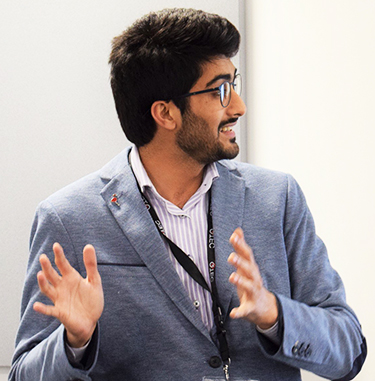
Bilal Ahmad serves as a Postdoctoral Researcher and Technology Lead for Software Solutions in Edtech at the Learnovate Centre, Trinity College Dublin, focusing on translating stakeholder needs into innovative web and mobile applications. Education: PhD in Software Engineering from Lero, the Irish Software Research Centre (University of Limerick) MSc in Computer Science BSc in Computer Science His research bridges Software Engineering and Human-Computer Interaction, with specialized expertise in Edtech, Smart Ageing, UX Research, and Global Software Development. He has extensive experience developing technology solutions for diverse user groups, notably creating a social volunteering network application for older adults during his PhD collaboration with IBM Ireland. His work emphasizes practical implementation of software solutions to address real-world challenges in aging populations and educational technology. Scientific awards: No specific awards documented in the source material. Advising and grants: No information provided regarding student supervision, research grants, or funding sources. Labs and Teams: Bilal is actively engaged with the Learnovate Centre (a Trinity College Dublin-affiliated Edtech research hub) and previously collaborated with IBM Ireland. He recently participated in NDRC Dublin's Pre-commercialisation program as part of a multi-disciplinary postdoctoral research team, while maintaining entrepreneurial involvement through hackathons and startup events.
Tom Chen is a Professor of Marketing and Director of Studies for MBA programmes at Kent Business School, University of Kent. He previously held an honorary position at the National Centre for Epidemiology and Population Health, Australian National University, until 2024. His research centers on service research, marketing theory, and co-creation strategies, with emphasis on disruptive service systems such as smart cities, digital health platforms, and mental health engagement. He co-founded the Co-creation in Service and Customer Engagement (CCIS-CE) Symposium and the Sharing Smart Cities Consortium. His recent publications show a strong trend in customer well-being, digital interactions, psychological ownership, and stakeholder engagement, published in top-tier journals like Journal of Service Management , European Journal of Marketing , and Journal of the Academy of Marketing Science . Australia’s Research Field Leader in Marketing 2020 Tom Chen serves as Associate Editor for the Journal of Services Marketing and Journal of Social Impact in Business Research , and is on the editorial boards of Journal of Service Theory and Practice and Service Industries Journal . He advises the EU Horizon Improva project on adolescent mental health platforms. While no direct grant information is listed, his leadership roles and advisory positions indicate active research funding and collaborative initiatives. He also contributes to academic governance through board membership with the American Marketing Association’s SERVSIG. He is involved in academic leadership through symposia and consortia, including the CCIS-CE Symposium and the Sharing Smart Cities Consortium, which foster transdisciplinary collaboration in service innovation and urban sustainability.
N. A. M. Maiden is a leading academic at City, University of London, with a prolific research output in human-centred artificial intelligence, digital creativity support, and requirements engineering. His work focuses on designing and evaluating digital tools that augment human creativity in professional domains such as journalism, elite sports coaching, and dementia care. His research interests are highly interdisciplinary, bridging computer science, human-computer interaction, and social applications. Key areas include co-creative AI systems, computational creativity, natural language processing, rule-based reasoning, and user-centred design. He investigates how technology can empower professionals by enhancing their creative thinking processes while maintaining high levels of human control. The trends in his recent publications demonstrate a consistent focus on developing and evaluating practical digital tools like 'Sport Sparks' for coaches and 'JECT.AI' for journalists. His work employs design science methodology, emphasizing co-creation with practitioners and empirical evaluation in real-world settings. The research spans from technical system architecture to human factors and societal impact, particularly in journalism innovation and healthcare technology. Automating science journalism tasks Designing digital tools for creative thinking in sports coaching Towards AI-enabled support for business model creativity Using computational tools to support journalists' creativity Creativity Triggers for requirements elicitation Dr. Maiden has made significant contributions to the field through numerous publications in top journals and conferences. His research often involves collaborative projects with industry partners and other academic institutions, securing funding for innovative work in human-computer collaboration. He mentors a research group focused on digital creativity and has been instrumental in developing novel methodologies for requirements engineering and creative problem solving. His work includes the development of serious games for forensic mental health settings (e.g., 'StreetWise') and digital solutions for improving dementia care. These projects highlight his commitment to applying technology for social good and improving quality of life through innovative information systems.
Federico Sánchez Quinto is a Visiting Researcher at Uppsala University's Department of Organismal Biology, specializing in ancient DNA analysis and population genomics. His work bridges evolutionary biology, archaeology, and anthropology to investigate human prehistory through genomic evidence. His research focuses on Population Genetics, Human Evolution, and Archaeogenetics, with specific expertise in Neolithic Scandinavian populations, Denisovan ancestry in Southeast Asia, and prehistoric migration patterns. He examines how genetic adaptations, pathogen evolution, and social structures shaped ancient societies, integrating genomic data with archaeological context to reconstruct human history. Recent publications reveal trends in analyzing ancient pathogen genomes, kinship systems in megalithic tombs, and high-impact discoveries like the Philippine Ayta's exceptional Denisovan ancestry. His methodological contributions to ancient DNA imputation enhance analytical precision in population genomics, while cross-disciplinary studies on Philippine migrations and Scandinavian adaptations demonstrate his field's expanding scope. Based at Uppsala University's Evolutionary Biology Centre (EBC), he collaborates within multidisciplinary teams combining genomics, archaeology, and anthropology. His research leverages institutional resources at Norbyvägen 18 C to advance understanding of human evolution through cutting-edge ancient DNA methodologies.
Professor Alex Mesoudi is a leading academic in cultural evolution, serving as the Professor of Cultural Evolution at the University of Exeter’s Penryn Campus in Cornwall, UK. He is also the President of the Cultural Evolution Society. His work bridges evolutionary theory with social sciences, focusing on how cultural traits evolve through psychological and social processes. Key research areas include experimental studies of social learning, agent-based modeling of cultural dynamics, and analysis of large-scale cultural datasets (e.g., pop music, football tactics). Mesoudi’s lab investigates migration’s impact on cultural diversity and employs interdisciplinary methods to explore cultural change. Research Interests: Human cultural evolution mechanisms Experimental transmission chains and technological innovation Agent-based models of cultural transmission Cross-cultural variation in learning strategies Big data analysis of cultural trends Lab and Collaborations: Mesoudi leads a vibrant research group with current PhD students Andoni Sergiou and Ishaan Sinha. Former students include Dugald Foster, Angel V. Jimenez, and Alice Williams. His lab has hosted visiting scholars from institutions worldwide, including Télécom Paris and the Federal Rural University of Pernambuco. He collaborates with global researchers on topics like cultural group selection and migration’s psychological impacts. Publications and Media: Mesoudi has authored influential books such as Cultural Evolution: How Darwinian Theory Can Explain Human Culture and contributed to high-impact journals like PNAS and Proceedings of the Royal Society B . He frequently engages in media discussions about cultural evolution through podcasts and documentaries, emphasizing the societal relevance of his work.