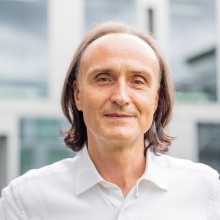
Frank Leymann is a Professor at the Institute for Architecture of Application Systems, University of Stuttgart. His research spans quantum computing, cloud systems, middleware, and business process management. Affiliation: University of Stuttgart, Institute for Architecture of Application Systems Key Projects: PlanQK, EniQmA, OpenTOSCA, SeQuenC Academic Recognition: Over 30 years of publications in service computing and quantum technologies Research Interests: His work focuses on quantum software engineering , hybrid quantum-classical systems , and cloud application architectures . Notable contributions include TOSCA standardization for cloud deployment and systematic studies on quantum optimization. Recent Publications: 2025-2024 articles emphasize quantum algorithm expressivity , cross-chain blockchain transactions , and post-quantum security . Earlier works (2023-2021) address quantum workflow provenance , QAOA optimization , and IoT platform architectures . Technical Leadership: Director of a multidisciplinary team developing frameworks like OpenTOSCA and tools for quantum application deployment.
Jung Woo Sik is a full-time Professor at Sejong University's Department of Quantum and Nuclear Engineering, where he leads the Nuclear Integrated Safety and Security (NISS) Laboratory . He obtained his PhD (1993) and MS (1989) from KAIST, and BS (1987) from Seoul National University. Prior to joining academia, he held senior research positions at KAERI, KEPCO E&C, and DAEWOO IAE. His research focuses on Probabilistic Safety Assessment (PSA) and Physical Protection (PP) for nuclear power plants. He has developed industry-adopted software including FORTE/FTREX (used in 70% of global NPPs), VIPEX for physical protection, COREX for seismic PSA, and BeEAST for core damage estimation. These tools address fault tree analysis, risk quantification, and security vulnerability assessment. Recent publications (2020-2024) demonstrate strong emphasis on seismic risk modeling, human reliability integration, and algorithmic innovations for fault tree analysis. His work consistently addresses nuclear safety challenges through computational methods that optimize risk assessment accuracy in complex scenarios like multi-unit plants and low-power operations.
Peter Juslin is a Professor at Uppsala University, affiliated with the Department of Psychology and the Division of Perception and Cognitive Psychology. His research focuses on cognitive psychology, judgment, and decision-making, particularly on phenomena like overconfidence, the naivety of intuitive statistics, and additive probability integration. He collaborates with interdisciplinary teams across psychology, law, and energy systems. PhD in Psychology (1993), Uppsala University Bachelor of Arts (1989) in Psychology and Philosophy, Uppsala University His research explores how humans make probability judgments, the role of similarity-based processes, and applications to real-world domains like legal decision-making and energy consumption. He critiques traditional heuristics-and-biases approaches, proposing instead that naive sampling models explain judgment errors more effectively. Recent work examines cognitive processes in demand response, environmental psychology, and associative models in probability estimation. Key themes include cognitive constraints, sequential decision-making, and the interplay between intuitive and analytic reasoning. Scientific awards include the Torgny Segerstedt Medal (2008), Oscar Award (1998), and New Scientist Award (1994). He was elected to the Royal Swedish Academy of Sciences in 2013. He teaches advanced courses in cognitive psychology, supervises students at all levels, and engages in public science through articles and lectures to governmental agencies.
Ronald Moen is an Associate Professor in the Department of Biology at the University of Minnesota Duluth and a Senior Research Associate at the Center for Water and the Environment, Natural Resources Research Institute. He holds graduate faculty appointments in Integrated Biosciences (since 2004) and Conservation Biology (since 2005) at University of Minnesota campuses. Ph.D. in Wildlife Conservation (University of Minnesota, 1995) M.S. in Wildlife with Plant Physiology minor (University of Minnesota, 1988) B.S. in Biological Sciences (Cornell University, 1984) Research Focus : Mammalian ecology with emphasis on habitat use, movement patterns, physiology, and predator-prey interactions using GPS radiotelemetry. Key projects include: Moose ecology (habitat use with LiDAR, parasites, predation, forage availability) American Marten habitat analysis Canada Lynx survival and reproduction Climate Change Adaptation Planning for National Park Service Wood Turtle habitat studies Northern Long-eared Bat distribution research Recent Publications highlight work in mammalian thermal ecology, wildlife telemetry accuracy, disease transmission dynamics, and conservation applications of LiDAR technology. Teaching : Courses in Mammalogy, Evolution, Conservation Biology, Animal Behavior, and Ecological Processes. Mentors graduate students in Integrated Biosciences and Conservation Biology programs. Students include multiple M.S. and Ph.D. advisees working on topics ranging from bat ecology to wolf genetics, with collaborations across institutions and agencies. Labs/Projects : Collaborates with MN DNR, Tribal agencies, County and Federal organizations on moose-deer interactions, carnivore monitoring, and climate change impacts in the Upper Midwest.
Håkan Grahn is a Professor of Computer Engineering at the Department of Computer Science, School of Computing, Blekinge Institute of Technology (BTH) in Sweden. He has been a faculty member since 1996, becoming a full professor in 2007. His academic leadership includes serving as Head of Department (1999-2002) and Dean of Research (2011-2013) at BTH. He leads multiple significant research projects including GPAI (General Purpose AI Computing) and Green Clouds, with funding from ELLIIT, the Knowledge Foundation, and Vinnova. His educational background includes: M.Sc. in Computer Science and Engineering (1990) from Lund University Ph.D. in Computer Engineering (1995) from Lund University Håkan's research spans several interconnected domains in computer science and engineering, with a strong emphasis on practical applications. His work in computer architecture focuses on optimizing system performance through innovative cache coherence protocols and memory management techniques. In the realm of parallel computing , he investigates multicore systems, GPU computing, and thread-level speculation to enhance computational efficiency. His research in AI and machine learning addresses energy efficiency, data stream mining, and practical applications in areas like district heating systems and airborne networks. The integration of image processing with machine learning forms another significant strand of his work, particularly in historical document analysis and medical imaging applications. These research areas converge in his leadership of major initiatives like BigData@BTH and GPAI, where he bridges theoretical advances with real-world implementation challenges. Analysis of Håkan's recent publications reveals a clear trajectory toward increasingly applied research with strong industry connections. While maintaining foundational work in computer architecture, his output increasingly focuses on practical AI applications, energy efficiency in computing, and domain-specific implementations in sectors like telecommunications, energy systems, and defense. The interdisciplinary nature of his work is evident in collaborations spanning computer science, engineering, and domain-specific applications, with a growing emphasis on sustainability and resource optimization in computing systems. Håkan has successfully supervised numerous doctoral students, with ten graduates and six current Ph.D. candidates. His research has been supported by substantial funding from: The Knowledge Foundation (BigData@BTH, HINTS, Green Clouds) ELLIIT (GPAI project) Vinnova (FANET-MCA, Directed COM & EW) Industry partners including Ericsson, Saab, Telenor, and Fortnox He is actively involved in multiple research groups including DISL (Distributed and Intelligent Systems Lab), CCS-Lab (Communication and Computer Systems Research Lab), and previously PAARTS (Parallel Architectures and Applications for Real-Time Systems). His leadership extends to organizing academic events like the Nordic workshop on Multi-Core Computing and the Swedish Artificial Intelligence Society workshop.
Maneka Sinha serves as Professor of Law at George Washington University Law School in Washington DC, with extensive expertise in criminal litigation, forensic evidence, and technology policy. She will serve as Visiting Professor of Clinical Law at NYU Law during fall 2025, teaching the Forensic Defense Clinic. Her educational background includes a BS from University of California, Berkeley and JD from New York University. Prior to GW Law, she was Professor of Law and Director of the Criminal Defense Clinic at University of Maryland Francis King Carey School of Law. Professor Sinha's research critically examines forensic evidence reliability and policing technologies within criminal legal systems. Her work bridges constitutional law, empirical science, and practical defense strategies, focusing on systemic biases in forensic methodologies and the Fourth Amendment implications of automated surveillance systems. She investigates how algorithmic tools impact probable cause determinations and disproportionately affect marginalized communities. Her publications demonstrate consistent focus on forensic science reform, with recent scholarship addressing automated gunshot detection systems, signal detection theory limitations, and junk science at sentencing. The research trajectory shows increasing emphasis on technology-driven policing and its constitutional ramifications. Excellence in Scholarship award at the 2024 Workshop for AAPI/MENA Women in the Legal Academy for The Automated Fourth Amendment Co-recipient of Joel R. Reidenberg Award for Outstanding Scholarship by a Junior Scholar at 2024 Privacy Law Scholars Conference for Challenging Automated Suspicion 2023-2024 AALS Bellow Scholar for Fourth Amendment technology research With ten years at the Public Defender Service for the District of Columbia, Professor Sinha served as senior advisor on forensic evidence and head of the nationally recognized Forensic Practice Group. Her international work includes 2017 fellowship with International Legal Foundation establishing Nepal's public defender agency and 2015 Brian Roberts Fellowship training Palestinian public defenders in the West Bank. She teaches Criminal Law and Criminal Procedure courses while developing innovative clinical programs in forensic defense.
Håkan Nilsson is a Senior Lecturer/Associate Professor at the Department of Psychology, Uppsala University, specializing in Perception and Cognition. His research focuses on cognitive psychology, decision making, and probability judgment with significant contributions to understanding human reasoning under uncertainty. His primary research interests include: Cognitive biases in probability judgment, particularly the conjunction fallacy How people interpret odds in sports betting contexts Mathematical modeling of decision processes (configural weighted average model) The relationship between numerical ability and decision quality Development of debiasing techniques for probabilistic reasoning Analysis of his recent publications reveals consistent focus on understanding probability judgment mechanisms. His work demonstrates that even numerically skilled individuals remain susceptible to decision paradoxes, suggesting deep-rooted cognitive processes. Notable research areas include how betting odds are converted to probability estimates and why combo bets appear more attractive despite lower probabilities. His scientific contributions encompass: Development of the configural weighted average model for probability judgment Studies on the relationship between numerical ability and susceptibility to decision paradoxes Research on the cognitive substrate of subjective probability Exploration of how monetary incentives affect probability assessment Nilsson has maintained extensive collaborations with Peter Juslin, Anders Winman, and Patric Andersson. His work appears in leading journals including Psychological Review, Journal of Experimental Psychology, and Cognition, demonstrating significant impact in cognitive and decision sciences.