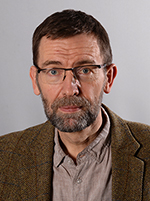
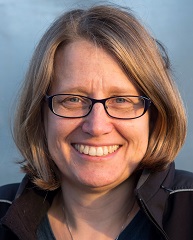
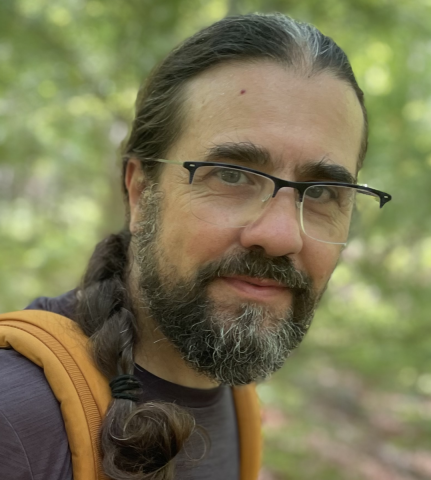
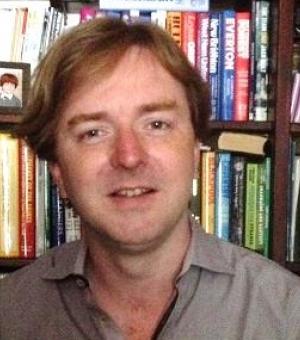
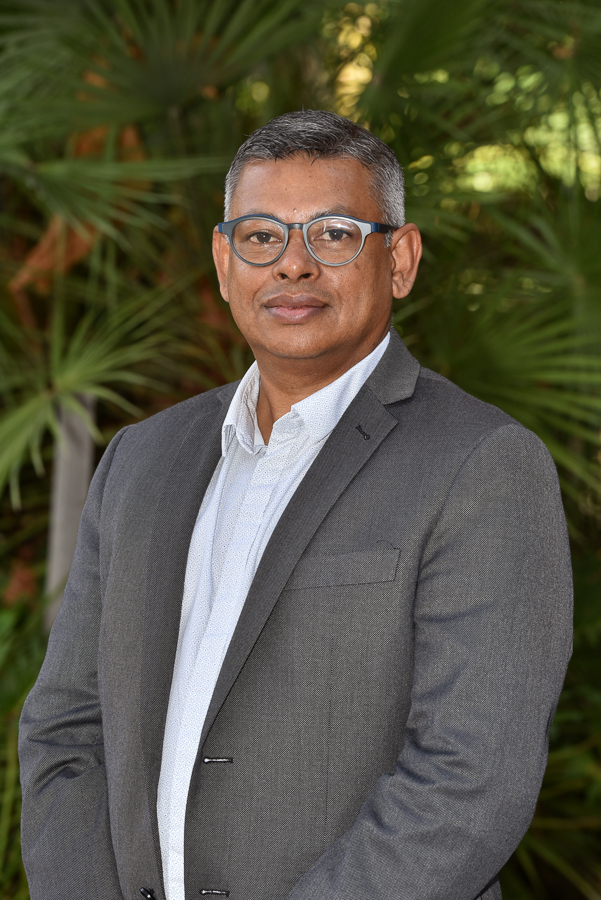
Gabriel Rei-Doval is an Associate Professor in the Linguistics Department at the University of Wisconsin-Milwaukee . His career spans sociolinguistics, bilingualism, and Galician language studies, with a focus on language contact, purism, and planning. He holds a PhD in Galician Linguistics (2001) and has published extensively on Galician, Hispanic, and Lusophone linguistics. Research Interests : Sociolinguistics and Language Contact Bilingualism in minority language contexts Language Purism and Standardization Galician, Hispanic, and Lusophone Studies Teaching Areas : Bilingualism, General Linguistics, Hispanic Sociolinguistics. Key Contributions : Co-editor of Lusophone, Galician, and Hispanic Linguistics: Bridging Frames and Traditions (2019) Author of Principios de lingüística hispánica (2025), a foundational textbook Founder of the Galician Studies Initiative at the Modern Language Association
Stephan Oepen is a Professor at the Department of Informatics, University of Oslo, specializing in Computational Linguistics and Natural Language Processing (NLP). He leads the Research Group for Language Technology and serves as Academic Chair in Artificial Intelligence for the Circle U European University Alliance. His research bridges formal linguistics with large-scale computation, focusing on semantic parsing, dependency structures, and multilingual language models. 2002–present: Researcher → Professor at UiO 2011–2017: Head of Language Technology Research Group 2019–20: Section Head for Machine Learning 2021–24: Department Head for Informatics Current projects include HPLT (High-Performance Language Technologies), Nordic Language Processing Laboratory (NLPL), and OpenEuroLLM . He co-directs the 2017 ACL Shared Task on Extrinsic Parser Evaluation and contributes to international NLP conferences like ACL, EMNLP, and CoNLL. Recent publications focus on: Uniform semantic graph representations Hybrid parsing architectures Continual training for small languages Diagnostic parser evaluation Copyright implications in LLMs Community language resource infrastructure He actively participates in editorial boards and technical coordination roles, including the LUMI Scientific Advisory Group and Horizon Europe's High-Performance Language Technologies project.
Hans-Olav Enger is a renowned Professor of Scandinavian Linguistics at the University of Oslo since 2008. He has held previous academic positions at the University of Stavanger (2003–2008) and Stockholm University (1992–1993, 1996–2000), and served as a part-time "Guest professor/Professor II" at the University of Zurich (2012–2019). His work focuses on the Department of Nordic Languages with expertise in morphology, grammatical gender, and diachronic linguistics. Current affiliation: University of Oslo, Nordic Languages Previous roles: Professor II (Zurich), Professor (Stavanger), Lecturer (Stockholm) Key projects: MultiGender (2019–2020), co-editor of Maal og Minne (2016–2024) Enger's research delves into grammatical gender systems , inflectional morphology , and grammaticalization processes in Scandinavian languages. His work explores the interplay between semantic rules and morphological structures, particularly in Norwegian dialects. Notable contributions include analyzing the Animacy Hierarchy , changes in plural inflection , and the autonomy of morphology in the context of sound laws. His publications reveal a focus on historical linguistics , morphosyntactic variation , and agreement patterns across Scandinavian languages. Enger has contributed to understanding gender assignment mechanisms , definiteness markers , and syntactic evolution in Norwegian dialects and beyond. Enger has supervised MA theses on topics like gender appropriation in Norwegian , linguistic features in multiethnic environments , and inflectional class changes . He actively participates in the Language Change research group and has co-edited the journal Maal og Minne since 2016.
apl. Prof. Dr. Thilo Rudnig is an extraordinary professor and Hebrew lecturer at the Faculty of Theology, University of Göttingen. His academic journey includes a doctorate from the University of Münster (1999), habilitation (2005), and extensive research on Old Testament texts. He coordinates the ludus linguarum at the Centrum Orbis Orientalis et Occidentalis and serves as the Faculty Representative for Good Scientific Practice and Chairman of the Equal Opportunities Commission. Rudnig's research focuses on Old Testament exegesis, Hebrew linguistics, prophetic literature, and ancient Near Eastern religions. Key areas include Ezekiel studies, Davidic historiography, temple theology, and Hebrew syntax. His work integrates philology, literary criticism, and comparative analysis of Ugaritic and biblical texts. His publications emphasize textual criticism, theological motifs in biblical narratives, and modern adaptations of scriptural themes. Recent works explore holiness concepts in Isaiah, Syriac Psalms, and cinematic reinterpretations of Job. His Luther Bible revisions reflect rigorous engagement with historical and linguistic contexts. Awards: Dissertation prize, WWU Münster (1999) Rudnig actively contributes to academic societies including the Scientific Society for Theology and the Hebraists Association. He examines Old Testament theology for the Evangelical Church of Hanover and participates in Christian-Jewish dialogue.
Professor Sam Hellmuth is a leading academic in phonology at the University of York's Department of Language and Linguistic Science within the Faculty of Arts and Humanities. She serves as Associate Dean for Teaching, Learning and Students while maintaining an active research program focused on Arabic prosody and second language phonology. Her educational background includes: BA (Hons) in Arabic and French, University of Leeds (1985-1989) MA in Linguistics (Arabic), SOAS University of London (2000-2001) PhD in Linguistics and Phonetics, SOAS University of London (2001-2006) Postdoctoral Researcher, University of Potsdam (2006-2007) Professor Hellmuth's research centers on suprasegmental phenomena in Arabic dialects, particularly intonation patterns across regional varieties. Her work bridges theoretical phonology with empirical corpus-based approaches, examining prosodic variation in both native Arabic speech and L2 English acquisition. She specializes in the syntax-phonology interface and has pioneered methodologies for documenting intonational variation through large-scale comparative projects. Her publication record reveals consistent focus on Arabic intonational typology, with recent work expanding to Northern England dialects and emergent bilinguals. The research demonstrates sophisticated integration of auditory transcription with statistical F0 modeling within the Autosegmental-Metrical framework. Professional recognition includes: Editorial Board, Al-'Arabiyya (Journal of the American Association of Teachers of Arabic) Editorial Board, Arabic Linguistics (John Benjamins) Economic and Social Research Council Peer Review College membership Professor Hellmuth actively supervises 25+ graduate students, primarily on Arabic phonology topics, and leads major funded projects including the ESRC-supported 'Generations of London English' (2023-2026). Her collaborative network spans institutions in Tunisia, Saudi Arabia, Lebanon, Pakistan, and across the UK. She directs the Phonetics and Phonology and Language Variation and Change research groups, with recent work focusing on corpus development for multidialectal Arabic teaching resources.
Dr. Aaron Griffith is an Assistant Professor at the Department of Languages, Literature and Communication within Utrecht University , specializing in Celtic and Classics . His research focuses on Historical Linguistics , Language Change , and the Celtic Languages and Culture , particularly during the Early and High Middle Ages . He is also involved in academic programs such as Ancient, Medieval and Renaissance Studies and Linguistics . Expertise Areas : Historical Linguistics, Celtic Languages and Culture, Language Change, Early and High Middle Ages Research Trends : Dr. Griffith's work spans Old Irish syntax, morphology, and manuscript analysis, with a focus on Celtic language evolution , textual criticism of the Milan Glosses and St. Gall Glosses , and diachronic typology . He has contributed to digital resources like glottothèque for Ancient Indo-European grammars. Secondary Activities : He serves as Secretary and Treasurer of the Societas Celtologica Europaea . His contact details include the email a.griffith@uu.nl and office Transcomplex Trans 10 , Room 3.01A, Utrecht.
Markus Zehnder is a Professor of Old Testament at Evangelische Hochschule für Leitung und Management (IHL) Bad Liebenzell since 2023. He also serves as a Guest Lecturer at STH Basel (Switzerland) and Professor for Biblical Studies at Ansgar College and Theological Seminary, Kristiansand (Norway). Previously, he held academic roles at institutions including Biola University, Basel University, and the Swiss National Science Foundation. Education: Ph.D. (Dr. Theol.) from Basel University (1997) Habilitation from Basel University (2003) Postdoctoral studies at Hebrew University of Jerusalem and Harvard University (1998-2001) Courses in University Didactics at Biola University and Ruhr-Universität Bochum His research focuses on Old Testament ethics, migration, interreligious relations, and the intersection of biblical law with contemporary issues. He has published extensively on topics like the annihilation of Canaanites, socioeconomic ethics, and violence in biblical texts. Markus Zehnder has contributed to 15 edited volumes and over 30 journal articles. His work spans structural analysis of Leviticus, divine status of the Messiah, and comparative studies with Confucian ethics. He co-directs the Norwegian Summer Academy for Biblical Studies and actively participates in academic societies including the Society of Biblical Literature and Norwegian Old Testament Society.
Hsiang-Lin Shih (she/her) is an Associate Professor of Asian Studies at St. Olaf College since 2022, with a PhD in Asian Languages and Literature from the University of Washington (2013). She specializes in early medieval Chinese poetry, diasporic Chinese literature, and agricultural themes in classical texts, blending digital humanities with experiental pedagogy. Education: PhD and MA (University of Washington), BA (National Dong Hwa University) Her research explores Chinese diaspora through historical migration patterns and literary representations, agricultural narratives in the Book of Songs and Yilan, Taiwan, and digital humanities via virtual exhibits and interactive tools like ThingLink. She employs multiliteracies pedagogy to enhance student engagement and career readiness. Recent publications, including the 2024 monograph on Cao Cao’s court poetry and 2021 article on hyperlinked farming poetry in the Shi jing, reflect her focus on intertextual connections and environmental contexts. Collaborative projects with students examine Taiwanese agrarian communities, digital mapping of Taipei, and translation of diasporic works. Scientific Awards: 2024 Professional Development Grant (St. Olaf) Mellon Digital Humanities on the Hill Grant (2017) Magnus the Good Awards for student projects (2016–2019) Luce Foundation Asia and Environment Grants (2016, 2018) Shih’s student collaborations include translations of Taiwanese literature (e.g., Wu Ming-Yi’s novella, 2024) and fieldwork in Yilan’s farming communities (2018–2019). She advocates for equity-driven education through online multilingual platforms and inclusive pedagogical frameworks.
Mark W. Post is a Senior Lecturer in the Discipline of Linguistics within the Faculty of Arts and Social Sciences at the University of Sydney, where he also serves as Deputy Head of School (Humanities) and Honours Coordinator. He is a member of the China Studies Centre, Sydney Southeast Asia Centre, and The Vere Gordon Childe Centre. Dr. Post's research focuses on the typologies and relationships among Greater Mainland Southeast Asian and Himalayan languages, with special emphasis on the Tani branch of Trans-Himalayan (Tibeto-Burman) languages. His fieldwork-based research encompasses languages of Eastern Arunachal Pradesh, India, particularly Galo and other Tani languages. His theoretical approach combines functional-diachronic perspectives with anthropological linguistics, viewing language as a dynamic process whose structures emerge from patterns of discourse and interaction. His recent publications reveal significant trends in Eastern Himalayan linguistics, with particular focus on classifier systems, topographical deixis, applicative constructions, and ethnolinguistic prehistory. His work demonstrates the exceptional linguistic diversity of the Eastern Himalayan region and its importance for understanding broader patterns in language evolution and cultural adaptation. 2011 Recipient of the Association for Linguistic Typology's Pāṇini Award Dr. Post supervises research on phonological and grammatical descriptions of Asian minority languages, particularly of Southeast Asia and the Himalayas, and on functional and diachronic analyses of grammatical phenomena. His current projects include 'Grammar and prehistory in the Eastern Himalaya' and 'A grammar and online/app-based dictionary of the Galo language.' He has received multiple research grants, including ARC Discovery Projects and funding from the Firebird Foundation for Anthropological Research. His laboratory work centers on the Centre for Cultural-Linguistic Diversity (Eastern Himalaya), where he coordinates documentation efforts for endangered languages of the region, working closely with local language communities like the Galo Language Development Committee of Arunachal Pradesh.
Dagmar Schmidt-Wehinger is a Lecturer at the Musicological Institute of the Eberhard Karls University of Tübingen since 2003, specializing in music theory, analysis, and historical research. Her work focuses on free atonality, the Second Viennese School, post-1950 sound structures, and the music of Iannis Xenakis. Education: Master of Arts (2004), Graduate Music Teacher (1997), Postgraduate studies in piano/chamber music (1995–1997), Artistic Final Examination (1994) Research interests include auditory analysis methodologies, control mechanisms in avant-garde compositions, and interdisciplinary approaches to text-music relationships. Her publications analyze Mozart's and Bach's operatic works, Berg's Lieder, and Xenakis' structural innovations. She has contributed to key musicological publications like Mozart Studien and Musikland Baden-Württemberg . Awards include the 1991 Stuttgart Prize for Piano Pedagogy.
Mark Sicoli is an Associate Professor at the University of Virginia , where he serves as Director of the Interdepartmental Program in Linguistics and Associate Editor of Language Documentation and Description . His work spans Zapotec-speaking communities in Mexico (since 1997) and Virginia Tribal Nations like the Nottoway (since 2020). As a Fellow of the UVA Institute for Advanced Technologies in the Humanities (IATH), he leads the Data Back! project (2025-2027) , focusing on digital infrastructure for community-driven language documentation. Specialties: Multimodality, Embodied Interaction, Community-Engaged Research, Video Analysis, Ethnography, Semiotic Theory Research Themes: Language in Human Evolution, Human Social Organization, Anarchist Theory, Language Contact, Documentary Linguistics His scholarship critiques evolutionary progress narratives through anarchist theory and interactional analysis , arguing that language evolved via mutual aid rather than self-interest. He has conducted NSF-funded projects on Zapotec and Chatino language surveys and whistled speech documentation, co-directing initiatives that trained 23 native speakers. His teaching includes collaborative courses like Language Revival in the Eastern Tribes with Nottoway citizens. Key publications include Saying and Doing in Zapotec (2020), exploring how language emerges through joint action, and a 2025 chapter on Zapotec perception categories in the Oxford Handbook of the Languages of Perception . His work emphasizes decolonizing linguistics and empowering Indigenous communities in language preservation. Scientific Awards: Fellow, UVA Institute for Advanced Technologies in the Humanities (IATH)
Professor Björn Hansen is Chair of Slavic Linguistics at the Institute of Slavic Studies, University of Regensburg, where he has held a professorship since 2002. Previously, he served as Lecturer in Slavonic Linguistics at the University of Cambridge (2000-2002) and as a research assistant at the University of Hamburg. He is also Partnerschaftsbeauftragter for university cooperation with the University of Novi Sad (Serbia) and University of Łódź (Poland), and chairs the doctoral committee for the Faculty of Philosophy IV at Regensburg. Born: 1964 in Flensburg 1984-1991: Studies in East Slavic Studies and German Language and Literature at University of Hamburg 1995: PhD in Slavic Linguistics (University of Hamburg) 2001: Habilitation in Slavic Philology - Linguistics (University of Hamburg) Hansen's research spans multiple areas of Slavic linguistics, with particular focus on the structures of Polish, Russian, Serbian and Croatian languages. His work investigates language contact phenomena, areal typology, language change in Slavia, heritage linguistics, and corpus linguistics. He specializes in syntax and semantics, particularly examining modality, grammaticalization processes, contact-induced change, clitics (including clitic climbing), indefiniteness, subject encoding, frame semantics of public discourse, and the language of religion. His methodological approach often combines corpus-based analysis with theoretical linguistic frameworks. Analysis of Hansen's recent publications reveals consistent focus on microvariation in South Slavic languages, particularly Bosnian, Croatian, and Serbian. His work demonstrates expertise in clitic phenomena, modal constructions, and subject case marking. He frequently employs corpus-based methodologies to investigate rare linguistic phenomena, especially in underresourced languages. His research increasingly connects historical linguistics with contemporary language use, examining how grammaticalization processes evolve over time and across language contact situations. Member of DFG-Fachkollegium 104-02 (2009-2024) Official expert for Alexander von Humboldt Foundation (since 2011) Reviewer for multiple national research foundations including DFG, Swiss National Science Foundation, and Austrian Science Fund Member of editorial boards for several international linguistics journals Hansen has supervised numerous doctoral and master's students, with research spanning heritage language syntax, Slavic modality, language contact phenomena, and corpus-based linguistic analysis. He leads multiple externally funded research projects including 'seeFfield' (VolkswagenStiftung, 2022-2029), 'LangGener' (DFG-NCN, 2018-2022), and several DFG projects examining microvariation in Bosnian/Croatian/Serbian, Polish-German bilingualism, and historical semantics of corruption. As Principal Investigator of the Graduate School for East and Southeast European Studies (2012-2019), he has significantly contributed to interdisciplinary research in the region. Hansen directs the Binational Study Program 'German-Polish Studies' (funded by DAAD) and has organized numerous international conferences and workshops on Slavic linguistics, including the 'Clitic Climbing' workshop (2017) and 'Perspectives of German-Slavic Multilingualism' conference (2016).
Hae-Young Kim is a Professor of the Practice in Asian and Middle Eastern Studies and Linguistics at Duke University. Her work bridges language education, sociolinguistics, and cultural studies with a focus on Korean as a heritage and second language. She holds a Ph.D. from the University of Hawaii (2000), M.A. degrees from Victoria University of Wellington (1991) and Seoul National University (1985), and a B.A. from Seoul National University (1983). Her research emphasizes bilingualism, translanguaging, and culturally-engaged language instruction. She develops pedagogical frameworks integrating historical, literary, and cultural content into Korean language courses. Notable areas include heritage learner motivation, aspect morphology in L2 Korean, and socially-conscious writing pedagogy. Over 25 years of academic publications on Korean language education, SLA theory, and sociolinguistic discourse analysis Co-developed curricula emphasizing cultural connections in language learning Active contributor to professional development workshops for Korean language educators Her teaching portfolio includes courses on Korean sociolinguistics, heritage language issues, and Korean popular culture. She currently leads Duke's Korean Studies program and collaborates with interdisciplinary initiatives in Asian humanities.
Professor Francis Leneghan is a Professor of Old English and Fellow of St Cross College at the University of Oxford. His research focuses on Old English literature, particularly Beowulf, biblical translations, and the literary culture of King Alfred's era. He leads major projects like ROEP (Resources for Old English Prose) and co-organized initiatives such as The Age of Alfred and Ideas of the World in Early Medieval English Literature. His work bridges textual analysis with historical contexts, emphasizing intertextuality, royal patronage, and manuscript culture. He holds editorial roles for the Studies in Old English Literature book series and serves as Chair of TOEBI (Teachers of Old English in Britain and Ireland). His publications include Old English Biblical Prose (2025) and co-edited volumes like Ideas of the World (2022, winner of the ISSEME Best Book Prize). He has secured significant funding, including a Leverhulme Research Fellowship and AHRC grants. His research explores themes of dynastic narrative in Beowulf, the influence of imperial thought on manuscripts like Cotton Tiberius B.i, and the reception of biblical texts such as the Psalms. He actively organizes conferences, such as the 2026 New Directions in Old English Prose conference, and contributes to interdisciplinary groups like the Oxford Psalms Network.
Sambit Datta is the Dean, International of the Faculty of Science and Engineering at Curtin University. He holds a Professorship in Computational Urban Science within the School of Electrical Engineering, Computing and Mathematical Sciences. His academic roles include adjunct positions at IIT Kharagpur, India, and NYUST Taiwan. He is a registered architect in India and a member of the Australian Institute of Architects. Prof. Datta's education includes a Dipl. Arch from CEPT University, M.Arch from the National University of Singapore, and a PhD in Computational Design from the University of Adelaide. He has received the Michael Ventris Memorial Award and served as a scholar at the Architectural Association, London. His research focuses on computational design, urban science, and AI-driven architectural innovation. He leads the Computational Design Research Laboratory (Codelab) and contributes to the Curtin Institute for Computation. His work spans generative grammars, sensor networks in healthcare, and digital heritage preservation. Key publications include studies on sensor-fusion environments, DFA (Design-Fabrication-Assembly) systems, and virtual reconstructions of historical temples. He has authored books on computational urban science and early temple architecture. Professional engagements include roles as Corresponding Editor for the Nexus Network Journal and Secretary of the CAADRIA (Computer-Aided Architectural Design Research in Asia).