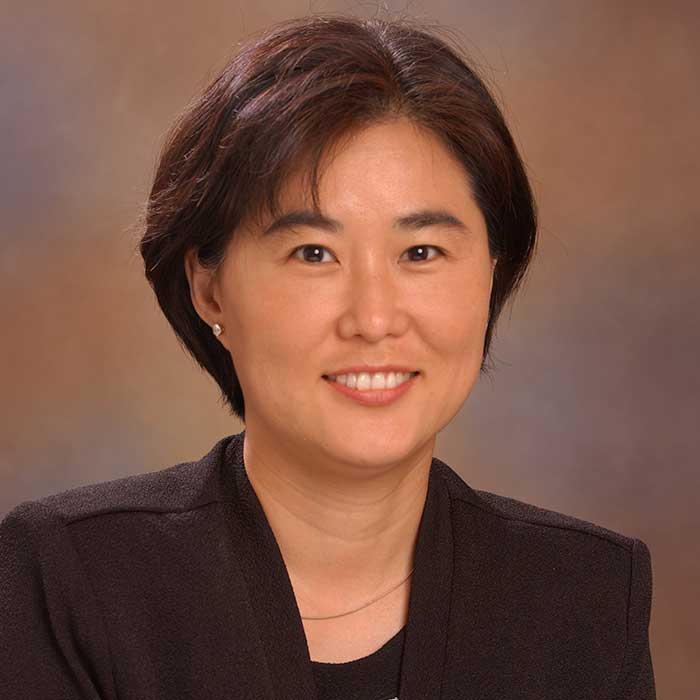
Dr. Kwangmi Kim is a Professor in the Department of Mass Communication at Towson University's College of Fine Arts and Communication. Since joining TU in 2003, she coordinates the Advertising and Public Relations program while teaching courses including Media Planning, Advertising Campaigns, and International Advertising and Public Relations. Her research focuses on international advertising, media globalization, and the intersection of social media with sports communication. Recent work analyzes Twitter usage patterns during major sporting events and develops social media data collection tools. She contributes to academic discourse through publications in journals like International Journal of Advertising , Asian Journal of Communication , and Sex Roles . Dr. Kim serves as Associate Editor of the Asian Journal of Communication since 2008 and previously held leadership roles in the Korean American Communication Association. Her expertise spans political economy of mass communication, gender/race representation in advertising, and digital media analysis.
Maroš Krivý is a Professor and Head of the Urban Studies MSc programme at the Estonian Academy of Arts, Faculty of Architecture. He is also a Research Fellow at the University of Cambridge’s Department of Geography under the ERC project 'Rethinking Urban Nature.' His work bridges architecture, urbanism, and environmental studies, focusing on postwar and post-Cold War periods. Research Interests: Cybernetic urbanism, neoliberalism, smart cities, mass housing, and political geography. Current Project: 'Urbanism at the End of History,' analyzing urban experts’ responses to global capitalism and social conflict. His recent publications explore topics like platform urbanism, ecological imaginaries, and postsocialist housing legacies. He has contributed to journals such as Environment and Planning D , Antipode , and Geoforum , with keywords spanning political economy, digital geography, and urban sociology. Scientific Awards: Marie Skłodowska-Curie Fellowship He advocates for critical engagement with urban design’s socio-political implications, emphasizing the interplay between architecture, power, and knowledge systems. His teaching and research challenge benevolent smart city narratives, highlighting their embedded inequalities and speculative logics.
E. Thomas Ewing is a Professor of History and the Associate Dean for Graduate Studies and Research at the College of Liberal Arts and Human Sciences, Virginia Tech. He is based in the Department of History and plays a key role in advancing interdisciplinary research and graduate education at the university. His research spans Russian, European, and world history, with a distinctive focus on the history of education, medical history, and the digital humanities. He has authored and edited several influential books on Soviet education and pandemic history. His current research investigates the transmission of information during the 1889–1890 Russian Influenza, employing digital humanities methodologies to analyze historical medical data. Ewing leads the Data in Social Context program at Virginia Tech, which integrates data analytics, computational thinking, and critical humanities inquiry into undergraduate and graduate education. Funded by the National Endowment for the Humanities, this initiative includes workshops for graduate teaching assistants and supports interdisciplinary teaching across the humanities and social sciences. His recent work emphasizes ethical dimensions of data, the societal impact of algorithms, and historical perspectives on public health crises. His publications and media engagements reflect a strong commitment to public scholarship. Notable articles in The New York Times , The Washington Post , and Fortune connect historical insights to contemporary issues such as pandemic responses and media responsibility. His research program combines rigorous historical scholarship with innovative digital methods, making significant contributions to both academic and public understanding of history in the age of data. National Endowment for the Humanities (NEH) funding for workshops on the 1918 Spanish Influenza and Images and Texts in Medical History He advises graduate students through the Data in Social Context workshop and supports interdisciplinary research training. He also coordinates the Data & Decisions Minor and collaborates with library data consultants and research groups across campus. His leadership extends to curriculum development, particularly in integrating quantitative and computational thinking with critical humanities education.
Colin Gordon is Professor of History and Department Chair at the University of Iowa in the College of Liberal Arts and Sciences. He is a leading scholar in 20th-century U.S. history, specializing in American public policy, political economy, and urban inequality. His research focuses on racial segregation, housing policy, labor history, and federalism, with a particular emphasis on St. Louis. He is an active public intellectual, contributing to outlets such as Dissent , Jacobin , and The Conversation . University of Iowa, Department of History, Professor Department Chair, 2006–2011, 2023–present Senior Research Consultant, Common Good Iowa Education: Ph.D., University of Wisconsin, Madison His research interests include 20th-century U.S. history, American political economy, racial segregation, urban decline, and the history of social policy. He combines rigorous historical analysis with digital humanities methods, creating innovative public-facing projects such as the Growing Apart data-visualization platform and digital companions to his books. His recent scholarship critically examines the role of federalism, state discretion, and private interests in perpetuating inequality. His publications span major academic presses and journals, with a strong trend toward analyzing structural inequality, the legacy of the New Deal, and the political economy of health and housing. His recent articles focus on federalism and class struggle, neoliberalism, health care policy, and the institutional mechanisms of segregation. He frequently collaborates with scholars like Sarah K. Bruch and Kennedy Gardner, often addressing contemporary crises through historical lenses. Scientific Awards and Honors: National Endowment for the Humanities Fellowship (2021–22) Russell Sage Foundation Visiting Scholar (2022–23) Mellon Foundation Higher Learning Grant (2023–26) F. Wendell Miller Professorship (2016) University of Iowa Regents Award for Faculty Excellence (2016) Distinguished Achievement in Publicly Engaged Research (2015) CLAS Collegiate Fellowship (2014) Professor Gordon has secured significant research funding and has held leadership roles including Director of Graduate Studies (2000–2004). He teaches courses on American inequality, public policy, and digital history. He advises on policy through Common Good Iowa, authoring reports on health coverage, economic development, and labor conditions. His digital projects serve as models for public history and engaged scholarship. Labs and Teams: He leads digital history initiatives including Growing Apart: A Political History of American Inequality and online companions to his books. He collaborates with researchers across disciplines and institutions, particularly on projects involving spatial analysis and public policy. His work with Common Good Iowa connects academic research to community and policy needs in Iowa.
Lisbet Tarp is an Associate Professor in Art History at the School of Communication and Culture, Aarhus University. Her academic work bridges traditional art historical scholarship with digital methodologies and interdisciplinary research, particularly in the fields of painting, materiality, and conservation. She is actively engaged in several high-impact research projects exploring the intersections of art, science, and technology. Research Interests: Digital Art History and computational analysis of paintings Materiality and technique in historical and contemporary painting Conservation science and hidden layers in artworks Mathematics and geometry in visual art Early modern court culture and ceremonial representation Interdisciplinary practices between art and anatomy Her recent publications reflect a strong trend toward integrating digital tools into art historical inquiry, with a focus on uncovering the material and technical dimensions of paintings. Projects such as Digital Art History: Rediscovering the Painting and ANAT: Anatomical Theater demonstrate her innovative approach to visual culture through scientific and digital lenses. Her work often involves collaborative, peer-reviewed publications and digital dissemination. Scientific Projects & Activities: ANAT: Anatomical Theater (2023–2029) – Investigating dissection as aesthetic practice in early modern and contemporary contexts Digital Art History: Rediscovering the Painting (2019–2022) – Using digital methods to analyze painting techniques and material composition MoCMa: Mobility Creates Masters (2017–2019) – Studying transnational influences in European art LUMEN Center (2015–2025) – Researching Lutheran theology and its impact on confessional societies and visual culture Lisbet Tarp has contributed extensively to academic discourse through peer-reviewed journals, anthologies, and digital publications. While no formal students or awards are listed, her leadership in major research initiatives underscores her scholarly influence. She employs digital platforms for both research and pedagogy, including student-organized seminars and open-access digital versions of her work.
Gabriel Pereira is Assistant Professor in AI & Digital Culture at the University of Amsterdam (UvA), based at the Media Studies department and the Institute for Logic, Language and Computation (ILLC). His primary affiliation is with the Natural Language Processing & Digital Humanities (NLP&DH) group. Pereira's research focuses on the critical study of data and algorithms, particularly as they intersect with vision, images, and surveillance systems. He brings an interdisciplinary approach that combines Science and Technology Studies (STS), critical algorithm studies, platform studies, and artistic interventions to examine how computational systems shape social relations and power structures. Pereira's research interests center on critical perspectives of computer vision and algorithmic governance, with particular attention to how these technologies operate in contexts of surveillance, platform labor, and digital culture. His work critically examines hegemonic computer vision systems that reinforce surveillance capitalism while exploring alternative ways of seeing and engaging with technology. He has conducted extensive research on Automated License Plate Recognition systems, WhatsApp disruptions in Brazil, and the political economy of smart surveillance projects like Curitiba's 'Digital Wall.' His methodology combines qualitative research with practice-based inquiry, including arts-based and interventionist approaches that challenge dominant technological narratives. His publication trends reveal a consistent focus on critical examinations of algorithmic systems, with growing attention to resistance practices, decolonial perspectives, and situated knowledge from the Global South. The articles show a trajectory from analyzing specific surveillance technologies toward broader theoretical frameworks for understanding algorithmic antagonisms and developing critical technical practices. His work consistently bridges theory and practice, often collaborating with artists and activists to create interventions that make visible the hidden operations of algorithmic systems. Independent Research Fund Denmark International Postdoc grant Deviant Practice Grant (Van Abbemuseum) Pereira actively organizes academic and artistic events, serving as Secretary of the Association of Internet Researchers and participating in the Tierra Común network. He co-organized the Con/Crit/Tec residency in São Paulo that brought together over 80 transdisciplinary researchers to explore alternative geographies of digital consciousness. His collaborative approach extends to numerous grant-funded projects examining platform labor, algorithmic surveillance, and critical data literacy. Pereira emphasizes organizing as an essential element of research work, facilitating knowledge exchange between academic, artistic, and activist communities. He is affiliated with multiple research collectives including the Center for Arts, Design and Social Research (CAD+SR), where he serves as a Researcher in Residence. His practice-based projects like 'Future Movement Future – REJECTED,' 'Algorithmic Sea,' and 'History of _rt' demonstrate his commitment to using artistic interventions as critical research methods. These projects often involve collaborations with artists, technologists, and activists to create alternative ways of engaging with and understanding algorithmic systems.
Raysa Amador is a Professor in the Department of Languages, Literatures, and Cultures at Adelphi University’s College of Arts and Sciences. She has served as Chair of the department (2006–2021) and Director of the Latin American Studies Program since 1990. Her academic leadership extends to numerous university committees and advisory roles, including the DACA, International & Immigration Task Force and the International Studies Committee. Ph.D., New York University (1978) M.A., New York University (1973) B.A., Cum Laude, Phi Beta Kappa, New York University (1972) Certificate, Data Processing Programmer, New York University (1979) Her research centers on Hispanic literature, Latina writers and artists, second language acquisition, and the intersection of law and literature in colonial chronicles. She explores themes of identity, gender, transculturation, and narrative power, particularly in the works of Frida Kahlo, Cristina Garcia, Julia Alvarez, and other Latina figures. Her pedagogical focus includes intermediate Spanish curriculum development and cultural literacy. The recent scholarly output reflects a strong trend in feminist and transnational studies, analyzing the female body, self-representation, and cultural identity across literature and visual art. Her work bridges interdisciplinary fields such as law, rhetoric, anthropology, and history, particularly in her studies of the Chronicles of the Indies and colonial legitimacy. Adelphi Presidential Award for Diversity and Inclusion (2020) Distinguished Faculty Excellence Award (2005) Septima Clark Distinguished Faculty Award (1999) President’s Faculty Development Award (multiple) Certificate of Award for Advancing Women's History (1999, 2000) Selected speaker, New York Council for the Humanities (multiple years) Amador has advised numerous undergraduate and graduate students in research and theses, particularly in Hispanic literature, identity, and social justice. She has secured multiple grants, including from the U.S. Department of Education and the New York Council for the Humanities, supporting seminars, speaker programs, and cultural festivals. Her leadership in organizing the Spanish Film Series with Pragda highlights her commitment to public humanities and cultural engagement. She has been instrumental in developing academic programs such as the Latin American Studies Concentration and has served on key search and governance committees. Her long-standing advisory role with Latino Students United (formerly La Unión Latina) underscores her dedication to student support and diversity initiatives.
Dr. Sinan Tankut Gülhan is an Assistant Professor at the University of Zielona Góra's Institute of Sociology in Poland, where he applies a multidisciplinary approach to urban sociology. With expertise spanning Turkish urbanization processes, comparative urban history, and digital transformation in urban contexts, he bridges theoretical frameworks with practical applications in urban planning and policy. His research interests focus on the intersection of urban sociology and digital transformation, examining algorithmic decision-making in urban planning, digital inequality, housing market dynamics, 'smart city' initiatives, and the impact of digital platforms on urban mobility. Drawing from Henri Lefebvre's spatial theory, he analyzes how urban spaces are produced through political, economic, and social processes, with particular attention to Istanbul's historical development. Dr. Gülhan has expanded his methodological approach from qualitative to quantitative and computational techniques, utilizing statistical analysis (RStudio, SPSS), data science applications (Python, machine learning), digital research methods (web scraping, text analysis), and spatial analysis (QGIS). His publications reveal a consistent focus on urban political economy, historical urban development, and the evolving relationship between state power and urban space. Actively engaged in public sociology, he collaborates with community organizations, policymakers, and media outlets, organizing workshops for planners and advising municipal governments on technology implementation. His work on the 1960 Istanbul Housing Census visualization demonstrates his commitment to making historical urban data accessible for contemporary urban challenges.
Prof. dr. Jeroen de Mast is a faculty member at the University of Amsterdam (UvA) , affiliated with the Faculty of Economics and Business and the Section Business Analytics . His research focuses on Lean Six Sigma , statistical engineering , and diagnostic problem solving , with applications in healthcare operations and industrial processes. He has authored numerous publications on topics such as variation reduction, measurement systems, and quality improvement frameworks. Academic Rank: Professor Contact: j.demast@uva.nl Research Trends (2019–2025): His work spans operational excellence , appointment scheduling optimization , and statistical validation , emphasizing interdisciplinary collaboration between statistics, healthcare, and business analytics. Key methodologies include DMAIC , DAPS diagrams , and adaptive polynomials .
Sara Velez is an Assistant Professor of Design at the Faculty of Arts and Humanities , University of Beira Interior, where she serves as Head of the Department of Arts and as a researcher with iA* - Arts Research. Her work bridges Communication Design with philosophical inquiry, particularly through Vilém Flusser's theoretical frameworks. PhD in Communication Design from University of Lisbon (2016) 2021-2025: Member of Covilhã UNESCO Creative Cities Network's Strategic Council and Board of Curators Active in LabCom - Communication and Arts research unit Research focuses on Communication Design's mediating role in society, examining intersections with ethics, digital culture, and political dimensions. Key projects include Total Design and Metadesign (2023) and ongoing LabCom initiatives. Her publications reveal a trajectory analyzing Flusser's contributions to design theory, ethical implications in democratic societies, and the societal impacts of technologically mediated communication. Current teaching includes courses in design theory and rapid prototyping.
Prof. Dr. Jukka Matthias Krisp is a Professor of Applied Geoinformatics at the Institute of Geography, Faculty of Applied Computer Science, University of Augsburg. He leads the Applied Geoinformatics research team focusing on Location Based Services, Geographic Visualization, Spatial Modeling, and GIS applications in ecological network planning. His research interests span multiple domains within geoinformatics: Location Based Services (LBS) including context modeling, navigation systems, and mobile applications Geographic Visualization and Visual Analytics for complex spatial data representation Spatial Modeling techniques for urban environments and transportation systems Geographic Information Systems applications in ecological network planning and environmental monitoring Indoor navigation systems and 3D spatial representation Prof. Krisp's recent publications demonstrate a strong focus on bicycle routing optimization, spatial analysis of social networks, and the integration of AI technologies like ChatGPT for geospatial data generation. His work often combines traditional GIS methodologies with emerging technologies to address urban mobility challenges, traffic congestion analysis, and sustainable transportation planning. He has made significant contributions to the field of Location Based Services, particularly in context-aware computing and spatial data processing. Among his notable scientific contributions: Development of surface roughness-centric approaches to bicycle routing Innovative methods for estimating night populations using mobile network data Integration of big data and cartographic techniques for understanding urban mobility patterns Application of fuzzy inference systems for traffic congestion analysis Narrative approaches to indoor navigation using 360-degree camera documentation Prof. Krisp actively supervises students and collaborates with researchers internationally. His team includes Pablo Löw, Zulfa Nur'aini Afifah, and former members like Lika Zhvania. He teaches courses such as Advanced Spatial Analysis, Geoinformation Systems and Cartography, and Visual Geodata Mining at the University of Augsburg.
Dr. Ioanna Lykourentzou is an Associate Professor in the Software Technology for Learning and Teaching department at Utrecht University's Faculty of Science. She leads the Collaborative Technologies Lab and coordinates the Computing Science Master's and Information Sciences Honors Bachelor's programs. Additionally, she serves as a Fair Data and Software fellow within the Open Science Team of the Faculty of Science and as a member of the Ethics Review Board for the Faculties of Science and Geosciences. Her research focuses on collaborative and crowd systems, developing methods that help people work together, coordinate efforts, and innovate at scale, both online and in physical spaces. Her interdisciplinary approach combines computational science (machine learning, agent-based modeling, mathematical optimization) with social sciences (personality testing, team building). Her expertise spans Human-Computer Interaction, Algorithms, Agent-Based Modelling, Telecollaboration, Creativity, and Innovation. Her recent publications (2021-2025) demonstrate a strong focus on human-AI interaction, generative models, and applications in cultural heritage and education. She examines how technology can facilitate collaboration, with particular attention to team formation, personality factors, and digital nudging techniques. Her work bridges theoretical research with practical applications in digital humanities, cultural heritage, and computing education. Dr. Lykourentzou has received significant recognition for her research, with multiple publications garnering substantial citations and reader attention across platforms like Mendeley and social media. Her work on personality-based team formation (2016) has been particularly influential with over 90 citations. Prior to joining Utrecht University, she worked as a Senior Researcher at the Luxembourg Institute of Science and Technology (LIST), where she coordinated the European H2020 project CROSSCULT. She has also collaborated with the Human-Computer Interaction Institute of Carnegie Mellon University as a visiting researcher and with INRIA Nancy-Grand Est and the Public Research Center Henri Tudor as a postdoctoral fellow.
Roland Meyer is a DIZH Bridge Professor for Digital Cultures and the Arts at the University of Zurich and Zurich University of the Arts (ZHdK) since July 2024. His work critically examines contemporary networked image cultures, focusing on algorithmic image processing, forensic practices, synthetic media aesthetics, and virtual image archives in the context of platform capitalism. PhD in Media and Art History (Karlsruhe Academy of Art and Design, 2017) Former research positions at Ruhr University Bochum, Humboldt University Berlin, and BTU Cottbus-Senftenberg His research spans: History of operative images AI-driven image synthesis Surveillance technologies Virtual archival systems Roland's publications and lectures analyze how digital platforms reshape visual epistemology, with recent work on Platform realism Synthetic media economies Forensic image practices DALL-E and Sora AI systems He organizes interdisciplinary symposia like As We May See (UZH) and Images Under Suspicion (Essen), and contributes to debates on AI's political visual implications through interviews with major media outlets.
Paul Robertson is a Senior Lecturer in the Department of Classics, Humanities and Italian Studies at the University of New Hampshire. He holds a Ph.D. from Brown University and a B.A. from Reed College, with expertise spanning ancient Mediterranean religion, philosophy, and the cognitive science of religion. His academic work bridges classical studies, religious theory, and cognitive science. Robertson's research interests include Ancient/Medieval Philosophy, Classical Studies, Cognitive Sciences, Comparative Religion, Early Christianity, Late Antiquity studies, and the Theory of religion. He particularly focuses on the origins of big ideas in western thought, tracing the diverse influences on modern understandings of morality, justice, virtue, health and spirituality. His work in the cognitive science of religion investigates how the human brain's biological evolution shapes religious beliefs and practices across cultures. His publications reveal a consistent focus on quantitative approaches to religious studies, ancient textual analysis, and the intersection of cognitive science with historical religious phenomena. Recent work has explored mind-based models of religion, statistical analysis of Paul's letters, and the cognitive underpinnings of religious imagery like shadows in the New Testament. Course Development Grant in Global Religion, "Religion and Cognition" (awarded by University of Notre Dame & Templeton Foundation, 2019) Cognitive and Neurological Approaches to the Study of Religious Beliefs (awarded by UNH College of Liberal Arts, 2018) New Hampshire Humanities Collaborative (NHHC) (awarded by Mellon Foundation, 2025-2027) Robertson teaches a diverse range of courses including Classical Mythology, Introduction to Humanities, Greek & Roman Religion, and specialized seminars on ancient views of the good life. His teaching spans from 2017 to 2025, demonstrating ongoing active engagement in undergraduate education across multiple disciplines within the humanities.
Univ.-Prof. Dr. Pierre Sachse is a Professor of General Psychology at the University of Innsbruck, Austria, where he holds the Professorship for General Psychology within the Faculty of Psychology. His office is located at Universitätsstraße 5-7 (Grauer Bär), Room 2S20, with postal address at Universitätsstraße 15, A-6020 Innsbruck. His research spans multiple domains of cognitive and experimental psychology, with particular emphasis on visual perception, memory processes, and psychophysiological measures. Professor Sachse's research interests focus on eye movement patterns, attentional mechanisms, memory consolidation processes, and sensory processing sensitivity. His work employs sophisticated methodologies including eye tracking, psychophysiological measurements, and experimental cognitive paradigms to investigate fundamental cognitive processes. He has made significant contributions to understanding how post-learning activities affect memory retention, how gaze behavior influences social interactions, and the relationship between sensory processing sensitivity and cognitive performance. His research bridges theoretical cognitive psychology with practical applications in work psychology and human-computer interaction. Analysis of his recent publications reveals a strong trend toward interdisciplinary research combining cognitive psychology with social, business, and historical perspectives. His work increasingly integrates advanced data analysis techniques with traditional experimental methods, as evidenced by the development of tools like SPBView for eye movement analysis. There's a clear progression from basic cognitive processes to their application in real-world contexts including team performance, leadership, and interpersonal communication. His research maintains a consistent focus on individual differences, particularly how sensory processing sensitivity moderates cognitive and emotional responses. Professor Sachse has supervised numerous doctoral and postdoctoral researchers, with Martini, Maran, Furtner, Hoffmann, and Büsel appearing frequently as co-authors on his publications. His collaborative network extends across multiple institutions and disciplines, reflecting the interdisciplinary nature of his research. While specific grant information isn't detailed in the provided materials, his extensive publication record suggests successful funding for multiple research projects over his career. His research group appears to focus on experimental cognitive psychology with specialized equipment for eye tracking, psychophysiological measurements, and behavioral experiments. The group conducts both laboratory and naturalistic studies, including mobile eye tracking in real-world environments. Their work spans basic cognitive mechanisms to applied contexts in business, leadership, and social interactions.