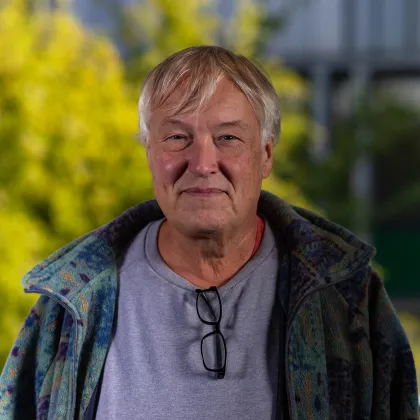
Alexander Nemecek is a Professor and Head of the Faculty of Engineering since 2004. His academic background includes degrees of Dipl.-Ing. (Diplom-Ingenieur) and Dr. techn. (Doctor of Technical Sciences). He leads research in photodetection systems, sensor technologies, and microelectronics. Education: Dipl.-Ing. in Electrical Engineering Dr. techn. (PhD) in Technical Sciences Research Interests: Photodetector design and optimization High-speed analog-to-digital converters MEMS-based gas sensing systems Automated measurement systems for bioprocessing Key Projects: 2022–2025: Leading the THWS World Twin Robotics Network project as Principal Investigator (PI), focusing on Digital Education integration. Grants & Advising: Secured funding for interdisciplinary robotics initiatives through the THWS project. Collaborations include teams at the Faculty of Engineering and external institutions.
Bruno Delacressonniere is an Associate Professor at ENSEA, affiliated with the Quartz laboratory and Electronic Systems department. His research focuses on RF electronics, electromagnetic compatibility (EMC), and advanced electronic systems including optical communications and sensor technologies. He teaches courses in analog electronics, microelectronics, and sensor systems. His research activities span nanophotonics for network-on-chip (NoC) architectures, reliability analysis of RFID systems, and innovative antenna designs for energy harvesting. He has contributed to advancements in optically controlled oscillators, SiGe-based phototransistors, and tunable microwave components using CMOS/SiGe technologies. Delacressonniere has supervised numerous Master’s theses and projects (PFE) focusing on embedded systems and RF design. His work bridges theoretical research with practical implementations, emphasizing energy-efficient solutions and high-reliability electronics for harsh environments. He leads the Electronic Systems team at Quartz, collaborating on projects involving 3D optical integration, microwave filter design, and photonics-based interconnects for multiprocessor systems. His publications reflect a strong emphasis on integrating nanophotonics and advanced semiconductor technologies for next-generation electronic systems.
Prof. Bongjin Kim is an Associate Professor in the School of Electrical Engineering at KAIST. Previously, he held a position as Assistant Professor at UCSB. His research focuses on secure hardware design, machine learning, and alternative computing architectures, including Ising machines and processing-in-memory systems. He leads the Kim Circuit Research Lab, which designs novel VLSI circuits for AI, robotics, and optimization problems. Education: PhD, University of Minnesota (ECE); MS, Pohang University of Science and Technology (ECE). He has advised over 20 graduate and undergraduate students, with notable advisees including Dr. Jooyoung Bae (PhD 2025) and Dr. Yihao Wu (PhD 2025). His work has been recognized with awards such as the NSF CAREER Award (2023) and the NRF Outstanding Young Scientist Grant (2025). Recent research includes developing a 28nm Ising machine for combinatorial optimization (A-SSCC 2024), a scalable bit-serial accelerator for PDEs (TCAS-I 2024), and a reconfigurable compute-in-memory macro (JSSC 2024). He serves on technical committees for ISSCC, A-SSCC, and ESSERC, and chairs sessions at ESSERC 2025 and A-SSCC 2025. Lab activities include the Basic Research Lab (NRF-funded) for Ising Foundation Model development and the C2 research project on ML ASIC accelerators. His group collaborates with institutions like SLAC, IME (A*STAR), and KAIST, fabricating over 30 test chips using 28nm/65nm processes.
Howard T. Russell, Jr. is an Associate Professor in the Department of Electrical Engineering at the University of Texas at Arlington. With a PhD from Santa Clara University (1976) and prior academic experience as an Adjunct Lecturer there (1973-2001), his expertise lies in analog circuit design, semiconductor device modeling, and feedback amplifier analysis. He founded OPAL Engineering, Inc. (1983-2000) to provide industry-focused analog design training. PhD, Electrical Engineering, Santa Clara University (1976) MSEE, BSEE, Texas A&M University (1967, 1966) Research focuses on precision analog circuits, including current mirrors, feedback amplifiers, and SPICE modeling. His work addresses thermal effects in dielectrically isolated bipolar technology and advanced translinear element applications. Publications span from 1970 to 2014, reflecting sustained contributions to analog electronics. Recent articles emphasize feedback circuit simulation methods, high-speed analog design, and thermally compensated architectures. His 2014 publication on VCVS-terminated subnetworks demonstrates modern analysis approaches. Adjunct Lecturer of the Year, Santa Clara University (1990) Recognized Professor, Phi Kappa Phi (2009) United States Patent: All-NPN Precision Current Mirror (2009) Teaching spans circuit theory, analog electronics, and semiconductor physics across 28 years. Courses include undergraduate and graduate levels with emphasis on hands-on lab work and simulation tools (MatLab, SPICE).
Dr. Omid Mirmotahari is an Associate Professor at the Department of Informatics , University of Oslo, specializing in teaching and research at the intersection of computer technology , pedagogy , and low-voltage circuit design . He has held academic roles since 2010, including positions in Robotics and Intelligent Systems and Study Lab . Academic Appointments : 2010–present (Associate Professor, Study Lab); 2008–2010 (Associate Professor, Robotics) Education : PhD in Nanoelectronics (2008), Cand.Scient in Microelectronics (2003), Cand.Mag in Computer Science (2002) His research spans two major areas: pedagogy (improving student engagement, peer review systems, and AI integration in education) and nanoelectronics (ultra-low-voltage CMOS logic, domino circuits, and energy-efficient amplifier designs). Recent work focuses on the environmental paradox of AI and gamification for STEM education. His 15 most recent publications (2025–2018) highlight trends in: AI ethics and sustainability Automated feedback systems Low-voltage circuit innovations Peer/self-assessment frameworks STEM outreach programs Digital learning environments (Canvas LMS) Scientific Awards : 2024: UiO Utdanningspris (Education Prize) 2013: Årets Foreleser (Student-Nominated) 2009: Best Paper Award, IMECS 2009: NFA Prize for STEM outreach 2006: NOKUT Utdanningskvalitetspris He actively contributes to student organizations (co-founder of MIKRO, dagen@ifi) and commercialization through board roles in industry. His work with the Robotics and Intelligent Systems group and Nanoelectronics research has yielded over 25 peer-reviewed publications.
Wooram Lee is an Associate Professor in Electrical Engineering, specializing in millimeter-wave (D-band) and sub-THz communication systems. His research focuses on integrated circuit design, phased arrays, and optical transceivers for next-generation wireless technologies and sensing applications. Lee’s research interests include Phased Array Engineering , D-band Communication , Optical Transceiver Development , and WDM-PON Systems . He explores calibration-free phase control, energy-efficient designs, and heterogeneous integration of arrays for scalable sub-THz communication and radar applications. Recent publications emphasize advancements in D-band amplifier design , frequency doubler efficiency , and 5G phased array transceivers . His work targets high-performance components like beamformers , power amplifiers , and spectrum sensing processors to address bandwidth and efficiency challenges. Lee has received a Predoctoral Fellowship from the Solid-State Circuits Society (SSCS) (2006–2011). His research is supported by multiple National Science Foundation (NSF) grants , including projects on energy-efficient D-band communication modules and heterogeneously integrated arrays. Current grants from the National Science Foundation fund projects such as Heterogeneously Integrated Arrays for Massively Scalable sub-THz Communications and Sensing (2024–2027) and Heterogeneous module, array antenna, and IC co-design for energy-efficient D-band wireless communications and radar (2023–2026). These emphasize scalable architectures and co-design methodologies for wireless systems.
George Souliotis is an Associate Professor at the Department of Electrical and Computer Engineering, University of Peloponnese, where he has been a faculty member since 2019. With over twenty years of professional and research experience in analog integrated circuit design, he has worked for multinational microelectronic companies and continues to serve as a consultant to companies in Greece and abroad. His expertise spans multiple domains of electronic circuit design including high-speed interfaces, RF circuits, and biomedical applications. Dr. Souliotis received his B.Sc. in Physics from the University of Ioannina in 1993, followed by M.Sc. and Ph.D. degrees in Electronics from the University of Patras in 1998 and 2003, respectively. Prior to his current position, he served as a Lecturer at the Department of Electrical Engineering, TEI of Western Greece (2015-2019), and as an Adjunct Lecturer there from 2002 to 2015. He was also a specialized technical and teaching laboratory staff member at the Department of Physics, University of Patras from 2005 to 2015. His research focuses on analog and mixed signal integrated circuit design , with particular expertise in high-speed serial interfaces (USB2, USB3, BLE, M-PHY), RF circuits operating up to 80 GHz, and low-power design. Dr. Souliotis has made significant contributions to circuits for communication protocols, precision analog design, and biomedical instrumentation. He has published over 60 papers in prestigious journals and conferences and holds two patents in the field, demonstrating consistent research productivity through 2024. Analysis of his recent publications reveals three dominant research streams: high-precision comparators and data converters, power-efficient DC-DC solutions, and biomedical interface circuits. His work consistently addresses challenges in speed, accuracy, and power consumption across diverse applications from consumer electronics to medical devices. The integration of traditional analog design with modern communication protocols represents a unifying theme across his research portfolio. Senior Member of IEEE Two patents in analog circuit design Dr. Souliotis serves as a reviewer for more than 10 international journals and conferences, contributing to scholarly discourse in his field. His industry consulting work demonstrates the practical applicability of his research, while his role in the ECSA Laboratory supports both undergraduate and graduate education in hardware design. His collaborations span academic and industrial partners in Greece and internationally. As a core member of the ECSA Laboratory (Electronics Circuits, Systems and Applications) at the University of Peloponnese, Dr. Souliotis contributes to research in FPGA and ASIC design, analog/mixed signal circuits, RF design, and digital systems for security applications. The laboratory provides essential infrastructure for advancing research in integrated circuit design while training students in state-of-the-art techniques across the analog-digital spectrum.
Dr. Longyang Lin is an Assistant Professor at the School of Microelectronics, Southern University of Science and Technology (SUSTech) in Shenzhen, China. He received his Ph.D. from the National University of Singapore in 2018 and has been with SUSTech since May 2021. His research focuses on cutting-edge integrated circuit design with emphasis on ultra-low power systems, hardware security, and cryogenic circuits. Education: Ph.D., National University of Singapore, 2018 M.Sc., Lund University, 2011-2013 B.Sc., Umeå University & B.Eng., Shenzhen University, 2007-2011 Dr. Lin's research spans ultra-low power digital circuit design , energy-efficient AI processor design , compute-in-memory , on-chip sensor fusion , and cryogenic CMOS circuit design . His work addresses critical challenges in battery-less systems, hardware security, and energy-efficient computing. He has developed innovative solutions for self-powered sensor nodes, widely energy-scalable VLSI systems, and secure integrated circuits that operate across extreme temperature ranges. His recent publications demonstrate a strong focus on hardware security, ultra-low power design, and biomedical applications. The research shows a clear progression toward more integrated systems that combine sensing, processing, and communication in highly energy-constrained environments. Many papers address the challenge of maintaining performance while drastically reducing power consumption, with several targeting sub-nanowatt operation. Scientific Awards: Takuo Sugano Award for Outstanding Far-East Paper, ISSCC 2022 ISSCC Demonstration Session Certificate of Recognition, 2022 ISSCC Demonstration Session Certificate of Recognition, 2020 IEEE SSCS Singapore Chapter Award, 2017 & 2018 ISSCC Student Travel Grant Award, 2017 Dr. Lin actively mentors students and researchers, with openings for Research Assistant Professors, Postdoctoral Fellows, Research Assistants, and Graduate Students. His research group benefits from ample funding and regular tape-out opportunities (3-5 per year across different process nodes). He serves as Associate Editor for IEEE Transactions on VLSI Systems and has authored or co-authored over 40 publications, including 10 in IEEE JSSC, 5 in ISSCC, and 12 in VLSI Circuits conference. His laboratory focuses on integrated circuit design for ultra-low power applications, with specialized expertise in hardware security, energy harvesting systems, and cryogenic electronics. The research environment supports tape-outs in advanced CMOS processes, enabling practical validation of theoretical designs.
Alexandre Sébastien Julien Levisse is a Lecturer at the Institute of Electrical Engineering within EPFL's School of Engineering, with additional roles as System Specialist in PAT/SEL departments and Scientist in IEM. His work centers on energy-efficient hardware architectures for edge computing and AI applications. Research focuses on: Computer Architecture & VLSI Design Low-Power Electronics for edge devices Emerging Memory Technologies (RRAM, OxRAM) Neuromorphic & Approximate Computing In-Memory/ Near-Memory Computing Edge AI Hardware Acceleration His 2022-2025 publications reveal strong emphasis on specialized edge AI hardware, including near-DRAM architectures (SideDRAM), RISC-V microcontrollers for healthcare (HEEPOcrates), and overflow-free memory systems. Key innovations involve hardware-software co-design for energy efficiency, variable precision computation, and novel memory hierarchies targeting wearable sensors and edge inference. Levisse teaches Fundamentals of VLSI Design and Lab in Advanced VLSI Design at EPFL. He actively contributes to digital education as a member of EPFL's Centre for Digital Education (CCE), developing curricula for next-generation hardware engineers.
Marco Lanuzza is an Associate Professor in the scientific disciplinary sector ING-INF/01-Electronics at the Department of Computer Engineering, Modeling, Electronics, and Systems (DIMES) at the University of Calabria. He obtained his degree and Ph.D. in Electronic Engineering from the "Mediterranea" University of Reggio Calabria in 2000 and 2005, respectively, and has taught at the University of Calabria and other institutions since 2005-06. He holds the National Scientific Qualification for Full Professor in Electronics (2019) and is a Senior Member of IEEE (2016). Education: Electronic Engineering (110/110), Ph.D. in Electronic Engineering Research Focus: Low-power/high-speed CMOS circuits, reconfigurable circuits, nanotechnology optimization Editorial Roles: Associate Editor for Elsevier's 'Integration, the VLSI Journal' and Wiley's 'International Journal of Circuit Theory and Applications' His research spans circuit design, nanotechnology validation, and applications in signal processing and IoT. Recent publications highlight innovations in content-addressable memory, PUF architectures, and STT-MRAM for in-memory computing. Key subfields include energy-efficient memory systems, hardware security, and cryogenic electronics. Scientific Awards: Senior Member of IEEE (2016) National Scientific Qualification for Full Professor (09/E3 - Electronics, 2019) Associate Editor for two major journals Marco Lanuzza contributes extensively to international conferences as Program Chair and TPC Member. He is part of the Nanoelettronica e Microsistemi research group at DIMES, focusing on multidisciplinary electronic systems and sensor design.
Prof. Vlassis Spyridon holds a full professor position in the Electronics Laboratory at the University of Patras. He specializes in integrated circuit design, wireless communication systems, and low-power electronics. With a Ph.D. in Electronics from Aristotle University of Thessaloniki (2000), his career spans academic research and industry collaborations. His research interests include battery-less RF tags for IoT, clock/data recovery systems, and high-speed serial interfaces. He has led projects in MEMS-based clock generators, transceiver ASICs, and power management ICs for hearing aids. Education: B.Sc. Physics (1994), Aristotle University M.Sc. Electronics (1996), Aristotle University Ph.D. Electronics (2000), Aristotle University Research focuses on analog integrated circuits, including voltage-controlled oscillators (VCOs), phase interpolators, and time-mode signal processing. He has developed innovative circuits for multi-Gigabit serial links and holds five patents, with over 70 peer-reviewed publications. Recent work includes MPHY-compliant serial interfaces and temperature-compensated oscillators. Industry collaborations include projects with telecom providers and startups, designing ASICs for MEMS headphones, solid-state relays, and wireless transceivers. His articles highlight advancements in low-power CMOS circuits, jitter optimization, and digital-to-PWM conversion. Patents: Wireless transmitter DC offset recalibration (2006) Subthreshold MOS resistor (2014) Tunable subliminal transconductor (2016) Additional Czech-registered innovations Labs/Teams: Active in the Electronics Laboratory at University of Patras, contributing to multi-disciplinary projects in analog and digital circuit design.
Nicole McFarlane is an Associate Professor in the Min H. Kao Department of Electrical Engineering and Computer Science at the University of Tennessee, Knoxville (UTK), where she also holds the TCE Advance Professor title. She is affiliated with the Tickle College of Engineering and leads the Micro-Bio-Electronics Group (MLAB), focused on advanced sensor technologies. Education: Nicole McFarlane earned a PhD in Electrical Engineering from the University of Maryland, College Park (2010), and dual bachelor's (BS, 2001) and master's (MS, 2003) degrees in Electrical Engineering from Howard University, Washington D.C. Research Interests: Her work centers on developing compact, efficient sensor systems using mixed-signal CMOS strategies and nanotechnology. Applications span electrochemical biosensors, point-of-care medical devices, nuclear imaging panels, and hardware security for embedded systems. The MLAB lab emphasizes cost-effective, scalable solutions for healthcare, military, and research domains. Article Trends: Recent publications (2024) highlight innovations in perimeter-gated SPAD arrays for cryptographic security, silicon photomultipliers for nuclear imaging, and asynchronous readout architectures. 2023 work includes multimodal gesture recognition systems and pH sensors with integrated encryption. These studies reflect her focus on merging cutting-edge CMOS technologies with secure, multifunctional sensor design. Scientific Awards: No awards explicitly listed in the provided texts. Advising & Grants: Nicole advises students in the Kao Department's graduate and undergraduate programs. While specific advisee names are not provided here, her research is supported by grants in microelectronics and sensor integration. She has pioneered portable biosensor systems, including wireless pH-impedance devices and encryption architectures for wearable health monitors. Labs & Teams: As founder/leader of the Micro-Bio-Electronics Group (MLAB), she oversees projects combining CMOS fabrication with nano/micro-fabrication techniques. The lab explores applications ranging from implantable medical sensors to battlefield-ready detection systems, emphasizing interdisciplinary collaboration.
Piet Wambacq is a professor at the Department of Electronics and Informatics, Vrije Universiteit Brussel. He is actively engaged in research and development across analog and digital integrated circuit design, with a focus on 6G applications and biomedical technologies. Research Interests Analog and mm-Wave IC design CMOS circuit and device technology co-design High-efficiency power amplifiers and low phase noise oscillators Silicon photonics and biomedical equipment Research Output Trends His recent publications emphasize 6G wireless communication, high-frequency analog circuits, silicon photonics reliability, and biomedical signal processing, with significant contributions in gallium nitride (GaN) and III-V semiconductor technologies. Advising and Projects Wambacq supervises PhD students and collaborates on projects like FWOSB180, FWOSB181, and IOF3016, addressing future health technologies and advanced communication systems.
Seyed Armin Tajalli is a Visiting Professor at the École polytechnique fédérale de Lausanne (EPFL), affiliated with the School of Engineering (STI), Institute of Electrical Engineering (IEM), and Integrated Neurotechnologies Laboratory (INL). He has extensive experience in ultra-low power integrated circuit design and high-speed serial communication systems. Dr. Tajalli received his B.S.E.E. and M.S.E.E. degrees (with honors) from Sharif University of Technology, Tehran, and Tehran Polytechnic University in 1997 and 1999, respectively. He earned his Ph.D.E.E. on low-power integrated circuit design techniques in 2010 from EPFL. Prior to his academic career, he worked with Emad Semicon from 1998-2006 as a senior analog/RF design engineer and technical manager. His research focuses on ultra-low power circuit design, including subthreshold source-coupled logic, analog/mixed-signal circuits, data converters, and serial data transceivers. His work addresses critical challenges in low-power design, high-speed communication, and energy-efficient circuit implementations. Recent publications demonstrate his expertise in spectrum shaping techniques, crosstalk reduction, and high-speed serial links for memory interfaces and multi-drop communication systems. Dr. Tajalli's publications span high-impact journals and conferences including IEEE Journal of Solid-State Circuits, IEEE Transactions on Circuits and Systems, and major conferences like ISSCC, ISCAS, and VLSI Symposium. His research demonstrates consistent innovation in low-power circuit techniques with practical applications in high-speed communication systems. Kharazmi Award on Research and Development, 2000 Outstanding Design Engineer, Emad Semicon, 2001 Presidential Award of the best Iranian researchers, 2003 ACM/CICC Award, 2009 EPFL Prime Special Award, 2009 Dr. Tajalli has advised PhD students including Kiarash Gharibdoust, whose thesis focused on Hybrid NRZ/Multi-Tone Signaling for High-Speed Low-Power Wireline Transceivers. His collaborative work with the ALGO team has resulted in significant contributions to high-speed serial data transceiver architectures. His research has been supported by various academic and industrial partnerships focused on advancing integrated circuit design techniques. His work is primarily conducted within EPFL's Integrated Neurotechnologies Laboratory (INL) and previously with the Microelectronic Systems Laboratory (LSM). These labs provide state-of-the-art facilities for mixed-signal IC design, characterization, and testing, supporting his research in ultra-low power circuits and high-speed communication systems.
Dr. Karuppasamy Soundarapandian is a Postdoctoral Researcher at ICFO (Institute of Photonic Sciences) within the Quantum Nano-Optoelectronics research group. He holds a PhD in Photonics from Universitat Politècnica de Catalunya (Spain). His work focuses on advanced materials and nanostructured systems for optoelectronic applications, with emphasis on graphene-based devices, quantum phenomena in 2D materials, and terahertz communication technologies. Dr. Soundarapandian's research spans from fundamental studies of exciton dynamics and carrier behavior to applied developments in high-speed data transmission and wearable sensors. His technical expertise includes fabrication and characterization of photonic devices, spectroscopic analysis, and integration of nanomaterials into functional systems. Recent projects involve exploring graphene's potential for 6G wireless communications, investigating topological edge states in hyperbolic media, and developing corrosion-resistant materials using natural inhibitors. Extensive experimental capabilities include ultrafast spectroscopy, terahertz time-domain spectroscopy, and advanced electron microscopy techniques. His contributions bridge nanotechnology, quantum physics, and applied photonics, addressing challenges in both fundamental science and next-generation technologies.