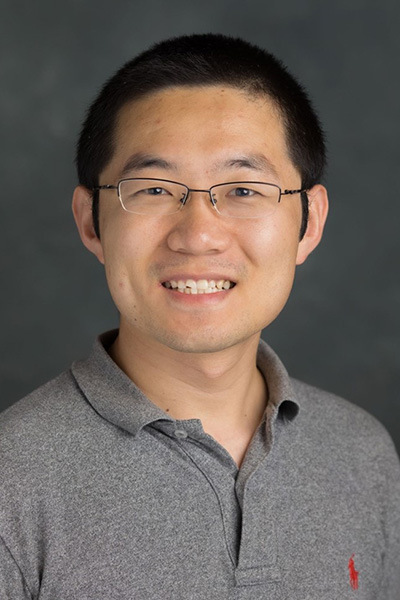
Xiangyu Liمشاهده پروفایل
استادیار
Dr. Xiangyu Li serves as an Assistant Professor in the Department of Mechanical, Aerospace and Biomedical Engineering at the University of Tennessee, Knoxville since August 2022, following a Postdoctoral Associate position at MIT's Department of Mechanical Engineering (2019-2022) where he researched building energy efficiency, radiative cooling, and water harvesting technologies. His academic foundation includes a PhD in Mechanical Engineering from Purdue University (2018) and a Bachelor of Science from Tsinghua University, Beijing (2012). This rigorous training underpins his interdisciplinary approach to sustainability challenges. Dr. Li's research tackles the water-energy-climate nexus through fundamental thermal science and materials innovation. His work spans: Radiative cooling for building efficiency (notably the Guinness World Record-holding 'whitest paint') Atmospheric water harvesting in arid environments Solar desalination and thermal energy storage systems High-temperature heat exchanger design using novel ceramics His methodology combines nanoscale thermal transport studies with scalable system engineering to address global sustainability challenges. Analysis of his 15 most recent publications reveals a strategic research trajectory: early work established foundational thermal transport principles in nanomaterials, while current research focuses on commercial-scale implementation of water/energy technologies. Key trends include machine learning integration for materials discovery, multi-cyclic atmospheric water harvesting systems, and standardization frameworks for radiative cooling performance assessment. Major recognitions include: 2021 R&D 100 Awards Finalist for radiative cooling technology Guinness World Record for developing the world's whitest paint (2021) Cover Article designation in ACS Applied Materials & Interfaces with global media coverage (BBC, CNN, WSJ) As an active scientific contributor, Dr. Li serves as reviewer for Nature Energy, Nature Communications, and other leading journals while co-chairing sessions at the Materials Research Society meetings. He directs the WISE Lab which bridges fundamental research with real-world water-energy solutions through industry partnerships and NSF-funded projects. The Water Innovation, Sustainable Energy (WISE) Lab under Dr. Li's leadership operates as an interdisciplinary hub where thermal science, materials engineering, and system design converge. Current initiatives include developing autonomous atmospheric water harvesters for drought-prone regions and high-efficiency thermal storage for renewable energy integration, with strong industry collaboration for technology transfer.