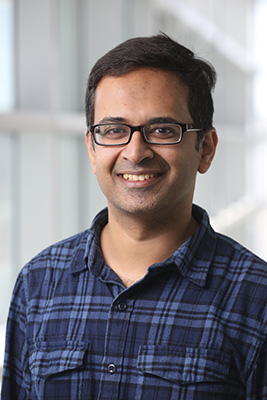
Shantanu Jadhav is a Professor of Psychology at Brandeis University, with affiliations to the Neuroscience Program, the Volen National Center for Complex Systems, and the Sloan-Swartz Center for Theoretical Neurobiology. He earned his B.Tech. from IIT Bombay, Ph.D. from UC San Diego, and completed postdoctoral training at UCSF and UC Berkeley. Research Focus: Neural mechanisms of learning, memory, and decision-making in rodent models Investigation of hippocampal-prefrontal interactions via multielectrode recordings, optogenetics, and computational analysis Role of neural oscillations (theta, gamma, sharp-wave ripples) in memory consolidation and cognitive flexibility Implications for neurological disorders like Alzheimer’s, autism, and schizophrenia Recent work highlights the coordination of dopamine activity with rule representations in the prefrontal cortex and hippocampus, the role of prefrontal ripples in suppressing hippocampal reactivation during sleep, and geometric transformations in cognitive maps enabling cross-environment generalization. His lab has shown that awake sharp-wave ripples are critical for spatial memory and that cross-region neural synchronization underpins memory-guided decisions. Scientific Recognition: Peter and Patricia Gruber International Research Award (2013) Sloan Research Fellow (2015-2017) NARSAD Young Investigator Award (2015-2018) Whitehall Foundation Award (2016-2020) SFARI Core Member (2022-2025) The Jadhav Lab at Brandeis trains postdoctoral fellows, graduate students (via the Neuroscience and Psychology Graduate Programs), and research assistants. Current studies explore hippocampal-prefrontal network dynamics, dopamine signaling in cognitive flexibility, and geometric representations in memory abstraction.