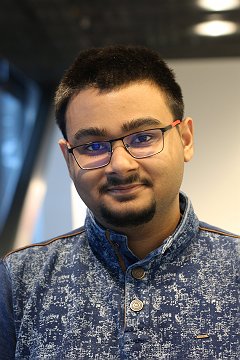
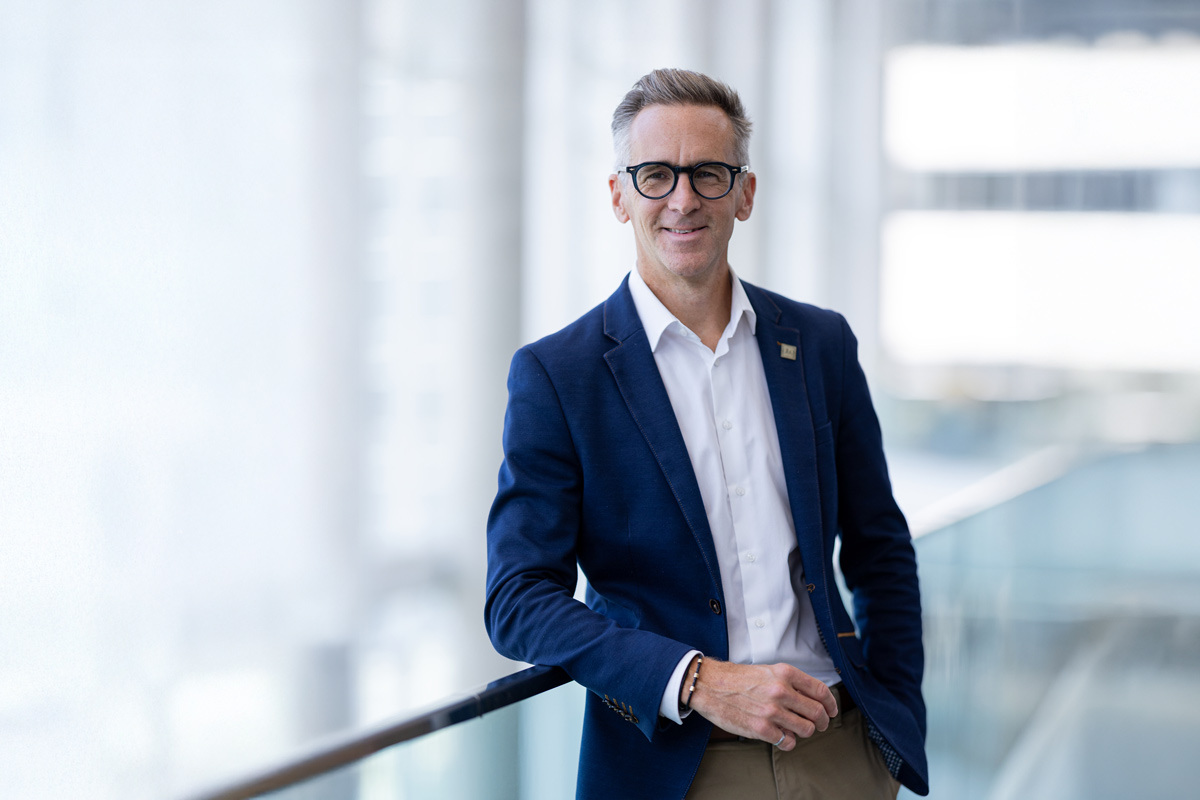
Steven S. Lumetta is an Associate Professor at the University of Illinois at Urbana-Champaign , affiliated with the Department of Electrical and Computer Engineering and Computer Science under the College of Engineering. He contributed to the deployment of the Blue Waters supercomputer and serves as Principal Investigator (PI) for the CompGen Major Research Instrumentation (MRI) Center . His research focuses on: Coherence models for high-core-count accelerators like Rigel 1000-core Development of software tools for automated feedback on programming assignments Supercomputing infrastructure design Hardware/software co-design methodologies Lumetta’s work bridges theoretical research and practical systems engineering, particularly in scalable computing systems. As PI for CompGen MRI Center, he leads efforts to advance computational genomics tools and infrastructure.
Richard Heininger is a Senior Lecturer at the Institute for Business Informatics - Communications Engineering at Johannes Kepler University Linz, where he teaches Communications Engineering courses and conducts research in cyber-physical systems and digital process engineering. His research interests include: Communications Engineering Cyber-Physical Systems Digital Process Twins Autonomy in Multi-Agent Systems Knowledge Management Process Engineering Professor Heininger maintains an active research profile with 22 documented research outputs including 13 conference proceedings, 5 peer-reviewed articles, and 4 book chapters. His recent publications demonstrate a strong focus on the intersection of human factors and technical systems, particularly in the areas of digital process twins, vulnerability management, and autonomy negotiation in multi-agent systems. His notable recent works include research on managing customer deviance in last mile logistics, human-centric negotiation mechanisms for multi-agent systems, and improving vulnerability management through process mining techniques. Professor Heininger is actively engaged in teaching, offering multiple Communications Engineering courses for the 2025W semester in various formats including lectures (VL), practical seminars (PS), and exercise sessions (UE and SE). His office is located in Science Park 3, 1st floor, Room S3 0153 at JKU.
Rachit Nigam serves as an Assistant Professor in the Department of Electrical Engineering and Computer Science (EECS) at the Massachusetts Institute of Technology's School of Engineering. He leads the FLAME Lab, focusing on the intersection of programming languages and computer architecture. His research profile demonstrates significant involvement in major programming languages conferences including PLDI, SPLASH, and ICFP, where he has served in various committee roles from Artifact Evaluation to Student Research Competition Chair. Dr. Nigam's research centers on programming languages and hardware systems, with particular emphasis on creating compilers that transform programs into architectures. His work bridges theoretical type systems with practical hardware implementation, developing tools like Calyx (an intermediate language for hardware accelerator generators) and Dahlia (implementing time-sensitive affine types). His approach combines formal methods with practical compiler design to address challenges in predictable accelerator generation and hardware compilation. His publication record reveals a consistent trajectory in hardware-aware programming language design, with recent work focusing on unifying static and dynamic intermediate languages for accelerator generators. The publications demonstrate expertise across multiple subfields including type systems for hardware timing constraints, modular hardware design methodologies, and synthesis-aided compiler techniques for specialized architectures like DSPs. As an active member of the programming languages community, Nigam has served on numerous conference committees including PLDI, OOPSLA, and LCTES. He has chaired sessions, organized tutorials (including 'DSL-based Hardware Generation'), and contributed to community initiatives like PL Tea. His GitHub presence shows active development in projects related to hardware compilation with significant contributions to repositories like Calyx, Filament, and Dahlia. Dr. Nigam leads the FLAME Lab at MIT, which focuses on creating programming models and compiler infrastructure for hardware acceleration. His work with the Calyx compiler ecosystem represents a significant contribution to the field of hardware accelerator generation, providing tools that enable more predictable and efficient hardware compilation processes. His research has practical implications for domain-specific hardware accelerators and the broader challenge of making hardware design more accessible through programming language techniques.
Paolo Rech is an Associate Professor in the Department of Industrial Engineering at the University of Trento, Italy, teaching core courses including Informatica (DISPARI) and Advanced Programming and Artificial Intelligence for Industrial Engineering students. His research spans hardware-software reliability under radiation exposure with emphasis on real-world applications. His primary research domains feature: Reliability Engineering : Pioneering fault-tolerance methodologies for radiation-prone environments Radiation Effects : Quantifying neutron/gamma impacts on GPUs, TPUs, and quantum devices Computer Architecture : Designing hardened RISC-V systems and post-CMOS accelerators AI Reliability : Developing fault-aware neural networks for safety-critical deployment Quantum Vulnerability : Characterizing error mechanisms in quantum circuits Analysis of his 15 most recent publications reveals a dominant focus on radiation-hardened computing systems, with 83% of works addressing neutron-induced faults in GPUs/TPUs and quantum devices. His methodology consistently integrates neutron beam experiments, fault injection frameworks, and architectural hardening techniques across space, medical, and autonomous systems applications. Scientific Awards: None documented in available sources. His teaching directly feeds into research supervision, with course content on C++ programming, object-oriented design, and quantum computing foundations forming the basis for student projects in fault-tolerant system development. Current grants likely support neutron irradiation testing and quantum reliability initiatives given publication patterns, though specific funding details aren't publicly itemized. He operates within University of Trento's engineering research ecosystem, collaborating with teams specializing in radiation testing and quantum computing through projects like ARCHYTAS and Trikarenos, though no dedicated lab name is specified in source materials.
Jean-François Boland is a Professor in the Department of Electrical Engineering at École de technologie supérieure (ÉTS), where he leads research in aerospace systems and embedded technologies through the LASSENA Laboratory. His expertise spans avionics, autonomous systems, digital design methodologies, and functional verification. Research Interests: Aeronautics & Aerospace : Flight control systems, radiation-hardened avionics, integrated modular architectures Intelligent Systems : Bipedal robot control, adaptive algorithms, autonomous navigation Digital Design : RTL verification, fault modeling, high-level synthesis His recent publications emphasize fault-tolerant aerospace systems , with 60% focused on radiation effects mitigation, 25% on autonomous robotics, and 15% on design methodologies. Key trends include AI-enhanced verification (2019), SEU-resistant flight controls (2013–2016), and bipedal locomotion control (2021–2022). Awards and Honors: Ambassadeur Honoraire (ÉTS, 2020) CNESST Safety Award & GREPCI Finalist (2017) CRIAQ Project Excellence Award (2012) Two ÉTS Teaching Excellence Awards (2011, 2013) He actively advises graduate students, with 16+ supervisees working on projects like fault-tolerant avionics and quadcopter control systems. Laboratory work at LASSENA emphasizes resilient embedded systems and aerospace-grade validation platforms.
John Wickerson is a Senior Lecturer in the Department of Electrical and Electronic Engineering at Imperial College London. His research spans formal methods, concurrency, and hardware/software synthesis. Academic Rank: Senior Lecturer Affiliation: Imperial College London His research interests include concurrency semantics, weak memory models, transactional memory, GPU and FPGA programming, and high-level synthesis for hardware accelerators. These areas intersect formal verification, programming language design, and hardware-software interface optimization. The publications of John Wickerson reflect trends in formalizing memory models, improving hardware synthesis reliability, and testing concurrency frameworks. His work addresses challenges in quantum compiler validation, GPU workgroup progress, and weak memory persistency across Intel, ARM, and C++ architectures. He actively contributes to academic communities as a Publicity Co-Chair and Session Chair in conferences like POPL and as a Committee Member in SPLASH and PLDI. His GitHub repository activity and X (Twitter) presence further demonstrate his engagement in technical dissemination.
Vladimir Getov is a Professor at the University of Westminster with extensive international affiliations including Honorary Professor at Technical University of Sofia and Visiting Lab Fellow at Pacific Northwest National Laboratory. His leadership roles span the IEEE Computer Society (Governor since 2015), CoreGRID/ERCIM Working Group (Topic Leader 2009-2015), and multiple editorial positions including Area Editor for High Performance Computing at IEEE Computer. His research centers on Performance Analysis and Engineering, Energy Efficient Computing, and Parallel and Distributed Architectures with significant contributions to cloud computing, wireless sensor networks, and component-oriented design. Recent work focuses on energy-drain attack prevention in MAC protocols and application-specific thermal modeling for multi-core processors. Key awards include the Bulgarian National Scientific Award 'Pythagoras' (2009), IEEE Computer Society Certificates of Appreciation (2008, 2010), and CoreGRID Outstanding Contribution Award (2008). His publication record spans 35+ years with over 100 papers including the 2024 IEEE ICAI conference paper on electronic digital computing history. As leader of the Distributed and Intelligent Systems Research Group since 1996, he has supervised 7 PhD students to completion with frameworks like AGOCS cloud simulator and TunableMAC protocol. His EU project leadership includes CoreGRID (2004-2009) and GridCOMP (2006-2010), securing sustained research funding including Daiwa Foundation support (2017) for low-energy co-design methodology.
Shing-Chi Cheung is a Professor of Computer Science and Engineering at the Hong Kong University of Science and Technology (HKUST), School of Engineering. He founded the CASTLE research group and co-founded the International Workshop on Automation of Software Testing (AST) in 2006. His leadership includes serving as General Chair of FSE 2014 and chairing multiple APSEC conferences. His research focuses on software quality enhancement through program analysis, testing, debugging, and AI techniques, targeting Android apps, open-source software, deep learning systems, smart contracts, and spreadsheets. Current projects include metamorphic testing frameworks, binary analysis tools, and vulnerability detection systems for emerging technologies. His publication portfolio demonstrates consistent contributions to software engineering since 2016, with recent work emphasizing AI-integrated testing methodologies, smart contract security, and deep learning system reliability. Key trends show increasing focus on cross-language analysis, data visualization quality, and compiler-level verification for modern software stacks. Distinguished Member of the ACM Fellow of the British Computer Society Editorial board member: Science of Computer Programming (SCP), Journal of Computer Science and Technology (JCST) Former editorial board member: IEEE Transactions on Software Engineering (2006-2009), Information and Software Technology (2012-2015) Four patents in China and the United States Cheung actively mentors through the CASTLE research group and serves on program committees for major conferences including ICSE, ESEC/FSE, and ISSTA. His work bridges academic research with practical applications through industry collaborations and tool development. He has contributed to numerous workshops and symposia as steering committee member and program chair.