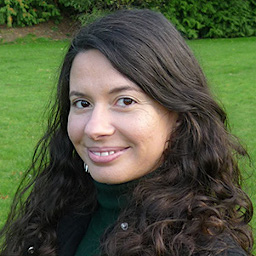
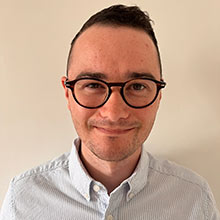
Dr. Daniel Berio is a researcher at Goldsmiths, University of London, specializing in computational models for human-like movement in digital art and robotics. His work bridges computer graphics, cognitive psychology, and robotic manipulation, focusing on stylized stroke generation, graffiti analysis, and kinematic modeling. He collaborates with Frederic Fol Leymarie and Rejean Plamondon, utilizing the Sigma Lognormal model to simulate human handwriting dynamics. Education : Doctoral thesis on AutoGraff (2021), exploring computational understanding of graffiti and calligraphy. Research Themes : Human-like motion in digital art, kinematic reconstruction from static traces, robotic graffiti generation, and perceptual fluency in aesthetic evaluation. Publications : 15+ works since 2015, spanning ACM Transactions on Graphics, British Journal of Psychology, and conferences like MOCO and IROS. Applications : Font stylization tools, synthetic graffiti generation, compliant robot control, and semantic typography systems.
Susana Araújo serves as Associate Researcher at CICPSI Research Unit within the University of Lisbon's Faculty of Psychology. She coordinates the Cognition in Context Group (CO2) since 2023 and holds Senior Investigator status in the Memory & Language team, specializing in neurocognitive mechanisms of reading acquisition and disorders using EEG-ERPs and eye-tracking methodologies. Education: PhD in Experimental and Cognitive Psychology (University of Algarve, Portugal; Donders Institute, Netherlands) Postdoctoral Fellowships (2012-2017) Her research critically examines literacy's impact on cognitive systems through investigations of visual word recognition , reading disorders , and rapid automatized naming . Current work explores how handwriting training influences graph recognition and identifies neurophysiological markers of dyslexia using multimodal assessment tools. Publication trends reveal sustained focus on cross-population comparisons (literate/illiterate adults) and meta-analytic approaches to naming-speed deficits. Her work bridges cognitive neuroscience with educational interventions, particularly in developmental dyslexia contexts. Scientific Recognition: FCT Postdoctoral Fellowship (2012-2017) FCT-Investigator Starting Grant (2017-2021) with highest Career Development score FCT CEEC-Ind Individual Contract She directs multiple FCT-funded projects including LEMON (2020-2024; €158,684) as Principal Investigator and VOrtEx (2018-2021; €183,590) as Co-PI. Her grant portfolio spans developmental dyslexia characterization, orthographic processing, and statistical learning deficits across eight funded projects since 2007. As CO2 Group Coordinator, she integrates multiple research teams under CICPSI while maintaining collaboration with the Max Planck Institute for Psycholinguistics where she served as Visiting Researcher in 2015.
Kera B Ackerman is an Associate Professor at the University of Kentucky in the Department of Early Childhood, Special Education, and Counselor Education. Her work focuses on special education, evidence-based practices, and rural education, with a strong emphasis on inclusive classrooms and interventions for students with intellectual disabilities and behavioral disorders. Doctor of Philosophy (2017), University of Kentucky Master of Science in Education (1999), University of Akron Her research explores inclusive education , reading fluency interventions , and co-teaching strategies . She leverages technology and peer coaching to enhance engagement and outcomes for students with disabilities, particularly in rural settings. The 15 most recent publications highlight her dedication to special education through digital tools , peer collaboration , and rural policy analysis . Notable topics include literacy strategies for students with intellectual disabilities, co-teaching efficacy, and systemic support for inclusive classrooms. Scientific Awards : Nietzel Visiting Distinguished Faculty Program Award, 2017 Grants and Projects : Dr. Ackerman has led initiatives like the IHE Special Education Consortium (FY25–FY26) and the KEEP project (2024–2027), focusing on evidence-based teacher preparation and urban-rural educational equity.
Karen Ray is a registered occupational therapist and Lecturer at the School of Health Sciences, College of Health, Medicine and Wellbeing, University of Newcastle . With over 30 years of experience, she specializes in school-based mental health, pediatric services, and interventions to enhance student participation and well-being. Doctor of Philosophy in Occupational Therapy, University of Newcastle Bachelor of Applied Science in Occupational Therapy, University of Sydney Her research focuses on child development , handwriting fluency , and co-teaching practices in school settings. Her work includes developing the Write Start-K intervention, which integrates cognitive and perceptual-motor strategies to improve early literacy and handwriting. Karen’s publications (2021–2025) emphasize handwriting readiness , trauma-informed practices , and literacy development in digital-native children. Her articles highlight collaborations with educational institutions and international impact. Awards 2021: HDR Publication of the Year, School of Health Sciences Karen leads grants funded by the University of Newcastle, focusing on assessment tools and intervention efficacy. She teaches courses such as Communication for Occupational Therapy Practice and Children, Youth and Families: An Occupational Approach .
Sabrina Gerth is a Professor for Digital Education in Primary Schools with a focus on language at the University of Teacher Education Tyrol (PHT). She leads the Institute for Primary Education and holds a formal role as deputy head of the Federal Focus on German in Primary School. Her academic career includes roles at institutions such as the University of Potsdam and the University of Helsinki, with research extending from 2007. Gerth’s work focuses on digital media’s impact on literacy acquisition, inclusive language education, and teacher training in primary education. She actively contributes to conferences globally, publishes in journals like Children and Cognitive Neurodynamics , and leads EU-funded projects like PIVOT and INNALP Edu Hub. Key research areas include handwriting biomechanics, audiobook integration in reading, and virtual reality in teacher education. Education & Career: PhD in Cognitive Science (unspecified year) Professor at PHT since 2024 Postdoc at University of Potsdam (2014–2022) Research roles at multiple universities since 2010 Research Interests: Gerth’s work explores how digital tools enhance literacy and language learning. Recent studies include electromyographic analysis of tablet-based writing, cross-cultural writing acquisition comparisons, and inclusive education strategies for multilingual students. She emphasizes bridging teacher training with practical digital media use. Publications Trends: Her articles (15 most recent listed) highlight themes such as handwriting mechanics, audiobook impacts on reading fluency, and VR-based teacher training. Keywords include educational technology, primary education, and cognitive development. Grants & Projects: PIVOT (EU Erasmus+, 2024–present): Inclusive instruction strategies INNALP Edu Hub (Austrian FFG, 2022–2025): Alps-focused educational projects VIRTUOUS (EU Erasmus+, 2021–2023): Teacher behavior management in virtual environments Labs/Teams: Coordinates the Wunderstift Learning Studio, investigating digital tools like smart pens and audiobooks in primary classrooms. Collaborates with institutions like University of Innsbruck and University of Nicosia on interdisciplinary projects.
Dr. Mitchell Longstaff is a Lecturer in the Faculty of Health at Southern Cross University with international teaching and research experience at institutions including Arizona State University and University of Greenwich. His research in cognitive psychology examines fundamental and applied cognition including working memory, eyewitness memory, motor control, and psychomotor skills. Key research areas: Dual-task performance and attentional mechanisms Evolutionary perspectives on cognitive sex differences Forensic applications including eyewitness testimony reliability Neurological influences on motor skills like handwriting and drawing His work has practical implications in education, forensics, ergonomics, and neurological assessment. He teaches Psychology Seminars, Learning and Memory, and Introduction to Psychology units, and supervises multiple Honours, Masters, and PhD students annually.
K. Mark Derby is a Professor in the Department of Special Education at Gonzaga University, where he has worked since 1996. He holds a Ph.D. in School Psychology from the University of Iowa and is a Licensed Psychologist in Washington State. His professional roles include Clinical Director of the Northwest Center for Applied Behavior Analysis and active participation in university committees such as the Faculty Benefits Committee and School of Education Assessment Committee. Education : A.A. from Spokane Falls Community College, B.A. in Psychology from Eastern Washington University, and Ph.D. in School Psychology from the University of Iowa. Dr. Derby specializes in Applied Behavior Analysis and School Psychology , with research focusing on severe behavior problems, functional behavioral assessment, academic interventions, and medication trials. His work addresses autism spectrum disorders, developmental disabilities, and learning disabilities through behavioral strategies like functional communication training, token economies, and direct instruction flashcards. He has published extensively on educational interventions for students with disabilities, including studies on handwriting, spelling, math, and reading comprehension. Recent publications highlight his contributions to Direct Instruction methods, Reading Racetracks , and Functional Communication Training . He has collaborated with colleagues such as T. F. McLaughlin, K. P. Weber, and R. L. Williams. Grants from the Washington State Campus Compact and Higher Education Coordinating Board (e.g., "Garfield & Friends" projects) underscore his community engagement. Dr. Derby also serves as a guest reviewer for journals like Journal of Applied Behavior Analysis and Education and Treatment of Children . His community service includes consulting for children with autism and severe behavioral issues, clinical direction for the Northwest Center for Applied Behavior Analysis, and involvement in service-learning projects like the "Kids on the Block" puppet show. Dr. Derby’s work bridges academic research and practical applications, emphasizing collaboration with families and schools.
Dr. Olivia Afonso is a Senior Lecturer in Psychology at the School of Psychology, Social Work and Public Health at Oxford Brookes University. She holds a BSc in Psychology and a PhD in Cognitive Neuroscience and Education. As Year 1 Lead for the BSc Psychology program, she teaches modules including 'Introduction to Psychological Research' and 'Topics in Developmental Psychology,' while supervising MSc and PhD students. Her research focuses on written language production, particularly spelling processes and handwriting cognition in both typical and atypical populations, including dyslexia, aging, and bilingualism. She leads the Writing Lab and collaborates with the SRUK/CERU research network. Her research investigates cognitive processes underlying spelling and handwriting, comparing handwriting vs. typewriting, and analyzing online measures like pen pressure and writing duration. Notable projects include evaluating AI reading assistants in Northern Ireland (funded by the Department of Education) and studying handwriting development in children with dyslexia. She has published extensively in journals like Brain and Cognition , Journal of Learning Disabilities , and Cognitive Science . Professional Memberships: Fellow of HEA, European Literacy Network, EARLI Writing SIG, National Handwriting Association Executive Committee, BPS Cognitive Section Executive Keynote Talks: 'Influences of spelling on handwriting speed' (National Handwriting Association, 2021), 'How we learn to write' (Royal Society of Medicine, 2021) Dr. Afonso's work bridges cognitive science and education, addressing practical applications for literacy support and neurorehabilitation. Her studies often employ cognitive-kinematic analysis to link high-level language processing with motor execution during writing.
Professor Vincent Connelly is a Professor of Psychology and Programme Lead for Psychology at Oxford Brookes University’s School of Psychology, Social Work and Public Health. He oversees strategic development of psychology programmes for 400+ students, integrating academic, technical, and administrative teams. Externally, he represents the university in the Association for Heads of Psychology Departments and serves as the British Psychological Society’s Director of Teaching and Learning. Research Interests : Armed Forces Organizational Psychology : Focuses on Reservists, Veterans, and 'Whole Force' integration. Key projects include family welfare support, military-civilian life balance, and veteran societal perceptions. Writing & Reading Development : Investigates writing difficulties in children with dyslexia and developmental language disorders. Includes interventions like sentence-combining and spellcheck usage. Grants & Collaborations : Lead/co-investigator on ESRC-funded studies on NHS teams, military reservists, and veteran integration. Collaborations with King’s Centre for Military Health Research and international institutions on defense and education topics. Professional Contributions : Member of Expert Advisory Group for UK Veterans Family Study and Academic Advisory Board for Forces in Mind Trust. Edited volumes on reading/spelling (e.g., Contemporary Perspectives on Reading and Spelling ) and military reservist dynamics. Teaching & Mentorship : Supervised doctoral students on topics ranging from veteran public perception to dyslexic writing strategies. Active in curriculum development and educational policy advocacy.
Adrea Truckenmiller is an Associate Professor in the Department of Counseling, Educational Psychology & Special Education (CEPSE) at Michigan State University (MSU). Her primary academic affiliations include the College of Education and CEPSE. She holds a Ph.D. from Syracuse University. Truckenmiller specializes in special education, school psychology, and multi-tiered systems of support (MTSS), having co-developed the MTSS MA degree program. Her research focuses on improving assessment-driven decision-making in literacy and writing instruction, particularly in K-12 settings. She has secured over $5 million in extramural grants and contracts, with 25+ peer-reviewed publications. Truckenmiller also serves on editorial boards for reading journals and school psychology publications, and contributes to the Lexia Educational Leadership Council. Her professional background includes directing research at the Florida Center for Reading Research and Regional Education Laboratory Southeast, as well as coaching district-wide positive behavior support programs at the Devereux Center for Effective Schools. Truckenmiller collaborates closely with school districts to ensure equitable access to evidence-based instruction through MTSS frameworks. Her work highlights the intersection of assessment validity, instructional design, and systemic equity in education. Education: Ph.D., Syracuse University Grants: Over $5 million in extramural funding Editorial Roles: Multiple school psychology and reading journal boards Leadership: Lexia Educational Leadership Council Truckenmiller’s research interests emphasize literacy screening assessments, writing fluency, and MTSS implementation. She critiques commercial assessment tools and advocates for cost-effective, data-informed interventions. Her recent articles analyze reading comprehension validity, writing automaticity, and pandemic-era special education identification trends. While no specific awards are listed, her extensive grant portfolio and publication record reflect her scholarly impact.
Jennifer Neyman is a Senior Lecturer in the Special Education & Applied Behavior Analysis Department at Gonzaga University, where she teaches evidence-based instruction, inclusive practices, behavior management, and response-to-intervention strategies. She also oversees the Early Childhood Special Education Program and directs the on-campus Integrated Lab Preschool, providing inclusive education for young children with and without disabilities. Education: B.Ed., Special Education, Gonzaga University M.Ed., Special Education, Gonzaga University Her research and teaching focus on applied behavior analysis and academic interventions in special education. She emphasizes bridging theory and practice through action research, guiding both undergraduate and graduate students in designing and implementing evidence-based strategies. Her work spans interventions in reading, mathematics, spelling, handwriting, behavior management, and communication for students with diverse disabilities including autism, intellectual disabilities, and learning disabilities. Her recent publications and conference presentations (2023–2024) demonstrate a consistent focus on direct instruction methods such as flashcards, racetrack procedures, model-lead-test, token economies, and precision teaching. These studies target skill acquisition in academic, behavioral, and life skills domains across preschool, elementary, middle, and high school settings. The research often involves students with autism spectrum disorder, learning disabilities, ADHD, and developmental delays, primarily in self-contained or inclusive classrooms. Scientific Awards: No awards listed in the provided text. Jennifer Neyman actively mentors students, co-authoring numerous research projects with them, particularly through undergraduate research conferences such as the Spokane Intercollege Research Conference. She emphasizes field supervision and maintains strong connections with K–12 classrooms. She also contributes to college-level instruction by promoting data-based decision-making among teacher candidates. Her work is deeply rooted in practitioner-focused, behavior-analytic approaches to improving educational outcomes for individuals with special needs. She leads the Integrated Lab Preschool, an on-campus facility that serves as both an educational program for young children and a training ground for future special educators. This lab supports experiential learning and applied research in early childhood special education and inclusive practices.
Dr. Mark Derby is a Professor in the Department of Special Education at Gonzaga University's School of Education, where he has served since 1996, progressing from Assistant Professor to Full Professor by 2004. He also serves as Clinical Director of the Northwest Center for Applied Behavior Analysis since 1998. His academic journey began with an AA from Spokane Falls Community College, followed by a BA in Psychology from Eastern Washington University, and culminated with a PhD in School Psychology from the University of Iowa. Prior to Gonzaga, he completed postdoctoral work at Johns Hopkins University. Dr. Derby's research focuses on evidence-based interventions for children with disabilities, particularly examining effective teaching methods for students with autism spectrum disorders and developmental disabilities. His work emphasizes practical applications of behavioral principles in educational settings, with significant contributions to academic interventions (particularly in reading, spelling, and math), functional behavioral assessment, and treatment of severe behavior problems. He has developed numerous intervention protocols that have been validated across multiple studies with diverse student populations. His extensive publication record demonstrates consistent research productivity, with over 100 peer-reviewed articles primarily investigating direct instruction methods, flashcard procedures, cover-copy-compare techniques, and other evidence-based practices for students with learning and behavioral challenges. His work often involves collaboration with graduate students, reflecting his commitment to research mentorship. Dr. Derby has secured significant external funding for his work, particularly through grants from United States Youth Hockey for disability hockey programs and from Washington State Campus Compact and the Higher Education Coordinating Board for community-based projects. His service to the profession includes editorial roles with the Journal of Applied Behavior Analysis and Education and Treatment of Children. As an educator, Dr. Derby teaches courses including Exceptional Children and Autism. He maintains an active research program while serving in various university committees, including as Faculty Senator and Coordinator of the Masters in Special Education Program. His professional activities bridge academic research with clinical practice through his role as Clinical Director at the Northwest Center for Applied Behavior Analysis.
Dr Cameron Downing is a Lecturer in the Department of Education at the University of York. He holds a PhD in Psychology and completed post-doctoral training at Bangor University. Prior to his current role, he taught at Bangor University and Leeds Trinity University. Education: PhD in Psychology Post-doctoral training at Bangor University Dr Downing's research focuses on understanding typical and disordered reading and writing development. Key areas include: the co-development of spelling and handwriting skills, disorders like dyslexia affecting literacy acquisition, and the creation/evaluation of school-based assessment and intervention tools. His methodological approach combines correlational studies and experimental designs, including randomized controlled trials. Recent research outputs include the development of the Spelling and Handwriting Legibility Test (SaHLT), investigations into remote literacy instruction efficacy, and studies on handwriting fluency correlations with cognitive skills. His work bridges cognitive psychology and educational practice, emphasizing practical applications for teaching professionals. Scientific Awards & Funding: Economic and Social Research Council (ESRC) Welsh Government Nuffield Foundation Waterloo Foundation Dr Downing supervises PhD students interested in literacy development disorders, educational interventions, and assessment tool validation. His laboratory work focuses on creating evidence-based literacy solutions for schools. Contact: cameron.downing@york.ac.uk, D/L/207, Department of Education, University of York, YO10 5DD, UK.
Barbara Urszula Gawda is a Professor and Head of the Department of Psychology of Emotions and Personality at the Institute of Psychology, Faculty of Education and Psychology, Maria Curie-Skłodowska University (UMCS) in Lublin, Poland. She has been with the Institute of Psychology at UMCS since 1992 and maintains active office hours on Tuesdays and Wednesdays. Her position as department head demonstrates her leadership within the academic institution. Professor Gawda specializes in psychology of emotions and motivation, personality psychology, and clinical psychology. Her research focuses on narrative psychology, cognitive representations of emotions, emotional concepts, psychopathology (particularly of emotions and personality), and forensic psychology. She has developed innovative assessment techniques including emotional verbal fluency methods to study emotional scripts and concepts. Her work bridges cognitive, clinical, and forensic psychology with applications in understanding personality disorders, emotional processing, and neural correlates of emotional experiences. Professor Gawda's recent publications reveal a strong trajectory toward neuroscientific approaches to emotion research, with increasing use of functional near-infrared spectroscopy (fNIRS) to examine neural correlates of emotional processing. Her work consistently explores the structure of emotional concepts (particularly love, fear, and hate) using verbal fluency techniques. A significant theme in her recent research is the investigation of existential concepts like existential vacuum and how protective factors such as curiosity and love serve as buffers against anxiety. She has also expanded her focus to examine digital generations' emotional processing and mental health. Professor Gawda has successfully led research projects including a National Science Center grant (2012-2015) titled 'Affective, cognitive and neural mechanisms of verbal fluency.' She has presented her work at 118 scientific conferences, including 31 international ones, demonstrating extensive scholarly engagement. Her research collaborations include work with A. Korniluk, M. Chojak, and N. Jach-Salamon on emotional processing and personality studies. She maintains active involvement with neuroimaging facilities, particularly those utilizing fNIRS technology, and has developed specialized assessment tools like the Verbal Fluency Test for adults.
Florence Bara is an Associate Professor at Université Toulouse Jean Jaurès , affiliated with the Cognition, Langues, Langage, Ergonomie (CLLE) laboratory. Her research focuses on learning psychology , developmental psychology , and multisensory educational tools , particularly for children aged 4-10 with and without disabilities. She leads the TACTILIVR project (supported by FIRAH) to develop tactile books for early intervention and inclusive education, and participates in initiatives like NUMEC (ANR-FQRSC) for digital writing tools. Her work combines quantitative statistical analyses and qualitative methods (interviews, video analysis) to improve teaching strategies. Key research areas: Educational Psychology, Multisensory Learning, Special Education Recent projects: TACTILIVR (tactile books), NUMEC (digital writing), handwriting studies Collaborations: CLLE, Université Toulouse Jean Jaurès, international partners in Quebec and Rwanda Her publications from 2025-2014 include studies on: Haptic perception in developmental disorders Tactile pictogram design for blind children Motor-cognitive integration in early writing Participatory research for inclusive education Comparative studies across France, Quebec, and Rwanda Handwriting training interventions