Lennart Svensson is a Professor at Chalmers University of Technology in the Signal Processing research group. His work focuses on nonlinear filtering, multi-object tracking, Bayesian statistics, and deep machine learning with applications in autonomous systems and sensor fusion. Research Interests Nonlinear Filtering and Bayesian Inference Multi-Object Tracking and Sensor Fusion Deep Learning for Autonomous Systems Performance Metrics (GOSPA, T-GOSPA) Lidar-Camera Fusion and Radiance Fields 5G SLAM and mmWave Sensing Publications Trends Recent work emphasizes uncertainty-aware multi-object tracking metrics, trajectory estimation using Poisson Multi-Bernoulli Mixtures, and sensor fusion techniques for autonomous driving. His research integrates Bayesian methods with deep learning for applications in automotive radar, lidar, and 5G positioning systems. Contact Email: lennart.svensson@chalmers.se
Professor Boris Konev is a faculty member at the University of Liverpool, affiliated with the School of Electrical Engineering, Electronics and Computer Science. He holds the academic rank of Professor in Computer Science. Description Logics Ontologies Automated Reasoning Temporal Logic Formal Verification Encrypted Database Applications His recent research focuses on temporal queries mediated by ontologies, knowledge evaluation agents using large language models, and semantic modularity in description logics. Key sub-fields include LLM applications, encrypted databases, and formal verification techniques. He has contributed to software development projects and industry partnerships, including design of equine simulators and online services with Racewood Limited. Current teaching includes the Foundations of Computer Science module (COMP109). Professional roles include guest editorships for AI Communications and program committee membership for the European Conference on Logics for Artificial Intelligence (JELIA).
Norman Kerle is a Professor at the Faculty of Geo-Information Science and Earth Observation (ITC) of the University of Twente, holding the chair of Geoinformatics for Disaster Risk Management within the Earth Systems Analysis department. He earned Masters degrees in geography from the University of Hamburg and Ohio State University, and a PhD in volcano remote sensing from the University of Cambridge (2002). His research spans volcanology, landslide detection, and quantitative geomorphology, with a focus on object-oriented remote sensing methods for disaster risk management. He leads the ITC Object-Based Image Analysis research group and coordinates EU-funded projects like RECONASS and INACHUS , emphasizing UAV-based structural damage mapping. Recent work includes post-disaster recovery assessment using remote sensing and macro-economic modeling. His scientific contributions include over 221 research outputs (peer-reviewed articles, book chapters, conference papers) and datasets such as Evaluating Resilience-Centered Development Interventions with Remote Sensing (2020). He has received the 2011 Lloyd's Science of Risk Prize (Natural Hazards) and served as Associate Editor for journals like Remote Sensing and Natural Hazards and Earth Systems Sciences . Prof. Kerle’s professional affiliations include the European Geosciences Union (EGU), American Geophysical Union (AGU), International Society for Photogrammetry and Remote Sensing (ISPRS), and Remote Sensing and Photogrammetry Society (RSPS). He has examined PhD theses and reviewed proposals for Horizon 2020, STEREO, and UNESCO.
Mehtaab Sawhney is a Clay Research Fellow and a tenure-track assistant professor at Columbia University specializing in combinatorics, probability, analytic number theory, and theoretical computer science. His academic journey began at the University of Pennsylvania where he enrolled in a Bachelor of Engineering in Computer Science (2016-2017), then continued at MIT where he earned a Bachelor of Science in Mathematics with Minor in Computer Science (2017-2020), followed by a Doctor of Philosophy in Mathematics (2020-2024) under the advisorship of Yufei Zhao. His research spans probabilistic combinatorics, random matrix theory, additive number theory, and theoretical computer science. Sawhney's work bridges theoretical mathematics with computational applications, focusing on random structures, additive combinatorics, and spectral properties of discrete objects. His publications demonstrate a strong interdisciplinary approach that connects number theory with probabilistic methods to solve complex combinatorial problems. The analysis of his publication record reveals a consistent focus on foundational mathematical structures with applications across multiple domains. His work on random graphs, additive bases, and arithmetic progressions has established him as a leading researcher in modern combinatorics, often collaborating with prominent mathematicians including Ashwin Sah, Yufei Zhao, and Vishesh Jain. His research output shows remarkable depth and breadth, with contributions to both pure mathematics and theoretical computer science. 2024 Clay Research Fellow 2021 Frank and Brennie Morgan Prize for Outstanding Research in Mathematics by an Undergraduate Student (joint with Ashwin Sah) Churchill Scholar 2020 Best Student Paper STOC 2021 (Joint with Ryan Alweiss, Yang Liu) Best Student Paper ITCS 2022 (Joint with Yang Liu, Ashwin Sah) 2023 Hartley Rogers Jr. Prize 2022 Charles W. and Jennifer C. Johnson Prize (joint with Ashwin Sah) NSF Graduate Fellowship Sawhney has established a robust research program with significant contributions across multiple mathematical disciplines. His frequent collaborations with top researchers worldwide indicate an active and influential research network. While specific advisees aren't listed in available information, his extensive publication record with numerous co-authors suggests active mentorship of junior researchers through collaborative projects.
Dr. He Xu is a Visiting Professor in the Department of Engineering Science at the University of Oxford, with a focus on Biomaterials , Tissue Engineering , and Biomechanics . She previously worked at Shanghai Normal University, rising from lecturer (2014) to associate professor (2018) and full professor (2024). Education: BEng in Materials Science and Engineering (China University of Geosciences), DPhil in Biomedical Engineering (Shanghai Jiao Tong University, 2014) Her research explores: Biomaterials : Smart hydrogels, piezoelectric systems, and nanogenerators for therapeutic applications. Tissue Engineering : Innovations in intervertebral disc and tendon regeneration. Drug Delivery : Targeted activation, nitric oxide therapy, and bioelectronic systems. Her publications span 2021–2025 , combining Biomaterials , Nanotechnology , and Medical Imaging to address challenges in Diabetes , Cancer , and Cardiovascular Disease . Key collaborations include the 3DMed Interreg 2 Seas Consortium and work on rapid Covid-19 testing .
Cristina Bazgan is a University Professor at Université Paris-Dauphine, affiliated with LAMSADE (Laboratoire d'Analyse et Modélisation de Systèmes pour l'Aide à la Décision) within PSL University. Her office is located at P 409 with contact number 01 44 05 40 90. She maintains an active research profile with numerous publications spanning graph theory, combinatorial optimization, and multi-objective optimization. Professor Bazgan's research primarily focuses on graph theory and combinatorial optimization , with significant contributions to domination theory, network analysis, approximation algorithms, and multi-objective optimization. Her work bridges theoretical computer science and operations research, addressing fundamental problems in computational complexity while developing practical algorithmic solutions. She has made notable contributions to understanding graph partitions, community detection in networks, and the complexity of various optimization problems. Analysis of her recent publications reveals a strong trend in multi-objective optimization and parameterized complexity . Her work often explores the interface between theoretical computer science and operations research, with applications to network analysis and decision support systems. A significant portion of her research addresses the complexity and approximability of graph-theoretic problems, particularly those related to domination, community structure, and anonymization in networks. Professor Bazgan has co-authored the book Combinatorial Algorithms (2022) with H. Fernau and contributed chapters to authoritative works on combinatorial optimization. While specific scientific awards aren't mentioned in the available information, her extensive publication record in top-tier journals demonstrates significant recognition in her field. She maintains an active collaboration network, frequently working with researchers such as Vanderpooten D., Tuza Z., Chlebíková J., and Herzel A. Her research has practical applications in network security, social network analysis, and decision support systems. The LAMSADE laboratory, where she is based, focuses on decision support systems and operations research, providing an interdisciplinary environment for her theoretical and applied work.
Jan Majkutewicz serves as an Assistant lecturer at the Department of Computer Systems Architecture within the Faculty of Electronics, Telecommunications and Informatics at Gdańsk University of Technology. His academic position focuses on advancing computational methodologies in natural language processing and knowledge representation systems. His research spans Natural Language Processing, Machine Learning, and Knowledge Representation with specific expertise in Large Language Models and graph-based embeddings. Current work investigates human-AI alignment through historical text analysis and neural representations of semantic hierarchies. Methodological innovations include cost-effective preference dataset generation and category graph embedding techniques that preserve structural relationships in knowledge bases. Publication analysis reveals consistent specialization in NLP and knowledge representation. The 2025 EditPrefs framework leverages historical text edits to address dataset scarcity in preference learning, while the 2021 Wikipedia category embedding research demonstrates practical applications for taxonomy navigation and parent category prediction through neural graph representations.
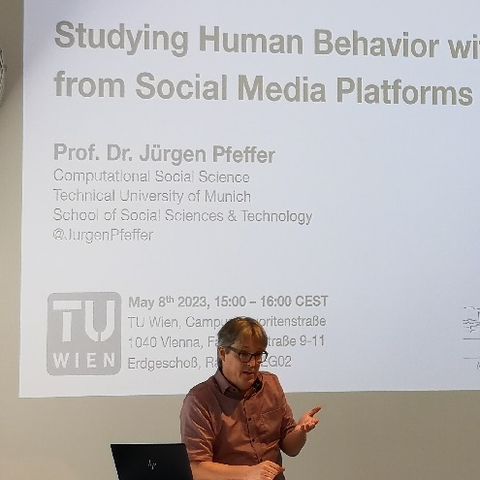
Jürgen Pfeffer is a Professor of Computational Social Science & Big Data at the Technical University of Munich's School of Social Sciences and Technology, with an additional appointment as Adjunct Professor at Carnegie Mellon University's Institute for Software Research. His interdisciplinary work bridges computer science and social science with a focus on analyzing large-scale socio-technical systems. His research expertise spans computational social science, network analysis, and big data methodologies. Pfeffer's work examines methodological, algorithmic, and theoretical challenges in analyzing dynamic social systems, with current projects focusing on modeling and detecting negative dynamics from social media, particularly online firestorms and hate speech against politically active women. His research combines network science approaches with computational methods to understand complex social phenomena. Pfeffer's publication record demonstrates significant contributions to the field since his 2010 doctorate, with high-impact papers in journals like Science and EPJ Data Science. His work on social media analysis, particularly the influential 2014 Science paper 'Social Media for Large Studies of Behavior' co-authored with Derek Ruths, has shaped methodological approaches in the field. His research shows consistent evolution from foundational network analysis to contemporary applications in political discourse, hate speech detection, and multi-layer network analysis. Hennig, M., Brandes, U., Pfeffer, J., & Mergel, I. (2012). Studying Social Networks. A Guide to Empirical Research Ruths, D., & Pfeffer, J. (2014). Social Media for Large Studies of Behavior Pfeffer, J., Morstatter, F., & Mayer, K. (2018). Tampering with Twitter's Sample API As an advisor and collaborator, Pfeffer has worked extensively with researchers including Raji Ghawi, Mirco Schönfeld, Momin Malik, and Kathleen Carley. His work demonstrates strong connections between theoretical network science and practical applications in social media analysis. His current research continues to address pressing issues in online discourse, with recent work focusing on hate speech classification, lexical change in negative word-of-mouth, and polarization dynamics in social media environments. Pfeffer leads the Pfeffer Lab, which focuses on developing methodological approaches for analyzing complex social systems through computational methods. His work has implications for understanding political legitimacy, social influence, and community dynamics in both online and offline contexts.
Jingling Xue is a Scientia Professor at the School of Computer Science and Engineering at the University of New South Wales (UNSW) in Sydney, Australia. As an IEEE Fellow of the Computer Society, he leads the Programming Languages and Compilers research group, focusing on practical applications of compiler optimization and program analysis techniques. His work bridges theoretical foundations with real-world software systems, particularly in developing open-source tools for large-scale program analysis. Professor Xue received his B.Eng and M.Eng degrees from Tsinghua University in 1984 and 1987, respectively, followed by a PhD from the University of Edinburgh in 1992. His academic journey has established him as a leading figure in programming languages and compiler technology. Xue's research spans programming languages, compiler technology, and program analysis with emphasis on practical relevance. His current projects include compiler techniques for improving parallelism and locality, pointer/alias analysis for million-line-scale programs, and static/dynamic analysis for detecting bugs and security vulnerabilities in real-world applications like web browsers and Android apps. His group actively develops open-source tools to support scientific replicability and reproducibility in these areas. His recent publications demonstrate a strong focus on applying program analysis techniques to modern challenges including AI compilers, homomorphic encryption, security vulnerability detection, and graph processing systems. The work shows evolution from traditional compiler optimization to addressing emerging domains like privacy-preserving computation and deep learning systems while maintaining rigorous theoretical foundations. Scientific Awards: Best Paper Award at CGO'13 Best Paper Award at CGO'16 Distinguished Paper Award at ECOOP'16 Distinguished Paper Award at ICSE'18 Distinguished Paper Award at ISSTA'19 Distinguished Paper Award at ASE'19 Distinguished Artifact Award at ISSTA'23 Best Artifact Award at FSE'23 Distinguished Paper Award at ASE'23 Test-of-Time Award at CGO'21 Professor Xue has successfully supervised 30 PhD students to completion, many of whom now work as professors or researchers in academia and industry. He has served as Program Chair for major conferences including LCTES'13, CC'18, CGO'20, and General Chair for LCTES'20. His group currently focuses on memory safety in Rust, smart contract analysis, AI compilers, compilation for privacy-preserving computation, and adversarial attacks in deep learning. The Programming Languages and Compilers group maintains strong connections with industry partners, translating theoretical advances into practical tools for real-world software development challenges. Their work on pointer analysis, memory safety, and compiler optimizations continues to influence both academic research and industrial practice.
Christian Winkler is Professor for AI-based UX optimization and general business administration at Nuremberg Institute of Technology since 2022. With over 25 years of experience spanning entrepreneurship, enterprise architecture, and academia, he brings substantial industry expertise to his academic role. His career includes founding multiple technology companies including an internet service provider (WWL Internet AG) that went public in 1999, Querplex GmbH through management buyout in 2003, and datanizing GmbH as an NLP SaaS provider in 2017. Professor Winkler's research focuses on practical applications of artificial intelligence in business contexts, with particular expertise in natural language processing, user experience optimization, and data-driven marketing strategies. His work bridges theoretical AI research with real-world business applications, emphasizing accessibility of complex technologies. He has published extensively on language models (including BERT and LLaMA implementations), text analysis techniques, and social media data analysis for business insights. Recent publications reveal a strong trend toward optimizing large language models for practical deployment, with significant focus on analyzing user-generated content from social platforms like Instagram and WallStreetBets. His work demonstrates how NLP can extract valuable business intelligence from unstructured data sources while making advanced AI techniques accessible to non-technical business professionals. Winkler teaches E-Commerce, International Marketing Tools - Quantitative Methods, Applied User Experience, and Communication Management, reflecting his interdisciplinary approach that combines technical AI knowledge with business administration expertise. He is an active contributor to the data science community through conference presentations at events like m3 Konferenz, MLsummit, and data2day, as well as educational content for Heise Academy on Python and NLP topics.
Sungsoo Ahn is an Assistant Professor at the Graduate School of AI, KAIST, where he leads the Structured and Probabilistic Machine Learning (SPML) Lab. His research focuses on developing machine learning algorithms for molecular science, particularly in drug discovery, material design, and generative modeling. He directs a team of 13 researchers (including 2 post-docs and 11 students) and maintains collaborations with institutions like Mila and industry partners. His core research integrates probabilistic machine learning , generative models , and AI for science , with applications spanning molecular dynamics simulation, language model reasoning, combinatorial optimization, and graph neural networks. Key methodologies include flow matching, diffusion models, GFlowNets, and equivariant neural networks applied to chemical and biological domains. Recent publications (2023–2025) demonstrate strong emphases on: (1) Molecular generation/optimization for drug design, (2) Enhancing reliability and reasoning in large language models, (3) Graph-based machine learning for scientific discovery, and (4) Efficient training paradigms for generative samplers. These appear predominantly in NeurIPS, ICML, ICLR, and ACL. He advises multiple PhD/master's students and post-doctoral researchers in the SPML Lab. Current research directions include torsion-aware molecular generation, causal AI safety, neural operators for quantum chemistry, and multi-agent systems for molecular optimization.
Qianqian Tong is an Assistant Professor in the Computer Science department at the University of North Carolina at Greensboro. Her research focuses on stochastic optimizations, sparse learning, federated learning, and privacy-preserving machine learning algorithms. She has developed novel methods for efficient optimization in deep learning and federated learning frameworks, including communication-efficient distributed algorithms and decentralized systems. Education: Ph.D. Computer Science and Engineering, University of Connecticut M.S. Computational Mathematics, Zhengzhou University B.S. Mathematics, Zhengzhou University Research interests include designing algorithms for sparse learning, federated learning with privacy guarantees, and applying deep graph learning to drug discovery. Recent projects involve tensor-based models for multidimensional data analysis and improving convergence in ADAM optimization. Her publications span optimization theory, federated learning systems, and molecular modeling applications. Though no awards are listed, her work demonstrates significant contributions to efficient machine learning methodologies. Teaching includes advanced courses on data science and computer science foundations. No lab affiliations or grant details are explicitly mentioned in the provided text.
Stefano Ferilli is a Professor of Computer Science at the University of Bari, Italy, where he leads the ARA (Apprendimento e Ragionamento Automatico) research lab within the Department of Computer Science. His academic roles include former Director of the Interdepartmental Center for Logic and Applications (CILA) and current head of the Artificial Intelligence & Intelligent Systems node in the CINI national laboratory. He holds a PhD in Computer Science and has been a key figure in advancing machine learning, logic programming, and digital library technologies. Education: Laurea (MSc equivalent) in Information Sciences (1996), Specialist Laurea in Computer Science (2003), and PhD in Computer Science (2001). His research focuses on foundational aspects of machine learning, multi-strategy reasoning, process mining, and applications in cultural heritage, bioinformatics, and smart environments. Research Contributions: Developed frameworks like INTHELEX (incremental theory learner), WoMan (process mining), and DoMInUS (document management). Over 370 publications, including a Springer monograph and multiple award-winning papers. Active in organizing conferences like ECML-PKDD, ICDM, and IRCDL, and serves on editorial boards of journals like Information Sciences . Projects: Led or participated in over 30 national and European projects, including EU-funded initiatives on digital libraries (COLLATE, DELOS) and AI applications. Collaborates with industries like Samsung and institutions like the Italian Police for traffic analysis and cultural heritage preservation. Awards: Recognized for outstanding peer review (MDPI, ECMLPKDD), best paper awards, and contributions to AI education and cultural heritage. Member of prestigious associations like AI*IA (Italian AI Society) and AICA (Italian Computing Society).
Enrico Franconi is a tenured full Professor in the Faculty of Engineering at the Free University of Bozen-Bolzano, Italy. He is the founder and director of the KRDB Research Centre for Knowledge-based Artificial Intelligence, established in 2002. His research focuses on applying database, AI, and semantic technologies to address challenges in information systems design, data integration, and big data analysis. He holds leadership roles including former Vice-Rector for Research (2005-2006) and director of the European Masters Program in Computational Logic (2004-2019). His academic contributions span Description Logics, knowledge representation, and ontology engineering, with a strong emphasis on theoretical foundations and practical applications. He has led numerous EU-funded projects, including ONTORULE and SeWAsIE, and contributed to international conferences as a program committee member and keynote speaker. His work bridges theory and practice, aiming to translate foundational results into real-world solutions. He is a prolific author with an h-index of 42 and has mentored researchers in areas like semantic web technologies and conceptual modeling. Key achievements include advancing ontology-driven data integration, developing tools like ICOM for conceptual modeling, and contributing to standards for semantic web languages. He is affiliated with the Computational Logic community and actively participates in international research networks such as CAIRNE. His research has been recognized through ANVUR evaluations ranking his department among Italy’s top computer science faculties.
Mehdi Toloo is a Reader in Business Analytics at the University of Surrey's Surrey Business School. He holds a BSc, MSc, and PhD, and is a docent. Previously, he was a Professor at Technical University of Ostrava (Czech Republic) and Sultan Qaboos University (Oman). His research focuses on Business Analytics, Operations Research, Data Envelopment Analysis (DEA), and Decision Analysis. He has supervised over 40 postgraduate students and contributed to top-tier journals like European Journal of Operational Research and Omega. He is an editor for journals including Computers & Industrial Engineering and Decision Analytics. Recognized globally, he ranks in the top 2% of scientists worldwide in Business Analytics & Operations Research (2020-2024). His research projects include performance evaluation with unclassified factors, economies of scope in network DEA, and selective measures in DEA. He collaborates internationally on projects like robust optimization and supply chain sustainability. His teaching spans undergraduate courses in Operations Research, Mathematics for Business, and Programming, alongside postgraduate modules on Quantitative Methods and Advanced DEA. His work bridges theoretical and applied research, with applications in healthcare, renewable energy, and public policy.