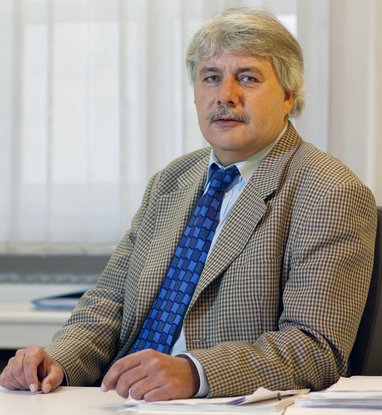
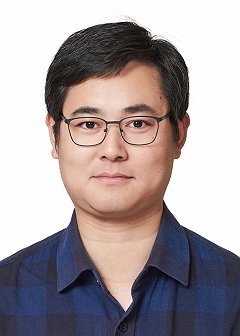
Wolfgang Huep serves as Professor and Vice Rector for Science and Research at Stuttgart University of Applied Sciences, where he leads institutional research strategy while maintaining active teaching responsibilities in the Surveying and Geoinformatics domain. His research focuses on Applied Geodesy and Measurement Technology , with significant contributions to spatial data acquisition systems and engineering surveying methodologies. These interests directly support infrastructure development and geospatial analysis applications within modern civil engineering contexts. As Vice Rector, Prof. Huep oversees all research initiatives and academic programs across the university. His leadership role involves strategic grant management and fostering interdisciplinary collaborations, though specific student advising records or funded projects aren't detailed in available sources. Contact occurs via office 2/210 with appointments required.
Karsten Hager serves as a Lecturer in Civil Engineering at Stuttgart University of Applied Sciences, teaching Sustainable mobility, Electromobility, Drones, Pollutant measurements, and GIS for the Bachelor of Civil Engineering program. His academic background includes: Bachelor and Master of Science in Geography from the University of Tübingen (2007-2013) Professional experience encompasses: Research Associate at the Institute of Urban Planning, University of Stuttgart (2013-2017) Managing Director of the Institute for City|Mobility|Energy (ISME) GmbH (since 2017) His research interests focus on sustainable urban systems, with emphasis on: Electric vehicle infrastructure and adoption Drone-based environmental monitoring Air quality assessment methodologies Geospatial analysis for transportation planning Integration of mobility and energy systems in urban contexts Through ISME GmbH, he directs applied research bridging academic theory with practical solutions for smart city development, particularly in sustainable transportation and energy-efficient urban design.
Reinhard Schinke is a Research Associate and Project Manager in the Research Area 'Built Environment - Resources and Environmental Risks' at the Leibniz Institute of Ecological Urban and Regional Development (IOER) in Dresden, Germany, a position he has held since 2011. He holds a Doctorate from Brandenburg University of Technology Cottbus and a Diplom-Ingenieur in Civil Engineering from TU Dresden, specializing in structural engineering. His research focuses on flood and groundwater risk analysis, climate change adaptation strategies, vulnerability assessment of built environments, and development of damage simulation models. Key areas include: Flood resilience technologies for buildings and infrastructure GIS-based flood damage estimation for urban and agricultural systems Monetary valuation of flood prevention measures Groundwater inundation impacts and mitigation Schinke has contributed significantly to interdisciplinary projects like INCREASE (social resilience in climate change) and KlimaKonform (municipal climate adaptation). His publication trends show consistent focus on refining flood damage models, developing geospatial risk assessment tools, and evaluating structural adaptation measures across European case studies. Awards: DAAD Research Fellowship (2011) at University of Western Ontario, Faculty of Engineering He actively participates in expert networks including the BWK (German Association for Water, Waste Management and Cultural Building) working group on high groundwater levels, contributing to technical guidelines and flood risk management frameworks.
Prof. Dr. Jochen Kubiniok is a Professor and Chair Holder at Saarland University's Physical Geography and Environmental Research department, located at the Dudweiler campus. His academic leadership position oversees research and teaching focused on the critical intersection of physical geography and environmental science, with particular emphasis on aquatic systems and landscape processes in the Saarland region and beyond. Prof. Kubiniok's research interests span multiple environmental disciplines, with primary focus on aquatic morphology and river ecology . His work examines environmental changes under climate change and anthropogenic activities , with methodological expertise in environmental analysis , applied geoinformatics , soil science , geomorphology , and remote sensing . His publications reveal a strong commitment to understanding landscape processes, water systems, and human-environment interactions, particularly in the Saarland region. Analysis of Prof. Kubiniok's recent publications (2013-2022) shows a consistent research trajectory focused on environmental systems, with particular emphasis on water quality, soil-landscape relationships, and anthropogenic impacts. His work frequently examines nitrate and pesticide pollution in spring waters and headwater streams, soil erosion processes, and the connections between land use practices and water quality . There is also significant research on forest ecology , primary forest degradation in Southeast Asia, and the potential of renewable energy in mountain regions. His methodological approach combines field observations with geospatial analysis to address complex environmental questions. Prof. Kubiniok maintains extensive collaborations with various organizations, including ministries, state agencies, environmental protection organizations, engineering firms, and the European Cultural Park Bliesbruck-Reinheim. These partnerships facilitate the integration of research and teaching, ensuring a practice-oriented program of study that addresses real-world environmental challenges. His cross-border cooperation with French institutions through the European Cultural Park Bliesbruck-Reinheim demonstrates his commitment to international environmental research and management approaches.
Jie Liu is a Researcher at the Institute of Software, Chinese Academy of Sciences and a Professor and Doctoral Supervisor at University of Chinese Academy of Sciences. He is also a Member of the Youth Innovation Promotion Association of the Chinese Academy of Sciences and an Executive Committee Member of the System Software Committee of the CCF Computer Society. His research is conducted within the Software Engineering Technology R&D Center. Dr. Liu received his Ph.D. from the University of Science and Technology of China in 2011 and his B.A. from the same institution in 2004. He has progressed through the ranks at the Institute of Software, CAS, starting as an Assistant Research Fellow (2011-2014), then Associate Research Fellow (2014-2024), and currently as a Researcher (since 2024). His research spans Big Data Intelligent Analysis Models and Systems at the intersection of AI, Software Engineering, and System Software. Specifically, his work covers three main areas: Big Data and Machine Learning Systems (statistics and AI algorithm model libraries, data quantitative analysis tools, LLM reasoning optimization, Earth Big Data); Intelligent Software Engineering (code model constraint decoding, data science agents, system log analysis agents); and Knowledge-Enhanced Intelligent Model Construction (knowledge extraction, knowledge graphs, domain AI model design). His research has resulted in innovative approaches to handling complex data analysis challenges across multiple domains. Dr. Liu's research has produced significant outcomes including EarthDataMiner, which supports SDG indicator calculations and won the 2024 Beijing Municipal Science and Technology Progress First Prize. His work on RISC-V software migration technology has been integrated into the Ruiqian tool (https://rvpt.top/), demonstrating practical applications of his research in emerging computing architectures. Beijing Science and Technology Progress Award, First Prize, 2024 2023 Surveying and Mapping Science and Technology Award, Special Prize, 2023 DASFAA Best Paper Runner-up, Second Prize, 2013 Dr. Liu has successfully guided numerous graduate students who have secured positions at major technology companies including Alibaba, ByteDance, Southern Power Grid, and Agricultural Bank of China. He has secured funding through multiple National Natural Science Foundation projects, National Key R&D Program projects, and over ten other research initiatives. His research collaborations span industry leaders like Huawei, JD.com, and TravelSky, as well as academic institutions within the Chinese Academy of Sciences. He teaches graduate courses such as 'Machine Learning Systems' and 'Cloud Computing and Big Data Technology' at University of Chinese Academy of Sciences, and has established a research group focused on developing innovative solutions at the intersection of AI and software engineering with real-world applications in earth sciences, healthcare, and intelligent systems.
Professor Kristina Schädler is a faculty member at the West Coast University of Applied Sciences (FH Westküste), where she serves as Professor of Data Processing within the School of Technology. She has been with the university since 2005 and also served as Dean of the Department of Technology. Her academic background includes a PhD in machine learning from TU Berlin, where she was awarded the Chorafas Research Prize for young scientists. West Coast University of Applied Sciences (since 2005) TU Berlin, Institute of Computer Science (1994-1999) Martin Luther University Halle/Wittenberg (1990-1994) Professor Schädler's research focuses on artificial intelligence and machine learning applications, particularly in image processing and data analysis. Her work spans multiple domains including industrial automation, agricultural technology, renewable energy, and animal husbandry. She has led numerous research projects that bridge academic theory with practical industrial applications, with particular emphasis on developing robust image processing systems that can be deployed in real-world settings. Her research portfolio demonstrates a consistent pattern of applying advanced machine learning techniques to solve practical problems across diverse industries. The ANIMET project, which developed facial recognition for horses, and the MaviSeg system for multichannel image segmentation represent her innovative approach to adapting computer vision technologies for specialized applications. Her work often involves close collaboration with industry partners to ensure practical relevance and implementation. Chorafas Research Prize for young scientists Innovationspreis at Equitana (2013) for the ANIMET project Professor Schädler has supervised numerous student theses that have resulted in practical applications across various domains. Her research group has secured funding from multiple sources including the European Commission, BMBF, and regional development agencies. She has established the CICAD project as a sustainable competence center for industrial image processing, which has trained multiple doctoral students through cooperative programs with the University of Lübeck. Her work demonstrates strong industry connections with companies like HIT Hinrichs Innovation + Technik, MBJ Solutions, and Fischer und Tausche Kondensatoren. Her research laboratory focuses on industrial image processing applications, with specialized equipment for 2D/3D imaging, spectral analysis, and machine learning implementation. The CICAD project established a dedicated competence center that continues to develop new applications of image processing technology across multiple industries.