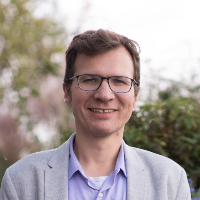
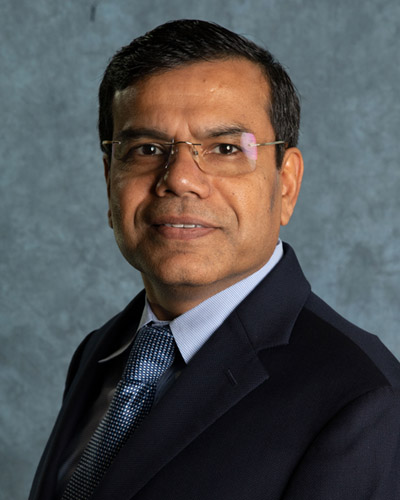
Dr. Sharon Howard is a historian and Honorary Research Fellow at the University of Sheffield, specializing in early modern crime and law, British history, and women's and gender history. Her work bridges traditional historical research with digital humanities methodologies, including data analysis and visualization. Her research focuses on community dynamics, legal authority, and digital tools for historical inquiry. She maintains the Early Modern Resources website (http://earlymodernweb.org), her personal blog (http://sharonhoward.org), and engages with digital history communities via Twitter (@sharon_howard). Her projects include Criminal Tattoos (2018), Digital Panopticon (2013), and London Lives (2009), among others. These initiatives emphasize accessible historical data and interdisciplinary collaboration.
Ronald J. Glotzbach is an Associate Professor at Purdue University's West Lafayette campus within the School of Applied and Creative Computing . His work focuses on web programming and development , leading projects that integrate dynamic content, databases, and educational technologies . He has taught courses such as CGT 356 (Web Programming), CGT 353 (Interactive Media), and CGT 456 (Advanced Web Programming). B.S. in Computer Graphics Technology M.S. in Technology Ph.D. in Curriculum and Instruction (pursuing) His research explores leading-edge web technologies for delivering interactive content, emphasizing web-enabling software, dynamic media integration, and mobile programming . Key trends in his publications include RSS technologies in education , web-based evaluation systems , and geospatial data tools for environmental sciences. Scientific awards include: Outstanding Professor (2003, 2004) CGT Dwyer Award for Outstanding Undergraduate Teaching (2005) CGT Outstanding Un-Tenured Faculty Award (2008) Professor Glotzbach has led numerous student teams in CGT projects , served as SIGGRAPH Student Volunteer Chair (2003-2005) , and collaborated with industry partners like Boeing (F-15 Distributed Mission Trainer) and Microsoft (XML Documents Testing Team) . He also provided expert testimony in a copyright case (2006) for Wargo & French, LLP.
Jie Shan serves as the Reilly Professor of Civil Engineering at Purdue University's College of Engineering with primary appointment in the Department of Civil and Construction Engineering. Her institutional affiliations include: Affiliate position in Environmental and Ecological Engineering Courtesy Appointment in the Department of Earth, Atmospheric and Planetary Sciences (EAPS) Her research focuses on geospatial technologies within civil infrastructure systems, integrating sustainability principles with environmental monitoring applications. The Geomatics Group (GSML) serves as her primary research unit, developing spatial data methodologies for engineering solutions. Professor Shan teaches CIVL 4110 (Sustainability Engineering and Environmental Engineering) from her office in HAMP 4110 on the West Lafayette campus. Contact is available via phone (765) 494-2168 or email jshan@purdue.edu.
Naomi Morris serves as a Teaching Fellow at the University of Portsmouth within the Faculty of Science & Health, specifically affiliated with the School of the Environment and Life Sciences and the Centre of Excellence in Defence, Risk & Resilience. She actively contributes to academic research in disaster management while accepting PhD students for supervision. Her research focuses on critical areas including disaster management, risk resilience, water rescue operations, and pandemic response strategies. These interests align with multiple United Nations Sustainable Development Goals, particularly those addressing disaster risk reduction and community resilience. Her work bridges theoretical frameworks with practical emergency response applications across diverse contexts. Morris has contributed to significant research projects including the GCRF-funded study on 'Impact of Covid19 in developing countries' and the examination of UK Search and Rescue frameworks titled 'For those in peril on the sea.' Her collaborative approach is evident through numerous co-authored publications spanning emergency medicine, geography, and public policy domains. Her research demonstrates an evolving trajectory from technical geospatial applications toward more community-centered emergency response frameworks, with particular emphasis on water rescue operations and pandemic prevention. This progression reflects growing focus on practical, community-based solutions to complex disaster scenarios. Morris actively collaborates across disciplines as a Co-Investigator on major projects. Her work has attracted substantial attention with significant readership on academic platforms like Mendeley, indicating relevance and impact within her research communities.
Dag Olav Hessen is a Professor at the University of Oslo , leading the Center for Biogeochemistry in the Anthropocene (CBA) . The center integrates expertise from the Department of Life Sciences, Earth Sciences, and Chemistry to investigate climate-carbon-ecosystem interactions in northern latitudes. Research Focus: Climate change impacts on freshwater and marine ecosystems Key Areas: Ecological stoichiometry, genome size, pelagic food webs, permafrost thaw Methodology: Interdisciplinary approaches combining fieldwork, lab experiments, and modeling His recent publications address critical issues like greenhouse gas dynamics in thawing permafrost , tipping points in lake ecosystems , and global change effects on zooplankton communities . Collaborative work spans Arctic char vulnerability, DOM-contaminant interactions, and climate governance frameworks.
Thushara Addanki is a Researcher at the Chair of Renewable and Sustainable Energy Systems, Technical University of Munich (TUM). He holds a Master's degree in Power Engineering from TUM, where he completed his thesis on Intertemporal Urbs with previous investments in the endogenous material demand for new capacity investments . His work focuses on modeling, optimization, and sustainability analysis of energy systems, with emphasis on renewable integration in developing regions and green hydrogen solutions. Research interests span energy system modeling, renewable resource assessment, life-cycle environmental impact integration, and techno-economic analysis of global hydrogen/synfuel supply chains. His publications reflect expertise in high-resolution geospatial analysis (pyGRETA), cross-sectoral optimization (Impuls-urbs), and international energy policy applications. Thushara contributes to projects including ETSAP Germany (energy systems modeling) and multi-national collaborations analyzing energy transitions in Uruguay, Bavaria, and global contexts. He is active in the ENS research team at TUM, advancing tools for sustainable energy planning.
Taro Mieno is an Associate Professor in the Department of Agricultural Economics at the University of Nebraska-Lincoln, specializing in precision agriculture and water resource economics. His work bridges agricultural policy, spatial econometrics, and environmental sustainability. University: University of Nebraska-Lincoln Department: Agricultural Economics Academic Rank: Associate Professor Research Interests: Precision agriculture and variable rate technologies Groundwater economics and drought resilience On-farm experimentation and data-driven decision making Agricultural policy and environmental externalities Machine learning applications in agronomic optimization Soil-water interactions and resource management Email: tmieno2@unl.edu
Nina Goldman is a human geographer and lecturer at the University of Basel's Department of Environmental Sciences. Currently, she is based at the University of Manchester on a two-year mobility fellowship from the Swiss National Science Foundation. Her work focuses on understanding social connection in urban environments and addressing loneliness through place-based interventions. She also conducts research for the World Health Organization and serves as a guest editor for a special issue on "Loneliness and the Built Environment" in the Journal Health & Place. Dr. Goldman teaches an annual introductory course in social science methods for the Land Use Changes research group at the University of Basel and has developed various courses since 2017, including "Introduction to Empirical Social Research" and "Urban Geography and Urban Health." Her teaching extends to field excursions across Switzerland, Germany, France, and China, focusing on urban health, poverty, sustainability, and spatial transformations. Her research interests center on the intersection of human geography, urban health, and social connection. Specifically, she investigates which place-based factors are most crucial in determining social connection in cities that, despite offering abundant opportunities for social contact, often leave residents feeling isolated. This work combines geographical analysis with social science methodologies to understand urban loneliness and develop interventions. Dr. Goldman's scholarly work reveals a strong evolution from spatial epidemiology of influenza transmission (reflected in her PhD "The Taming of the Flu") to her current emphasis on loneliness as a critical urban health challenge. Her publications demonstrate an interdisciplinary approach bridging geography, public health, and social science, with increasing focus on policy implications across 52 countries. Swiss National Science Foundation Mobility Fellowship Dr. Goldman has advised numerous students through her courses and field excursions. Her research for the World Health Organization on governmental approaches to addressing loneliness represents a significant contribution to public health policy. She organizes international workshops on place-based interventions for loneliness, fostering global collaboration on this pressing issue. While not explicitly mentioned as leading a formal lab, Dr. Goldman collaborates with the Land Use Changes research group at the University of Basel and participates in international research initiatives related to urban health and social connection. Her work with the World Health Organization and her guest editorship for the Journal Health & Place indicate active engagement in shaping research agendas in her field.
Hye-Chung Kum is a Professor in the Department of Health Policy & Management at Texas A&M University, where she pioneers Population Informatics to transform digital data into evidence-based health policy solutions. Her work bridges computer science, public health, and social work to address critical data challenges in healthcare systems. Education: PhD, University of North Carolina at Chapel Hill (UNC-CH), 2004 MSW (Master of Social Work), UNC-CH, School of Social Work, 1998 MS, UNC-CH, Department of Computer Science, 1997 BS, Yonsei University, Seoul, Korea, Department of Computer Science, 1995 Research Vision: Dr. Kum develops privacy-preserving human-computer hybrid systems for cleaning and integrating chaotic real-world data (e.g., EHRs, administrative records). Her Population Informatics framework enables ethical large-scale analysis while addressing data genocide in marginalized communities through innovations like the Secure Decoupled Linkage (SDLink) system. Publication Trends: Recent work (2024-2025) reveals three dominant threads: (1) Mental health service utilization dynamics during/post-pandemic, (2) Racial/ethnic disparities in emergency department use and cancer outcomes, and (3) Ethical data sharing frameworks for vulnerable populations. Her Texas-focused studies on Medicaid payment models and AI-driven record linkage demonstrate practical policy applications. Research Infrastructure: As director of the Population Informatics Lab, she leads cross-disciplinary teams developing Privacy-by-Design tools that balance public health needs with data sovereignty—particularly for American Indian and Alaska Native communities. Her grant-funded work consistently addresses Medicaid transformation and healthcare cost drivers through secondary data analytics.
Professor Stefan Siebert is Head of the Department of Crop Sciences at the Agricultural Faculty of the University of Göttingen, a position he has held since October 2017. His academic career spans multiple prestigious institutions including the University of Bonn, University of Frankfurt, and University of Kassel, where he completed his doctoral studies. University of Göttingen (2017-present): Professor and Head of Crop Science/Agronomy University of Bonn (2016-2017): Temporary Head of Chair Crop Science University of Bonn (2009-2015): Habilitation in Crop Science and Resource Conservation University of Frankfurt (2004-2009): Postdoctoral Scientist University of Kassel (2002-2005): Ph.D. Student and Scientist Professor Siebert's research focuses on sustainable resource use in crop production, climate change impacts on plant growth, plant growth modeling, and drought risk assessment. His work integrates large-scale data analysis with modeling approaches to understand the complex interactions between resource use, crop management, and productivity. He has developed comprehensive datasets on water, soil, and nutrient use in agriculture and pioneered methods for analyzing irrigation systems globally. His recent publication trends reveal a strong emphasis on irrigation systems, climate change impacts on agriculture, and advanced crop modeling techniques. The analysis of his 15 most recent articles shows consistent focus on water resource management, spatial analysis of agricultural systems, and the effects of climate variability on crop production. His work frequently combines remote sensing data with ground-based measurements to create high-resolution datasets for agricultural decision-making. Professor Siebert leads several significant research projects including ZERN (Future of Nutrition in Lower Saxony, 2024-2029), Collaborative Research Center 1502 on Regional Climate Change (2022-2025), and OUTLAST (Development of a global drought hazard forecasting system, 2022-2025). He has been continuously developing and maintaining a global dataset on irrigated areas since 1997, establishing himself as a leading authority in agricultural water management. His teaching portfolio is extensive, covering scientific writing, field production exercises, general crop production, methodical work, plant biology, crop production and breeding, sustainability of production systems, and applications of data analysis to agronomy. Professor Siebert's work bridges theoretical research with practical applications in sustainable agriculture, making significant contributions to our understanding of how to maintain food security in the face of climate change.
Dr. Tolga Sinmazdemir is a Senior Lecturer in Political Methodology at the Department of Politics and International Studies, SOAS University of London. His research focuses on political conflict and violence, with a special emphasis on the Middle East. Previously, he served as an Assistant Professor at Bogazici University, Istanbul, and held a fellowship at the London School of Economics and Political Science (LSE) School of Public Policy. Current Affiliation: SOAS University of London Prior Affiliation: Bogazici University Research Network: Evidence in Governance and Politics (EGAP) His work rigorously analyzes original data to identify causes and consequences of conflict, including studies on Syrian refugee flows, host society attitudes in Turkey, and cross-border dynamics. Tolga holds a Ph.D. in Politics from New York University. His recent publications examine refugee integration in co-religious societies, threat perceptions among refugees, and geographical influences on foreign policy preferences. His methodological expertise includes survey experimentation and collaborative cross-border research. Tolga supervises doctoral students including Yun-Tzu Chang, Anna E. Kensicki, and Rodi Yilmaz, focusing on transnationalism, narrative constructs, and ideological electoral decline in Turkey.
Sushil Prasad is a Professor of Computer Science at the University of Texas at San Antonio (UTSA), affiliated with the College of Sciences. His research focuses on data-intensive computing, energy-efficient deep learning models, parallel algorithms, and high-performance software systems. He holds a Ph.D. from the University of Central Florida, an M.S. from Washington State University, and a B.Tech. from the Indian Institute of Technology, Kharagpur. His work emphasizes integrating parallel and distributed computing into early computer science curricula. Key research interests include geospatial data analysis using ICESat-2 and Sentinel-2 imagery, edge device-optimized neural networks, and scalable polygon processing algorithms. He has contributed to frameworks like MPI-GIS and Crayons for high-performance geospatial computing. His educational initiatives include NSF-funded curriculum modernization efforts in parallel computing education. Recent work trends show a focus on climate science applications (e.g., polar sea ice classification), energy-efficient AI, and GPU/OpenMP parallelization. He has organized workshops like EduHPC and EduPar to advance HPC education strategies. Notable recognition includes the TCPP Outstanding Service Award (2012). His projects span cloud-based GIS systems, distributed ML training, and big spatial data processing. Collaborations include NSF-funded research on colocation mining, trajectory analysis, and curriculum development for undergraduate HPC education.
Nikitas Karanikolas serves as Professor in the Department of Informatics and Computer Engineering at the University of West Attica since March 2018, following a distinguished career progression from Assistant Professor (2004) to Associate Professor (2010) and Professor (2014) at the Technological Educational Institute of Athens. His professional trajectory includes significant roles as Systems Head of TEI Athens Library (1996-1997) and Chief of Informatics at Aretaieio University Hospital (1997-2004), alongside leadership positions in the Greek Computer Society as Board Member (2004-2006) and Secretary General (2006-2008). His academic foundation includes: Bachelor's in Statistics and Informatics from Athens University of Economics and Business (1988) PhD in Applied Informatics from Athens University of Economics and Business (1994) with thesis "Technological and Linguistic approaches in Natural Language Understanding" Dr. Karanikolas maintains an exceptionally broad research portfolio spanning Natural Language Processing , Computational Linguistics , Medical Informatics , and Green Energy systems. His work consistently bridges theoretical computational frameworks with practical healthcare applications, particularly evident in recent dementia care technologies and Greek language processing systems. The interdisciplinary nature of his research connects computational phonology with medical diagnostics and e-government applications. Analysis of his 15 most recent publications reveals a pronounced shift toward AI-driven healthcare solutions (particularly dementia patient monitoring), multilingual NLP systems (Greek and Polish), and urban safety applications . His work demonstrates consistent methodology development in ontological representations and multimodal fusion techniques, with increasing emphasis on real-world clinical and governmental implementations since 2023. No scientific awards were documented in the source materials. With 16 journal papers, 68 conference publications, and six authoritative Greek university textbooks, Dr. Karanikolas maintains an active research trajectory. His advising capacity is evidenced through extensive publication mentorship, particularly in medical informatics and NLP projects. While specific grant details are unavailable, his hospital information system implementations and textbook authorship suggest successful research funding acquisition. Current research activities focus on multimodal aggression prediction systems for dementia care, Greek language ontological frameworks, and urban navigation safety applications, primarily conducted through the University of West Attica's informatics infrastructure.
Thomas Kjeldsen is a Professor in the Department of Architecture & Civil Engineering at the University of Bath. He leads multiple research projects funded by organizations such as The British Council, Royal Academy of Engineering, and The Leverhulme Trust. His research focuses on extreme events, machine learning, hydrological modeling, and nature-based solutions. He is affiliated with centers including the Water Innovation and Research Centre (WIRC), EPSRC Centre for Doctoral Training in Statistical Applied Mathematics (SAMBa), and the Institute for Mathematical Innovation (IMI). Research Interests: Extreme events, machine learning applications in hydrology, flood risk management, and civil engineering resilience. Key Projects: Development of rainfall frequency models for infrastructure design, flood reconstruction using historical data, and capacity-building for South African flood studies. His work contributes to UN Sustainable Development Goals related to climate action and clean water. Recent studies emphasize non-stationary hydrological analysis, urban flood modeling using machine learning, and interdisciplinary approaches to water resource management. Activities include advising doctoral students, organizing academic events (e.g., British Hydrological Society Symposium), and serving on external committees like Affinity Water. His research has been widely cited and featured in policy discussions and international media.
Prof. Suzanne J.M.H. Hulscher is a Full Professor in Water Systems at the University of Twente, specializing in fluvial and coastal morphodynamics. Her research focuses on flood risk management, sediment dynamics, and climate adaptation. She has contributed to over 845 publications and supervised 55 research projects, including Vera van Bergeijk's PhD work on overtopping flows. Key achievements include the Simon Stevin Meester award (2016) and multiple best paper awards. Her work addresses UN Sustainable Development Goals through studies on saltwater intrusion, dike breach modeling, and nature-based solutions. Research highlights include hydraulic model calibration, estuarine sand wave dynamics, and vegetation effects on hydrodynamics. She actively contributes to editorial roles (CivilEng Journal) and policy advisory bodies (Wetenschappelijke Raad). Her interdisciplinary efforts bridge engineering, ecology, and climate science. Research areas: Coastal morphology, river dynamics, environmental hydraulics Key collaborations: 4TU.Centre for Research Data, IAHR, Netherlands Academy of Engineering Grants: Not explicitly listed, but extensive publications imply significant funding Her lab focuses on combining field data with numerical modeling for real-world applications like flood dashboard development and machine learning-based prediction systems. Current projects explore climate change impacts on engineered estuaries and distributive justice in climate policy.