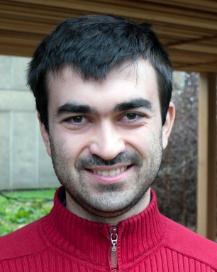
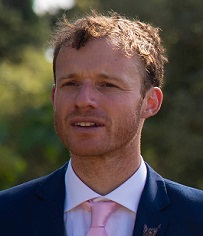
Ryan Grady is an Associate Professor in the Department of Mathematical Sciences at Montana State University, affiliated with the College of Letters & Science. His research bridges geometry, topology, and quantum field theory (QFT), with a focus on derived geometry and higher Lie theory. Research Interests: His work applies QFT techniques to geometric and topological problems, explores derived algebraic structures (e.g., L-infinity spaces, cosheaves), and investigates connections between renormalization group flows and sigma models. Recent publications address K-theoretic invariants, operadic structures in topology, and algebraic models for topological field theories. Scientific Awards: Stannard Award for Graduate Teaching (2021) NExT Fellow (2019) ICCM Best Paper Award (2018) Research Enhancement Grant (2018) Member, MSU Center for Faculty Excellence (2017) Education: Ph.D. and M.S. in Mathematics from the University of Notre Dame (2012, 2009), and B.S. in Mathematics from the Colorado School of Mines (2007). Students: Co-chaired Eric Berry (PhD 2021) and Adam Howard (PhD 2021), advised Garrett Oren (MS 2021), and mentored Bryce Morrow (BS 2023).
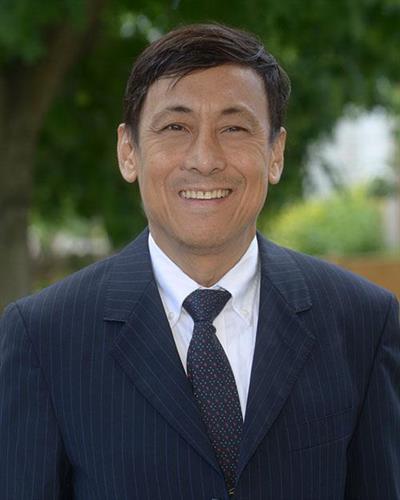
Shing-Tung Yau is a distinguished mathematician and professor associated with the Shing-Tung Yau Center at Southeast University's School of Physics, reflecting his profound influence in mathematical physics. His career spans premier institutions including Harvard University (emeritus) and Tsinghua University, where he holds active positions. Yau's research centers on differential geometry , mathematical physics , and geometric analysis , with transformative work on Calabi-Yau manifolds underpinning string theory. His investigations into Einstein's equations, black hole thermodynamics, and geometric flows bridge pure mathematics and theoretical physics, driving advancements in quantum gravity and mirror symmetry. His publications reveal consistent focus on geometric structures in theoretical physics, particularly Calabi-Yau applications in string compactification and geometric flows for singularity analysis. Recent works emphasize Kähler-Einstein metrics and stability in algebraic geometry. Scientific accolades include: Fields Medal (1982) for contributions to partial differential equations and Calabi conjecture Wolf Prize (2010) for geometric analysis breakthroughs MacArthur Fellowship (1985) and Crafoord Prize (1994) National Medal of Science (1997) for unifying geometry and physics Yau has mentored over 50 doctoral students, including Gang Tian and Huai-Dong Cao, shaping modern geometric analysis. He leads collaborative initiatives like the Harvard-Yau Center and Tsinghua's Mathematical Sciences Center, fostering cross-disciplinary research in geometric methods for quantum gravity. Current efforts focus on geometric foundations of quantum information and gravitational wave mathematics.
Jørgen Ellegaard Andersen is a Professor and Center Director at the Department of Mathematics and Computer Science, University of Southern Denmark (SDU), and holds the D-IAS Chair at the Danish Institute for Advanced Study (DIAS). He is also a Distinguished Visiting Professor at the California Institute of Technology since 2013, reflecting his international stature in mathematical sciences. University: University of Southern Denmark School: Faculty of Science Department: Department of Mathematics and Computer Science Position: Professor, Center Director, D-IAS Chair Andersen earned his DPhil in Mathematics from the University of Oxford in 1992, with a thesis on Jones-Witten theory and the Thurston Compactification of Teichmüller space. His research lies at the intersection of quantum theory and geometry, focusing on quantum topology, geometric quantization of moduli spaces, topological quantum field theory, low-dimensional geometry, and applications to RNA and protein folding. His work combines deep mathematical rigor with potential applications in quantum computing and biophysics. The trends in his recent publications show a consistent focus on quantization of moduli spaces, topological recursion, mapping class group representations, and quantum Chern-Simons theory. His work often bridges pure mathematics and theoretical physics, with increasing attention to computational and applied aspects in quantum technologies. ERC Synergy Grant ReNewQuantum (EUR 10m, Principal Investigator) Distinguished Visiting Professor, Caltech Andersen leads major research projects such as ReNewQuantum and TopQC2X, securing significant funding from the EU and Danish agencies. He actively supervises PhD students and collaborates with leading mathematicians worldwide, including Maxim Kontsevich and Bertrand Eynard. His work is frequently highlighted in the media for its potential impact on quantum computing and Danish industry. He is a central figure in the Quantum Mathematics center at SDU and collaborates with institutions like MSRI and the University of Hamburg. His research group is part of international networks focused on geometric and topological methods in quantum theory.
Eva Miranda is a Full Professor of Mathematics at the Universitat Politècnica de Catalunya (UPC), Barcelona, and a Researcher at the Centre de Recerca Matemàtica (CRM). She leads the Geometry, Topology, Algebra, and Applications Group (GEOMVAP) and directs the Laboratory of Geometry and Dynamical Systems. Her research focuses on symplectic and Poisson geometry, with applications to dynamical systems, fluid dynamics, and mathematical physics. Key areas include singular symplectic manifolds, integrable systems, and the interplay between geometry and computation. Affiliations: Full Professor at UPC (Department of Mathematics) ICREA Academia Researcher Chercheur Affilié at Observatoire de Paris Member of BGSMath and European Mathematical Society Her research explores connections between geometry and computational complexity, notably demonstrating Turing universality in 3D Euler flows (a breakthrough resolving a decades-old problem). She also investigates singularities in Hamiltonian systems, symplectic reduction, and Poisson geometry. Her work bridges disciplines like celestial mechanics, fluid dynamics, and computer science. Notable achievements include the ICREA Academia Prize (2021), Bessel Research Prize (2022), and Hardy Lectureship (2023). She supervises a vibrant team of PhD students and postdocs, fostering interdisciplinary collaborations through networks like SYMCREA and COMPLEXFLUIDS. Her recent projects include exploring topological Kleene field theories, entropy in Turing-complete systems, and desingularization of Poisson manifolds. She actively promotes women in mathematics and contributes to scientific outreach through lectures and media articles.
Dr. Oliver Fabert is an Associate Professor in the Department of Mathematics at the Faculty of Science, Vrije Universiteit Amsterdam. His research focuses on advanced topics in symplectic geometry, Hamiltonian systems, and Floer theory. He teaches courses such as Differential Geometry, Non-linear Dynamical Systems, and Partial Differential Equations. Key research interests include Hamiltonian systems, periodic solutions, symplectic manifolds, and the application of Floer theory to nonlinear PDEs. His work often intersects with algebraic topology and geometric analysis, addressing challenges like the small divisor problem in Hamiltonian PDEs and the development of regularization techniques in polysymplectic geometry. Dr. Fabert has published extensively on topics such as hyperkähler Floer theory, pseudoholomorphic curves, and topological recursion relations. His contributions span foundational work in symplectic field theory and polyfold theory, with applications to both finite and infinite-dimensional Hamiltonian systems. He has supervised at least one PhD thesis and actively engages in teaching advanced mathematical concepts, reflecting his commitment to both research and education in theoretical mathematics.
Alexander Goncharov is the Philip Schuyler Beebe Professor of Mathematics at Yale University's Department of Mathematics. His research focuses on arithmetic algebraic geometry, geometry, representation theory, and mathematical physics. He has received the European Mathematical Society Prize for his contributions to mathematics. His work spans topics such as motives, moduli spaces, polylogarithms, and quantum geometry. Education: Ph.D. 1987 (USSR). His research explores connections between algebraic geometry, number theory, and physics, with a focus on motivic cohomology, Hodge theory, and geometric representation theory. He has contributed to the understanding of scattering amplitudes, cluster varieties, and quantum invariants of moduli spaces. Research highlights include studies on Hodge correlators, motivic fundamental groups, and the geometry of moduli spaces. His recent work integrates quantum geometry with algebraic structures, such as cluster algebras and non-commutative systems. Key publications address exponential volumes of hyperbolic surfaces, spectral descriptions of non-commutative systems, and quantum aspects of moduli spaces. He has authored over 100 papers and is a leading figure in the field, with contributions to both pure mathematics and its intersections with theoretical physics. His lab or team collaborations are not explicitly detailed in the provided texts.
Alfonso Giuseppe Tortorella is a tenure-track Assistant Professor (Ricercatore a tempo determinato di tipo B) at the Dipartimento di Matematica, Università degli Studi di Salerno. His academic journey includes postdoctoral research at institutions such as KU Leuven (2018–2021) and CMUC/CMUP in Portugal. He holds a PhD in Mathematics from the University of Florence (2017), focusing on deformation theory of coisotropic submanifolds in Jacobi manifolds. Research Interests: Poisson geometry in its broad sense, including deformation theory, Jacobi manifolds, VB-groupoids, and multiplicative structures on Lie groupoids. Recent work explores symplectic foliations and L∞ algebras in geometric contexts. Publications: Over 15 peer-reviewed articles, with recent contributions on symplectic foliations, Dirac-Jacobi structures, and homogeneous G-structures. His work often combines geometric analysis with algebraic structures like L∞ algebras. Awards : Abilitazione Scientifica Nazionale (2021–2030), FWO Postdoctoral Fellowship, INdAM PhD Scholarship. Teaching : Courses in Differential Geometry and Advanced Mathematics at University of Salerno and KU Leuven. Advising : Supervised PhD/MSc/BSc students in geometric topics, including contact geometry and Jacobi manifolds. Labs/Teams: Active member of the Geometric properties of real and complex manifolds group at Università di Firenze, and collaborates with international researchers in Poisson and contact geometry.
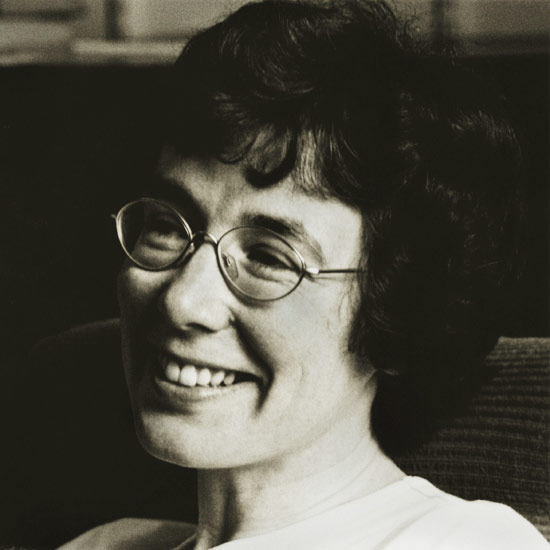
Professor Dame Frances Kirwan serves as the Savilian Professor of Geometry at New College, Oxford since 2017. Previously, she was University Professor at Balliol College (1996-2017) and became an Emeritus Fellow there in 2009. She has held significant leadership positions including President of the London Mathematical Society (2004-2006), the second-youngest president in the society's history, and served on the Programme Committee for the 2006 International Congress of Mathematicians in Madrid. Her educational background includes PhD studies at Cambridge University in 1984 under Sir Michael Atiyah. Her academic career began with a junior position at Harvard University before returning to the UK, where she became Fellow of Magdalen College and later Balliol College. She has been an influential figure in mathematics, delivering invited talks at the International Congress of Mathematicians in Zurich (1994) and Beijing (2002). Professor Kirwan's research centers on the profound connections between algebraic and symplectic geometry, with groundbreaking contributions to invariant theory. Her methodology uniquely combines algebraic and topological approaches to unravel the structure of geometric objects, drawing from diverse mathematical disciplines. This integrative research has developed essential techniques for classifying geometric structures, particularly in moduli spaces of complex algebraic curves. Her exceptional contributions have been recognized through numerous prestigious honors: L'Oréal-UNESCO For Women in Science Award (2023) for "exceptional work in pure mathematics combining geometry and algebra" Sylvester Medal of The Royal Society (2021) DBE for services to mathematics (2014) Fellow of the Royal Society (2001) EPSRC Senior Research Fellowship (2005-2010) for work on moduli spaces Professor Kirwan's research program has received substantial support including the EPSRC Senior Research Fellowship, enabling her to advance fundamental work in algebraic geometry. Her leadership extends beyond research to shaping mathematical discourse through society presidencies and committee memberships. Her publications demonstrate consistent focus on moduli spaces, cohomology structures, and geometric invariant theory across three decades.
Dr Benoit Vicedo is a Senior Lecturer in the Department of Mathematics at the University of York. He has held academic positions including a postdoctoral role at York and previously served as a Lecturer at the University of Hertfordshire before becoming a Reader at York in 2018. Education: Vicedo completed his undergraduate studies and PhD in Mathematics at the University of Cambridge (2008). His postdoctoral work included roles at the École Normale Supérieure (ENS) in Paris, DESY in Hamburg, and the University of York. Research: His work focuses on classical and quantum integrable systems, quantization of 1+1 dimensional field theories, and dualities such as the AdS/CFT and ODE/IM correspondences. He explores higher-dimensional integrability and gauge-theoretic frameworks like 4D Chern-Simons theory. Grants & Supervision: Vicedo leads the EPSRC-funded project 'Higher gauge theory and higher-dimensional integrability' (2025–2028) and co-supervises PhD students Ricky Li and Henry Bittleston. His research group is part of the Mathematical Physics and Quantum Information cluster at York. Labs/Teams: Active member of the Mathematical Physics group, collaborating internationally on topics such as affine Gaudin models and non-ultralocality in integrable systems.
Loring Tu is a Professor of Mathematics in the Department of Mathematics at Tufts University. He holds a PhD from Harvard University (1979) and has taught at institutions including the University of Michigan and Johns Hopkins University. His research focuses on algebraic geometry, topology, and differential geometry, with particular emphasis on the interplay between algebra and geometry, such as in equivariant cohomology, Hodge theory, and degeneracy loci. He has held visiting positions at the Institute for Advanced Study and the Institut Henri Poincaré. His work explores localization theorems, where topological information of manifolds is encoded at special points. Education: PhD in Mathematics, Harvard University, 1979 AM in Mathematics, Harvard University, 1976 AB in Mathematics, Princeton University, 1974 Research Interests: Loring Tu studies manifolds, algebraic geometry, topology, and differential geometry, with a focus on localization theorems and the connection between algebraic and geometric structures. His work includes applications of equivariant cohomology to understand topological invariants and the geometry of moduli spaces. He emphasizes the universality of mathematics and its cultural significance, bridging classical and modern geometric theories. Publications: His articles address topics like fixed point theorems, cohomology localization, and geometric structures, reflecting a deep engagement with foundational mathematical concepts. Recent works include studies on equivariant cohomology and the Campbell-Hausdorff formula. Professional Contributions: Tu serves as a series editor for Developments in Mathematics (Springer) and has contributed to editorial responsibilities promoting advanced mathematical monographs.
Tatyana Barron is a Professor in the Department of Mathematics at the University of Western Ontario since July 2022. She holds a Ph.D. from Pennsylvania State University (1998) and has held academic positions at institutions like the University of Michigan and the University of Arizona. Her research focuses on geometric quantization, complex geometry, and mathematical physics. She has supervised five Ph.D. students and has an extensive publication record spanning topics from Toeplitz operators to entropy analysis in quantum systems. Education: Ph.D. in Mathematics, Pennsylvania State University (1998) Bachelor's Degree, Moscow Institute of Physics and Technology (1994) Research Interests: Tatyana Barron explores geometric quantization techniques applied to complex manifolds, with particular emphasis on Kähler and multisymplectic structures. Her work bridges differential geometry, algebraic geometry, and quantum mechanics, addressing topics like automorphic forms, entropy in quantum systems, and the asymptotic properties of geometric operators. She has contributed to understanding Berezin-Toeplitz operators, entanglement in mixed states, and geometric models for therapeutic approaches involving electromagnetic fields. Her recent publications (2023-2025) highlight advancements in geometric signal theory, entanglement quantification, and semiclassical asymptotics. She has also explored mathematical models for medical applications using electromagnetic principles. Advising: Supervised five Ph.D. students focusing on topics ranging from holomorphic differentials to singular Lagrangian submanifolds. She co-supervised three of these students with colleagues in geometric analysis and differential geometry.
Nikita Nekrasov is a Permanent Professor at the Institut des Hautes Etudes Scientifiques (IHES) since 2000. He is a prominent physicist known for his significant contributions at the interface of gauge theories, string theory, and modern mathematical physics. His work has profoundly enriched these interconnected fields of theoretical physics and mathematics. His research interests span Gauge Theories , String Theory , Mathematical Physics , Quantum Field Theory , Integrable Systems , Topological Field Theory , and Supersymmetric Gauge Theories . Nekrasov's work often bridges deep mathematical structures with physical phenomena, particularly in the context of supersymmetric gauge theories and their connections to string theory. His scholarly output demonstrates consistent focus on the mathematical structures underlying physical theories, with particular attention to integrable systems, topological aspects of field theories, and the geometric structures that emerge in quantum field theories. His research has established important connections between seemingly disparate areas of physics and mathematics. Nekrasov has received numerous prestigious awards including the Hermann Weyl Prize (2004), Jacques Herbrand Prize (2004), Compositio Mathematica Prize (2009), Ogden Porter Jacobus Fellow, Dicke Fellowship, and membership in the Harvard Society of Fellows. He has held significant academic positions including Permanent Professor at IHES since 2000, Robert H. Dicke Fellow at Princeton University (1999-2000), and Junior Fellow at Harvard Society of Fellows (1996-1999). He also maintains a senior researcher position at ITEP (Institute for Theoretical and Experimental Physics), Laboratory 180 of Particle Physics, though currently on leave.
Jeremy Toulisse is a Lecturer at the University of Nice - Sophia Antipolis, where he works within the Faculty of Sciences at the J.A. Dieudonné Mathematics Laboratory (UMR n° 7351 CNRS UNS). His office is located at number 713 in Nice, France. Toulisse holds an HDR (Habilitation à Diriger des Recherches), which qualifies him to supervise PhD students in the French academic system. Toulisse's research focuses on advanced geometric structures and representation theory. His primary interests include Higher-rank Teichmüller theory and Anosov representations, Higgs bundles, harmonic applications, pseudo-Riemannian geometry, minimal and maximal surfaces, and quantum Teichmüller theory. His work bridges differential geometry, topology, and mathematical physics, with particular emphasis on geometric structures arising from surface group representations. Analysis of Toulisse's publication record reveals a consistent focus on geometric structures in pseudo-Riemannian settings, particularly examining maximal and minimal surfaces in various geometric contexts. His research shows strong connections between representation theory, harmonic maps, and geometric analysis, with increasing attention to higher-rank generalizations of classical Teichmüller theory. The progression of his work demonstrates movement from foundational studies in hyperbolic geometry toward more complex structures in pseudo-hyperbolic spaces and symmetric spaces. Toulisse has been actively involved in the mathematical community through workshop organization. He has co-organized multiple specialized workshops including the Workshop on Anosov representations (2021), the Workshop on Minimal surfaces in symmetric spaces and Labourie's conjecture (2022), and the Relative character varieties and parabolic Higgs bundles workshop (2018). These workshops, often funded by organizations like the European Research Council and Persyval-Lab, focus on cutting-edge topics in geometric representation theory and attract researchers from around the world. As part of the J.A. Dieudonné Mathematics Laboratory, Toulisse contributes to one of France's prominent mathematics research centers. His work intersects with several research teams within the laboratory that focus on differential geometry, topology, and mathematical physics. The collaborative nature of his publications, particularly with researchers like François Labourie, Brian Collier, and Nicolas Tholozan, demonstrates his integration into international research networks focused on geometric structures and representation theory.
Dusa McDuff is the Joan Lyttle Birman ’48 Professor of Mathematics at Barnard College, part of Columbia University, where she teaches undergraduate and graduate courses in mathematics, including Calculus I, Perspectives in Mathematics, and advanced topics in geometry and topology. She previously held faculty positions at the University of York, University of Warwick, MIT, and SUNY Stony Brook, where she was named Distinguished Professor in 1998. B.S., University of Edinburgh Ph.D., University of Cambridge Professor McDuff is a leading figure in symplectic geometry and topology. Her research has fundamentally shaped the field, particularly through her influential books with Dietmar Salamon on J-holomorphic curves and symplectic topology. She has developed foundational theories that underpin modern symplectic invariants and moduli space analysis. Her work bridges pure mathematics with insights from mathematical physics, especially in Hamiltonian systems and geometric quantization. She is also known for her accessible survey articles that introduce symplectic geometry to broader audiences. The most recent articles and lectures reflect sustained contributions to symplectic topology, with emphasis on Kuranishi structures, Lagrangian submanifolds, and the analytical foundations of J-holomorphic curves. Her publications span from technical monographs to educational surveys, demonstrating both depth and breadth in her scholarly output. Themes include moduli spaces, pseudoholomorphic curves, quantum homology, and the interplay between geometry and dynamics. Satter Prize, American Mathematical Society Outstanding Woman Scientist Award, AWIS Member, National Academy of Sciences (1999) Fellow, Royal Society (1994) Member, American Philosophical Society (2013) Fellow, American Mathematical Society (2012) Senior Berwick Prize, LMS (2010) Multiple honorary doctorates Honorary Fellow, Girton College, Cambridge Professor McDuff has advised numerous students and researchers indirectly through her books and mentorship, though specific names are not listed in the source. She has received major research grants supporting her work in symplectic topology, and her service includes leadership roles such as serving on the MSRI Board of Trustees. She is deeply committed to advancing the role of women in mathematics and has been an active voice in promoting gender equity in the mathematical sciences. While no formal lab or research group is mentioned, her collaborative work with Dietmar Salamon and Katrin Wehrheim indicates strong research partnerships. She continues to be an active presence in the mathematical community through lectures, publications, and advocacy.
Dr. Jock McOrist is a Senior Lecturer in Mathematics at the University of New England's School of Science and Technology. Educated at the University of Sydney (B.Sc., M.Sc.), University of Chicago (M.S., Ph.D.), he completed postdoctoral work at Cambridge. His research explores mathematical physics, particularly string theory and quantum field theory applications in differential geometry. He supervises PhD students in physics and mathematics, focusing on heterotic string vacua and quantum field theory. His recent publications (2017-2025) consistently investigate moduli spaces in string theory, geometric structures in quantum field theories, and heterotic compactifications. BHP Biliton Science and Engineering Fulbright Scholar Sugarman Prize EPSRC Postdoctoral Fellowship University Medal (Sydney) He co-founded the Australia and New Zealand Geometry, Strings and Fields seminar series to foster regional collaboration.