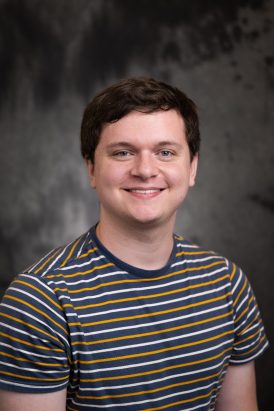
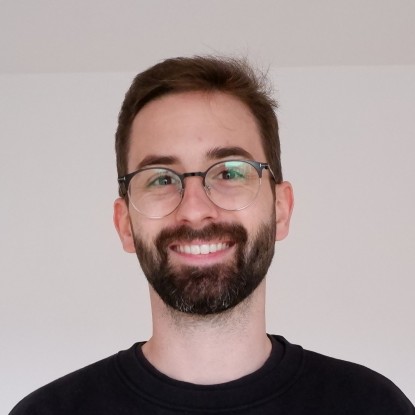
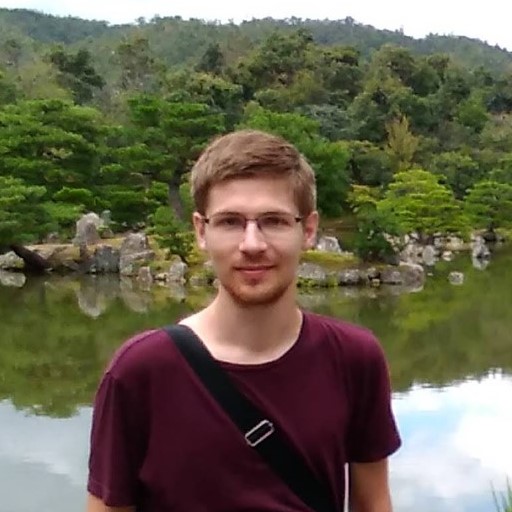
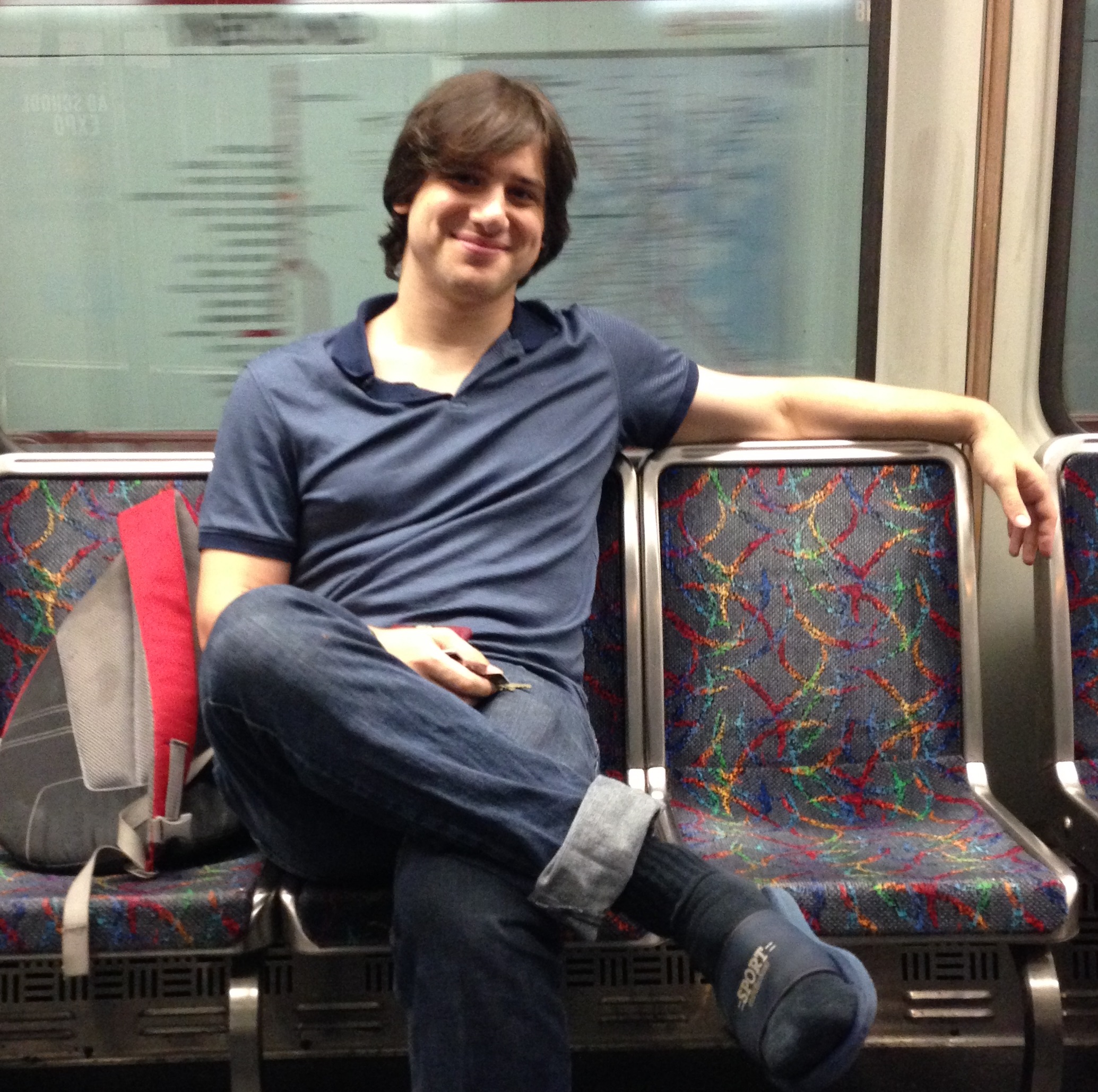
Andrei Negut is an Associate Professor and Chair of Representation Theory at the École Polytechnique Fédérale de Lausanne (EPFL). He holds positions in the School of Basic Sciences (SB) and Department of Mathematics (MATH), leading the CRT laboratory. His research focuses on quantum algebras, representation theory of Lie groups and algebras, and their geometric realizations through moduli spaces of sheaves. He teaches advanced courses like Representation Theory II and Quivers and Quantum Algebras, and advises PhD students such as Giacomini Niccolò and Kaushik Archi. His academic roles include membership in the Doctoral Program Mathematics committee and teaching responsibilities in SMA and EDAM programs. Research interests span quiver varieties, quantum loop groups, shuffle algebras, and K-theoretic stable envelopes. He has authored over 50 papers on topics including affine Hecke categories, Yangians, and categorification techniques.
Sean Cotner is an NSF Research Fellow and Postdoctoral Assistant Professor in the Department of Mathematics at the University of Michigan, affiliated with the College of Literature, Science, and the Arts. He earned his Ph.D. in Mathematics from Stanford University in 2023 and a B.S. from Pennsylvania State University in 2018. His research focuses on arithmetic geometry, algebraic groups, and integral questions related to the local Langlands program. Cotner has contributed to significant publications in journals such as Inventiones Mathematicae and Compositio Mathematica . He has held positions including a graduate research role at Stanford under Brian Conrad. Cotner’s work bridges pure mathematics disciplines, emphasizing geometric and algebraic structures. His expository writings on topics like Steinberg’s theorem and reductive groups demonstrate his commitment to advancing foundational mathematical theory. Awarded the NSF Research Fellowship, he has also engaged in collaborative projects, including work with Jeffrey D. Adler and Bogdan Zavyalov. Cotner’s academic contributions include both original research and pedagogical efforts, such as exercises for the Arizona Winter School 2025 on representation theory of p-adic groups.
Dr. Konstantin Jakob is a Research Fellow in the Algebra Group at TU Darmstadt, affiliated with the Collaborative Research Center CRC 326 - GAUS. His research focuses on the wildly ramified geometric Langlands correspondence, moduli spaces of meromorphic connections, local systems, Higgs bundles, and rigid local systems. He has organized workshops on topics like non-abelian Hodge theory and has spoken at international venues including Tsinghua University and the Banff International Research Station (BIRS). He has taught courses on Springer theory and algebraic number theory at TU Darmstadt, employing hybrid formats. His academic activities include visiting positions at the Yau Mathematical Sciences Center (Beijing) and the Sydney Mathematical Research Institute (SMRI). He actively contributes to the field through organizing seminars and collaborative research initiatives. His work intersects algebraic geometry, representation theory, and number theory, with a focus on geometric structures underlying Langlands duality and moduli problems. Recent research trends emphasize rigid local systems and their applications to arithmetic geometry and mathematical physics. No scientific awards have been explicitly mentioned in the provided materials. His research is supported through CRC 326 and institutional grants at TU Darmstadt.
Akshay Venkatesh holds the Robert & Luisa Fernholz Professorship in the School of Mathematics at the Institute for Advanced Study (IAS). He is renowned for his work at the intersection of number theory and topology, particularly in exploring algebraic structures related to the topology of locally symmetric spaces. Previously, he served as a Professor of Mathematics at Stanford University (2008–2018) and held positions at the Courant Institute and MIT. Venkatesh's research bridges diverse areas including representation theory, dynamics, and algebraic topology, with a focus on the Langlands program and motivic cohomology. Educations: PhD in Mathematics, Princeton University (2002) B.Sc. in Mathematics, University of Western Australia (1997) Research Interests: Venkatesh investigates the profound connections between number theory and geometry, such as the analogy between prime numbers and knots. He explores the topology of locally symmetric spaces, which encode arithmetic information through their cohomology and geometric structures. His work often reveals unexpected links between algebraic varieties, modular forms, and geometric invariants. Key Contributions: His studies on the topology of locally symmetric spaces have advanced understanding of the Langlands program and motivic cohomology. He has pioneered methods to decode arithmetic properties (e.g., solutions to polynomial equations modulo integers) through topological invariants of geometric spaces. Awards and Honors: Fields Medal (2018) Ostrowski Prize (2017) Infosys Prize (2016) SASTRA Ramanujan Prize (2008) Salem Prize (2007) Honorary Doctorate, University of Western Australia (2019) Labs/Teams: Venkatesh led a special program on analysis and topology of locally symmetric spaces at IAS (2017–2018), fostering interdisciplinary collaborations in number theory and topology. His research often intersects with algebraic geometry and representation theory.
Dennis Gaitsgory is a Professor at the Max Planck Institute for Mathematics in Bonn, Germany, since 2021. Previously, he held academic positions at Harvard University (2005–2021), the University of Chicago (as a professor), and was a Clay Research Fellow. His career spans 30 years of groundbreaking work on the geometric Langlands conjecture, a major area bridging mathematics and theoretical physics. Education: Studied at Tel Aviv University, earned a doctorate at the Hebrew University of Jerusalem in 1997 under Joseph Bernstein. The geometric Langlands program , central to his research, establishes profound connections between algebraic geometry, representation theory, and quantum field theory. His work has far-reaching implications for number theory, quantum computing, and mathematical physics, positioning him as a key figure in modern mathematics. Scientific Awards: 2025 Breakthrough Prize in Mathematics for his contributions to the geometric Langlands conjecture. At the Max Planck Institute, Gaitsgory leads a research team advancing the geometric Langlands program. His career includes visiting roles at Princeton University and sustained collaborations that have reshaped the field over decades.
Nick Rozenblyum is an Associate Professor in the Department of Mathematics at the University of Toronto. His research spans algebraic geometry and topology , with a focus on structures arising from topological quantum field theory and representation theory . He has co-authored a comprehensive book on derived algebraic geometry with Dennis Gaitsgory, covering advanced topics like duality, deformations, and formal geometry. Rozenblyum's publications explore deep connections between geometric Langlands theory , symplectic geometry , and homotopy theory . His collaborative work addresses topics such as cyclic nerve symmetries , Calabi-Yau structures , and equivariant cohomology , reflecting a broad engagement with modern mathematical frameworks. His research also intersects with noncommutative geometry and factorization homology , particularly in higher categorical contexts. Rozenblyum's work on automorphic sheaves and shtuka constructions contributes to ongoing developments in geometric representation theory and number theory.
Tsao-Hsien Chen is an Associate Professor in the School of Mathematics at the University of Minnesota, Twin Cities, with office contact at Vincent Hall (206 Church Street SE, Minneapolis). His research focuses on geometric representation theory, particularly the geometric Langlands program, D-modules, and perverse sheaves. Chen actively organizes advanced seminars including the Geometric Methods in Langlands Program series (2021-2025) covering Springer correspondence, character sheaves, and Weil representation. He co-organizes international workshops such as the Summer School on Relative Langlands Duality (2024) and Beijing-Shanghai Summer School (2025), demonstrating leadership in the global mathematics community. His publication analysis (2015-2024) reveals sustained contributions to Langlands program foundations, with emphasis on Hitchin systems in characteristic p , symmetric varieties, and depth preservation. Collaborations with leading mathematicians like David Nadler and Xinwen Zhu underscore his work's significance in bridging algebraic geometry and representation theory. No scientific awards are documented in available sources. Information regarding academic advising or grant funding is not provided in current materials, though his seminar leadership suggests active mentorship roles. Chen's community engagement extends to directing specialized workshops including D-modules applications (2024) and Modern Perspectives in Representation Theory (2025), positioning him at the forefront of current research trends.
Georg Linden is a Researcher at the University of Duisburg-Essen, Faculty of Mathematics, working in the research group of Vytautas Paškūnas. He obtained his PhD in 2023 from the University of Wuppertal under the supervision of Sascha Orlik. His educational background includes doctoral studies completed in 2023 at the University of Wuppertal. Specific undergraduate or master's institutions are not documented in the source material. Linden's research focuses on the representation theory of p-adic groups, non-archimedean analytic geometry, and the p-adic Langlands program. These interconnected fields drive modern advancements in arithmetic geometry and number theory, particularly through geometric interpretations of automorphic forms and Galois representations. His work bridges abstract algebraic structures with concrete geometric models in non-archimedean settings. His publications demonstrate consistent exploration of Drinfeld upper half spaces across varying field characteristics, revealing structural parallels between local fields of positive characteristic and finite fields. This research trajectory highlights evolving methodologies in p-adic geometry, with increasing emphasis on equivariant vector bundles and compactification techniques for modular spaces. No scientific awards or honors are referenced in the available documentation. Information regarding student supervision, grant funding, or collaborative projects beyond his primary research group is not provided in the source texts. Linden actively contributes to Vytautas Paškūnas' research group at the University of Duisburg-Essen, which specializes in p-adic representation theory and its interfaces with algebraic geometry. This collaborative environment fosters interdisciplinary approaches to longstanding problems in the Langlands program.
Peter Spacek is a Researcher at the Faculty of Mathematics, Technische Universität Chemnitz, Germany, under Prof. Christian Sevenheck. Previously, he was an Early Career Fellow of the London Mathematical Society, supported by the Heilbronn Institute, hosted by Prof. Nicolas Perrin at the Laboratoire de Mathématiques de Versailles. He holds a PhD from the University of Kent (UK), and Master's/Bachelor's degrees from the University of Amsterdam (Netherlands). His research focuses on mirror symmetry for (quasi-)cominuscule homogeneous spaces, including the Cayley plane (E₆) and Freudenthal variety (E₇). Key areas include Landau-Ginzburg models, quantum cohomology, and minuscule posets. He collaborates widely, with recent work on irregular Hodge numbers and canonical mirror constructions. He has presented at international conferences, including 'Mirrors in the Midlands 2024' and 'StringMath22', and co-organized reading groups on the Langlands program and conformal field theory. His teaching includes Lie algebras, reflection groups, and algebraic geometry modules.
Xinwen Zhu is Professor of Mathematics at Caltech's Division of Physics, Mathematics and Astronomy. His research bridges advanced mathematics and theoretical physics through geometric approaches to representation theory. Primary research domains: Geometric aspects of the Langlands program Connections between number theory and quantum physics Representation theory applications in algebraic geometry
Prof. Dr. Eva Viehmann is a mathematician specializing in arithmetic geometry, with a focus on Shimura varieties, the Langlands program, and moduli spaces. She has been a Professor at the University of Muenster since 2022, following a prior professorship at the Technical University of Munich (2012–2022). Her work intersects algebraic geometry and number theory, particularly through affine Deligne-Lusztig varieties and Newton stratifications. Education: Diploma in Mathematics (2003), Doctorate (2005), and Habilitation (2010) at the University of Bonn. Her research explores the geometry of moduli spaces of shtukas, local Shimura varieties, and the interplay between these structures and automorphic representations. She has received prestigious awards including the Gottfried Wilhelm Leibniz-Prize 2024, ERC Starting Grant (2011–2016), and ERC Consolidator Grant (2018–2024). She was a member of the Junge Akademie (2011–2016) and the National Academy of Sciences Leopoldina. Prof. Viehmann's publications highlight her contributions to the Langlands program, Newton stratifications in loop groups, and connected components of affine Deligne-Lusztig varieties in mixed characteristic. Her work bridges abstract theory with concrete geometric structures in arithmetic contexts. Scientific Awards: ERC Starting Grant (2011–2016) ERC Consolidator Grant (2018–2024) Gottfried Wilhelm Leibniz-Prize (2024) Member of Junge Akademie (2011–2016) Member of the National Academy of Sciences Leopoldina She has also served as an invited sectional speaker at the International Congress of Mathematicians (ICM) 2018 in Rio de Janeiro.
Dr David Jordan is a Professor in the School of Mathematics at the University of Edinburgh, specializing in topological field theory and quantum algebra. His research bridges mathematics and physics, focusing on categorical symmetries in quantum systems. He collaborates globally, notably as a Principal Investigator in the Simons Collaboration on Global Categorical Symmetries, exploring symmetries in quantum field theories. Despite shifting from physics to mathematics early in his academic journey, he maintains close ties with physicists to formalize quantum mechanical anomalies mathematically. His research interests emphasize quantum groups, algebraic geometry, and representation theory, with a focus on structures like skein modules, character varieties, and braided tensor categories. Teaching highlights include foundational courses like Proofs and Problem Solving, emphasizing mathematical rigor and critical thinking for undergraduates. He advocates for students to embrace the challenge of university-level mathematics, stressing perseverance over innate ability. Dr Jordan’s work is highly collaborative, with most publications co-authored to foster open scientific dialogue. He has contributed to advancements in categorical symmetries, quantum cluster characters, and geometric Langlands duality, reflecting a commitment to interdisciplinary innovation in modern mathematics.
Pavel Safronov is a Lecturer in the School of Mathematics at the University of Edinburgh, where he has been since 2020. His academic journey began with a physics undergraduate degree at St. Petersburg University, followed by a master’s in physics at the University of Texas, where he transitioned to mathematics. His research focuses on mathematical physics, algebraic geometry, and category theory, particularly topological quantum field theories and shifted Poisson structures. He balances teaching and research, emphasizing interactive learning and student engagement. Education: BSc in Physics (St. Petersburg University), MSc in Physics (University of Texas). His postdoctoral work included positions at the University of Oxford, Max Planck Institute for Mathematics (Bonn), and institutions in Geneva and Zurich before settling in Edinburgh. Research interests span topological quantum field theories, symplectic geometry, and categorical structures. Recent work explores deformation quantization, coisotropic correspondences, and cohomological Hall algebras. His articles often bridge abstract algebraic geometry with physics concepts like supersymmetric twists and BV quantization. Teaching philosophy emphasizes face-to-face interaction to assess student understanding, advising students to engage actively with faculty and resources. Outside academia, he practices classical piano and enjoys hiking and cycling in Scotland, activities he finds rejuvenating for his research.
Jacob Tsimerman is an associate professor in the Department of Mathematics at the University of Toronto. His research lies at the intersection of number theory, algebraic geometry, and model theory, with a focus on arithmetic geometry and functional transcendence. Institution: University of Toronto Department: Department of Mathematics Position: Associate Professor Email: jacobt@math.toronto.edu Office: HU1001B, 215 Huron Street, Toronto His research interests include Number Theory, Arithmetic Geometry, Hodge Theory, o-minimality, Shimura Varieties, and Automorphic Forms. He has made significant contributions to the André-Oort conjecture, Ax-Schanuel theorems, and equidistribution problems using tools from model theory and transcendental number theory. His recent publications show a deep engagement with functional transcendence, differential geometry, and the interplay between algebraic and analytic structures. He frequently collaborates with leading mathematicians such as Jonathan Pila, Benjamin Bakker, and Michael Lipnowski. His work often appears in top-tier journals including Annals of Mathematics , Inventiones Mathematicae , and Compositio Mathematica . He has taught a variety of advanced courses such as Number Theory (MAT382), Algebraic Number Theory (MAT415), Topology (MAT327), and Problem Solving Seminars (MAT475, MAT495). He has also produced lecture notes on Etale Cohomology and organized Putnam preparation seminars. While no specific awards are listed in the provided material, his publication record in premier journals indicates high-level recognition in the mathematical community. He advises students informally through seminars and courses, though no formal PhD students are listed. He is involved in research grants and collaborations, particularly in areas bridging logic and number theory. His office hours and course materials suggest active engagement with undergraduate and graduate education. He maintains a research group or circle of collaborators, particularly with Benjamin Bakker, Jonathan Pila, and others working on o-minimality and its applications to Diophantine problems.
Tyler Genao is a Zassenhaus Assistant Professor (postdoc) at the Ohio State University. He completed his PhD in 2023 at the University of Georgia under advisor Pete L. Clark. His research focuses on Number Theory and Arithmetic Geometry, with emphasis on elliptic curves, modular forms, and algebraic structures. His work explores topics like torsion bounds, isogeny classes, and modular curves. Recent research trends include studying torsion subgroups of elliptic curves over number fields, properties of Shimura curves, and computational approaches to non-unitary partitions. His articles often intersect algebraic geometry and number theory, addressing questions in arithmetic dynamics and Galois representations. No awards or grants are explicitly mentioned in the provided text.