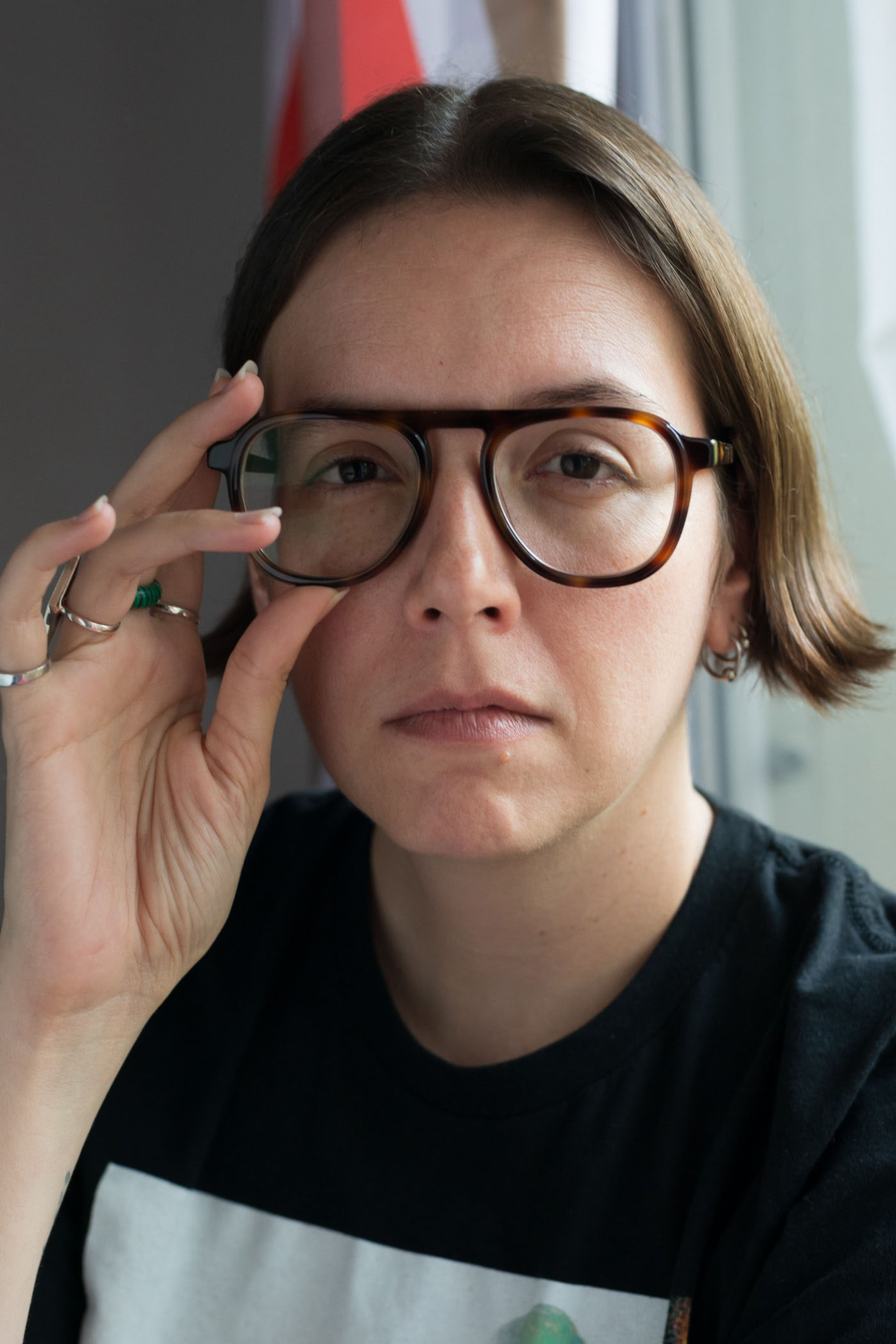
Megan Volpert serves as part-time Adjunct Faculty in the MFA Writing program at Reinhardt University's College of Humanities, Sciences, & Technology and concurrently holds a part-time Assistant Professor position in Interdisciplinary Studies at Kennesaw State University. She is also a Fellow at the American Institute for Philosophical and Cultural Thought and Director of Insights for Halo Media. Her research traverses popular culture through interdisciplinary lenses, blending philosophy with music criticism, television analysis, queer theory, and creative writing. Notable projects include anthologizing philosophical examinations of cultural phenomena like Tom Petty's music and RuPaul's Drag Race, establishing her as a cross-disciplinary scholar. Volpert's creative-academic output includes 15+ books recognized with significant honors: Two-time Lambda Literary Award finalist American Library Association honoree 2019 Georgia Author of the Year for poetry collection Boss Broad
Jason Hockman is a Reader in Music and Sound Design at the School of Digital Arts (SODA) at Manchester Metropolitan University . He is a leading researcher in Music Information Retrieval (MIR) , computational audio analysis, and music production technologies. He is also a professional music producer and performer under the aliases Jason oS and DAAT , and co-founder of Detuned Transmissions , an artist collective and independent record label. Research Interests: Computational analysis and generation of audio for music production Ethnographies of breakbeat-oriented UK dance music Neural audio synthesis and adversarial networks Automatic drum transcription and onset detection Gesture-based music interaction systems Interactive audio for games and multimedia Publications Trends: His recent work focuses on generative audio models , including GAN-based drum synthesis, neural impact sound synthesis, and latent space exploration for audio. He has also contributed extensively to automatic transcription systems for percussion and string instruments, and interactive performance tools that integrate gesture control and real-time audio manipulation. Scientific Contributions: Co-author of the widely cited Review of Automatic Drum Transcription (2018) Developer of interactive systems like MyoSpat for gesture-based control Pioneer in combining ethnographic research with computational music analysis Teaching & Supervision: Jason integrates his research and music production experience into undergraduate and postgraduate teaching. He supervises students in music technology, sound design, and MIR, and emphasizes a holistic approach that bridges creative practice and academic inquiry. Creative Practice: Through Detuned Transmissions , he releases and distributes electronic music internationally, maintaining an active presence in both academic and artistic communities.
Associate Professor John Ferguson is a post-digital/electronic musician and sound artist at Queensland Conservatorium, Griffith University since 2015, currently serving as Head of Creative Music Technology . He has held academic positions at Brown University (Visiting Assistant Professor) and Kingston University London (Lecturer). His Ph.D. from Newcastle University (2010) focused on artistic methods in digital media and redefining live musicianship. Current ARC Discovery Project (DP240100680) on regional digital music ecosystems Founded Interactive Media Lab collaborations Expertise in Pure Data, Arduino, Touch Designer for custom instruments Research explores post-digital systems blending tactile interaction with generative audio-visual environments. Supervises PhD/DMA students in topics like AI collaboration, sonic identity, and redundant technology repurposing. Grants include Queensland Museum , Australia Council for the Arts , and Griffith University internal funding for media architecture projects.
Joaquin Lago Ballesteros is a Professor in the Applied Didactics Department at the University of Santiago de Compostela, affiliated with the Teacher Training Faculty. He holds a PhD from the University of Vigo (2011) focusing on tactical performance in football. His research group, Edunartex, explores intersections between education, nature, art, and excursionism. His academic career includes roles in sports science education, with a focus on youth physical activity, motor competence, and injury prevention. Key research areas include gender differences in physical education outcomes, motivational strategies in classroom environments, and tactical analysis in professional football. Publications highlight contributions to understanding body image perceptions in children, seasonal athlete performance variables, and innovative teaching methodologies. He has collaborated with institutions across Spain and Portugal, emphasizing practical applications of pedagogy in sports and health education. Recent work explores music-supported CPR training, parental perceptions of physical education, and the role of psychological needs in student engagement. His research frequently bridges theoretical insights with practical implications for school curricula and athletic coaching strategies.
Noah Askin is an Associate Professor in the Organization and Management group at the Paul Merage School of Business, University of California, Irvine. He holds a joint PhD in business administration and sociology from the University of Chicago and an AB from Harvard University. His academic and professional work bridges organizational theory, social networks, creativity, and cultural industries. PhD, University of Chicago MA, University of Chicago MBA, University of Chicago Booth School of Business AB, Harvard University His research focuses on the structural and cultural forces shaping creativity, innovation, and organizational success, particularly in creative industries like music. Using both qualitative and computational methods, he investigates how networks, status, and organizational design influence outcomes. His work has been published in leading journals such as Administrative Science Quarterly and American Sociological Review , and featured in The Economist , Forbes , Rolling Stone , and the BBC. The most recent 15 articles reflect a consistent trajectory in computational social science, organizational sociology, and cultural dynamics. They explore themes such as network brokerage, status hierarchies, creativity measurement, and leadership in change-intensive environments. His research increasingly integrates data science with sociological theory to analyze cultural production and organizational behavior. Thinkers 50 Radar list recognition Noah teaches MBA courses on organizational design, leadership, change management, and creativity. He has directed executive education programs and continues to advise organizations and coach executives, maintaining strong ties to industry. He has no listed advisees in the provided text but mentors students through formal and informal channels. He has not mentioned specific grants, but his research impact suggests external funding support. He is the co-author of the upcoming book Orchestrating Connection: How to Build Purposeful Community in a Tribal World (August 2025), which extends his scholarly work into practical community-building frameworks. While no formal lab or research center is explicitly mentioned, his work involves computational analysis of cultural and organizational datasets, likely supported by research teams or collaborations within the Merage School and beyond. His interdisciplinary approach fosters collaboration across sociology, business, and data science domains.
Andrea Borghesi is an Assistant Professor (tenure-track) at the Department of Computer Science and Engineering (DISI), University of Bologna, Italy. His research focuses on optimization techniques, Machine Learning, and energy-efficient computing in High-Performance Computing (HPC) systems. He holds an M.S. (2013) and Ph.D. (2017) in Computer Engineering from the University of Bologna, and has been awarded the Italian National Scientific Qualification for Associate Professor in Computer Engineering (2018-2020). **Employment History**: 2020–Present: Executive Scientific Representative at ALMA-AI (Inter-departments Center for Artificial Intelligence, University of Bologna) 2019–Present: Assistant Professor (RTDA) at DISI, University of Bologna 2018–2019: Postdoctoral Fellow at DISI 2017–2018: Research Intern at University of Bologna’s Department of Electrical, Electronic and Information Engineering **Research Interests**: Borghesi’s work addresses complex systems, predictive maintenance, and energy efficiency. Key areas include HPC scheduling, AI-driven monitoring, and interdisciplinary AI applications. His projects span energy-aware scheduling, federated learning for anomaly detection, and AI fairness in healthcare and education. **Grants & Projects**: Lead or contributed to EU-funded initiatives such as AEQUITAS (AI fairness), StairwAI (AI accessibility), and OPRECOMP (transprecision computing), alongside national projects like vertOpt (AI application matching) and EXADATA (exascale monitoring). **Labs & Collaborations**: Active in the Inter-departments Center for Artificial Intelligence (ALMA-AI) and collaborated with institutions like CINECA and industry partners such as ENI and YANMAR. His work integrates AI, optimization, and simulation to solve real-world challenges in computing and healthcare.
Jordi Vallverdu Segura is an ICREA Academia Research Professor in the Department of Philosophy at Universitat Autònoma de Barcelona, actively supervising PhD students and leading multiple research projects through 2028. His work bridges philosophy, cognitive science, and artificial intelligence with a distinctive interdisciplinary approach. His educational background includes: Ph.D. in Philosophy from Universitat Autònoma de Barcelona (2002) Master's in History of Sciences from Universitat Autònoma de Barcelona (2001) Undergraduate degree in Philosophy from Universitat de Barcelona (1996) Advanced Music Degree from Escola Superior de Música de Catalunya (2011) Vallverdu Segura's research focuses on the philosophical implications of artificial intelligence, particularly examining embodied cognition in relation to generative AI systems. His work explores how human-robot interaction challenges traditional cognitive architectures and investigates quantum-inspired approaches to brain emulation. Recent publications demonstrate his growing interest in ethical frameworks for AI applications in healthcare, especially for neurodiverse populations. His scientific recognition includes: ICREA Academia Award h-index of 13 with over 682 citations As principal investigator, he currently leads the 'Philosophical Applications and Its Limits in Generative AI Technology' project (2024-2028) and previously directed the European Commission-funded CSI-COP project on GDPR compliance (2020-2023). His research group, Grup de Recerca d'Estudis Humanístics de Ciència i Tecnologia, maintains active collaborations across Europe including with researchers in Italy, Poland, and France. The group has secured funding from diverse sources including the Spanish Ministry of Economy and Competitiveness, European Commission, and Associació Catalana d'Universitats Públiques. The research team maintains strong connections between theoretical philosophy and practical applications, particularly in developing value-based design frameworks for social network applications and exploring epistemological innovations in biomedical sciences.
Dr. Robin Kuchar is a Post-Doc Researcher and Lecturer at the Institute of Sociology and Cultural Organisation (ISCO), Leuphana University Lüneburg. His work bridges cultural sociology, urban studies, and music industries, with a focus on DIY music venues and their evolving roles in cities and cultural ecosystems. Education: MA in Applied Cultural Science (2009), PhD in Sociology (2017). Dr. Kuchar’s research investigates the Culture and the City , DIY & Underground Scenes , Production of Culture , and Music Industries . His 2020 monograph Musikclubs zwischen Szene Stadt und Music Industries analyzes the autonomy and commercialization of DIY music clubs in Hamburg-St. Pauli. He also explores Livemusic & Music Venues and Cultural Participation through empirical studies. His publications highlight trends in urban music ecosystems , pandemic resilience , and subcultural memory . He is a co-series editor of Urban Music Studies , a member of IASPM and KISMIF, and co-initiator of the Urban Music Studies Scholars Network. Dr. Kuchar integrates academic and practical roles, including project management for Hamburg’s Day of Music (2012) and organizing concerts. His teaching and research emphasize mixed-method approaches and critical cultural analysis.
Justin Paterson is a Professor of Music Production at the London College of Music , University of West London. He combines academic research with professional music production, focusing on interactive music playback , haptic audio , and extended reality sound design . His research explores innovative audio technologies for immersive experiences, including projects like the HAPPIE consortium (haptic authoring pipeline) and the variPlay system for interactive music. He has developed AI-driven audio tools while emphasizing responsible AI (RAI) principles. His scientific publications (2007-2024) cover topics like multimicrophone phase coherence , interactive 3D audio , and haptic feedback systems . He actively participates in audio engineering conferences and innovation in music symposiums . As a professional music producer , he has worked with international artists like Ofenbach and Ximena Sariñana . He chairs the Innovation in Music conference series and teaches postgraduate programs in Advanced Music Technology and Creative Practice .
Antonio Fernández-Caballero is a Full Professor at Universidad de Castilla-La Mancha in the Departamento de Sistemas Informáticos , with a career spanning since 1996. His academic contributions focus on interdisciplinary research at the intersection of Computer Science, Neuroscience, and Human-Computer Interaction. Primary affiliation: Universidad de Castilla-La Mancha Department: Sistemas Informáticos Academic rank: Professor His research interests include affective computing, machine learning, computer vision, and applications in healthcare and smart cities. He has published extensively on emotion recognition using EEG/fNIRS signals, robot gesture interpretation for autism therapy, and domain-specific generative AI for medical simulations. Recent publications highlight his work in extended reality for rehabilitation, IoT solutions for elderly care, and systematic reviews on deep learning for defect detection and smart city societal aspects. Collaborations span institutions in Spain and Portugal, with cross-disciplinary applications in medical informatics, robotics, and smart environments.
Dr Shelley Davidow is a Senior Lecturer in Curriculum and Pedagogy and Alternative Education Coordinator at the University of the Sunshine Coast (UniSC), Queensland, Australia. She holds a PhD in Creative Arts (UniSC), MSc in Education (Sunbridge College), and BA (Witw). With professional experience across five continents, she specializes in transformative pedagogies, decolonizing education, and stress mitigation in classrooms. Education: PhD(Creative Arts), MSc(Ed), BA Affiliation: School of Education and Tertiary Access, UniSC Research Areas: Classroom stress, creative writing pedagogy, Steiner education, and intergenerational trauma Her recent publications include Write Now (2025), a creative writing guide, and The Girl with the Violin (2024), a historical novel addressing Holocaust legacies. Her work bridges academic research with global educational practices, particularly in regions impacted by war and social struggle. Scientific Awards: Shortlisted for Maskew Miller Young Africa Award (1991) and Macmillan Writers Prize for Africa (2003) Grants: Multiple projects funded by Steiner Education Australia (2019-2023), including RP scoping studies and literacy initiatives Teaching Areas: Literacy across curriculum, inclusive practice, Steiner education, and creative writing Dr Davidow is a core member of the UniSC Indigenous and Transcultural Research Centre (ITRC), integrating Aboriginal and Torres Strait Islander epistemologies into her decolonial research. Her podcast Episode 17 - Raising Stress-Proof Kids (2018) disseminates findings on childhood stress biology and educational applications.
Assoc. Prof. Dr. Ramazan KAMİLOĞLU is a Turkish musicologist at Inönü University's State Conservatory, Department of Music, since 2011. He specializes in Turkish religious music, Sufi traditions, and Ottoman musical heritage. PhD in Turkish Religious Music from Ankara University (2007) MA in General Turkish History from İnönü University (1998) BA in Theology from Erciyes University (1990) His research focuses on Sufi music , makam analysis , and historical intersections between anatolian folklore and Ottoman traditions . Publications examine TRT archives, Armenian-Turkish musical exchange, and 19th-century composers. Recent works include analysis of Mevlevi order influences ( 2024 ), Neşet Ertaş's compositions ( 2022 ), and archival studies of Cemil Bey's instrumental works ( 2020 ). Collaborations span 20+ universities including Marmara, Amasya, and Istanbul University. Head of Department (2011-2020) Deputy Conservatory Director (2020-) Advisor for 6 MA theses on regional music analysis Active in ethnomusicology and historical preservation , he has performed internationally in Tasavvuf Müziği Konseri events (2016-2019) and contributed to TRT repertory analysis.
Dr. Cheng-Zhi Anna Huang is currently a faculty member at the Massachusetts Institute of Technology (MIT) with a joint appointment between the Department of Electrical Engineering and Computer Science (EECS) and the Department of Music and Theater Arts (MTA), spanning both the College of Computing and School of Humanities, Arts, and Social Sciences. She simultaneously holds an adjunct associate professor position at the Université de Montréal's Department of Computer Science and Operations Research. Her academic background includes a PhD from Harvard University, a master's from the MIT Media Lab, and dual bachelor's degrees in music composition and computer science from the University of Southern California. Dr. Huang's research focuses on human-AI co-creation in music, with particular emphasis on: Generative AI models for music composition and performance Neural network interpretability for musical applications Interactive systems for real-time human-AI collaboration Reinforcement learning frameworks for creative expression Cross-cultural music modeling and computational musicology She pioneers novel approaches to musical interaction through machine learning, aiming to develop systems that extend how humans understand, learn, and create music. Her publication portfolio shows strong emphasis on generative models for music, particularly transformer architectures, with consistent output in top AI/ML venues since 2014. Recent work focuses on controllable music synthesis, human-AI co-creation frameworks, and performance modeling. The 14 most recent publications demonstrate progression from fundamental music representation research toward sophisticated interactive systems and evaluation frameworks. Awards and Honors: Canada CIFAR AI Chair (Mila) Outstanding Paper Award at NeurIPS Workshop CtrlGen (2021) First Prize in San Francisco Choral Artists New Voices Project (composition) Dr. Huang actively supervises graduate students, with recent master's advisees including Nithya Shikarpur (2024) working on human-AI co-creation for Hindustani music, and Yusong Wu (2023) researching controllable performance synthesis. She is currently recruiting postdoctoral researchers and PhD students for her MIT Music Technology laboratory, focusing on multi-agent reinforcement learning and human-AI interaction in musical contexts.
Laurina Zhang serves as Associate Professor of Strategy & Innovation at Boston University's Questrom School of Business, holding office in the Rafik B. Hariri Building at 595 Commonwealth Avenue. Her academic journey includes prior faculty positions at Georgia Institute of Technology's Scheller College of Business and Western University's Ivey Business School. PhD, Rotman School of Management, University of Toronto (2014) BComm, University of Toronto (2007) Professor Zhang's research centers on organizational and policy mechanisms influencing innovation and inequality, specifically examining how technology democratizes access for disadvantaged groups in entrepreneurial and creative domains. Her work bridges strategic management with social impact through rigorous empirical analysis of large-scale datasets and natural experiments. Her publication portfolio demonstrates consistent focus on gender equity, innovation policy, and technological disruption across high-impact journals. Key trends include longitudinal analysis of social movements (particularly #MeToo's impact on Hollywood), experimental studies of volunteer motivation in scientific contexts, and investigations into intellectual property strategies within digital markets. This research consistently addresses systemic barriers while measuring policy intervention effectiveness. Best Dissertation Award at Academy of Management Kauffman Junior Faculty Fellowship Questrom's Shahdadpuri Faculty Research Award NBER Innovation Policy Working Group Support Poets & Quants' Best 40-Under-40 MBA Professors Elective Professor of the Year for Corporate Strategy Zhang's teaching excellence spans multiple institutions, evidenced by Georgia Tech's Class of 1934 Award recognizing only 40 faculty university-wide. Her research has secured substantial funding through NBER working groups while generating significant media attention from Forbes, PCMag, Billboard, and The Conversation. Prior to academia, she applied economic expertise at the Bank of Canada, grounding her scholarly work in practical policy contexts.
Rob Godman is a Professor in Music at the University of Hertfordshire , specializing in interdisciplinary practices through his role in the School of Creative Arts . As a composer and sound artist, he has been active since the 1990s, with works commissioned by major festivals like Huddersfield Contemporary Music Festival and St Magnus Festival. Research Interests : Live instrument with responsive electronics Algorithmic and spatial sound Interdisciplinary collaborations with architects, sculptors, and medical experts Integration of scientific principles (e.g., Faraday Instability) into sound design Field recordings for hidden environment exploration Ancient acoustics, particularly Vitruvian principles Recent Research Outputs include audio-visual installations like Cosmoscope (Wellcome Trust funded, 2017-2018) and Hydrosiren (2018), alongside film soundtracks and academic contributions such as the chapter on Echeia in The Companion to the Reception of Vitruvius (2024). His 2025 projects involve glass sculptures using wren sonograms and reinterpretations of William O Smith’s electroacoustic clarinet works. Scientific Awards and Grants : Royal Philharmonic Society Prize for Composition ACE funded commissions AHRC IAA network grant (2023-2025) Wellcome Trust funded Anarchy in the Organism Extension (2013-2015) AHRC Research in Film Awards (2018, 2020) Teaching and Supervision focus on Music Composition and Music Technology pathways. He has supervised multiple PhD students and served as an External Examiner for institutions like the Institute of Contemporary Music Performance.