
Paul Tupper is a Professor in the Department of Mathematics at Simon Fraser University (SFU), part of the Faculty of Science. He holds a Ph.D. in Scientific Computing from Stanford University (2002). His research focuses on applied mathematics with emphasis on mathematical modeling in epidemiology, speech perception, neural networks, and computational linguistics. He teaches advanced courses in probability, numerical linear algebra, and calculus for social sciences. His work bridges theoretical mathematics and real-world applications, particularly in understanding complex systems like disease transmission dynamics and cognitive processes. Recent studies include modeling the transition of pandemics to endemic states, genomic analysis of viral spread, and audio-visual perception mechanisms in speech. He actively contributes to public health policy discussions through epidemic modeling research. Professor Tupper's research has been published in high-impact journals and conferences, with notable contributions to diversity metrics in biology and geometry, stochastic differential equations, and connectionist models of linguistic phenomena. His courses reflect interdisciplinary interests, integrating mathematical rigor with practical computational methods.
جستجوی استاد راهنمای دانشگاهی
برای مسیر پژوهشیتان، استاد راهنما، استاد دانشگاه و پژوهشگر مناسب را پیدا کنید و با آنها ارتباط بگیرید.
نمایش ۷۳۶-۷۵۰ از ۸٬۷۲۸ استاد راهنما
اطلاعات پروفایلها از صفحات عمومی دانشگاهها گرفته شده و ممکن است بهروز نباشد.
Pekka Abrahamsson is a Professor at the Faculty of Information Technology and Communication Sciences at Tampere University , Finland. He actively contributes to research in Software Engineering , Artificial Intelligence , and AI Ethics , with recent work focusing on generative AI, multi-agent systems, and ethical software design. Published over 42 research outputs (2016–2025) Editorial roles in multiple international conferences (2016, 2019, 2022–2024) His research emphasizes practical applications of AI in software development, including tools like ChatGPT for full-stack coding, multi-agent systems for requirements engineering, and frameworks for AI ethics in software practices. He also explores challenges in continuous software engineering and quantum computing architecture. Key publication trends (2024–2025) include: Agile methodologies enhanced by AI Ethical alignment in AI systems Autonomous software development platforms AI tool adoption in programming education Quantum software architecture reviews Technical debt in embedded systems Awards and recognitions : PlumX Metrics highlight 1 scientific prize (unspecified) High readership on platforms like Mendeley (up to 211 readers) Multiple citations in Scopus (up to 53 citations for quantum computing work) Grants and collaborations include global studies on work-from-home impacts, AI tool usage in programming courses, and projects like CodePori for autonomous development. His work influences policy and industry practices, particularly in AI ethics and multi-robot systems.
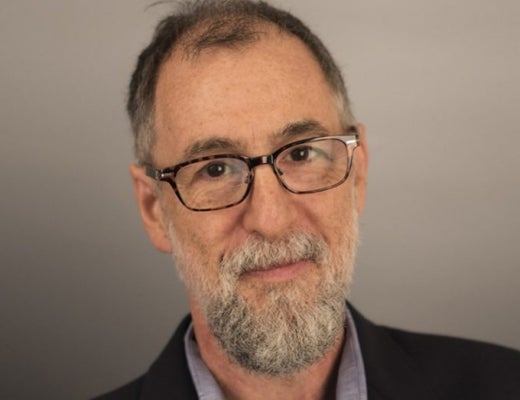
Paul Cohen is a Professor of Computer Science at the University of Pittsburgh's School of Computing and Information (SCI), where he also directs the Modeling and Managing Complicated Systems Institute (MOMACS). Previously, he served as the founding Dean of SCI from 2017 to 2020. Before joining Pitt, he was a Program Manager at DARPA (2013–2017), leading initiatives like Big Mechanism and Communicating with Computers. Earlier roles include founding director of the University of Arizona’s School of Information: Science, Technology and Arts (SISTA), and professor at the University of Southern California’s Information Sciences Institute and the University of Massachusetts. Education: PhD in Computer Science and Psychology (Stanford University), MS in Psychology (UCLA), BS in Psychology (UC San Diego). Research Interests: Focuses on artificial intelligence, machine learning, natural language processing, and modeling complex systems like cell signaling pathways and socio-environmental interactions. His work emphasizes explainable AI, human-computer communication, and interdisciplinary problem-solving. Key Contributions: Authored Empirical Methods for Artificial Intelligence and over 200 peer-reviewed articles. His research spans robotics, education technology (e.g., the AnimalWatch tutoring system), and collaborative analysis tools like COLAB. He has won a Telly Award for his video on systemic challenges and a Best Paper award for spatial language learning frameworks. Awards & Recognition: Elected Fellow of the AAAI, recipient of the Telly Award, and winner of the Best Paper Award at the IEEE Conference on Development and Learning. Leadership & Outreach: Advocates for polymathy in education to address global challenges. His work includes developing curricula for complex systems thinking and promoting diversity in STEM through initiatives like AnimalWatch.

Danielle Li is the David Sarnoff Professor of Management of Technology and a Professor at the MIT Sloan School of Management, specializing in the Technological Innovation, Entrepreneurship, and Strategic Management academic group. She is also a Faculty Research Fellow at the National Bureau of Economic Research (NBER). Her academic journey includes an AB in mathematics and the history of science from Harvard College and a PhD in economics from MIT. Prior to joining MIT, she taught at Harvard Business School and the Kellogg School of Management. AB in Mathematics and History of Science, Harvard College PhD in Economics, MIT Professor Li's research focuses on the economics of innovation and labor economics, with particular emphasis on how organizations evaluate ideas, projects, and people. She investigates the intersection of technology and workplace dynamics, especially how AI impacts worker productivity, the nature of work, and career trajectories in AI-intensive environments. Her work examines how businesses implement AI tools and the resulting effects on workforce composition and skill requirements. Her publication portfolio reveals a consistent focus on innovation economics, labor market dynamics, and the organizational implications of technology. Recent work increasingly centers on AI's workplace impact, with her 2025 Quarterly Journal of Economics paper 'Generative AI at Work' demonstrating how AI assistance increases worker productivity by 15% on average, with differential effects across experience levels. Her research combines rigorous economic analysis with practical business implications, spanning pharmaceutical innovation, hiring practices, promotion decisions, and gender gaps in the workplace. Best Paper Prize: 2017 FIRCG Conference Best Paper Prize: 2018 CEPR Management, Organizations, and Entrepreneurship Conference Best Paper Prize: 2017 Red Rock Conference Best Paper Prize: 2018 LBS Summer Finance Symposium Best Paper Prize: 2019 American Economic Journal: Applied Economics Professor Li's research has been supported by significant grants and has influenced both academic discourse and business practice. Her work on AI in the workplace has informed executive education programs at MIT Sloan, including 'Making AI Work: Machine Intelligence for Business and Society' and 'Artificial Intelligence' courses. She actively engages with media and business leaders to translate research findings into practical insights, frequently appearing in the New York Times, Wall Street Journal, and Economist. Her research on gender promotion gaps and hiring practices has particular relevance for organizational human resource policies. Professor Li is deeply embedded in MIT's AI research ecosystem, collaborating with colleagues across Sloan and CSAIL. She contributes to MIT's AI Expert Spotlight series, focusing on how businesses should implement AI responsibly and effectively. Her work bridges economic theory with practical business applications, particularly in understanding how AI transforms work processes and organizational structures.
Kannan Srinivasan is the H.J. Heinz II Professor of Management, Marketing and Business Technology at Carnegie Mellon University's Tepper School of Business, a position he has held since 1999. Prior to joining CMU, he taught at the business schools of the University of Chicago and Stanford University. His academic career spans over three decades with significant contributions to marketing science and data analytics. His educational background includes: Ph.D. in Management from University of California Los Angeles (1986) MBA in Marketing/Finance from Xavier School of Management, Jamshedpur, India (1980) BA in Engineering from University of Madras, Chennai, India (1978) Srinivasan's research focuses on advanced data analytics models applied to marketing problems, with particular expertise in internet-generated large-scale data analysis. His work bridges the gap between theoretical marketing models and practical business applications, especially in the areas of algorithmic pricing, consumer behavior analysis, and AI-driven marketing strategies. He has pioneered research in dynamic pricing systems, location-aware marketing technologies, and the economic implications of AI in consumer markets. Analysis of his recent publications reveals a strong trend toward examining the intersection of artificial intelligence, consumer welfare, and market dynamics. His work increasingly focuses on ethical implications of AI in marketing, algorithmic bias, and the socioeconomic impacts of digital platforms across various sectors including real estate, social media, and e-commerce. His scientific achievements include: Elected Fellow of the Informs Society of Marketing Science (2013) for lifetime contribution to the field Served as President of the Informs Society of Marketing Science Holds multiple patents related to time and location aware dynamic push content, dynamic pricing, and online advertising Srinivasan has advised numerous doctoral students whose careers have led them to faculty positions at top institutions including Duke, Harvard, Columbia, Yale, University of Chicago, Wharton, University of Michigan, and Indian Institute of Management Bangalore. He has extensive consulting experience with large firms and startups, translating academic research into practical business applications. His professional service includes editorial roles at prestigious journals including Management Science, Marketing Science, and Quantitative Marketing and Economics, as well as significant committee service within CMU including the Elliott D. Smith Award Committee and various Dean's Advisory committees. His research is organized around several key initiatives focused on applying advanced analytics to solve complex marketing problems, with particular emphasis on developing interpretable AI models that balance business objectives with consumer welfare considerations.

Jiaojiao Jiangمشاهده پروفایل
مدرس ارشد
Dr. Jiaojiao Jiang is a Senior Lecturer in the School of Computer Science and Engineering at the University of New South Wales (UNSW). She holds a Ph.D. from Deakin University (Melbourne, Australia) and has published over 45 articles with 1,100+ citations. Her research focuses on AI-driven cybersecurity solutions, particularly misinformation detection and modeling information propagation dynamics. She is affiliated with UNSW's Sydney campus and can be contacted at jiaojiao.jiang@unsw.edu.au . Education: Ph.D., Deakin University, 2010s Research Interests: Artificial Intelligence applications in cybersecurity Misinformation detection and network analysis Machine learning for network security Data privacy in IoT systems Publications span topics like fake news detection via graph neural networks, multiplex network robustness, and cyber threat intelligence frameworks. Her work bridges theoretical network science with practical cybersecurity challenges.

Andrew Thomas Campbell is a Professor and Albert Bradley 1915 Third Century Professor in the Department of Computer Science at Dartmouth College. His research focuses on ubiquitous computing, machine learning, and mental health, particularly using mobile and wearable sensors to assess and manage mental illnesses. He leads the StudentLife project, which tracks college students' mental health over four years, and co-directs the HealthX Lab. Campbell's work has received prestigious awards, including the ACM UbiComp 10-Year Impact Award for pioneering mobile sensing in mental health. He previously held tenure as an Associate Professor at Columbia University and has industry experience at Google and Verily. His research spans $42M in grants from NIH, NSF, and corporate partners, emphasizing technology-driven solutions for mental health challenges. Education: B.Sc. from Aston University, M.Sc. from City University, Ph.D. from Lancaster University. He teaches CS 1 Introduction to Programming and mentors numerous students. Awards include the Dean of the Faculty Award for Mentoring (2025) and multiple ACM Test of Time Awards. His lab collaborations involve跨学科 teams addressing mental health through AI and sensing technologies.

Emily Whitingمشاهده پروفایل
دانشیار
Emily Whiting is an Associate Professor of Computer Science at Boston University and Director of the Shape Design & Computation Lab. She also serves as Director of PhD Admissions and Co-Director of the BU Computer Graphics Lab. Her research focuses on computational fabrication, architectural geometry, and computer-aided design, bridging digital geometry processing, engineering mechanics, and rapid prototyping. She holds a PhD from MIT (2012), an SM in Design & Computation from MIT (2006), and a BASc in Engineering Science from the University of Toronto (2004). Previously, she was faculty at Dartmouth and a Marie Curie Postdoctoral Fellow at ETH Zurich. Her research interests include 3D printing optimization, structural design for fabrication, and tools for functionally-valid object creation. Notable projects include work on elastic garments, climbing experience replication, and print-wind instrument design. Her work has been featured on TEDx and PBS NOVA, and she has received awards such as the NSF CAREER Award and Sloan Research Fellowship. Education: PhD (MIT), SM (MIT), BASc (University of Toronto) Labs: Shape Design & Computation Lab, BU Computer Graphics Lab Key Projects: Knitting 4D garments, Environment-Scale Fabrication, Thermal-comfort casts Recent professional activities include program committee roles at SIGGRAPH 2025 and UIST 2024, and serving as Program Co-Chair for Pacific Graphics 2024. She advises a team of PhD and MS students, with alumni now in academia and tech industries.

Douglas K. Hartman is a Professor in the Department of Teacher Education at Michigan State University (MSU) , with a joint appointment in Educational Psychology and Educational Technology. He holds a Ph.D. from the University of Illinois Urbana-Champaign. His research focuses on the application of technologies to enhance human learning across diverse contexts, including schools, communities, workplaces, and sports. Hartman’s work bridges educational theory and practice, emphasizing innovation in teaching methodologies and digital literacy. His research interests span educational technology , new literacies , and technology integration in learning environments. He has contributed to understanding how digital tools impact early childhood education, teacher professional development, and global educational policies. His recent studies explore AI applications in literacy assessment and generative AI’s role in artistic disciplines. Key themes in his publications include cross-cultural educational collaboration (e.g., CLIL approaches in EMI contexts), early literacy development, and teacher roles in online learning. While no awards are explicitly noted, his extensive scholarly output reflects sustained contributions to educational innovation. Hartman’s affiliation with MSU’s College of Education positions him at the forefront of interdisciplinary research, though specific grants or labs are not detailed in the provided texts. He maintains an active research agenda addressing 21st-century challenges in education through technology-driven solutions.

Professor Gina Neff is a Professor of Responsible AI at the Digital Environment Research Institute (DERI), Queen Mary University of London. She specializes in the ethical and societal implications of emerging technologies, particularly AI's impact on democracy, digital rights, and creative industries. Her work bridges academic research, policy-making, and industry collaboration. She holds dual roles as Deputy CEO of Responsible AI UK (a £33M initiative) and Executive Director of the Minderoo Centre for Technology & Democracy at the University of Cambridge. These roles emphasize her commitment to shaping AI governance frameworks and fostering democratic accountability in technological innovation. Her research focuses on AI ethics, digital policy, and sociotechnical systems. Key themes include mitigating harmful algorithmic practices, protecting creative sector rights in the AI era, and ensuring equitable technological development. Neff has advised governments and organizations on AI regulation, misinformation mitigation, and data governance. Recent initiatives include leading the ESRC’s Digital Good Network and contributing to UK policy consultations on copyright and AI. She frequently engages with media and policymakers, advocating for transparent, human-centered approaches to technology.

Professor Daniel Angus is a faculty member at Queensland University of Technology (QUT), holding the position of Professor of Digital Communication in the School of Communication and serving as Director of QUT's Digital Media Research Centre (DMRC). His research focuses on computational methods applied to communication and media studies, with a particular emphasis on AI, automation, misinformation, and digital societal impacts. He holds a PhD in computer science from Swinburne University of Technology and has extensive experience in interdisciplinary research across computer science, design, communication, linguistics, and journalism. Affiliations: ARC Centre of Excellence for Automated Decision Making & Society, ARC Centre of Excellence for the Dynamics of Language. Research Projects: Leads projects like 'Using Machine Vision to Explore Instagram’s Everyday Promotional Cultures' and 'Evaluating the Challenge of ‘Fake News’ and Other Malinformation'. Research Interests: Daniel’s work bridges technology and society, exploring AI ethics, algorithmic transparency, social media governance, and computational methodologies for analyzing communication patterns. He develops tools like Discursis and PauseCode to study discourse and conversational dynamics in healthcare, aged care, and media contexts. Grants & Awards: Principal Investigator on multiple ARC grants and collaborates with industry stakeholders to address challenges like unhealthy food advertising and platform accountability. His research has informed policy submissions to parliamentary committees on social media regulation and AI adoption. Supervision: Current PhD students focus on topics like algorithmic transparency, computational methods for meme analysis, and AI in publishing. Labs/Teams: Directs the Digital Media Research Centre, fostering interdisciplinary projects on digital culture and platform studies.
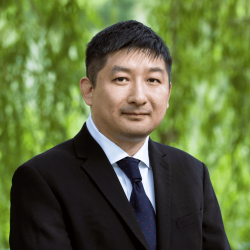
Professor Jin Xuan is the Associate Dean (Research and Innovation) at the University of Surrey's Faculty of Engineering and Physical Sciences, and holds a Chair in Sustainable Processes. He is also a Turing Fellow at the Alan Turing Institute. Previously, he led the Department of Chemical Engineering at Loughborough University. His research focuses on net-zero energy, circular economy, and sustainable development through AI and engineering innovations. He has pioneered Energy and AI as an interdisciplinary field, leading advancements in multiscale predictive models for energy systems and low-carbon solutions. Roles: Associate Dean, Professor of Sustainable Processes, Turing Fellow Affiliations: University of Surrey, Alan Turing Institute Prior Position: Head of Chemical Engineering, Loughborough University His research interests span AI-driven energy systems, CO2 capture/utilization, and renewable energy devices like fuel cells and electrolysers. He has developed novel models for complex systems and co-founded journals such as Energy and AI. He leads the UKRI CircularChem Centre, recognized with the IChemE Global Sustainability Award (2023). Awards: Philip Leverhulme Prize (2022), Beilby Medal (2020) Professor Xuan’s work bridges academia and industry, emphasizing ethical and policy frameworks in energy systems. He advises on grants and collaborates globally, fostering innovation in digital twins and sustainable technologies.

Davide Donadio is a Professor of Chemistry at the University of California, Davis. His research focuses on molecular modeling and simulations of materials, particularly in non-equilibrium processes, thermal transport, and nanostructure assembly. He leads the Naotheory Group, which develops predictive multiscale models for energy-related materials. Education : Habilitation in Materials Science, Italian Ministry for University and Research (2013) Ph.D. in Materials Science, University of Milano (2003) M.S. in Physics, University of Milano (1998) Research Interests : His work spans molecular-level understanding of energy conversion, thermal management, and nanostructure formation. Key areas include phononics, thermoelectrics, and interfacial phenomena in materials like ice surfaces, semiconductors, and clathrates. He employs machine learning and first-principles methods to bridge simulation and experiment. Awards : UC Davis Hellman Fellow (2017–2018) Young Scientist Award, Italian Institute for the Physics of Matter (1998) Grants & Labs : His funding and collaborations drive advancements in nanostructured materials and computational tools like PLUMED tutorials. The Naotheory Group actively publishes in high-impact journals and collaborates internationally on thermal transport and materials design.
- Machine Learning
- Artificial Intelligence for Science and Engineering
- Language Models and Agents
- +۳ مورد دیگر
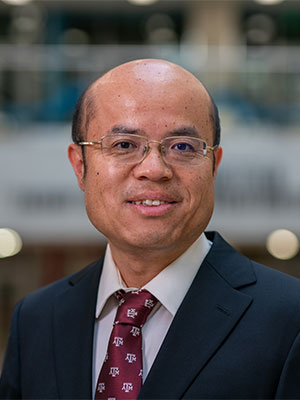
Shuiwang Ji is a Professor and Truchard Family Endowed Chair in the Department of Computer Science & Engineering at Texas A&M University, where he also holds Presidential Impact Fellow and Chancellor EDGES Fellow titles. He specializes in machine learning, AI for science/engineering, and language models/agents. His research bridges theoretical advances and practical applications in materials science, quantum chemistry, and biomedical engineering. Education: Ph.D. in Computer Science from Arizona State University (2010). Research focuses on equivaraint neural networks for symmetry-aware learning, graph-based molecular modeling, and generative AI for scientific discovery. He develops algorithms that integrate physics principles with deep learning, addressing challenges in materials design, PDE solving, and biomolecular structure prediction. Publications emphasize symmetry-aware architectures (e.g., equivariant Fourier neural operators), efficient interatomic potential computations, and diffusion models for protein/DNA design. Recent work explores trustworthiness in LLMs and causal reasoning in graph neural networks. Awards include NSF CAREER Award (2014), IEEE Fellow (2023), and Texas A&M teaching excellence awards. His work has been recognized in top venues like NeurIPS, ICML, and ICLR. His research group collaborates on projects funded by NSF, NIH, and industry partners, advancing AI applications in healthcare, robotics, and environmental science.

Nagham Saeedمشاهده پروفایل
دانشیار
- Electrical and Electronic Engineering
- Industrial Internet of Things (IIoT)
- Artificial Intelligence in Engineering
- +۹ مورد دیگر
Dr. Nagham Saeed is an Associate Professor in Electrical and Electronic Engineering at the School of Computing and Engineering, University of West London, where she has been actively engaged in teaching and research since 2007. She holds a PhD in Intelligent MANET Optimisation from Brunel University and leads the Industrial Internet of Things (IIoT) research group. Her academic service includes editorial and technical committee roles for IEEE and MDPI, and she is a Chartered Engineer (CEng), Senior Member of IEEE, Member of IET, and Senior Fellow of the Higher Education Academy (HEA). PhD in Intelligent MANET Optimisation System, Brunel University (2011) Her research focuses on intelligent systems for smart cities, applying artificial intelligence to telecommunications, energy modeling, and industrial applications. She explores AI-driven optimization in next-generation networks, smart grid integration, battery management systems, and sustainable ICT. Her work also extends to engineering education, particularly feedforward teaching methods and student engagement. The recent publications reveal a strong trend in applying AI and machine learning to solve real-world challenges in energy systems, IoT, transportation, and environmental sustainability, often with a focus on smart cities and renewable integration. Dr. Saeed has been recognized with several awards, including: 2021 University of West London Student Union Best Supervisor/Tutor Award 2022 IEEE Region 8 Outstanding Women in Engineering Section Volunteer Award She mentors early-career engineers and academics and actively promotes electrical and electronic engineering among young girls. She has served as the 2023 IEEE Women in Engineering UK & Ireland Chair and is currently the Vice Chair (Chair-Elect) for the IEEE UK & Ireland Section (2024–2025). Her leadership spans technical innovation, academic service, and diversity advocacy in engineering. She teaches across a range of programs, including MSc Industrial Internet of Things, BEng and MSc Electrical and Electronic Engineering, and supervises PhD research in related fields.
نمایش نتایج تا ۷۵۰ مورد اول. برای یافتن نتایج دقیقتر، جستجوی خود را با فیلترها محدود کنید.