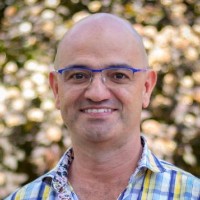
Laura Edmondson is the Helman Family Distinguished Professor and Chair of the Department of Theater at Dartmouth College. She holds affiliations with the African and African American Studies Program and Women's, Gender, and Sexuality Studies Program. Her work bridges postcolonial African drama, feminist/queer performance studies, and transnational theater historiography. Education: B.A. Indiana University, M.A./Ph.D. University of Texas at Austin. Her research examines Eastern/Central African performance through lenses of empire, trauma, and humanitarianism. Recent projects include a NEH-funded book on contagion and care in Central Africa. Notable publications include Performing Trauma in Central Africa: Shadows of Empire (IU Press, 2018) and articles in GLQ , Theatre Journal , and Journal of the African Literature Association . She received the 2021 Oscar Brockett Prize for her analysis of Faustin Linyekula's work. Service includes editing Theatre Journal , leading Dartmouth's Women's, Gender, and Sexuality Studies program, and mentoring through awards from the Dean of the Faculty. Her collaborative theater project Forged in Fire (2015) explored South Sudanese refugee narratives.
George Chauncey is the DeWitt Clinton Professor of American History at Columbia University, leading the Columbia Research Initiative on the Global History of Sexualities. His work focuses on gender, sexuality, and urban culture, particularly LGBTQ history in the U.S. He has contributed to landmark legal cases, including Supreme Court rulings on marriage equality. Education: Ph.D. in History from Yale University (1989), B.A. from Yale (1977). Before Columbia, he taught at the University of Chicago and Yale, where he chaired the History Department and Committee for LGBT Studies. Research interests include postwar New York City’s LGBTQ communities, the intersection of law and sexuality, and transnational queer histories. He consults on public history projects, including exhibitions at the New York Public Library and Library of Congress. Awardees include the Library of Congress’s John W. Kluge Prize (2022), Yale’s Sidonie Miskimin Clauss Prize (2012), and numerous fellowships. His writings have appeared in The Atlantic, New York Times, and The New Yorker. Advising roles include mentoring students at Yale and University of Chicago; grants include Guggenheim and National Humanities Center fellowships. Active in public engagement, he chairs the New-York Historical Society’s Board of Trustees. Current projects include a book on postwar LGBTQ life in New York’s segregated neighborhoods, blending archival research with oral histories.
Professor Cati Connell is an Associate Professor of Sociology at Boston University and former Director of the BU Women’s, Gender, and Sexuality Studies Program. She holds a PhD in Sociology from the University of Texas at Austin (2010). Her research focuses on LGBTQ+ rights, military inclusion, gender dynamics, and workplace experiences. Key themes include queer identity formation, policy impacts on marginalized communities, and the intersection of labor practices with gender and sexuality. Education: PhD in Sociology from the University of Texas at Austin, 2010 Her research interests center on military integration post-DADT repeal, generational solidarities in LGBTQ+ communities, and the evolving meanings of self-identification terms like “lesbian.” She explores how institutions shape queer narratives, analyzing topics such as homonormativity, gendered compromises, and aesthetic labor in retail environments. Her work combines qualitative methodologies with theoretical frameworks like Bourdieu’s sociology of the body. In her recent publications (2015–2024), Connell examines the paradoxes of queer visibility in professional spaces, the tensions between civil rights and institutional policies, and digital platforms’ role in fostering LGBTQ+ solidarity. Her analysis often critiques how equality reforms can inadvertently reinforce exclusionary norms. Scientific awards: No awards explicitly mentioned in the provided texts. Advising and grants: While no specific advisees or grants are listed, Connell’s research trajectory suggests active mentorship in LGBTQ+ studies and sociology. Her work likely involves collaborative projects, though funding details remain undocumented. Labs/teams: Affiliated with Boston University’s Sociology Department and previously led the Women’s, Gender, and Sexuality Studies Program. No specific lab or team affiliations are noted in the texts, but her interdisciplinary focus implies potential collaborations across gender studies, queer theory, and military sociology initiatives.
Dr Oscar Zhou serves as a Lecturer in Media Studies and Director of Studies for Planning, Culture and Environment (PGT) at the School of Arts, University of Kent, following prior academic appointments at the University of Sussex, University of Brighton, and University of Hertfordshire. His scholarly trajectory includes a PhD in Media and Cultural Studies from the University of Sussex and a Masters in Globalisation and Communications from the University of Leicester. His educational credentials: PhD in Media and Cultural Studies, University of Sussex Masters in Globalisation and Communications, University of Leicester Undergraduate training in communication and technical science Zhou's research critically examines intersections of digital culture, gender/sexuality studies, and media technologies, with concentrated focus on LGBTQ+ communities' engagements in transnational contexts. Employing digital and algorithmic ethnography, he investigates queer digital cultures, critical health communication, and platform politics—particularly analyzing how algorithms reconfigure power dynamics around gender, sexuality, and youth wellbeing in Chinese digital ecosystems like Douyin/TikTok. Analysis of his publication record reveals consistent exploration of Chinese digital media landscapes, emphasizing queer visibility on platforms such as Douyin and Zhihu, danmei fan cultures, and gender politics in television. His work also addresses digital activism, influencer economies, and geopolitical representations in fandom, demonstrating methodological innovation through short-video platform analytics and participatory youth research. Professional recognition: Fellow of the Higher Education Academy As an active PhD supervisor, Zhou seeks candidates with qualitative and ethnographic expertise in digital culture, particularly welcoming projects on Chinese media, algorithmic governance, and queer health communication. He chairs the UK-China Media and Cultural Studies Association while contributing to the Centre for Health and Medical Humanities, currently leading collaborative research on short-video apps' societal impacts through the lens of gender, sexuality, and youth wellbeing.
Matthew Kramer is the Churchill College Professor of Legal and Political Philosophy at the University of Cambridge's Faculty of Law. He holds academic qualifications including B.A. (Cornell), J.D. (Harvard), Ph.D., and LL.D. (Cambridge). His research focuses on Legal Philosophy, Political Philosophy, and Moral Philosophy. He leads the Cambridge Forum for Legal and Political Philosophy (CFLPP), a key center for UK analytic legal and political philosophy. Kramer is a Fellow of the British Academy (F.B.A.) and has authored influential works such as Freedom of Expression as Self-Restraint (2021) and Liberalism with Excellence (2017). His scholarship critically engages with H.L.A. Hart's legal positivism, rights theory, and moral realism. Recent publications explore Hohfeldian analysis, legal normativity, and liberal principles in contexts like hate-speech regulation. Education: B.A. Cornell University, J.D. Harvard Law School, Ph.D. and LL.D. from Cambridge University. His work bridges legal theory, political morality, and moral philosophy, addressing topics such as the death penalty, torture ethics, and the boundaries of liberal tolerance. Kramer’s interdisciplinary approach is evident in contributions to debates on constitutional design, rights ontology, and the intersections between law and moral obligation. Awards: Fellow of the British Academy (F.B.A.) Key Roles: Director of CFLPP, Member of Faculty of Law Research Groups: Cambridge Forum for Legal and Political Philosophy His publications span over 50 books and articles, including critiques of legal positivism and defenses of moral realism. Kramer’s recent work emphasizes the philosophical foundations of rights and the ethical dimensions of legal practice, reflecting his commitment to advancing analytic jurisprudence.
Geoffrey C. Layman serves as Professor and Department Chair of Political Science at the University of Notre Dame, with faculty fellowships at the Ansari Institute for Global Engagement With Religion and affiliation at the Rooney Center for the Study of American Democracy. His research centers on American political behavior, party system evolution, and religion-politics intersections, emphasizing long-term coalition changes and secularization's impact on polarization. Recent work analyzes how secular voters reshape electoral dynamics and how religious/secular orientations intensify partisan conflict, published in top journals including American Political Science Review and Journal of Politics . Publications from 2021-2025 reveal a concentrated focus on secular political behavior, with studies examining atheist voting, pandemic-era secularization acceleration, and Catholic political consistency under cross-pressures—highlighting secularism as a critical new fault line in American politics. His major honors include: Distinguished Book Award, Society for the Scientific Study of Religion (2022) for Secular Surge Jack L. Walker, Jr. Outstanding Article Award, APSA Political Organizations and Parties Section (2012) As Department Chair, Layman oversees academic operations and mentoring, with research supported by major publications and institutional affiliations. His book The Great Divide (2001) established foundational work on religious-cultural conflict in party politics, extended in recent collaborative projects.
Dr Marcin Smietana is a Research Fellow at the University of Cambridge , affiliated with the Department of Sociology and the Reproductive Sociology Research Group (ReproSoc) . His work focuses on LGBTQ+ family formation , transnational surrogacy , and reproductive justice , funded by grants including a Marie Curie Fellowship and Wellcome Trust support. He teaches courses on Sociology of Gender , Health and Illness , and MPhil in Health, Medicine & Society . PhD in Sociology (University of Barcelona/AFIN) Postdoctoral work at UC Berkeley and Cambridge His research explores queer resistance to authoritarianism , racial dynamics in ART (assisted reproductive technologies), and reproductive decision-making among gay men. He co-edited the landmark volume Making Families: Transnational Surrogacy, Queer Kinship and Reproductive Justice (2018), which bridges reproductive anthropology with queer theory . Current projects examine queer ecologies and critical animal studies . Key contributions include: Identifying repro-regional moral frameworks in cross-cultural surrogacy studies (USA, India, Russia) Documenting the intersections of race and queer reproduction in international surrogacy markets Deconstructing emotional economies in U.S. commercial surrogacy He supervises dissertations on transnational surrogacy , queer kinship , and species relationships in reproduction , with publications spanning Reproductive BioMedicine & Society Online , Sociological Research Online , and edited volumes. His upcoming book examines gay men’s reproductive decision-making in transnational contexts.
Judith A. Peraino is a Professor in the Music Department at Cornell University's College of Arts and Sciences, with significant affiliations to the Feminist, Gender and Sexuality Studies Program, American Studies Program, Lesbian, Gay, Bisexual and Transgender Studies Program, and Medieval Studies Program. Her educational background includes a Ph.D. and M.A. from The University of California, Berkeley, and a B.A. from The University of Chicago. Peraino's research spans both medieval song and contemporary rock music, focusing on the intersection of subject formation, social identity, and musical expression across historical periods. Her primary research areas include: LGBT and Queer Theory in musical contexts Medieval song traditions and troubadour culture Rock, punk, and synthpop music genres Gender and sexuality in musical expression Sound and media studies across historical periods Peraino's scholarly work reveals two major interconnected trajectories: medieval musical traditions (particularly Guillaume de Machaut and troubadour songs) and contemporary popular music studies (focusing on punk, rock, and queer musical identities). Her research demonstrates how music has been historically used to challenge norms of gender and sexuality, from ancient times to the present. She has received prestigious recognition including a National Endowment for the Humanities Fellowship (2020), the H. Colin Slim Award, the Philip Brett Award, and Cornell's Stephen and Margery Russell Distinguished Teaching Award. Peraino gained significant public attention for discovering previously unknown Lou Reed recordings created for Andy Warhol in 1975, which was featured in The New York Times, The Washington Post, and Rolling Stone. She has co-curated major exhibitions including 'Anarchy in the Archive: Cornell's Punk Collections' and 'Electrifying Music: The Life and Legacy of Robert Moog,' and conducted interviews with prominent musical figures like Masha Alyokhina (Pussy Riot), John Doe and Exene Cervenka (X), and Gary Numan. As an educator, she teaches undergraduate courses including The History of Rock Music, Punk Culture, The Beatles, and Music and Queer Identity, as well as graduate seminars on The Velvet Underground Archive, Medieval Song traditions, and Gender and Glam Rock. She also performs as a conga drummer with Cornell ensembles and local Latin jazz groups.
Professor Peter Nicolas is the William L. Dwyer Chair in Law and Director of the Intellectual Property Law & Policy Graduate Program at the University of Washington School of Law. He holds adjunct professorships in Gender, Women & Sexuality Studies and Music. His primary affiliations include the UW School of Law, where he has been a faculty member since 2000. He previously served as Associate Dean from 2008–2010. Education: B.A. Economics (1991), M.P.P. (1992), University of Michigan; J.D. (1999), Harvard University; A.A.A.S. (2021), Shoreline Community College (Music Performance); B.A. (2023), University of Washington (Music). Research focuses on the intersection of music law and copyright, constitutional law, LGBTQ+ rights, evidence law, and federal courts. His work bridges legal scholarship with music theory, with recent courses including Copyright Law, Music Law & Policy, and Intellectual Property Theory. Notable contributions include Evidence: A Problem-Based and Comparative Approach (5th ed., 2025) and Harmonizing Music Theory and Music Law (2023). His writings address topics like AI music fraud, streaming royalties, LGBTQ+ legal protections, and post-Obergefell jurisprudence. Frequently quoted by media outlets on music law and IP issues. Former roles include Research Economist at the University of Michigan and Ann Arbor City Council member. Labs/Teams: Leads the IP LL.M. program and collaborates with interdisciplinary music law initiatives. Consults on high-profile cases involving LGBTQ+ rights and evidentiary standards.
Robert Lorway is Professor and Canada Research Chair in Global Intervention Politics and Social Transformation at the University of Manitoba's Institute for Global Public Health. With a PhD in Sociocultural Medical Anthropology from the University of Toronto, his research analyzes how global health interventions reshape communities and subjectivities, particularly among marginalized populations in Africa and Asia. His ethnographic approach combines medical anthropology with social studies of science to examine HIV prevention, health activism, and surveillance. Lorway's award-winning books include 'Namibia’s Rainbow Project: Gay Rights in an African Nation' (Lamda Literary Award finalist) and 'AIDS Activism, Science and Community across Three Continents.' His current project 'Demonopolizing Science' examines how sex worker collectives challenge undemocratic health governance. He has received major grants from CIHR, SSHRC, and Wenner-Gren Foundation. Honors include the CAHR-CANFAR Excellence in Research Award and multiple research chairs. His international collaborations with community-based organizations inform critical studies of how health interventions impact citizenship and social justice.
Dr. Luiz Valle Junior is an Assistant Professor in Law and Criminology at Northeastern University London. He holds a PhD in Law from Birkbeck, University of London, with prior training in international political science from Universidade de Brasília (UnB) and Pontifícia Universidade Católica do Rio de Janeiro (PUC-Rio). His research focuses on intersections of queer theory, psychoanalysis, and continental philosophy within international human rights law and activism. He critically examines topics such as queer sociality, gender trouble, and the ethical dimensions of psychoanalytic frameworks. His publications analyze how psychoanalytic critique can reshape understandings of queer international relations and social ethics. Recent work engages with Lacanian ethics, gender politics, and Brazilian conservatism’s impact on sexual/reproductive rights. Though no awards are listed, his scholarly contributions bridge law, philosophy, and political theory. Dr. Valle Junior’s academic affiliations include Northeastern University’s global network across 13 campuses. His research often addresses marginalized communities’ rights through interdisciplinary lenses, though no specific grants or lab affiliations are detailed in the text.
Dr. Johan Andersson is an Associate Professor in Urban Cultural Geography at King's College London's Department of Geography, part of the School of Global Affairs. He holds a BA in Comparative Literature and Art History from Stockholm University (2000) and a PhD in Urban Studies from University College London (2008). His postdoctoral roles included a fellowship at the University of Leeds and a visiting scholar position at the Graduate Center of City University New York. His research focuses on queer nightlife, cinema and urban spaces, and postindustrial urbanism. Notable works include Berlin's queer archipelago (2023) and Berghain: Space, affect, and sexual disorientation (2022). He co-edited The City in American Cinema: Film and Postindustrial Culture (2019) and has published widely on topics like queer space, gentrification, and transnational religious networks. Andersson leads the Urban Futures research group and co-founded Queer@King's, a hub for LGBTQ+ studies. He advises PhD students on urban, cultural, and social geography topics. His work intersects with UN SDGs addressing sustainable cities and communities (SDG 11) and reducing inequalities (SDG 10).
Christopher Ewing is an Assistant Professor in the Department of History at Virginia Commonwealth University. He specializes in transnational histories of race, sexuality, and queerness in contemporary Germany, with a focus on post-1970 queer movements and their intersections with racial politics. Ph.D., History, The Graduate Center, CUNY (2018) M.Phil., History, The Graduate Center, CUNY (2016) M.A., History, The Graduate Center, CUNY (2014) B.A., History and German Studies, Vassar College (2012) His research bridges LGBTQ history, transnational social movements, and the role of racialized desire in modern European contexts. He is particularly interested in sex tourism, queer media, and the global dimensions of German history. Christopher's recent publications include analyses of gay rights' entanglement with racial dynamics, such as studies on the AIDS epidemic's racialized impact and the contradictions in West German homosexual magazines. His edited volume on queer media in the German-speaking world is under contract with Palgrave Macmillan. Schilling Fund Award (2023) National Endowment for the Humanities Nomination (2022) Dahlem Junior Host Program (2019) Fellow at German Historical Institute (2016-2017) He mentors graduate students in the history of sexuality and transnational social history. His work has been featured in major journals like Journal of the History of Sexuality and Sexualities , as well as museum exhibitions and public media such as The Washington Post .
Jennifer V. Evans is a Professor of History at Carleton University. She holds a B.A. from McGill University, an M.A. from Simon Fraser University, and a Ph.D. from SUNY Binghamton. Her research focuses on queer German history, visual culture, and the intersection of sexuality with memory and space. She leads the SSHRC-funded 'Populist Publics' project analyzing digital misinformation and has held fellowships from institutions like the Alexander von Humboldt Foundation and the Royal Society of Canada. Her major works include Queer Life After Fascism (2023) and Life Among the Ruins (2011), exploring post-war queer subcultures and photographic ethics. She co-edited Queer Cities, Queer Cultures (2013) and authored groundbreaking articles on Nazi-era sexuality and digital Holocaust memory. Evans supervises graduate students in transnational German history and collaborates internationally on projects like the 'George Mosse Lectures.' Education: B.A. McGill, M.A. Simon Fraser, Ph.D. SUNY Binghamton Awards: Konrad Adenauer Prize (2023), SSHRC Insight Grants (2019, 2013, 2003), Royal Society Membership (2016) Key Projects: 'Populist Publics' (social media analysis), 'A Short History of Drag' (2026 Mosse Lectures) Her teaching spans undergraduate courses on authoritarianism and graduate seminars on social theory. She mentors over 20 doctoral and master's students, many recognized with university awards. Evans' work bridges visual culture and queer historiography, emphasizing ethical engagement with marginalized histories.
Jordi Díez is a Professor of Political Science at the University of Guelph, affiliated with the College of Social & Applied Human Sciences. His expertise spans comparative politics, Latin American politics, environmental policy, judicial politics, and sexual minority rights. He holds a doctoral degree from the University of Toronto and has held visiting professorships at institutions including Harvard University, UC San Diego, and universities across Latin America. Research Interests : Díez's work focuses on environmental policymaking in Latin America (with a focus on Mexico's Lacandone rainforest), security and defense relations in North America, the expansion of LGBTQ+ rights in Argentina, Chile, and Mexico, and the applicability of Global North public policy theories to Latin American contexts. His current SSHRC-funded projects examine judicial politics in Latin American constitutional courts and the judicialization of abortion rights. Teaching : He teaches courses ranging from introductory comparative politics to advanced judicial politics and Latin American politics at both undergraduate and graduate levels. His pedagogical approach integrates digital media's impact on public opinion and social movements. Grants & Projects : He leads SSHRC-funded research on Latin America’s constitutional courts and LGBTQ+ rights expansion. Past collaborations include a co-edited volume on globalization and environmental degradation in the Global South (Broadview Press). Awards : While no specific prizes are listed, his work has received consistent federal research funding, including SSHRC grants for comparative judicial studies and LGBTQ+ policy research. Labs/Teams : Collaborates with global networks including experts from the Americas and Europe on comparative public policy and judicial behavior studies.