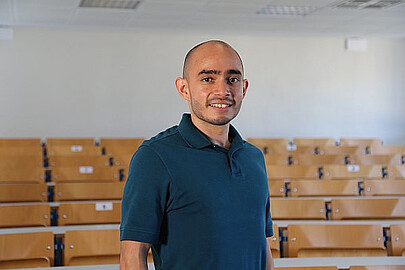
Dr. Victor Gabriel Lopez Mejia is a postdoctoral researcher at the Institute of Automatic Control Engineering, Faculty of Electrical Engineering and Computer Science, Leibniz University Hannover. His work focuses on data-driven control systems, reinforcement learning, and multi-agent system synchronization. PhD in Electrical Engineering (2019), University of Texas at Arlington M.Sc. in Electrical Engineering (2013), CINVESTAV, Mexico B.Sc. in Telecommunications and Electronics (2010), Universidad Autonoma de Campeche Research interests include: Neural network applications in control systems Reinforcement learning for cooperative control Game-theoretic analysis of multi-agent systems Data-based modeling of nonlinear dynamics Publications highlight advancements in data-driven predictive control, Gaussian process-based estimation, and nonlinear system analysis, with recent work in IEEE Transactions on Automatic Control and conferences like CDC and ECC. He has held academic roles including Adjunct Professor at the University of Texas at Arlington and Research Assistant at UTARI (2016-2019).
Alexander Mertens serves as Associate Professor and Department Head of the Institute of Industrial Engineering within RWTH Aachen University's Faculty of Mechanical Engineering, concurrently leading the Ergonomics and Human-Machine Systems group. His dual doctorates (Dr.-Ing. and Dr. rer. medic.) underpin his interdisciplinary approach bridging engineering and medical sciences. His research centers on human-centered technology integration , with core interests in Ergonomics , Human-Machine Systems , and Virtual Reality applications . He investigates physiological workload monitoring, human-robot collaboration, and inclusive workplace design—particularly through AR/VR systems and sensor-based interventions for manufacturing and healthcare contexts. His work emphasizes translating biomechanical and psychosocial insights into practical solutions for worker safety and performance. Analysis of his 2024-2025 publications reveals three dominant trends: human-robot collaboration in manufacturing (evident in VR-based robot assistance studies), physiological workload assessment (using pupillometry and multimodal signals), and workplace health innovation (addressing interruptions, musculoskeletal disorders, and aging populations). These threads consistently prioritize human factors in digital transformation across automotive, healthcare, and industrial domains. Prof. Mertens directs the Ergonomics and Human-Machine Systems laboratory, driving initiatives like AixistenzRobotik (Aachen Competence Center for Interactive Robotics in Health/Care) and workHEALTH (holistic prevention of work-related musculoskeletal disorders). His team develops adaptive interfaces for inclusive factories and evaluates digital escape signage through age-differentiated studies, maintaining strong industry partnerships for real-world implementation.
Pedro Neves Rito is an Associate Professor at the Department of Communication and Art within the School of Education at the Polytechnic Institute of Viseu, where he has been teaching since 2007. His teaching focuses on web programming, creative programming, microcontroller programming, sensors, and ICT training for pre-school and primary school teachers. He is also a member of the CI&DEI Research Group and has served as Coordinator of the Information and Communication Technologies Area since 2022. His educational background includes: Doctorate in Information Technologies and Systems from the University of Minho (2015) Master's degree in Multimedia in Education from the University of Aveiro (2007) Degree in Computer Engineering from the Instituto Superior de Engenharia de Coimbra Numerous professional certifications including Adobe Certified Expert in Dreamweaver CS3 and Flash CS3 Rito's research spans multiple innovative areas at the intersection of technology and education. His primary interests include the adoption and diffusion of technologies, creative programming and application development, video game design, and tangible interfaces. He has extensively explored how gamification techniques can enhance learning experiences, particularly in programming education, and has investigated the potential of augmented reality in educational contexts. His work often focuses on practical applications for classroom settings, especially for pre-school and primary school teachers. His recent publications show a strong trend toward integrating artificial intelligence in educational game design, with particular emphasis on STEAM education and programming concepts. He has conducted systematic reviews on the educational potential of video games and developed frameworks for designing educational mobile video games. His research consistently emphasizes practical implementation strategies for educators, with a growing focus on AI applications in educational settings. Rito actively supervises numerous graduate students across various programs, particularly in Arts, Multimedia, and Education fields. He has led and participated in multiple research projects including "dEweB - Digital Era: WEB 3.0 and beyond," "Smart City Kids Lab," and "Eco-sensors4Health." His work demonstrates a commitment to applying technology innovations in real educational settings through practical implementation and teacher training.
Bo Chen is a Professor in the Department of Mechanical Engineering – Engineering Mechanics and the Department of Electrical & Computer Engineering at Michigan Technological University. She directs the Intelligent Mechatronics and Embedded Systems (IMES) Laboratory, focusing on advanced controls, optimization, and artificial intelligence for connected and autonomous vehicles, electric vehicle–smart grid integration, and smart mobility. PhD in Mechanical and Aeronautical Engineering from the University of California, Davis (2005) Visiting Professor at Argonne National Laboratory (2014–2015, 2016) Sabbatical at Oak Ridge National Laboratory (2022–2023) Dr. Chen's research spans Mechatronics , Embedded Systems , Hybrid Electric Vehicles , and Cyber-Physical Systems . Her work includes vehicle-to-grid integration , battery control systems , and cybersecurity for automotive systems . Recent publications highlight advancements in predictive control algorithms for hybrid vehicles, consensus-based frequency regulation , and plausibly deniable encryption systems for mobile devices. Funded by the National Science Foundation, Department of Energy, and industry partners, her research has secured over $10 million in grants. ASME Fellow Best Paper Award (2008 IEEE/ASME MESA Conference) Top Cited Article Award (Journal of Computers & Graphics) Best Survey Paper Award (IEEE Transactions on ITS) Co-recipient of four Best Student Paper Awards Dr. Chen has held leadership roles as Chair of the Technical Committee on Mechatronics and Embedded Systems (IEEE ITS Society), Chair of the ASME Design Engineering Division's Technical Committee, and Associate Editor for IEEE Transactions on Intelligent Transportation Systems (2012–2019). She organized multiple international conferences and co-edited special issues on intelligent transportation systems.
Jun Li is a Professor at the University of Oregon within the College of Arts and Sciences . He serves as the Director of the Network & Security Research Laboratory and Founding Director of the Center for Cyber Security and Privacy. His academic career spans over 100 peer-reviewed publications and significant contributions to cybersecurity, networking, and distributed systems. PhD (UCLA, 2002) - Outstanding Doctor of Philosophy M.E. (Chinese Academy of Sciences, 1995) - Presidential Scholarship B.S. (Peking University, 1992) His research focuses on Cyber Security & Privacy , Computer Networking , and Distributed Systems , particularly examining: DDoS defense mechanisms Internet routing security DNS security Blockchain applications IoT security protocols Social bot detection Recent work (2023-2024) emphasizes adaptive DDoS filtering, cryptojacking detection, and security frameworks for smart homes. His publications span top-tier venues like IEEE Transactions on Dependable and Secure Computing , ACM Transactions on Internet of Things , and INFOCOM . Scientific honors include: ACM Recognition of Service Award University of Oregon Faculty Excellence Award Ripple Faculty Fellowship Multiple best paper awards He has received funding from the NSF (including CAREER award), DHS , Intel , Narus , Ripple , and the State of Oregon . His work extends to patents in hybrid peer-to-peer security protocols.
Timo Seppälä is a University Lecturer in Digital Operations at Aalto University's School of Science, Department of Industrial Engineering and Management. His research focuses on global value chains, supply chain management, and digital technology implementations in technology- and service-based businesses. He explores platformization of supply chains, collaborative innovation management for complex digital ecosystems, and the implications of artificial intelligence platforms across industries. Global Value Chains Digital Platforms & Ecosystems Artificial Intelligence Governance Blockchain Applications in Industry Recent publications highlight trends in AI diffusion monitoring, blockchain-based systems for industrial applications, and sustainability challenges in digital economies. His work spans empirical analysis of corporate digitalization, platform governance, and multi-actor value creation. No scientific awards are currently documented.
Scott Douglas is an Associate Professor at the Utrecht School of Governance, Utrecht University, specializing in Public Administration , Collaborative Governance , and Crisis Management . He focuses on the dynamics of collaborations between governments, companies, and community organizations to address complex societal challenges such as radicalization, child abuse, and crisis response. Education: University of Oxford, DPhil (2011) University of Oxford, MPhil Comparative Government (2008) London School of Economics, BSc Industrial Relations (2005) His research emphasizes interdisciplinary collaboration , innovative tools like the Performance Management Game, and public value creation . He co-founded the Security in Open Societies platform and leads international consortia such as Horizon and Adapt! on crisis governance. Key publications analyze collaborative performance regimes, cognitive biases in public procurement, and frameworks for evaluating governance measures. His work spans journals like Public Administration Review , Public Management Review , and PLoS One . Scientific Awards Member of De Jonge Akademie (2023) He bridges research , education , and societal impact through projects with NWO, municipalities, and the Dutch Safety Investigation Board. Current initiatives include studying how University Medical Centers can lead in primary prevention networks.
Professor Ulysses Sengupta is a leading academic and practitioner in architecture and urbanism at the Manchester School of Architecture , where he holds the Professor of Architecture and Urbanism title. He is the founding director of the [CPU]lab (Complexity Planning and Urbanism Research Laboratory) and leads the [CPU]ai master’s design atelier, which integrates data-driven design and computational thinking into architectural education. His work bridges academic research, pedagogy, and practice through Softgrid Limited , an internationally networked architecture and urban research firm. Founding director of [CPU]lab Leader of [CPU]ai atelier Director of Softgrid Limited International collaborations with institutions like the Architectural Association and University of Westminster Research Interests focus on cities as complex adaptive systems, utilizing big data, IoT, and machine learning to address urban sustainability and governance. Key themes include: Smart cities and digital urban disruption Agile governance and participatory planning Complexity-based design methodologies Global South urbanism and resource-limited settings Interdisciplinary tools for urban data analysis Eco-architecture and futureproofing urban systems Articles highlight his work on urban data analysis, mobility-as-a-service, transdisciplinary systems mapping, and the intersection of social/environmental justice in smart cities. His Google Scholar profile reflects a consistent focus on computational urbanism and sustainable transformation frameworks. Scientific Awards include shortlisting for the Colvin Prize (2025), a prestigious honor in architectural research. His projects span ESRC, H2020, and Innovate UK grants, including leadership in the DACAS network and Synchronicity EU initiative. Professional Contributions encompass advisory roles for international organizations like RIBA, policy briefs for the United Nations University, and design competitions in China, India, and the UK. His [CPU]ai atelier redefines architectural education through computational complexity.
Dr. Melissa Kossman serves as Associate Professor and Director of the School of Health Professions at the University of Southern Mississippi, where she leads the Athletic Training Program. Her academic leadership spans curriculum development, policy implementation, and graduate education in sports medicine. Her educational trajectory includes: PhD in Human Movement Science (Motor Control and Neuroscience) from University of North Carolina at Chapel Hill (2019) MS in Athletic Training from A.T. Still University (2015) BS in Athletic Training from Indiana University-Bloomington (2013) Dr. Kossman's research program investigates cultural phenomena in sport environments through mixed-methodological frameworks, with core emphases on concussion-related behaviors, policy design/implementation, and healthcare professional preparation. Her work bridges qualitative depth with quantitative rigor to address systemic challenges in athletic training and sports safety culture, particularly regarding injury disclosure and prevention protocols. Her publication record (2018-2023) reveals consistent focus on concussion disclosure dynamics in NCAA athletes, implementation barriers for heat-acclimatization policies in high school football, and biopsychosocial dimensions of career-ending injuries. This body of work demonstrates methodological sophistication in analyzing cultural barriers to safety compliance and developing evidence-based interventions for sports medicine contexts. Professional engagement includes active membership in National Athletic Trainers' Association, American College of Sports Medicine, Southeastern Athletic Trainers' Association, Mississippi Athletic Trainers' Association, and Mixed Methods International Research Association.
Mona Moisala is a Doctor of Psychology and active researcher specializing in cognitive science and psychology, with particular expertise in attentional multimodal networks and brain responses to digital media. Her research has been supported by major projects funded by the Academy of Finland, including 'Bridging the Gaps,' 'Kasvava mieli,' 'Mind the Gap Between Digital Natives and Educational Practices,' and 'CENT.' Her research interests focus on how digital media affects cognitive functions, particularly in adolescents and young adults. She investigates media multitasking, video gaming, social media interactions, and their neural bases, examining how these activities influence attention, concentration, and brain responses. Her work bridges cognitive neuroscience with practical applications for education and mental well-being. Analysis of her publication trends shows a consistent focus on cognitive neuroscience applied to digital media effects, with increasing attention to adolescent development and educational implications over time. Her research combines experimental methods with real-world applications, as evidenced by her popular science book 'Concentration recovery guide' which translates complex cognitive concepts for general audiences. Behavioral Science Faculty Pro Gradu Award (2013) Mona Moisala actively supervises master's theses and has served as Principal Investigator on major research grants totaling millions in funding. Her research has generated significant media attention, with 47 media appearances where she discusses cognitive science topics for public audiences. She has also contributed to academic service through journal reviewing for publications like Cortex, Brain and Behavior, and Computers in Human Behavior, and has been a member of organizations including Heureka and Young Academy Finland. Her international collaboration includes a visiting researcher position at Leiden University (2018), demonstrating her engagement with the global research community. Her work continues to address critical questions about how digital environments shape cognitive development and brain function.
Jin Yunshui is an Associate Professor at the Media Experiment and Practice Teaching Center within Tongji University's School of Art and Media. He holds a PhD in Digital Design and Technology from the University of the Arts London (2022) and has extensive experience in digital animation, interactive media, and immersive technologies. Education PhD in Digital Design and Technology (2017-2022), University of the Arts London, UK MFA in Media Art and Design (2011-2012), Bauhaus University Weimar, Germany Master of Arts (2010-2013) and Bachelor of Animation (2006-2010), Tongji University Research Interests Jin's work spans virtual reality (VR) , augmented reality (AR) , serious games , cultural heritage digitization , 3D visualization , and natural user interfaces . He focuses on applying immersive technologies to education, mental health, and historical preservation. Research Trends His recent publications highlight comparative studies of VR/AR systems, immersive education applications, and ethical design of interactive media. Key themes include digital storytelling , user engagement metrics , and technological frameworks for generative art . Scientific Awards 金曦奖-创新印象艺术奖 (2022) The Rookies奖沉浸式媒体组冠军 (2019) 全国计算机设计大赛一等奖 (2009) 同济大学优秀教师 (2018) Grants & Projects Jin leads major initiatives like the Shanghai Educational Research Project on Mental Health Intervention (2024), Ministry of Education's National Golden Course in Shadow Puppetry (2023), and international collaborations with Brunel University on creative industries (2023). Labs & Teams He heads the Non-planar Imaging Laboratory at Tongji and contributes to the Forever Project with Holocaust survivor holography (2017).
Joanna Dziekońska is a Lecturer at the Department of Didactics and Early Education, Faculty of Social Sciences, University of Warmia and Mazury in Olsztyn. Her work focuses on digital education, childhood studies in digital environments, and special education practices. PhD candidate in Pedagogy at the University of Warmia and Mazury (2020–present) Master's in Journalism and Social Communication (2010) Bachelor's in Journalism and Social Communication (2008) Postgraduate studies in Logopedics at the University of Warmia and Mazury (2012) Bachelor's in Early Childhood Education at the University of Warmia and Mazury (2011) Her research examines digital upbringing, hybrid childhood experiences, and the role of new technologies in education. She has published extensively on children's internet communication, digital culture implications, and intensive parenting in digital eras. Joanna's publications explore digital native integration, digital communities, and educational technology trends. Key themes include digital literacy, hybrid learning environments, and media influence on child development. She has presented at national pedagogical conferences and contributed to reports analyzing digital society impacts on education and parenting strategies. Joanna has been a research and teaching staff member at the University of Warmia and Mazury since 2015, preceded by roles as a preschool teacher and speech therapist in Olsztyn and Myszyniec.
Charles M. North is an Associate Professor in the Department of Economics at Baylor University, where he has been a faculty member since earning his PhD from the University of Texas. Prior to academia, he practiced law in Dallas after graduating from Duke University School of Law. His research uniquely bridges Economics of Religion , Law & Economics , and Applied Microeconomics , with a focus on experimental economics applied to criminal justice, religious markets, and legal systems. He has published extensively in journals like the Journal of Economic Behavior and Organization and Journal of Money, Credit & Banking , exploring topics such as religion’s impact on the rule of law and experimental studies of jury behavior. Education: PhD in Economics (University of Texas, 1999) JD in Law (Duke University, 1990) MBA in Business (Baylor University, 1987) BA in Business Administration (Baylor University, 1986) Teaching: Courses include Introductory Economics, Game Theory, and Law & Economics Director of the Baylor Business Fellows program Research Trends: Recent work focuses on experimental economics in criminal justice Longstanding interest in religion-economic-legal intersections Studies on jury bias, plea bargaining, and religious freedom Personal Interests: Founder of Baylor’s Aloha Fridays tradition Fan of Everton Football Club (UK) Created Ted Lasso filming location tours in London Contact: charles_north@baylor.edu
Dr. Marie Vasek is a Lecturer in Information Security at the Department of Computer Science, University College London (UCL) . She joined UCL in August 2019 after serving as an Assistant Professor at the University of New Mexico (UNM) from 2017-2019. PhD in Computer Science (2017) - University of Tulsa, advised by Dr. Tyler Moore MSc in Computer Science (2015) - SMU BA in Computer Science & Mathematics (2012) - Wellesley College Her research spans computer security, focusing on security economics and cybercrime measurement . Key areas include cryptocurrency fraud (pump-and-dumps, Ponzi schemes), SMS scams, decentralized finance (DeFi) deception, and ethical challenges in security research. Recent work examines physical cryptocurrency attacks ("wrench attacks"), regulatory frameworks for CBDCs, and social media's role in illicit drug advertising. Dr. Vasek has received notable recognition, including the 2016 Google Anita Borg Scholarship . She co-directed StopBadware (2011-2020) and contributes to UCL's teaching through courses like COMP0141 Security and COMP0057 Research in Information Security . Her publications appear in venues like USENIX Security , IEEE Blockchain Conference , and Workshop on the Economics of Information Security .
Nader Sadegh is a Professor in the Woodruff School of Mechanical Engineering at the Georgia Institute of Technology's College of Engineering, where he also serves as Associate Director and Education Director of the Robotics Ph.D. Program. His research spans robotics, control theory, and artificial intelligence with applications in industrial automation and public health. Dr. Sadegh's educational background includes: B.S. from University of California, Santa Barbara (1982) M.S. from University of California, Berkeley (1984) Ph.D. from University of California, Berkeley (1987) His research evolved from pioneering work on adaptive learning controllers for robotic manipulators—which enable robots to learn repetitive tasks without precise models—to neural network applications and nonlinear system identification. Current work focuses on barrier state theory for safety-critical control systems, safe trajectory optimization in robotics, and epidemiological modeling for disease transmission control. His methodologies consistently bridge theoretical control frameworks with industrial implementations to enhance system accuracy and autonomy while reducing hardware complexity. Analysis of his recent publications reveals a dominant trend toward safety-critical control architectures using barrier states and functions, with expanding applications in quadrotor navigation, agricultural robotics, and pandemic response systems. The interdisciplinary nature of his work connects control theory with machine learning, epidemiology, and industrial automation. Scientific distinctions include: Associate Editor, Journal of Dynamic Systems, Measurement, and Control (1993-1997) Registered Professional Engineer in Georgia U.S. Patent 5,946,449 for precision apparatus with non-rigid structures Dr. Sadegh has secured significant industry-sponsored research including Xerox Corporation projects on photoreceptor speed regulation, Ford Motor Company collaborations on assembly operations and continuously variable transmissions, and Visteon-funded work on high-precision manufacturing systems. His grants consistently target practical implementations where theoretical control methods solve real-world problems in automotive systems, electro-hydraulic valves, and glass forming processes. Based at the Georgia Tech Manufacturing Institute (GTMI), his lab develops integrated control solutions for complex mechanical systems, with recent emphasis on safety-guaranteed autonomous operations in unstructured environments and data-driven modeling for biological processes.