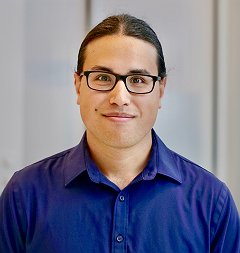
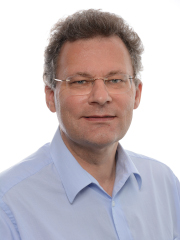
Hans Tompits is an Associate Professor in the Department of Knowledge-Based Systems at Technische Universität Wien (Vienna University of Technology). His research focuses on computational logic, declarative logic programming, and formal methods, with a particular emphasis on Answer-Set Programming (ASP). He coordinates the Master's program in Logic and Computation and leads projects in areas such as formal methods for optimization, fault-tolerant autonomous systems, and algorithmic composition. His work bridges theoretical advancements with practical applications, including tools like SeaLion (an ASP IDE with debugging support) and dlvhex (an ASP-based semantic web reasoner). He has contributed to foundational topics like program equivalence, debugging techniques, and integration of ASP with external systems. His recent projects address challenges in autonomous vehicle architectures, music composition algorithms, and safety-critical system design. Tompits has published extensively on topics ranging from nonmonotonic reasoning and modal logics to the development of declarative programming tools. His interdisciplinary approach spans computer science, mathematics, and AI, with applications in both academic and industrial contexts.
Jonathan Ragan-Kelley is the Esther and Harold E. Edgerton Assistant Professor of Electrical Engineering & Computer Science at MIT and an Assistant Professor of EECS at UC Berkeley. He leads the Visual Computing group at CSAIL, focusing on high-efficiency visual computing, compilers, and architectures for image processing, machine learning, and 3D rendering. His research bridges systems, compilers, and hardware design, emphasizing scalable solutions for computational challenges. Education: PhD in Computer Science from MIT (2014), postdoc at Stanford University, and visiting researcher at Google. He co-created the Halide language and has developed multiple domain-specific languages (DSLs) and compiler systems. Research interests include compiler optimization, scheduling languages (e.g., Exo), and efficient computing frameworks. He has received awards such as the NSF CAREER Award and ACM SIGGRAPH’s Significant New Researcher Award. Awards: ACM SIGGRAPH Award, NSF CAREER, Intel Outstanding Researcher Award Key Contributions: Halide compiler framework, Exo scheduling language, machine learning acceleration techniques Labs/Teams: Visual Computing at MIT CSAIL
Sara Magliacane is an Assistant Professor at the University of Amsterdam and a Research Scientist at the MIT-IBM Watson AI Lab . She leads research at the intersection of causality and machine learning , focusing on improving AI robustness, generalization, and safety through causal reasoning. Her work spans causal representation learning , causal discovery , and causality-inspired ML in domains like reinforcement learning and dynamical systems. PhD in Artificial Intelligence (2017), VU Amsterdam MSc in Computer Engineering (2011), Politecnico di Milano/Torino BSc in Computer Engineering (2008), Università degli Studi di Trieste Her research explores causal variable identification from high-dimensional data (e.g., images, sequences) and causal graph discovery for domain adaptation. Methods include CITRIS , FANS-RL , and SNAP , with applications in embodied AI and biomedical data. The group emphasizes theoretical guarantees and scalable algorithms for real-world systems. Recent work trends include temporal causal modeling , intervention-efficient learning , and nonstationary reinforcement learning . Publications cover topics like causal discovery in partially observed settings , causal graph pruning , and sample-efficient concept learning , often combining neurosymbolic approaches with deep learning. Scientific Awards : ELLIS Scholar Sara supervises PhD students across universities (UvA, University of Pisa) and collaborates with institutions like TU Delft , Harvard , and IBM Research . She co-organizes workshops at premier conferences (NeurIPS, ICML, AISTATS) and teaches causality courses at the University of Amsterdam and Harvard Data Science Initiative. Her lab, Amsterdam Machine Learning Lab (AMLab) , investigates causal structure in embodied agents , safe reinforcement learning , and hybrid dynamical system modeling . The group maintains active partnerships with institutions such as MIT-IBM Watson AI Lab , Qualcomm , and Adyen .
Adam T. Smith is Distinguished Professor of Arts and Sciences in Anthropology at Cornell University, specializing in Archaeology, Political Theory, Landscape Studies , and Material Culture . He co-founded Project ArAGATS in Armenia and co-directs the Aragats Foundation , focusing on collaborative archaeological research in the South Caucasus. His work spans from the Bronze Age to contemporary heritage preservation issues. PhD (1996), MA (1993) - University of Arizona, Anthropology MPhil (1991) - University of Cambridge, Social & Political Science BA (1990) - Brown University, Anthropology & Political Science Research interests center on political anthropology through material culture , analyzing how objects shape political systems from ancient to modern contexts. His projects include Caucasus Heritage Watch for satellite monitoring of endangered sites and extensive studies of Late Bronze Age/Early Iron Age fortresses in Armenia. Key contributions involve redefining South Caucasus chronologies using radiocarbon dating and Bayesian modeling. Recent publications focus on 2023: Cultural heritage documentation during Nagorno-Karabakh conflicts 2022: Critiques of Armenian Genocide erasure in archaeological discourse 2018: Revised Bronze/Iron Age timelines for the Caucasus 2015: Sovereignty mechanisms in Urartian landscapes Scientific honors include 2023 Finalist - Falling Walls Science Breakthrough (Social Sciences) 2010-2011 Guggenheim & Cornell Humanities Fellowships 1997-1999 Michigan Society of Fellows He leads the Landscapes and Objects Laboratory and teaches courses like Archaeological Research Design while engaging in public archaeology through initiatives like St. James AME Zion Church excavations in Ithaca, NY.
Carlo Angiuli is an Assistant Professor of Computer Science at the Department of Computer Science in the Luddy School of Informatics, Computing, and Engineering at Indiana University. His research focuses on programming languages and logic through the lens of type theory, particularly dependent types, proof assistants, and homotopy type theory. He is currently coauthoring a book on dependent type theory with Daniel Gratzer. Ph.D. in Computer Science from Carnegie Mellon University (CMU) Develops programming language foundations and computational interpretations of type theory Active in the HoTTEST Summer School organization and PL Wonks seminar group Recipient of multiple prestigious awards for type theory research His recent publications explore universe polymorphism, cubical type theory, and the intersection of category theory with programming language design. As a community builder, he organizes international research seminars and maintains experimental proof assistants like RedPRL. His teaching includes advanced courses on modern dependent types and foundational computer science topics. Scientific Awards : Best Paper Award (FSCD 2019) CMU School of Computer Science Distinguished Dissertation Award He contributes to proof assistant development and hosts the PL Wonks research group at Indiana University.
Stefan Kowalewski serves as Professor of Embedded Software at RWTH Aachen University, leading the Chair of Embedded Software (Informatik 11) within the Department of Computer Science. His research spans critical domains including medical cyber-physical systems, automotive software, and industrial automation, with over 150 publications demonstrating sustained scholarly impact. Professor Kowalewski's work focuses on three interconnected research pillars: Embedded Systems Verification: Pioneering model checking techniques for PLC code, particularly addressing state space challenges in GRAFCET-based specifications Medical Cyber-Physical Systems: Developing safety-critical software for mechanical ventilation, extracorporeal membrane oxygenation, and ARDS diagnosis systems with strong clinical collaborations Automotive Software: Creating verification frameworks and safety architectures for automated vehicles through projects like UNICARagil Recent publications reveal an increasing integration of AI techniques with traditional verification methods, particularly for medical applications involving neonatal care and critical respiratory support. His 2024-2025 work shows particular emphasis on timing isolation in vehicle communication systems, middleware performance evaluation, and robust AI models for medical diagnosis. Professor Kowalewski maintains active collaborations with RWTH Aachen University Hospital's medical departments and automotive industry partners. His laboratory operates specialized facilities including the Cyber-Physical Mobility Lab for vehicle research and in-vivo testing setups for medical device validation. He has supervised numerous doctoral candidates, with recent students focusing on topics like ARDS classification algorithms, GRAFCET verification techniques, and safety architectures for software-defined vehicles. His educational contributions include developing remote teaching platforms for cyber-physical systems education.
Marc C.W. Geilen is an Associate Professor at the Electronic Systems group , Eindhoven University of Technology. He leads the Model-Based Design Lab and contributes to the CompSOC Lab and High Tech Systems Center . His work focuses on model-based design methods, design automation, and optimization for real-time and embedded systems. Research Keywords: Cyber-Physical Systems, Real-Time Systems, Embedded Systems, Performance Analysis, Design Automation Key Collaborations: EU ECSEL TRANSACT project, SAM-FMS project, Arrowhead Tools initiative His recent publications address weakly-hard timing constraints in server-based systems, hybrid performance modeling for cyber-physical systems, and neural network optimization for communication. Article trends span Real-Time Scheduling , Trustworthy Modeling , Neural Network Efficiency , and Resource Allocation in distributed environments. Scientific Awards : Partial-Order Reduction for Performance Analysis (2018) Teaching activities include courses in Computational Modeling , Embedded Signal Processing , and Discrete Mathematics . He collaborates across projects like TRANSACT, SAM-FMS, and Arrowhead Tools, focusing on flexible manufacturing and cloud-to-edge transitions.
Stuart Milligan is a Visiting Researcher specializing in Operations Management with a focus on supply chain dynamics and omni-channel retail systems. His active research includes a 2025 publication in the Journal of Operations Management and a 2023 doctoral thesis examining operations-marketing interfaces in retail contexts, demonstrating ongoing scholarly contributions. His educational background features a Doctor of Philosophy awarded in January 2023 for the thesis "An exploration of the operations-marketing interface in the omni-channel context," supervised by Dr. Yalabik and Dr. Celik. Milligan's research integrates Systems Theory and Adaptive Systems frameworks to analyze complex retail operations, particularly through in-depth case studies of grocery fulfillment and road freight collaboration. His methodology emphasizes empirical investigation of performance evolution in adaptive supply chain environments, with strong connections to United Kingdom-based industry contexts. Current research trends show progression from doctoral work on operations-marketing interfaces to contemporary studies of omni-channel fulfillment performance, consistently applying case study approaches to supply chain challenges. Milligan secured research funding as a collaborator on The British Academy project "The benefits of collaboration in the road freight sector" (2019-2020), working under Principal Investigator Dr. Giannikas with co-investigators including Dr. Yalabik. Though no formal laboratory affiliation is documented, his collaborative projects indicate active participation in interdisciplinary research teams addressing supply chain optimization and retail operations management.
Roopsha Samanta serves as an Assistant Professor in the Department of Computer Science at Purdue University, where she leads the Purdue Formal Methods (PurForM) research group and participates in the Purdue Programming Languages (PurPL) initiative. Her academic foundation includes a PhD from the University of Texas, Austin (2013) and postdoctoral research at the Institute of Science and Technology Austria prior to joining Purdue in 2016. Education: PhD in Computer Science, University of Texas, Austin (2013) Postdoctoral Researcher, Institute of Science and Technology Austria Professor Samanta's research centers on bridging formal methods with programming languages to enhance software reliability, with core expertise in program verification, program synthesis, and concurrency. Her work uniquely targets both professional developers and non-programmers, developing techniques to ensure programs align with user intent through automated reasoning and synthesis. Recent efforts focus on distributed systems verification where traditional methods face scalability challenges. Analysis of her 2020-2024 publications reveals a dominant trajectory in distributed agreement systems, particularly advancing parameterized verification for unbounded process networks. Key innovations include bounded verification techniques for doubly-unbounded systems, explainable synthesis through specification localization, and secure multi-party computation frameworks like HACCLE. Her work consistently integrates theoretical formal methods with practical system implementation. Scientific Awards: NSF CAREER Award (2019) for “Robustness of Inductive Reasoning Engines” Amazon Research Award (2021) supporting secure computation research Her research is primarily funded through competitive grants including the NSF CAREER award and Amazon Research Award, enabling exploration of verification robustness and secure multi-party computation. While specific advising details aren't publicly documented, her leadership of the PurForM group indicates active mentorship of graduate researchers in formal methods. Current projects suggest expanding applications to privacy-preserving technologies and explainable AI-assisted programming. The PurForM research group, under her direction, develops foundational tools for program verification and synthesis with emphasis on distributed and concurrent systems. Collaborations within PurPL and industry partners like Amazon drive translational research from theoretical models to practical verification frameworks applicable to real-world distributed infrastructure.
Yan Cong is an Assistant Professor at Purdue University, focusing on Chinese linguistics and computational linguistics. Their work bridges natural language processing (NLP), semantics, and pragmatics, with applications in artificial intelligence (AI), language education, and healthcare. Research Focus: Developing text analysis models to quantify and improve language learning, assessing semantic/pragmatic competence in language models, and applying computational methods to speech and language fluency. Background: Former NLP researcher at the Feinstein Institutes, with a PhD in Linguistics from Michigan State University. Research Themes: Yan Cong integrates linguistic theory with AI to explore language understanding in humans and machines. Key areas include Computational modeling of semantics and pragmatics Application of NLP to second language acquisition Development of interpretable AI systems for education and healthcare Analysis of speech disturbances in clinical contexts (e.g., schizophrenia, aphasia) Awards: No specific honors mentioned in the provided text.
Todd Millstein is a Professor in the Computer Science Department at the University of California, Los Angeles (UCLA). He served as the Computer Science Department Chair from 2022-2025 and is also an Amazon Scholar. His research focuses on making software systems more reliable through programming languages techniques, with significant contributions to network verification and probabilistic programming. Millstein received his Ph.D. from the University of Washington Department of Computer Science, where he was a member of the Cecil group led by Craig Chambers. Prior to that, he completed his undergraduate studies at Brown University under the guidance of Paris Kanellakis and Pascal Van Hentenryck. Millstein's research spans several areas of programming languages and systems with a focus on reliability. He has made significant contributions to network verification, developing the Batfish network configuration analyzer which is now managed by Amazon Web Services and forms the basis of Oracle Cloud's Network Path Analyzer. His work has been recognized with the ACM SIGCOMM Networking Systems Award in 2025. He also works on interactive program verification through lemma synthesis and scalable reasoning methods for probabilistic programming languages. His research bridges programming languages theory with practical systems challenges, as highlighted in his SPLASH/OOPSLA 2024 keynote "Everything is a Program (even if it's not)". Millstein's recent publications demonstrate a consistent focus on verification and reliability across multiple domains. His work shows a progression from foundational programming language techniques to practical applications in networking and probabilistic systems. Key themes include data-driven approaches to program analysis, synthesis of verification artifacts, and applying programming languages techniques to non-traditional domains like network configuration. Millstein's scientific achievements have been recognized with numerous prestigious awards including an NSF CAREER Award, an ACM SIGPLAN Most Influential PLDI Paper Award, an ACM SIGCOMM Networking Systems Award, IEEE Micro Top Picks selection, best-paper awards from PLDI, OOPSLA, and SIGCOMM, a Microsoft Research Outstanding Collaborator Award, an Okawa Foundation Research Grant, an IBM Faculty Award, and a Facebook Research Award. He has also received both the Northrop Grumman Excellence in Teaching Award (for junior faculty) and the Eon Instrumentation Inc. Excellence in Teaching Award (for senior faculty) from UCLA Engineering. Millstein advises several Ph.D. students including Ana Brendel, Poorva Garg (co-advised with Guy Van den Broeck), Rajdeep Mondal (co-advised with George Varghese), and Rathin Singha (co-advised with George Varghese). His research has been supported by various grants including an NSF CAREER Award, Okawa Foundation Research Grant, IBM Faculty Award, and Facebook Research Award. He has also been a Co-Founder and Chief Scientist of Intentionet, which was later acquired by Amazon Web Services. Millstein is actively involved in the Batfish project, an open-source network configuration analyzer that has had significant practical impact. Batfish is now managed by AWS, powers Oracle Cloud's Network Path Analyzer, and is used by dozens of companies. His research group continues to work on network reliability, developing techniques for scalable BGP policy verification and behavioral testing of protocol implementations.
David Naumann is Professor and Department Chair of Computer Science at Stevens Institute of Technology. His leadership in the department and active research program positions him as a key figure in programming languages and formal methods research. Naumann's research focuses on formal methods and software security, with particular emphasis on relational and hyperproperty verification , fine-grained confidentiality/integrity policies , and program analysis and verification . His work bridges theoretical foundations with practical applications in security-critical systems. He has developed novel program logics and verification techniques that enable precise reasoning about information flow and security properties. His recent publications (2022-2025) reveal a strong trend toward modular relational verification techniques with applications to pointer programs, distributed systems, and concurrent applications. The research spans theoretical foundations (algebraic structures for alignment) to practical tools (WhyRel prototype), demonstrating both depth and breadth in addressing verification challenges. Naumann has served as program committee co-chair for IEEE Computer Security Foundations Symposium (2021-2022) and has been active on committees for POPL, CCS, CSF, ECOOP, and other top venues. His editorial service includes ACM Transactions on Programming Languages and Systems, Formal Aspects of Computing, and Journal of Object Technology. He leads the Cypress research group at Stevens Institute of Technology and has secured significant funding from NSF, Microsoft Research, and Siemens. His mentoring extends to numerous PhD students who have gone on to successful careers in academia and industry.
Prof. Dr. Matthias Armgardt holds the Nucleus Professorship for Global Legal History and Civil Law as well as Computational Legal Theory at the Faculty of Law, University of Hamburg . His work focuses on interdisciplinary fundamental research at the intersection of history, logic, philosophy, and legal reasoning. Historical perspective: Comparative study of ancient Jewish, Greek-Hellenistic, and Roman law Logical perspective: Development of computational legal theory using formal logic and AI Philosophical perspective: Analysis of Leibniz's legal philosophy Legal perspective: Critique of German civil law with comparative methods His research includes collaborations with Harvard Law School, European University Institute, and University of Bologna. Key projects: CISAL (Center for Ancient Legal History) and LLCA (Legal Logic, Computational Law, and AI project). He organizes summer schools on Law and Logic with institutions like the European University Institute.
Professor Vallipuram Muthukkumarasamy is an Associate Professor at the School of Information and Communication Technology at Griffith University, where he has pioneered Network Security teaching and research since joining in 2001. He leads the Networking & Security and Blockchain Research Group at the Institute for Integrated and Intelligent Systems. Muthu holds a Ph.D. from Cambridge University and a B.Sc. Eng. with 1st Class Honors from the University of Peradeniya, Sri Lanka. His extensive academic appointments include Group Leader of Network Security and Blockchain Research (2008-present), Program Director for the Graduate Certificate in Blockchain Technology (2022-present), HDR Convenor (2022-present), Member of the University Council (2020-2021), and Deputy Head of School for Learning and Teaching (2013-2016). Muthu's research expertise spans Cyber Security, Blockchain Technology (DLT), and Wireless Sensor Networking. He has secured national and international funding for interdisciplinary research, published over 150 articles in international journals and conferences, and supervised more than 30 research Masters and PhD students to completion. He pioneered the Network Security teaching at Griffith and successfully proposed and led the development of Queensland's first Master of Cyber Security Program, creating a truly interdisciplinary curriculum with Law, Business, and Criminology Schools. His recent publications reveal a strong research trajectory in blockchain applications, security visualization techniques, and wireless sensor networks. His work explores DeFi user behavior analysis, NFT privacy risks in the metaverse, blockchain transaction visualization, and the integration of blockchain with AI for credit scoring systems. His wireless sensor network research focuses on energy-efficient routing protocols and network lifetime modeling. Muthu has received multiple best teacher awards from students and peers, and during his tenure as Deputy Head of School, the Griffith IT program was ranked #1 in Australia for overall student satisfaction. He successfully proposed and developed Cisco-related courses at undergraduate and postgraduate levels and instrumental in creating industry-sought-after networking and security courses across all academic levels. His funded research includes significant projects such as Increasing the South East Queensland Cyber Security Workforce, Linking Digital Payments to Crime Using Big Data Machine Learning Tools, Improving Water Markets through Digital Technologies, and developing Indo-Australian partnerships for digital transformation through blockchain. He is actively involved in community and charity activities and has been instrumental in internationalization efforts for Griffith University.
Dr Rachel Grant is a Senior Lecturer and Course Director in Bioscience at London South Bank University (LSBU), affiliated with the Bioscience and Bioengineering Research Centre within the School of Human Sciences. She joined LSBU in 2020 after academic roles at Oxford, Cambridge, Anglia Ruskin, and Northampton Universities. Senior Lecturer, LSBU (2020–present) Course Director, Bioscience Research focus: behavioural and evolutionary ecology Her educational background includes: BSc (Hons) Biology (1986–1990) PG Dip Animal Behaviour (2000–2003) PhD (2003–2010) PG Cert LTHE (2012) Rachel's research spans behavioural and evolutionary ecology , with a focus on amphibians, reptiles, and birds. She investigates the influence of geophysical variables on animal behaviour—work relevant to conservation and hazard forecasting. A significant portion of her recent work centers on psittacine bird welfare and personality models, as well as exotic pet welfare models like the Five Domains. She also explores human behavioural ecology , particularly the evolutionary origins of patriarchy and deimatic displays in humans. Her expertise supports the UN Sustainable Development Goals in education and planetary protection. The recent publication trends highlight her interdisciplinary approach, combining zoology, conservation, animal welfare, and evolutionary theory . Her work frequently intersects with public policy, media, and ethical considerations in pet ownership and research inclusivity. Articles from 2024 demonstrate her engagement with both scientific journals and public-facing platforms, addressing topics from reptile expos to disabled researchers' career progression during the pandemic. Scientific engagement and recognition include: Media contributor: Channel 5's "Tsunami", Discovery Channel, NASA Unexplained Files News and radio interviews on animal behaviour and conservation Public engagement through documentaries and outreach Rachel leads curriculum development as Course Director and teaches modules such as Aetiology of Disease, Foundation Biology, Employability, and Level 6 Project. She mentors student research and integrates research methods and statistics into her teaching. While no formal grants or students are listed, her leadership in the DISCOVerY Project indicates involvement in equity-focused research initiatives. She is actively contributing to academic discourse through peer-reviewed publications and public science communication. She is associated with the Bioscience and Bioengineering Research Centre , where her work contributes to understanding animal-environment interactions, improving welfare standards, and promoting inclusive research practices. Her team collaborates on interdisciplinary projects linking biology, geophysics, and social sciences, particularly in risk forecasting and conservation applications.