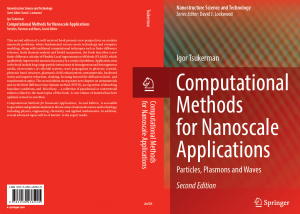
Dr. Igor Tsukerman is a Professor in the Department of Electrical and Computer Engineering at The University of Akron's College of Engineering and Polymer Science. He joined the university in 1995 after working as a Principal Research Associate for GE Canada and the University of Toronto. His research spans electromagnetic analysis, photonics, metamaterials, and computational methods. Ph.D. in Electrical Engineering, St. Petersburg Polytechnic, Russia (1988) B.Sc./M.Sc. with honors in Control Systems, St. Petersburg Polytechnic, Russia (1982) His work focuses on: Electromagnetic analysis and simulation Photonics and plasmonics Metamaterials and topological electromagnetics Homogenization theory applications Finite element/difference computational methods Dr. Tsukerman has received five major NSF awards and various industrial grants. He has held visiting positions at institutions across the US, Austria, Denmark, France, Germany, Hong Kong, Italy, Singapore, and Switzerland. He authored two books: Electromagnetic Analysis: From Electrostatics to Photonics (World Scientific, 2020) Computational Methods for Nanoscale Applications (Springer, 2nd edition, 2020)
Jens Wittsten is a Researcher affiliated with the Department of Engineering at the University of Borås' Academy of Textiles, Technology and Economics. He serves as the main supervisor for doctoral student Markus Klintborg and holds office in room C801. His work bridges applied mathematics, materials science, and computational engineering. Research interests include modeling phenomena in moiré heterostructures (e.g., twisted graphene layers), semiclassical quantization in strained lattices, and seismic data processing techniques. He has contributed to understanding electronic phase transitions, magic angles in bilayer graphene systems, and numerical methods for wave propagation modeling. His publication trends reflect interdisciplinary focus: recent works address both fundamental physics (e.g., Hofstadter butterfly studies) and applied engineering challenges (e.g., warehouse optimization via GPU-accelerated routing). Jens advises one doctoral candidate and maintains an active research portfolio spanning over 25 peer-reviewed articles since 2010. His methodological innovations include contributions to seismic apparition techniques and dealiasing algorithms.
Ana Djurdjevac is an Assistant Professor in the Department of Numerical Analysis and Stochastics at the Freie Universität Berlin , within the Department of Mathematics and Computer Science. Her research focuses on numerical analysis, stochastic processes, and partial differential equations, with particular emphasis on uncertainty quantification and mathematical modeling in evolving domains. She teaches advanced courses such as Numerical Methods for Stochastic Differential Equations and Stochastik I , reflecting her expertise in computational methods and probabilistic frameworks. Her work integrates theoretical analysis with practical numerical techniques, addressing challenges in domains such as fluid dynamics, quantum systems, and biological surface fluctuations. Recent contributions include studies on hybrid algorithms for particle systems, rough homogenization in stochastic dynamics, and synchronization mechanisms in conservation laws. Djurdjevac actively participates in academic events, including the 2025 SIAM Conference on Computational Science and Engineering, and collaborates on projects involving quasi-Monte Carlo methods for Bayesian inversion and domain decomposition techniques. Professional activities highlight her role in shaping emerging fields like stochastic PDEs on evolving domains and feedback loops in agent-based models. While no specific awards are listed, her prolific publication record and teaching roles underscore her contributions to computational science and applied mathematics.
Bogdan Ungureanu is a Research Fellow in the Department of Physics at Imperial College London's Blackett Laboratory. He holds a PhD in Civil Engineering and has expertise in seismic metamaterials, structural mechanics, and risk assessment for urban infrastructure. His work integrates applied mathematics, theoretical mechanics, and civil engineering to design novel metamaterials for vibration reduction and seismic protection. His research spans seismic metamaterials, elastic wave control, and metamaterial applications in urban systems. Key areas include topological crystals, subwavelength effects in structured plates, and anomalous dispersion phenomena such as negative group velocity. He has collaborated with CNRS laboratories in Marseille and Le Mans, as well as the CNRS-Imperial 'Abraham de Moivre' International Research Laboratory. Recent publications focus on ceramic metatiles for elastic wave control, seismic metamaterial performance under clamping and geometry variations, and topological effects in edge wave localization. His work often combines Comsol Multiphysics simulations with experimental validation in structural dynamics and fluid mechanics. Dr. Ungureanu's articles highlight trends in metamaterial design for seismic shielding, interaction effects in urban structures, and theoretical advances in transformation elastodynamics and Floquet-Bloch theory. His expertise in finite element analysis supports industrial applications like floating metamaterial plates for mechanical vibration reduction. No scientific awards are listed. His advising/grant activities are unspecified, though his lab affiliations include the Blackett Laboratory and interdisciplinary collaborations within Imperial College's Faculty of Natural Sciences.
Dr. Yousef Daneshbod is an Associate Professor of Mathematics at the University of La Verne, affiliated with the College of Arts and Sciences. His research interests span computational mathematics, numerical analysis, machine learning, and parallel computing. He holds a PhD and M.S. in Mathematics from Claremont Graduate University and M.S. and B.S. in Engineering from Shiraz University, Iran. His work focuses on numerical algorithms, Hessian-based methods, and computational techniques for scientific problems. Key areas include high-accuracy Hessian approximation in chemical dynamics, domain decomposition methods, and parallel computing scalability. He has also contributed to educational approaches in deep learning and computational science pedagogy. Recent publications explore topics such as power load forecasting with recurrent neural networks, efficient parabolic solvers, and vibration analysis using fundamental solutions. His research combines theoretical rigor with practical applications in fields like fluid dynamics, energy systems, and microfluidics.
Frank Neubrander serves as Executive Director and Chair of the Gordon A. Cain Center for STEM Literacy and holds the Demarcus D. Smith Alumni Professorship in the Department of Mathematics at Louisiana State University. He directs the LSU College Readiness Program, which encompasses dual-enrollment initiatives, STEM pathways, and teacher training programs serving over 18,000 Louisiana K-12 students annually through state-of-the-art STEM education access. His research spans Laplace transforms, operator semigroups, asymptotic analysis, generalized functions, operational calculus, and evolution equations, with significant contributions to finite difference schemes for differential equations. Neubrander actively bridges theoretical mathematics with practical applications in mathematics education, developing programs to enhance STEM literacy and equitable access for diverse student populations across Louisiana. Analysis of his 2011-2025 publications reveals consistent focus on operator semigroup approximation methods, rational Padé techniques, and asymptotic behavior of abstract Cauchy problems. His work demonstrates deep integration of functional analysis with computational mathematics, yielding advances in numerical solution methods for evolution equations while maintaining rigorous theoretical foundations in Banach space theory. No specific scientific awards, fellowships, or medals were explicitly listed in the provided materials, though his endowed professorship signifies institutional recognition of scholarly contributions. Neubrander leads multiple grant-funded initiatives through the Cain Center, including the LSU Dual-Enrollment Program and STEM Teacher Training Programs serving 18,000 students. His advisory roles on the Louisiana Board of Regents’ Teacher and Leader Effectiveness Council and STEM Advisory Council directly influence state educational policy and resource allocation for STEM education. The Gordon A. Cain Center operates as an interdisciplinary hub under Neubrander's direction, coordinating faculty expertise across LSU to develop innovative K-12 curricula and professional development. This structure enables statewide impact through partnerships with school districts and educational organizations, focusing on creating sustainable pathways from secondary education to STEM careers.
Harish Cherukuri is a Professor and Department Chair of Mechanical Engineering and Engineering Science at the University of North Carolina at Charlotte. He holds affiliations with the William States Lee College of Engineering and serves as Chair since 2019. His research focuses on plasticity theory, metal forming, and computational methods in solid mechanics. Education: PhD in Theoretical and Applied Mechanics from UIUC (1995), MS from Montana State University (1989), BTech from Jawaharlal Nehru Technological University (1987). Research interests include finite-element methods, dynamic material behavior, and shear-flow localization. He has held roles such as Director of Graduate Programs (2003–2008) and Interim Chair (2012–2013). Professional memberships include ASME and the Electrostatics Society of America.
Prof. Dr. Rudolf Scherer is a faculty member at the Department of Mathematics, Karlsruhe Institute of Technology (KIT). He specializes in Numerical Analysis , Applied Mathematics , and Mathematical Modeling , with a focus on Ordinary and Partial Differential Equations and Fractional Differential Equations . His research spans geometric integration, symplectic methods, and computational techniques for physical systems. Affiliation: Institute for Applied and Numerical Mathematics, KIT Research Interests: Numerical Analysis, ODE/PDEs, Fractional Calculus, Symplectic Integration His work includes collaborations with institutions such as the Chinese Academy of Sciences, Tsinghua University, and Kuwait University, with extended stays across multiple years. Publications highlight applications in stochastic Hamiltonian systems , Maxwell’s equations , and Protter-Morawetz problems for mixed-type PDEs.
Dr. Stephan Simonis is a Research Fellow at the Karlsruhe Institute of Technology (KIT), working within the Department of Mathematics and specifically with the Institute for Applied and Numerical Mathematics (IANM2). He leads the LBRG Mathematical Modeling and Numerics Lab since 2023 and serves as an associate editor for the Elsevier journal Examples and Counterexamples since 2024. He is also a member of the steering committee for the EU-funded FALCON project (doi: 10.3030/101138305). Dr. Simonis completed his education as follows: BSc and MSc in Mathematics at KIT, Germany and KTH, Sweden (2011-2018) PhD in Mathematics at KIT (2023), with research visits at UFRGS, Brazil and ETH Zürich, Switzerland Dr. Simonis's research focuses on Applied and Computational Mathematics, particularly in developing and analyzing numerical methods for partial differential equations. His work centers on lattice Boltzmann methods for multi-physics simulations, including applications to fluid flow, blood flow, and solid mechanics. He integrates robust numerical schemes with uncertainty quantification and machine learning, leveraging high-performance computing to explore complex parameter spaces. His research has significant applications in engineering and scientific computing. His publication record demonstrates a strong focus on numerical analysis of lattice Boltzmann methods, with recent work expanding into uncertainty quantification, machine learning integration, and applications to complex fluid dynamics problems. The breadth of his work spans theoretical analysis, algorithm development, and practical implementation in the OpenLB library, with publications in top journals across mathematics, physics, and engineering disciplines. Dr. Simonis has received numerous accolades for his work: ERASMUS+ EQF7 scholarship (2016-2017) DAAD PPP mobility funding (2019) KIT Faculty Teaching Award (2021) KHYS Networking Grant (2022) KHYS ConYS Grant (2024) Oberwolfach Leibniz Graduate Student (2024) NHR Starter project (2024) DAAD PRIME fellowship (2025) Dr. Simonis actively mentors students through various thesis projects in mathematics, fluid dynamics, and high-performance computing. His current open thesis topics focus on lattice Boltzmann methods, relaxation schemes, and stability analysis. He has secured significant research funding including the DAAD PRIME fellowship and NHR Starter project, demonstrating strong support for his research program. His teaching portfolio includes Computational Fluid Dynamics and Simulation Lab, Parallel Computing, and Project-centered Software Lab across multiple semesters. As leader of the LBRG Mathematical Modeling and Numerics Lab since 2023, Dr. Simonis oversees a research group focused on developing advanced numerical methods. His involvement in the EU-funded FALCON project and as associate editor for Examples and Counterexamples further demonstrates his growing leadership in the computational mathematics community.
Antonio Luciano Martire is a Researcher at Sapienza University of Rome, affiliated with the Department of Methods and Models for Economy, Territory, and Finance within the Faculty of Economics. He teaches courses including Computer Science and Excel Laboratory for Business and Quantitative Finance, with office hours held on Wednesdays from 11-12 AM. His educational background includes a Bachelor's Degree in Mathematics (2008), Doctorate in Mathematics for Economic and Financial Applications (2012), and a Specialization Diploma in Applied Econometrics (2014), all from Sapienza University of Rome. Martire's research focuses on mathematical finance, computational methods, and actuarial science, with particular expertise in Volterra integral equations, options pricing models, and quantitative finance applications. His work bridges theoretical mathematics with practical financial applications, developing numerical methods for complex financial instruments and insurance products. His recent publications (2020-2024) demonstrate a consistent research trajectory in developing numerical solutions for integral equations with applications to financial derivatives, insurance products, and cryptocurrency markets. The research shows increasing sophistication in computational approaches, including neural network applications to fractional calculus problems. Martire has extensive teaching experience, having taught Financial Mathematics Laboratory and Quantitative Finance courses since 2013. His technical expertise includes scientific software (Matlab, Mathematica, R, STATA) and programming languages (C/C++).
Dr. Florentina Tone is a Professor in the Department of Mathematics and Statistics at the University of West Florida, part of the Hal Marcus College of Science and Engineering. She has been a faculty member since 2006, contributing to both undergraduate and graduate education through classroom and online instruction. Her academic background includes a Ph.D. in Mathematics from Indiana University and both a Master’s and Bachelor’s degree in Mathematics from the University of Bucharest, Romania. Dr. Tone's research is centered on numerical analysis of partial differential equations , with a focus on convergence, stability, and error estimation of numerical schemes. Her work applies to fluid dynamics, phase field models, and coupled physical systems. She has published in leading journals such as SIAM Journal on Numerical Analysis and Numerische Mathematik , and has presented at numerous national and international conferences. The analysis of her recent publications reveals a consistent focus on rigorous mathematical validation of numerical methods, particularly finite element and finite difference schemes for time-dependent PDEs. Her work spans applications in fluid mechanics, heat transfer, chemotaxis, and electromagnetics, demonstrating strong interdisciplinary reach within applied mathematics. She has been recognized for her contributions with the Distinguished Research and Creative Activities Award from UWF. This honor reflects her sustained excellence in scholarly output. Dr. Tone actively supervises student research projects and teaches courses such as Complex Analysis, Numerical Analysis, Linear Algebra, and Calculus. While specific grant details are not listed, her sustained publication record and award suggest active research funding. She has mentored students through research advising, contributing to academic development within the department. She is affiliated with the Department of Mathematics and Statistics, which supports research through seminars, colloquia, and student associations such as the Math Association. The department also hosts technical reports and research labs, including the CSDA Lab, which may support data-intensive computational work.
Dr. Jia Liu is a Professor and Chair of the Department of Mathematics and Statistics at the University of West Florida, within the Hal Marcus College of Science and Engineering. She has been a key academic figure at UWF since 2006, leading both research and departmental initiatives in computational and applied mathematics. Her educational background includes a Ph.D. in Mathematics from Emory University, funded by the National Science Foundation, focusing on preconditioned Krylov subspace methods for incompressible flow problems. She earned her M.S. and B.A. in Mathematics from Central China Normal University, where her bachelor's thesis received the highest honor. Dr. Liu's research lies at the intersection of numerical linear algebra, scientific computing, and interdisciplinary applications. Her primary interests include: Numerical solvers for large sparse linear systems Krylov subspace iterative methods Preconditioning techniques Applications to Navier-Stokes and optimization problems Geometric and topological analysis of ellipsoids Complex networks and community detection via spectral clustering Machine learning for disease prediction and biological modeling The trends in her publications reflect a consistent focus on robust numerical algorithms with applications across fluid dynamics, network science, and biomedical modeling. Her work emphasizes both theoretical development and practical implementation in high-performance computing environments. Dr. Liu has served as an editor and editorial board member for several peer-reviewed journals and regularly reviews submissions. While specific awards are not listed, her sustained publication record in prestigious venues such as SIAM Journal on Scientific Computing and Journal of Biological Dynamics underscores her scholarly impact. As department chair and professor, she plays a central role in academic advising, curriculum development, and research mentorship. She teaches core courses including Differential Equations, Numerical Analysis, and Real Analysis, contributing significantly to both undergraduate and graduate education. Her leadership extends to managing research grants and fostering collaborations across disciplines. Though no formal lab name is mentioned, her research activities suggest involvement with computational modeling groups, likely associated with applied mathematics and data science initiatives at UWF. Her ongoing work continues to advance numerical methods for complex systems in science and engineering.
Hans-Jakob Kaltenbach is a Professor at the Department of Aerodynamics and Fluid Mechanics, Technical University of Munich (TUM) School of Engineering and Design. He has held this position since 2011, following prior roles in R&D at Jülich Research Centre (2009–2011), Deutsche Bahn AG (2004–2008), and academic positions at TU Berlin (1998–2004) and Stanford University (1992–1995). Education: Diploma in Mechanical Engineering, Technical University of Munich (1989) Intermediate Diploma in Process Engineering, University of Karlsruhe (1985) Doctoral Degree in Atmospheric Physics, DLR (1992) Habilitation in Numerical Simulation of Turbulent Flows, TU Berlin (2002) Research Interests: Numerical Flow Simulation and Computational Aeroacoustics (CAA) Flow Control via Passive and Active Methods Aerodynamics and Aeroacoustics of Vehicles (Road, Rail, Aerospace) Flow Noise Generation and Attenuation in Ducts Turbulence Modeling and Large Eddy Simulation (LES) Scientific Awards: Doctoral scholarship from the Volkswagen Foundation (1990–1992) Contributions to Education: Lectures on Aeroacoustics, Continuum Mechanics, Numerical Fluid Mechanics Practical courses in Computational Aeroacoustics and Computational Fluid Dynamics
David Newton is a Professor and Head of Division for Management Accounting, Finance & Law at the Centre for Governance, Regulation and Industrial Strategy within the School of Management at the University of Bath. He maintains an active research profile with numerous recent publications and is currently accepting doctoral students for supervision. Professor Newton's research primarily focuses on financial mathematics and quantitative finance, with particular emphasis on derivatives valuation and structural bond default models. His work bridges theoretical financial mathematics with practical applications in risk management and portfolio optimization. Recent research directions include applying machine learning techniques to financial modeling, cryptocurrency asset pricing, and ESG factors in debt markets. His fingerprint analysis reveals significant contributions to Option Pricing, Lattices, Mortgages, Cryptocurrency, Volatility, Finite Difference Methods, and Portfolio Selection. Analysis of Professor Newton's recent publications reveals a strong trend toward integrating advanced computational methods with traditional financial models. His research spans option pricing theory, portfolio optimization under uncertainty, cryptocurrency markets, and the intersection of ESG factors with corporate finance decisions. The work demonstrates a consistent focus on developing innovative quantitative approaches to complex financial problems, with applications ranging from deep learning for transition probability densities to structural models of bond default. Research actively contributes to UN Sustainable Development Goals Specializes in financial mathematics of option pricing and derivatives valuation Develops empirical testing of structural bond default models Professor Newton actively supervises doctoral students, with current advisees including Haozhe Su, Hui Tian, Qi Hu, and Yulin Wu. His former research group members have achieved notable success, with six becoming associate or assistant professors across the UK, USA, China, and Australia, while others have established careers in finance, founded businesses, or work in major financial centers worldwide including Switzerland, Singapore, Portugal, and the City of London. Professor Newton leads a research group focused on financial mathematics and quantitative finance, with ongoing projects in derivatives pricing, risk management, and the application of machine learning to financial modeling. The group maintains active international collaborations, as evidenced by the diverse geographical distribution of co-authors on recent publications spanning the UK, China, Switzerland, and other financial centers.
Saulo Orizaga is an Assistant Professor in the Department of Mathematics at New Mexico Tech. He holds a Ph.D. in Applied Mathematics from Iowa State University (2014) and prior postdoctoral roles at Duke University (2017–2020) and the University of Arizona (2014–2017). His research focuses on applied and computational mathematics, including mathematical modeling, stability analysis, phase field modeling, and applications in materials science and biomedical engineering. He is affiliated with the American Mathematical Society (AMS), Society for Industrial and Applied Mathematics (SIAM), and SACNAS. Orizaga's research interests span numerical methods for partial differential equations, viscoelastic fluid dynamics, and biomedical flow modeling. His work emphasizes computational techniques like GPU-accelerated algorithms and stability analysis of complex systems. Recent studies include modeling arterial blood flow with atherosclerosis, fiber jet formation, and Cahn-Hilliard equation solutions. No scientific awards are explicitly listed, but his contributions reflect active engagement in interdisciplinary computational research. His professional trajectory includes teaching and research mentorship, though specific advisee details are not provided. He maintains a personal website and is accessible via saulo.orizaga@nmt.edu.