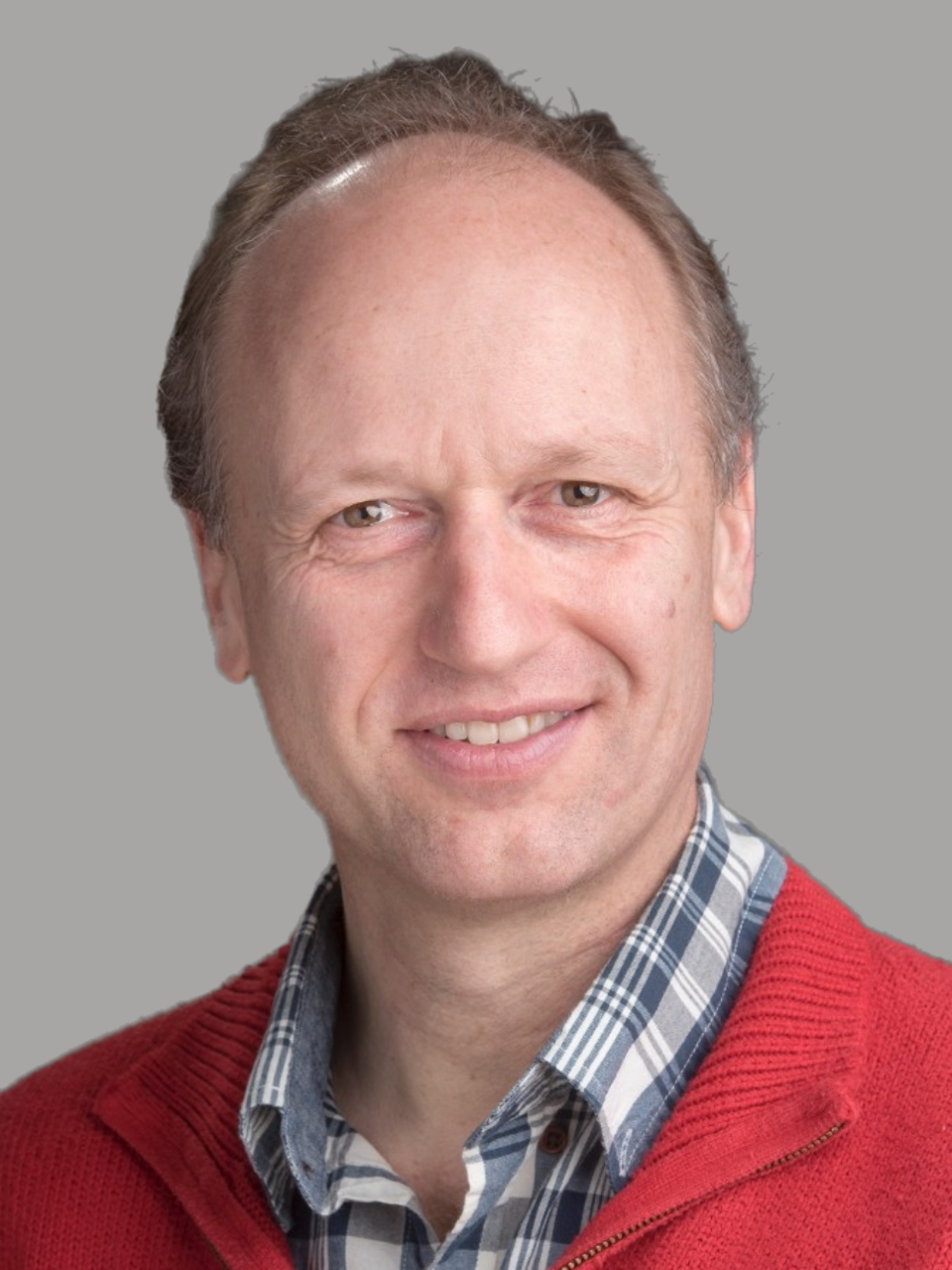
Thomas Hagstrom is a Professor at Southern Methodist University, holding a Ph.D. from the California Institute of Technology (1983). His research specializes in numerical analysis and scientific computing, with particular focus on computational methods for time-domain wave propagation phenomena. Research areas include: Radiation boundary conditions and fast propagation algorithms for scattering problems High-order Hermite discretization methods Discontinuous Galerkin discretizations Efficient time-stepping for stiff equations Applications span electromagnetic/acoustic scattering, sound generation by turbulent flows, gas-phase combustion, and multiscale coupling of kinetic models. His work has been supported by NSF, AFOSR, ARO, and NASA.
Bernhard Rabus is a Professor and holder of the Industrial Research Chair in Synthetic Aperture Radar (SAR) at Simon Fraser University's School of Engineering Science. His work focuses on SAR technologies, with emphasis on maritime applications and novel land applications using multi-channel SAR systems. He leads the SARlab and collaborates with institutions like IEEE. Rabus earned his Ph.D. in Geophysics from the University of Alaska Fairbanks and an M.Sc. from the Technical University of Munich. His research integrates advanced interferometric and polarimetric techniques to study glaciers, landslides, and environmental dynamics. Recent projects include landslide deformation analysis, glacier motion tracking, and SAR-based wildlife monitoring. Rabus teaches graduate courses like ENSC895/EASC609 and advises students on SAR applications. His work is funded through industrial and academic partnerships, addressing challenges in geohazard monitoring and remote sensing innovation. Education: Ph.D., Geophysics, University of Alaska Fairbanks (1997); M.Sc., Technical University of Munich (1992) Affiliations: IEEE, SARlab Director Labs/Teams: SARlab, collaborating with NASA, ESA, and industry partners Research Highlights: Rabus pioneers SAR applications for maritime domain awareness, landslide prediction, and glacier dynamics. His team develops novel algorithms for interferometric analysis and airborne SAR systems. Recent studies include Fels Slide displacement tracking and Arctic ice cap stability assessments. Outcomes contribute to disaster risk reduction, climate science, and environmental policy. Awards: Industrial Research Chair in SAR (SFU), recognized for advancing SAR technology in geoscience and engineering. Grants/Projects: Funded by NSERC, NASA, and industry partnerships for SAR sensor development and environmental monitoring initiatives.
Professor Douglas A. Christensen holds a dual appointment in the Department of Electrical and Computer Engineering and the Department of Biomedical Engineering at the University of Utah. With academic training in Electrical Engineering (BS from Brigham Young University, 1962; MS from Stanford, 1963; PhD from University of Utah, 1967), he has been a faculty member since 1971 and completed postdoctoral work in Biomedical Engineering at the University of Washington (1972-1974). His research program focuses on wave-based bioengineering applications, particularly therapeutic ultrasound and optical biosensors , with methodological expertise in acoustic modeling , thermal simulations , and MRI-guided interventions . Key contributions in ultrasonic bioinstrumentation include the 1988 textbook Ultrasonic Bioinstrumentation and co-authorship of Basic Introduction to Bioelectromagnetics (1999) and Introduction to Biomedical Engineering, Biomechanics and Bioelectricity (2009). Recent research (2023-2024) demonstrates in vivo ultrasound simulation validation using hybrid angular spectrum methods and CSF influence analysis in transcranial focused ultrasound treatments. Career awards include ECE Chair's Award (2022), Lifetime Achievement Award (2020), and multiple teaching honors since the 1990s, including University Distinguished Teaching Award (2004). His NIH-funded research (1996-2012) on MR-guided HIFU and 3D thermometry has produced validated simulation tools for skull aberration correction and thermal diffusivity estimation.
David Südholt is a Visiting Professor at the School of Electronic Engineering and Computer Science, Queen Mary University of London, affiliated with the Centre for Digital Music (C4DM). His research focuses on machine learning integration with physical models for voice synthesis, exploring applications in text-to-speech systems, singing voice synthesis, and unconventional vocal expressions. He collaborates with industry partner Nemisindo and investigates themes like audio engineering and sound synthesis. His work bridges machine learning techniques with traditional physical modeling approaches to enhance synthesis quality and expressive capabilities. Key research interests include vocal tract modeling, timbre manipulation, real-time signal processing, and the implementation of finite difference schemes in audio synthesis. His projects aim to expand the expressive range of physical models to include non-standard vocal techniques (e.g., screams, whispers) through machine learning-driven parameter estimation. Recent publications highlight advancements in gradient-based vocal tract estimation, differentiable digital signal processing, and real-time timbre transfer using frameworks like DDSP. He also contributes to FAUST-based implementations of audio algorithms and interactive web-based sound synthesis tools for instruments like the langeleik. No academic awards or student advisement records are listed in the provided information.
Bas P. de Hon is an Assistant Professor in the Electromagnetics group at TU/e's Department of Electrical Engineering. His research focuses on analytical techniques and numerical modeling for electromagnetic, acoustic, and elastic field problems, ranging from exploration geophysics to THz and optical applications. His educational background includes an MSc from Delft University of Technology and a PhD from TU/e. His research group specializes in multi-scale modeling techniques including MD, DSMC, hybrid MD-DSMC, and CFD, validated through experimental methods like micro-PIV and 3D micro-PTV. Recent publications demonstrate a focus on electromagnetic scattering analysis, optical fiber connections, and computational methods. Research trends show advanced applications in wave propagation, numerical optimization, and photonic device modeling. Laboratory affiliations include the Electromagnetic and Multi-Physics Modeling and Computation Lab at TU/e and collaborations with industry partners including ASML and Philips.
Alex Y. Song is a Senior Lecturer at the University of Sydney, affiliated with the School of Electrical and Information Engineering and the Sydney Nano Institute. His research bridges theoretical and experimental studies in nanophotonics, topological materials, quantum photonics, non-Hermitian physics, and thermal photonics, with applications in integrated devices, sustainable energy, and information processing. Education: Ph.D. in Electrical Engineering (Princeton, 2014), M.S. in Electronic Engineering (Tsinghua, 2009), B.S. in Mathematics and Physics (Tsinghua, 2006). His work focuses on nanophotonics, including plasmonic couplers, photonic crystals, and metasurfaces for controlling light-matter interactions. Recent efforts emphasize quantum topological photonics, radiative cooling textiles, and nonreciprocal photonic devices. Collaborations span institutions like Stanford and Princeton. Key trends include leveraging photonic band structures (e.g., Dirac-cone perturbations), dynamic modulation in nonreciprocal systems, and sustainable material design for thermal management. He employs rigorous coupled-wave analysis, finite-difference time-domain simulations, and inverse design methods. Grants: 2025 Perceptive quantum sensors (Office of National Intelligence), 2024 Reflective Flat Metalens (Nano Institute), 2023 Fragility in Topological Photonics (AOARD). He mentors Ph.D. students in projects like nanophotonic control of broadband radiation and electroactive scaffolds , while contributing to open-source software ( Inkstone , T-Dyno ). Outreach includes pre-college science programs and conference exhibitions.
Dr. Jinjie Liu is a Professor in the Division of Physics, Engineering, Mathematics, and Computer Science at Delaware State University. His research focuses on numerical analysis and mathematical physics, particularly in electromagnetics, nonlinear optics, metamaterials, and semiconductor devices. He holds a B.S. from the University of Science and Technology of China (2001), an M.S. (2003), and Ph.D. (2006) from Stony Brook University, followed by postdoctoral training at Arizona State University and the University of Arizona. Research Highlights: Development of advanced FDTD methods for material interfaces and nonlinearities. Investigation of transformation optics and cloaking phenomena. Simulations of semiconductor devices and hydrodynamic electron fluid models. Awards: DSU Vice President’s Choice Awards for Research (2013). Selected Projects: Transformation Optics Based Local Mesh Refinement Subpixel Smoothing FDTD Method Invisibility Cloaking Simulation
Roberto Sabatini is a researcher at the Laboratory of Fluid Mechanics and Acoustics (LMFA, UMR 5509) in Lyon, France. His primary affiliation is with École Centrale Lyon (ECL) and the University of Lyon system. He specializes in acoustics research, focusing on aeroacoustics of rotating machines, compressible flow dynamics, and nonlinear acoustic phenomena. His work bridges fundamental fluid mechanics with applied research in environmental and geophysical acoustics. Research interests include propagation of acoustic-gravity waves in the upper atmosphere, seismic infrasound analysis, and numerical modeling of wave interactions in complex environments. He contributes to projects involving volcanic eruption impacts, earthquake-generated acoustic signals, and multi-component gas dynamics in thermospheric regions. His work often employs advanced numerical methods like immersed interface techniques and spectral element approaches for wave simulation. Recent studies focus on global atmospheric wave propagation, such as the Lamb wave induced by the Hunga Tonga eruption, and scalable models for ionospheric disturbances. He collaborates on interdisciplinary projects combining fluid dynamics with space physics, aiming to improve understanding of coupled atmospheric-ionospheric systems. His technical contributions include advancements in underwater acoustics localization and efficient computational methods for elastic/acoustic wave scattering. Current research also explores nonlinear effects in infrasound propagation through turbulent fields and gravity wave breaking processes.
Peter Petropoulos is an Associate Professor in the Department of Mathematical Sciences at New Jersey Institute of Technology (NJIT). His research focuses on fluid dynamics, electrohydrodynamics, and computational mathematics, with a particular emphasis on the effects of electric fields on fluid interfaces and instabilities. He has led or co-led multiple National Science Foundation (NSF)-funded projects, including studies on electrohydrodynamic mixing, computational mathematics conferences, and mathematical sciences computing environments. His work spans theoretical, numerical, and applied aspects of fluid dynamics and electromagnetism, with applications in materials science and engineering. Research Interests: Electric field effects on fluid flows Interfacial instabilities and stabilization Dielectric and dispersive media Numerical methods for partial differential equations Dr. Petropoulos has authored over 40 publications, including works on Rayleigh-Taylor instability suppression, Havriliak-Negami dielectrics, and high-order numerical schemes for Maxwell's equations. His research has contributed to advancements in both fundamental science and applied computational techniques. Grants/Projects: Interaction between flow and topography in interfacial electrohydrodynamics (NSF, 2007–2012) Conference on Frontiers in Applied and Computational Mathematics (NSF, 2007–2008) Mathematical Sciences Computing Research Environments (NSF, 1995–1997) His collaborations include researchers in fluid mechanics, applied mathematics, and computational physics, reflecting his interdisciplinary approach to scientific inquiry.
Simone Deparis is a Professor and senior scientist in the Mathematics Section at EPFL's School of Basic Sciences (SB). He specializes in numerical analysis, computational fluid dynamics, and mathematics education. Deparis holds a PhD from EPFL and a mathematics degree from ETH Zurich. He pioneered a flipped classroom approach in first-year linear algebra courses, earning the 2018 Credit Suisse Award for Best Teaching. His research focuses on fluid-structure interaction, hemodynamics, and reduced basis methods, with applications in cardiovascular systems and biomedical engineering. Collaborations include EPFL’s Teaching Support Center (CAPE) and development of MOOCs on programming languages like MATLAB/Octave. Research interests span multiscale modeling, numerical methods for PDEs, and interdisciplinary applications in engineering and medicine. Deparis has contributed to open-source tools like the LifeV library, advancing computational hemodynamics simulations. His flipped classroom experiments emphasize student engagement and equity, leveraging innovative pedagogical strategies. Awards reflect his dual excellence in research and teaching. Education : M.Sc. Mathematics (ETH Zurich), PhD (EPFL) Key Projects : Fluid-structure interaction in arteries, numerical methods for cardiovascular simulations, flipped classroom pedagogy Grants/Awards : 2018 Credit Suisse Award for Best Teaching Labs/Teams: Involved in EPFL’s MATHICSE group and collaborations with biomedical engineering teams. Research outputs include over 50 peer-reviewed articles, focusing on computational methods and educational innovation.
Jean-Pierre Croisille is a Professor at the University of Lorraine , affiliated with the UFR Mathematics Computer Science Mechanics department. He is a key member of the Partial Differential Equations research team, focusing on numerical methods and computational techniques for solving complex fluid dynamics and wave propagation problems. His research interests span Applied Mathematics , Computational Physics , and Numerical Analysis , with a strong emphasis on high-order compact schemes, finite volume methods, and spherical harmonics approximations. His work addresses challenges in simulating shallow water equations , Navier–Stokes systems , and Kuramoto–Sivashinsky-type equations , particularly on irregular or spherical domains. His publications reveal a consistent trend toward optimizing convergence properties of numerical schemes and enhancing accuracy in long-time simulations . Notable areas include Cubed Sphere modeling, Sturm–Liouville problems , and biharmonic equations in irregular domains.
Théau Cousin is a Research Fellow at INSA Rouen, specializing in mathematical modeling and numerical simulation. He completed his PhD in 2024 on electromagnetic tomography under the supervision of C. Gout, C. Fauchard, and A. Tonnoir. His postdoc (2024–2028) focuses on the regionalized i-DEMO project SCALE OP, funded by Normandy Region and FEDER/ERDF. His research integrates wind energy systems, electromagnetic tomography, and computational methods for civil engineering applications. Education: Mathematical Engineering Engineer (INSA Rouen), followed by a CIFRE-funded PhD (2021–2024) with industry partners Routes de France and CEREMA. He has taught undergraduate (L1/L2) courses in STPI at INSA Rouen. Administrative roles include organizing numerical methods workshops and serving on INSA Rouen’s Scientific Council (2020–2022). Research output includes contributions to LIDAR-based wind field reconstruction, electromagnetic bench design for civil materials, and PML techniques for Maxwell’s equations. His work bridges theoretical models with practical applications in renewable energy and infrastructure monitoring.
Christian Simonsen Fisker is a Part-time Lecturer at the Department of Materials and Production within the Faculty of Engineering and Science at Aalborg University. His research spans interdisciplinary fields including materials science, optics, and social dynamics. He holds a PhD in Architecture and Media Technology (2011), focusing on mobility patterns among seniors in car-centric cities. Expertise: Thin-film solar cells, nanostructuring, and senior mobility case studies Part-time academic with active publication record from 2007-2014 Key research interests include: Optimization of photovoltaic materials through nanoimprinting and FDTD simulations Social implications of mobility loss among aging populations Material defect modeling using advanced computational methods Publications demonstrate focus on: 6 articles on solar cell technology (2011-2014) 1 PhD thesis analyzing urban mobility challenges No awards listed but maintains active research output across multiple disciplinary areas.
Kaylee Litson, Ph.D., is an Assistant Professor in the Department of Psychology at the University of Houston, affiliated with the College of Liberal Arts and Social Sciences and the Industrial-Organizational Program. She is the Director of the Interdisciplinary Quantitative Methods Collaboratory, where she leads research in advanced statistical modeling and psychological measurement. B.S. in Psychology, Utah Tech University (2012) Ph.D. in Quantitative Psychology, Utah State University (2019) Postdoctoral Fellowship in Biostatistics, Temple University (2020) Dr. Litson's research lies at the intersection of quantitative psychology, education, industry, and health. She specializes in structural equation modeling (SEM), latent variable development, and the analysis of longitudinal, nested, and multi-method data. Her work emphasizes both theoretical and statistical rigor in measuring complex psychological constructs such as creativity, cognitive load, and soft skills. Her recent publications highlight trends in methodological innovation, particularly in latent interaction effects, finite mixture modeling, ergodicity in cognitive models, and the measurement of black-box psychological phenomena. She actively develops frameworks for integrating theoretical meaning with statistical best practices in latent variable specification. Dr. Litson has applied her methods to study graduate students' research self-efficacy, working memory models, and the impact of soft skills on career trajectories. While no specific awards are listed, her research program reflects a strong commitment to advancing quantitative methods in psychology. She is currently accepting PhD student applications for the 2025–26 academic year, indicating active mentorship and research supervision. Her lab focuses on improving the capture of variability in complex datasets, with future work likely extending into AI-assisted modeling, real-time cognitive assessment, and cross-domain applications of quantitative methods.
Ana Djurdjevac is an Assistant Professor in the Department of Numerical Analysis and Stochastics at the Freie Universität Berlin , within the Department of Mathematics and Computer Science. Her research focuses on numerical analysis, stochastic processes, and partial differential equations, with particular emphasis on uncertainty quantification and mathematical modeling in evolving domains. She teaches advanced courses such as Numerical Methods for Stochastic Differential Equations and Stochastik I , reflecting her expertise in computational methods and probabilistic frameworks. Her work integrates theoretical analysis with practical numerical techniques, addressing challenges in domains such as fluid dynamics, quantum systems, and biological surface fluctuations. Recent contributions include studies on hybrid algorithms for particle systems, rough homogenization in stochastic dynamics, and synchronization mechanisms in conservation laws. Djurdjevac actively participates in academic events, including the 2025 SIAM Conference on Computational Science and Engineering, and collaborates on projects involving quasi-Monte Carlo methods for Bayesian inversion and domain decomposition techniques. Professional activities highlight her role in shaping emerging fields like stochastic PDEs on evolving domains and feedback loops in agent-based models. While no specific awards are listed, her prolific publication record and teaching roles underscore her contributions to computational science and applied mathematics.