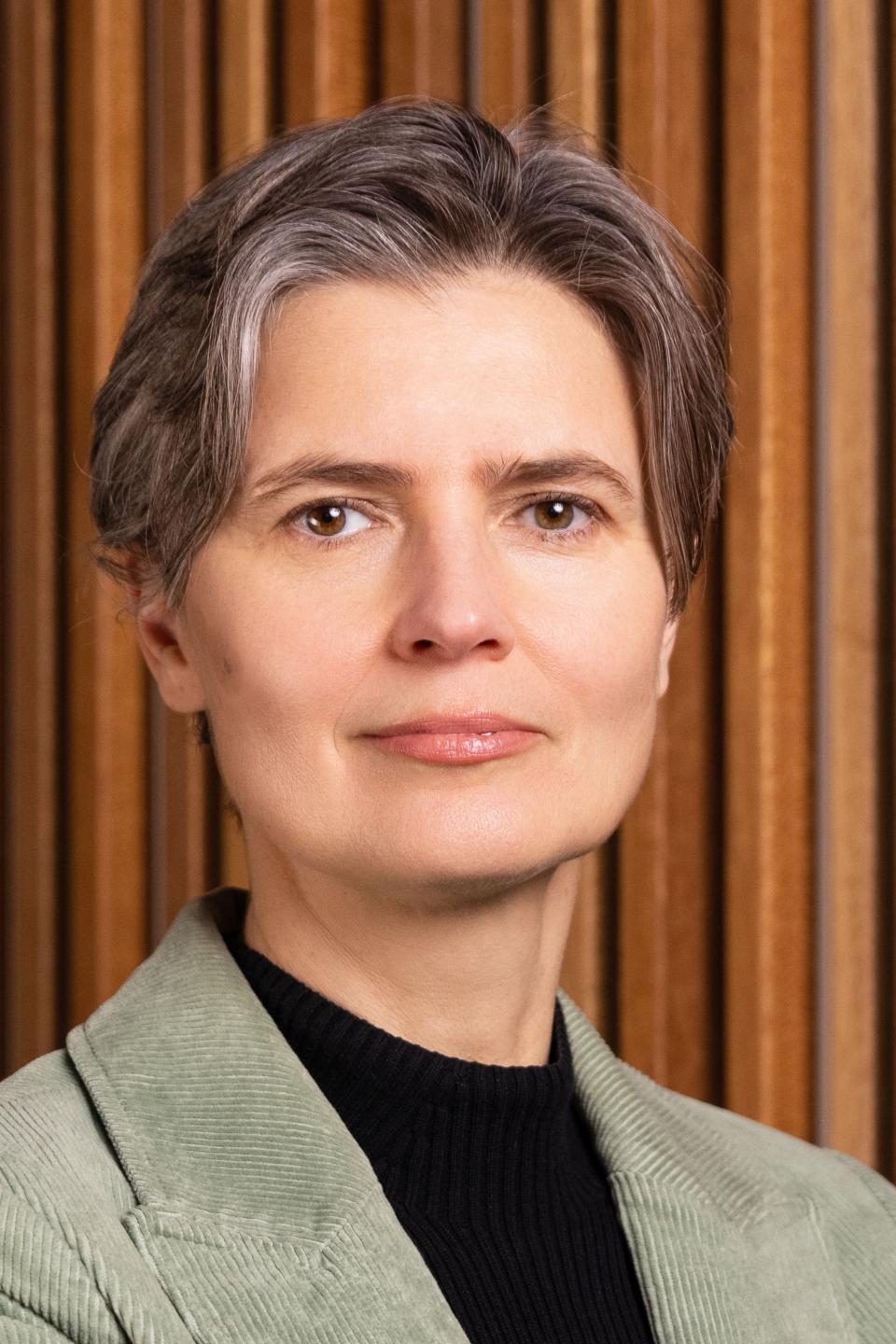
Ana Valdivia is a Departmental Research Lecturer at the Oxford Internet Institute (OII), specializing in AI, Government, and Policy. Her research bridges critical data studies with computer science, focusing on AI's environmental footprint, algorithmic fairness, and sociotechnical impacts. She holds a mathematics background and collaborates with civil society organizations. Currently, she is a Visiting Research Fellow at UCL and writing a book on AI supply chains for Bristol University Press. Her interdisciplinary work combines quantitative (machine learning) and qualitative (ethnographic) methods. Key projects include investigating AI's environmental costs, surveillance technologies, and algorithmic accountability in risk assessment tools. She is Associate Editor for Big Data & Society and has received grants from the British Academy and The Alan Turing Institute. Valdivia advises DPhil students on AI governance, fairness, and digital policy. Her research has influenced international media and policy debates, with coverage in The Guardian , The New York Times , and El País . She leads OII's Research Programme on AI, Government, and Policy, emphasizing transdisciplinary approaches to AI's societal challenges.
Chenliang Xu is an Associate Professor in the Department of Computer Science at the University of Rochester, affiliated with the Goergen Institute for Data Science and Artificial Intelligence (GIDS-AI). His research focuses on computer vision, audio-visual learning, and trustworthy AI. He holds a PhD from the University of Michigan (2016), with prior degrees from Nanjing University of Aeronautics and Astronautics and the University at Buffalo. Notable awards include the Best Paper Award at ACCV 2024 and the James P. Wilmot Distinguished Professorship. His work spans interdisciplinary topics such as video understanding, multimodal reasoning, and robust AI. Key research contributions include audio-visual scene synthesis, bias mitigation in models, and applications in public health. He has secured over $3M in grants, including NIH funding for AI-driven video description tools and public health initiatives. Prof. Xu advises a dynamic research group with 11 PhD students and numerous collaborators. His lab explores cutting-edge projects like egocentric audio-visual understanding, generative AI for avatars, and multimodal defense mechanisms. He teaches courses in machine vision, deep learning, and advanced computer vision.
Christoph T. Koch is a Professor of Physics at Humboldt-Universität zu Berlin, where he has held the W3 Chair since 2015. Previously, he held a similar position at Ulm University (2011–2015), supported by the Carl Zeiss Foundation. His research focuses on advanced electron microscopy techniques, including quantitative transmission electron microscopy (TEM), electron holography, and strain mapping. He leads the AG Strukturforschung/Elektronenmikroskopie group, advancing materials science through innovations in imaging and spectroscopy. Education: B.Sc./M.Sc. in Physics at Heidelberg University (1996–1998), followed by an exchange at Arizona State University (1997–1998). PhD in Physics from Arizona State University (2002, advisor: Prof. John C.H. Spence). Postdoctoral research at the Max Planck Institute for Metals Research, Stuttgart (2002–2011). Research interests include: Electron diffraction and phase retrieval Nanometer-scale strain and defect analysis Electron energy-loss spectroscopy (EELS) for plasmonics and bandgap mapping Development of FAIR data infrastructure for materials science Leadership: Managed the Department of Physics at Humboldt University (2020–2024). Collaborates widely, with key co-authors including P.A. van Aken, W. Sigle, and C. Felser. His work bridges experimental microscopy and computational modeling, addressing challenges in semiconductors, ceramics, and 2D materials. Notable contributions include pioneering methods for 3D reconstruction via electron ptychography, dynamic electron diffraction analysis, and strain mapping in advanced CMOS technologies. Current efforts emphasize real-time imaging and AI-driven data analysis in materials research.
Dr. Ziquan Liu is a Lecturer (Teaching & Research) at Queen Mary University of London's School of Electronic Engineering and Computer Science, affiliated with the Centre for Multimodal AI. He holds a PhD from City University of Hong Kong (2023) and dual B.Sc./B.Eng. degrees from Beihang University (2017). His research focuses on trustworthy machine learning, adversarial robustness, and uncertainty quantification in foundation models. He has served as a reviewer for top conferences like NeurIPS, ICLR, and CVPR, earning an Outstanding Reviewer Award in 2021. His teaching includes modules on machine learning for visual data analysis and principles of machine learning. He supervises PhD students in AI safety and reliability, with notable work on conformal prediction, adversarial attacks, and multimodal learning. His research outputs span top venues such as ICML, CVPR, and NeurIPS, addressing challenges in algorithmic fairness, model certification, and cross-modal alignment.
Dr. Svetlana Yanushkevich is a Professor in the Department of Electrical and Software Engineering at the Schulich School of Engineering, University of Calgary. She is also a Full Member of the Hotchkiss Brain Institute and the Mathison Centre for Mental Health Research and Education. Her research focuses on biometric technologies, decision support systems, biomedical applications, and computational intelligence. She leads the Biometric Technologies Laboratory, developing strategies for risk assessment in biometric systems and healthcare monitoring through machine reasoning and signal processing. Education : BSc/MSc in Electrical Engineering (1989), State University of Informatics and Radioelectronics, Minsk PhD in Electrical Engineering (1992), same institution Dr. Habilitated in Technical Sciences (1999), Warsaw University of Technology Research Interests : Dr. Yanushkevich’s work spans biometric system design (e.g., gait analysis, facial attributes), decision support via probabilistic models (Bayesian networks, causal inference), biomedical applications (stroke rehabilitation, wearable sensors), and computational intelligence for data science. She emphasizes fairness, bias mitigation, and trustworthiness in AI systems, particularly in healthcare and accessibility contexts. Recent Research Trends : Her recent publications address causal modeling for accessibility barriers, UAV operator cognitive workload, and medical device optimization in radiation therapy. She explores AI ethics, stress contagion in human-robot teams, and cross-spectral biometric systems. Awards & Recognition : 2024 FEIC Fellow (Engineering Institute of Canada) 2019 Research Excellence Award (Schulich School of Engineering) 2001 Senior IEEE Membership Advising & Grants : She coordinates courses like ENCM 509 (Biometric Systems Design) and ENEL 610 (Biometric Technologies). Her research is supported by grants focusing on healthcare AI, accessibility technologies, and computational epidemiology. Labs & Collaborations : Her Biometric Technologies Lab collaborates with institutions like Hokkaido University and the IEEE Computational Intelligence Society. Projects include wearable health monitoring, decision support platforms, and AI-driven epidemiological modeling.
Luis Espinosa-Anke is a Senior Lecturer at Cardiff University's School of Computer Science and Informatics. His academic journey includes working as a Natural Language Processing (NLP) scientist at Savana Médica, a Madrid-based healthcare AI company, prior to joining Cardiff. He completed his PhD at Pompeu Fabra University in Barcelona while working at Savana. Dr. Espinosa-Anke's research focuses on Artificial Intelligence and NLP, with particular emphasis on meaning representation, computational semantics, multilingual NLP, and computational lexicography. His work spans theoretical and applied aspects of language technology, with applications in healthcare, social media analysis, and multilingual systems. His recent publications reveal a strong trend toward analyzing language model behavior, bias detection in AI systems, and creating resources for semantic analysis. The publications show increasing focus on practical applications of NLP in healthcare, social media, and cross-lingual settings, with notable contributions to datasets like WIKITIDE and 3D-EX that support definition extraction and semantic understanding. laCaixa Fellow Fulbright scholarship recipient Erasmus Mundus program participant Dr. Espinosa-Anke has secured research funding including a Kaggle Open Research grant ($2,000 USD) as PI for the 'Don't Patronize Me!' project, a Snap Inc. grant ($10,000 USD) as CO-I for modeling meaning shift in social media, and a £90,000 Welsh Government grant for English-Welsh bilingual embeddings research. He currently supervises five PhD students working on meaning representations, contextual word embeddings, NLP for healthcare applications, and metaphor identification.
Desmond Upton Patton is the Brian and Randi Schwartz University Professor at the University of Pennsylvania, with joint appointments in the School of Social Policy & Practice and Annenberg School for Communication, and a secondary appointment in the Department of Psychiatry at the Perelman School of Medicine. His work bridges social work, data science, and digital sociology to address issues like social media's impact on marginalized communities, AI bias, and violence prevention. Education: B.A., University of North Carolina at Greensboro (2004); M.S.W., University of Michigan (2006); Ph.D., University of Chicago (2012). Research focuses on social media's role in trauma, grief, and violence among Black and Hispanic youth. He developed the Contextual Analysis of Social Media (CASM) methodology to address cultural biases in AI. Key projects include studying grief pathways on Twitter, digital mourning practices, and algorithmic equity in child welfare systems. Notable awards include the Deborah K. Padgett Early Career Achievement Award (2018) and fellowships at Harvard's Berkman Klein Center and the Harvard Kennedy School. He advises platforms like Twitter and Spotify on safety and bias. Grants include an NSF-funded program supporting STEM researchers from underrepresented backgrounds. He directs SAFELab, which explores digital safety and equity. Courses taught include 'Advocacy in Emergent Technology' and 'Journey to Joy: Designing a Happier Life.' Future work emphasizes AI ethics, inclusive tech policy, and leveraging community insights to shape equitable digital tools.
Anna Beer is a researcher in the Faculty of Computer Science, specializing in data mining and machine learning with a focus on density-based clustering, spectral clustering, and interactive clustering frameworks. She holds a BSc and MSc in computer science and maintains an ORCID profile (https://orcid.org/0000-0002-6890-997X) for her research contributions. Research Themes: Development of clustering algorithms (e.g., DISCO, Scar, LUCKe), fairness in density-based clustering (FairDen), and applications to molecular dynamics and climate research (DROPP). Collaborations: Works with colleagues like Ira Assent, Christian Plant, and Lars Krieger, with recent contributions to conferences like ICLR 2025. Activities: Presented research on density-connectivity distance at a 2023 oral contribution. Publications: 9 publications since 2019, including 3 in 2025 and 6 in 2024, covering topics from cluster evaluation to deep active learning strategies.
Sarah Collins Rossetti is an Associate Professor of Biomedical Informatics and Nursing at Columbia University’s Vagelos College of Physicians and Surgeons. She focuses on leveraging computational tools to reduce documentation burden in EHR systems and improve patient safety through predictive analytics. PhD in Nursing from Columbia University School of Nursing Post-Doctoral Research Fellowship at Columbia’s Department of Biomedical Informatics Her research emphasizes AI-driven patient deterioration prediction , user-centered design , and interprofessional collaboration to enhance clinical workflows. She co-leads the CONCERN Early Warning System study, which reduced mortality risk by 35% and sepsis risk by 7.5%. Recent publications highlight trends in generative AI limitations in EHRs, equity in predictive systems , and healthcare process modeling . She chairs AMIA’s 25×5 Task Force to reduce documentation burden by 75% by 2025. 2019 PECASE recipient 2024 Donald A.B. Lindberg Award for Informatics Innovation 2019 FAMIA recognition Rossetti collaborates with health analytics centers and trains future researchers through NIH- and AHRQ-funded projects, blending machine learning with clinical expertise in critical care settings.
Stefano Puntoni is a Professor of Marketing and a behavioral scientist at the Rotterdam School of Management, Erasmus University. He serves as Head of the Department of Marketing Management at RSM and as Director of the Psychology of AI Lab at the Erasmus Centre for Data Analytics. His academic journey began with a "Laurea" in Statistics and Economics from the University of Padova in 2000, followed by a Ph.D. in Marketing from London Business School in 2005. His primary research focuses on autonomous technology adoption in consumer markets and production, with particular emphasis on the value of human labor in the age of AI. Additional research areas include advertising language, consumer identity, and numerical cognition. Puntoni's work spans interdisciplinary boundaries, connecting marketing, psychology, and artificial intelligence. An analysis of his recent publications reveals a strong trend toward understanding human-AI interactions in consumer contexts. His research examines how consumers perceive decisions made by algorithms versus humans, preferences for material versus digital products in identity-based consumption, and psychological reactions to human versus robotic job replacement. These studies collectively explore the tension between technological advancement and human elements in decision-making processes. Scientist in Residence, Experiments in Arts and Economics, ZKM Centre for Art and Media (2021) Science Communication Grant, Royal Dutch Academy of Sciences (€10,000) (2021) Case Centre's Marketing Case Award (2021) EFMD Case Writing Award (2020) Case Centre's Outstanding Case Writer Award (2020) C.W. Park Award, Journal of Consumer Psychology (2019) Puntoni has mentored numerous doctoral students, including Phyllis (Jia) Gai, Eugina Leung, and Elisa Maira, many of whom have gone on to prestigious academic positions. He currently serves as Associate Editor for both the Journal of Consumer Research and the Journal of Marketing. His teaching spans marketing strategy, innovation and technology adoption, brand management, and decision making across multiple institutions including RSM, Lancaster University, London Business School, and Bocconi University. As Director of the Psychology of AI Lab at the Erasmus Centre for Data Analytics, Puntoni leads a research team exploring the intersection of human psychology and artificial intelligence in business contexts. His lab focuses on understanding consumer and worker reactions to AI implementation, with practical applications for businesses navigating the digital transformation.
Adriana Iamnitchi is a Full Professor and Key Domain Chair for Computational Science at Maastricht University's Faculty of Science and Engineering, affiliated with the Department of Advanced Computing Sciences. Her research focuses on computational social science, social media dynamics, and misinformation detection. Her primary research interests include: Analysis of coordinated information campaigns across social platforms Development of LLM-based synthetic data generation for social media research Polarization quantification in multi-community networks Policy compliance frameworks for digital regulation (e.g., EU's Digital Services Act) Ethical AI applications for content moderation and transparency Her recent publications (2023-2025) demonstrate strong focus on: Cross-platform disinformation detection using multimodal embeddings Generative AI for synthetic social media datasets Quantitative analysis of toxicity monetization in creator economies Regulatory compliance automation for content transparency
Patrick Jaillet is the Dugald C. Jackson Professor in the Department of Electrical Engineering and Computer Science at MIT's School of Engineering. He holds joint appointments with the Laboratory for Information and Decision Systems (LIDS), the Operations Research Center (ORC), the Operations Research and Statistics Group at MIT Sloan, and the Department of Civil and Environmental Engineering. Previously, he served as Head of Civil and Environmental Engineering at MIT (2002-2009) and Chair of the Department of Management Science and Information Systems at UT Austin (1997-2002). Dr. Jaillet's research focuses on online optimization and learning, sequential decision-making under uncertainty, and security and resilience in complex networks. His work spans theoretical foundations in optimization and machine learning with applications in transportation, online market analytics, and network security. He has developed mathematical frameworks for problems involving uncertainty, dynamic resource allocation, and strategic behavior in complex systems. His recent publications reveal strong trends in bridging theoretical optimization with practical machine learning applications. Key themes include Bayesian optimization for black-box functions, online learning with limited information, mechanism design for resource allocation, and network security applications. His work increasingly integrates large language models with traditional optimization techniques, reflecting the evolving landscape of AI-driven decision-making systems. Fulbright Scholar (1990) Fellow of the Institute for Operations Research and Management Science (INFORMS) Best Applications Paper Award at ICAPS 2019 Long-standing Associate Editor for top journals including Operations Research and Transportation Science Dr. Jaillet has advised over 40 doctoral students who now hold prominent positions in academia and industry, including faculty positions at MIT, Georgia Tech, and ETH Zurich, and research scientist roles at Amazon, Microsoft Research, and Google. His research has been consistently funded by major agencies including NSF, ONR, AFOSR, and international partners like Singapore NRF, with current projects focusing on learning algorithms for autonomous security and fundamental tradeoffs in optimization. He leads a vibrant research group spanning MIT's EECS department and ORC, with current funding supporting work on neural bandits, federated optimization, and network security applications. His research group operates at the intersection of theory and practice, with strong connections to industry through collaborations with IBM, Microsoft, Google, and various transportation and technology companies. The group maintains active partnerships with international institutions, particularly through SMART in Singapore, reflecting Dr. Jaillet's global research impact.
Zijin Zhang is an Assistant Professor of Business Analytics at the Carroll School of Management, Boston College. She holds a Ph.D. in Technology & Operations from the University of Michigan's Ross School of Business and a B.S. in Mathematics and Statistics from Nanjing University. Her office is located in Fulton Hall 454B at Boston College. Her research centers on data-driven decision-making in operations management, organized around three pillars: Engineering value : Designing algorithms for real-time decisions under uncertainty Economic value : Optimizing data acquisition costs versus decision impact Social value : Examining ethical implications of data practices and technology regulation Applications span retail operations, AI markets, and public-sector resource allocation. Recent publications focus on algorithmic decision-making in operations management, with recurring themes of data optimization, fairness in resource allocation, and policy impact analysis. Methodologies combine optimization, game theory, and machine learning. Awards & Honors: Rackham Doctoral Intern Fellowship (2024) Michigan Ross China Research Award (2023) First Prize, National Olympiad Informatics (2013) Thomas William Leabo Fellowship (2022-2023) DSI Doctoral Research Showcase Finalist (2025) Teaching includes Operations Management (TO 313) at University of Michigan with a 4.9/5.0 evaluation score. She has received multiple research grants including Rackham Research Grant (2024) and Ross School Doctoral Grant (2022). Engages in academic service as INFORMS conference session co-chair (2024) and PhD program panels. Maintains industry connections through past internships at Oracle and CITIC Group.
Florian Leiser is a Professor at the Chair of Information Infrastructures (led by Prof. Dr. Ali Sunyaev) at Technical University of Munich's Heilbronn campus. His research focuses on human-AI collaboration, privacy-preserving algorithms, and explainability in machine learning systems. Current research areas include Hybrid Intelligence, Human-centered Generative AI (LLMs), Federated Learning, and Health Information Systems Recent publications demonstrate expertise in Explainable AI for medical imaging LLM hallucination detection Federated learning architectures Human-in-the-loop systems Healthcare data applications He contributes to teaching through Human-Centered Artifact Design courses Collaborative teaching roles in machine learning Supervising student projects
Dinesh Manocha is a Distinguished University Professor of Computer Science at the University of Maryland, with joint appointments in the Department of Electrical and Computer Engineering and the University of Maryland Institute for Advanced Computer Studies (UMIACS). He is also affiliated with the Maryland Robotics Center and the Institute for Systems Research. His educational background includes a Ph.D. in Computer Science from the University of California at Berkeley (1992) and a B. Tech in Computer Science and Engineering from the Indian Institute of Technology, Delhi, India (1987). Professor Manocha's research spans multiple domains with significant emphasis on: Computer Graphics and Visualization Robotics and Motion Planning Virtual and Augmented Reality Systems Geometric Computing Algorithms AI Applications for Autonomous Systems High Performance Computing His extensive publication record shows consistent innovation in multi-agent navigation, collision avoidance algorithms, and applications in virtual environments. Recent work focuses on trajectory prediction for autonomous vehicles and physics-based simulation for immersive experiences, with algorithms integrated into industry-standard systems like ROS (Robot Operating System). Among his numerous honors, Professor Manocha is recognized as: ACM, IEEE, AAAS, and AAAI Fellow Member of the IEEE VGTC Virtual Reality Academy Recipient of the Pierre Bézier Award from the Solid Modeling Association University of Maryland Distinguished University Professor Multiple best paper awards across premier conferences He has supervised 54 PhD students throughout his career and currently advises numerous graduate researchers. His research has attracted significant funding from NSF, Google, Amazon, Facebook, and industry partners. Notably, he co-founded Impulsonic, a company developing physics-based audio simulation technologies acquired by Valve Corporation in 2016. Professor Manocha leads the GAMMA research group, which continues to advance geometric algorithms with applications across multiple disciplines.