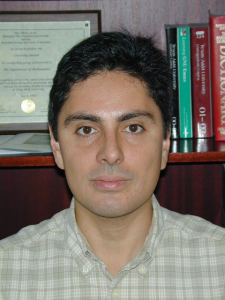
J. Maurice Rojas is a Professor and Associate Head of Graduate Programs at Texas A&M University's Department of Mathematics. His research focuses on computational algebraic geometry, discrete geometry, and polynomial equation solving with applications in complexity theory and number theory. He holds a Ph.D. from the University of California, Berkeley (1995), alongside earlier degrees from Berkeley and UCLA. Rojas' work bridges theoretical and algorithmic approaches to problems in algebraic geometry, including fewnomial theory, real and p-adic root counting, and tropical geometry. His contributions address the computational complexity of polynomial systems, with recent emphasis on sparse polynomials and circuit-based algorithms. He has authored over 50 papers and contributed to NSF-funded projects on arithmetic geometry and algorithmic methods. His research has explored applications in statistical modeling of petascale data, topological data analysis, and interdisciplinary collaborations between mathematics and computer science. Notable achievements include foundational work on A-discriminants, Viro's patchworking, and the development of sub-linear algorithms for algebraic structures.
Borislav Radkov Draganov is a Professor of Mathematical Analysis at the Faculty of Mathematics and Informatics, Sofia University St. Kliment Ohridski. His research focuses on approximation theory, harmonic analysis, and operator theory. Key research areas include: Trigonometric polynomial approximation Smoothness moduli and K-functionals Weighted approximation in function spaces Converse inequalities and saturation classes Sampling operators and multivariate approximation His recent publications (2023-2025) analyze Voronovskaya estimates for convolution operators, saturation classes for generalized exponential sampling operators, and convergence rates in variable exponent Lebesgue spaces. Collaborators include Tuncer Acar and I. Gadjev. He has extensively studied Peetre K-functionals, Bernstein-type operators, and Szasz-Mirakjan operators over two decades, establishing precise equivalence relations and Jackson-type inequalities in both homogeneous Banach spaces and weighted Lp spaces.
Clemens Sämann is an associate professor at the Department of Mathematics, Faculty of Mathematics, University of Vienna. His research focuses on Lorentzian geometry, general relativity, and differential geometry, with significant contributions to spacetime structures, geodesic analysis, and curvature bounds. Research Interests: Lorentzian geometry and causality Geodesic completeness in non-smooth spacetimes Curvature theorems for Lorentzian length spaces Impulsive gravitational waves with cosmological constant Λ Recent Publications (2024-2016): His work spans timelike curvature bounds, Hausdorff measures in Lorentzian contexts, and mathematical models of spacetime singularities. Key trends include causal differential calculus, metric splitting, and geometric analysis of gravitational wave interactions.
Ilie Grigorescu is an Associate Professor at the University of Miami , affiliated with the College of Arts and Sciences and the Department of Mathematics . He also collaborates with the Computer Science division within the same college. Research Interests: Stochastic Processes Probability Theory Mathematical Biology Evolutionary Modeling Interacting Particle Systems Applied Mathematics Recent Publications focus on branching diffusions, evolutionary fixation times, stochastic game theory, and neuronal phase transitions. His work connects probabilistic models to biological and network systems, including studies on hydrodynamic limits and risk-averse optimal stopping. Contact: Email at i.grigorescu@miami.edu or call (305) 284-2146.
Eötvös Loránd University's Faculty of Science researcher Dávid Szeghy has been affiliated with the Department of Geometry since 2006. His work focuses on differential geometry, mathematical physics, and geometric analysis of Lorentz manifolds. PhD in Mathematics (2008, ELTE) Publications span 2003–2023 with emphasis on horizon differentiability, isometric group actions, and pseudo-Riemannian conjugate loci Key collaborations include J. Szenthe and A. Fothi Research trends show deep engagement with Lorentzian geometry , including studies on: Orbit type theorems for isometric actions Normalizable vs. non-normalizable orbits Horizon smoothness in general relativity Exponential mapping properties in spacetime His work appears in journals like Annales Henri Poincaré , Classical and Quantum Gravity , and Geometriae Dedicata , with citations across mathematics and physics domains.
Alex Eskin is the Arthur Holly Compton Distinguished Service Professor in the Department of Mathematics at the University of Chicago. He has been a faculty member at the University of Chicago since 1999 and is a leading researcher in dynamical systems, geometric group theory, and the theory of moduli spaces. His educational background includes: Undergraduate studies at UCLA PhD from Princeton University (1993) under Peter Sarnak Eskin's research focuses on rational billiards, geometric group theory, and the dynamics of the SL(2,R) action on moduli spaces of translation surfaces. His work bridges several areas of mathematics including ergodic theory, geometry, and number theory. He is particularly known for his breakthrough results on the classification of invariant and stationary measures for the SL(2,R) action on moduli spaces, which led to his Breakthrough Prize in 2020. Eskin's recent publications demonstrate a continued focus on measure rigidity, Lyapunov exponents, and the geometry of moduli spaces. His work often involves deep collaborations with other leading mathematicians such as Maryam Mirzakhani (until her passing), Amir Mohammadi, and others. The research spans from foundational theoretical work to applications in counting problems and effective estimates. His major scientific achievements include: Clay Research Award (2007) for work on quasi-isometric rigidity of solvable groups Fellow of the American Mathematical Society (2012) Election to the National Academy of Sciences (2015) Breakthrough Prize in Mathematics (2020) for classification of P-invariant and stationary measures for the moduli of translation surfaces Eskin has advised several PhD students including Moon Duchin and Simion Filip. His research has been supported by major grants from the National Science Foundation and the Simons Foundation. He has been an influential figure in the field, giving invited talks at the International Congress of Mathematicians in 1998 and 2010. His work has opened new directions in the study of dynamics on moduli spaces and has deep connections to other areas of mathematics. While not explicitly mentioned in the provided texts, Eskin is likely involved in research groups or seminars at the University of Chicago related to geometry, topology, and dynamical systems. His extensive collaboration network suggests active participation in the broader mathematical community through workshops, conferences, and collaborative research projects.
Adam Kanigowski is an Associate Professor in the Mathematics Department at the University of Maryland. His research focuses on dynamical systems, particularly smooth flows, spectral theory, and mixing properties. Key Research Areas: Ergodic theory, parabolic systems, area-preserving flows, and spectral analysis. Publication Trends: Recent work examines chaotic properties of smooth systems, multiple mixing phenomena, and spectral singularities across surfaces of varying genus. Articles also address arithmetic applications, including prime number theorems for skew products. Technical Themes: Rigidity, slow entropy, Fourier uniformity, and the interplay between deterministic sequences and dynamical systems.
Professor Guozhen Lu is a distinguished faculty member at the University of Connecticut, recently elected to the Connecticut Academy of Science and Engineering (CASE) in 2025. His research bridges advanced mathematical analysis with geometric and functional frameworks, establishing him as a leading figure in modern analysis. Lu's research centers on Partial Differential Equations, Harmonic Analysis, and Geometric Analysis, with particular emphasis on functional inequalities including Sobolev, Trudinger-Moser, and Hardy-Rellich inequalities. His work explores sharp constants, stability phenomena, and extremal problems across diverse geometric settings such as Heisenberg groups, hyperbolic spaces, and CR manifolds. He investigates how geometric structures influence analytical properties, often revealing deep connections between analysis and geometry. Analysis of his 2024-2025 publications shows intense focus on stability of fundamental inequalities (Sobolev, Poincaré, Uncertainty Principle), with innovative approaches to multi-parameter operators and geometric constraints. His work consistently targets optimal constants and dimension-dependent phenomena, pushing boundaries in non-Euclidean analysis. His notable scientific recognition includes: Connecticut Academy of Science and Engineering (CASE) Membership (2025) While specific details about student advising and grant funding are not documented in available sources, Lu's editorial contributions (including special issues honoring Robert Fefferman and David Jerison) demonstrate significant service to the mathematical community. No information is available regarding dedicated laboratories or research teams.
Dr. Esteban Ferrer Vaccarezza serves as a full Professor (Catedrático) in Applied Mathematics at the School of Aeronautics (ETSIAE-UPM) of the Polytechnic University of Madrid, where he leads the FerrerCFD research group within the Department of Mathematics Applied to Aerospace Engineering and the Center for Research in Computational Simulation (CCS). Education and Professional Background: Doctorate in Engineering from the University of Oxford, specializing in high-order numerical methods development Pre-PhD industry experience: Six years as research scientist/consultant at CENER (Spain's National Renewable Energy Centre) in the UK and Spain Research Focus: Dr. Ferrer pioneers high-order (order ≥ 3) Computational Fluid Dynamics solvers using Spectral and Discontinuous Galerkin methods. His work minimizes numerical dispersion/diffusion errors through mesh refinement (h-refinement) and polynomial enrichment (p-refinement), achieving exponential convergence for smooth solutions. Key application domains include aerodynamics, aeroacoustics, turbulence modeling, and machine learning integration for wind/tidal turbine optimization. Current Research Impact: The FerrerCFD group develops industry-relevant computational tools for complex aeronautical flows (e.g., airfoil simulations at high angles of attack) and renewable energy systems (horizontal-axis/Darrieus turbines). Their unique sliding mesh capability enables high-fidelity rotating body simulations, validated through Direct Numerical Simulation (DNS) and Large Eddy Simulation (LES) for bluff body flows and turbine wake interactions. Research Infrastructure: The group maintains active industry partnerships to translate mathematical innovations into practical engineering solutions, with demonstrated capabilities in 3D unstructured parallel solvers, Fourier-series-extended flow modeling, and multi-phase fluid dynamics simulations for cross-flow turbines.
Stefano Vigogna is an Associate Professor in the Department of Mathematics at the University of Rome Tor Vergata with significant contributions to theoretical machine learning. He is affiliated with the Rome Center on Mathematics for Modeling and Data Sciences (RoMaDS), focusing on the mathematical foundations of learning algorithms. His research expertise spans: Machine Learning Statistical Learning Theory Harmonic Analysis Professor Vigogna's publication record demonstrates deep theoretical work connecting advanced mathematics to machine learning. His research investigates the spectral properties, geometric structure, and convergence behavior of neural networks using functional analysis and harmonic analysis techniques. Notable publications include his 2022 ICML paper on multiclass learning with exponential convergence rates and numerous works exploring the mathematical properties of deep learning systems through reproducing kernel spaces. He teaches Statistica for the Master's program in Environmental Biology and Statistical Learning for the Master's program in Pure and Applied Mathematics, reflecting his dual expertise in mathematical theory and practical data science applications. Professor Vigogna maintains active collaborations with leading researchers including Lorenzo Rosasco and Ernesto De Vito, advancing our fundamental understanding of learning algorithms through rigorous mathematical analysis. His work represents an essential bridge between pure mathematics and the theoretical foundations of modern artificial intelligence.