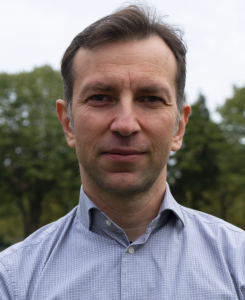
Norman Kerle is a Professor at the Faculty of Geo-Information Science and Earth Observation (ITC) of the University of Twente, holding the chair of Geoinformatics for Disaster Risk Management within the Earth Systems Analysis department. He earned Masters degrees in geography from the University of Hamburg and Ohio State University, and a PhD in volcano remote sensing from the University of Cambridge (2002). His research spans volcanology, landslide detection, and quantitative geomorphology, with a focus on object-oriented remote sensing methods for disaster risk management. He leads the ITC Object-Based Image Analysis research group and coordinates EU-funded projects like RECONASS and INACHUS , emphasizing UAV-based structural damage mapping. Recent work includes post-disaster recovery assessment using remote sensing and macro-economic modeling. His scientific contributions include over 221 research outputs (peer-reviewed articles, book chapters, conference papers) and datasets such as Evaluating Resilience-Centered Development Interventions with Remote Sensing (2020). He has received the 2011 Lloyd's Science of Risk Prize (Natural Hazards) and served as Associate Editor for journals like Remote Sensing and Natural Hazards and Earth Systems Sciences . Prof. Kerle’s professional affiliations include the European Geosciences Union (EGU), American Geophysical Union (AGU), International Society for Photogrammetry and Remote Sensing (ISPRS), and Remote Sensing and Photogrammetry Society (RSPS). He has examined PhD theses and reviewed proposals for Horizon 2020, STEREO, and UNESCO.
Maurice van Keulen is an Associate Professor affiliated with the University of Twente's research institutes including Datamanagement & Biometrics, Digital Society Institute, and TechMed Centre. His multidisciplinary work bridges computer science, healthcare, and social systems. Research Focus: Van Keulen specializes in artificial intelligence applications with emphasis on: Data management (quality, integration, probabilistic databases) Explainable AI and interpretable machine learning models Healthcare informatics (cancer prediction, medical imaging, outcome analysis) Natural language processing and social media analytics His recent work explores dynamic sparse training, meta-learning for data imputation, and ethical AI frameworks. Publication Trends: Recent articles (2023-2025) show strong focus on: Interpretable AI methods in healthcare diagnostics Robust machine learning under data corruption Meta-learning approaches for data preprocessing 3D medical imaging and reconstruction techniques Awards: Beste paper award (2018) for work on probabilistic data conditioning Supervision & Activities: Has supervised 14 research projects and serves on executive boards including EDBT (Extending DataBase Technology) and IFIP WG 2.6. Leads research on ethical dimensions of AI systems.
Simon Parsons is a Professor of Machine Learning at the University of Lincoln and Director of the Centre for Doctoral Training on AI for Sustainable Agriculture. Education: PhD, University of London, 1993 Previous Academic Positions: Queen Mary and Westfield College Massachusetts Institute of Technology City University of New York University of Liverpool King's College London Research Interests: Simon's research centers on the design and analysis of autonomous systems, particularly how teams of autonomous systems make decisions in complex environments. He is a leading expert in computational argumentation, with foundational contributions to argument-based dialogue systems and argumentation for explanation. Recently, he has directed these interests toward sustainable agriculture, leading projects on agricultural robot safety assurance, human-robot interaction explanation optimization, food supply chain waste reduction, plant nitrogen measurement, precision herbicide application, and generative AI modeling of cow rumen biome dynamics. Awards: No scientific awards mentioned in the provided text. Leadership and Projects: As Director of the Centre for Doctoral Training on AI for Sustainable Agriculture, he spearheads interdisciplinary initiatives integrating machine learning with agricultural science to address global food security challenges, emphasizing both productivity gains and environmental sustainability through cutting-edge robotics and AI solutions.
Prof. Mehdi Dastani is a Professor and chair of the Intelligent Systems group within the Department of Information and Computing Sciences at Utrecht University's Faculty of Science. He leads the Master's program in Artificial Intelligence and focuses on formal and computational models in AI, particularly multi-agent systems. His research integrates insights from philosophy, psychology, and law to develop autonomous agents that reason about social and cognitive concepts like norms, emotions, and responsibility. Dastani has held academic roles at Utrecht University since 2001, including postdoctoral research and faculty positions. Education: M.Sc. Computer Science (University of Amsterdam, 1991), M.Sc. Philosophy (University of Amsterdam, 1992), Ph.D. in Humanities (University of Amsterdam, 1998). His work spans theoretical and applied projects, including grants for initiatives like Golden Agents (simulating Golden Age creative industries) and traffic control systems using virtual organizations. He is actively involved in academic committees, editorial boards, and organizing international conferences like AAMAS and PRIMA. Research Interests: Multi-Agent Programming, Normative Systems, Autonomous Agents, Cognitive Robotics, and Human-Centered AI. His projects address challenges like norm enforcement, decision-making in complex systems, and ethical AI integration with societal needs. Advising & Grants: Supervised numerous PhD students (e.g., Birna van Riemsdijk, Bas Testerink) and secured grants for projects such as 'Controllable AI: Human-Centered Approach'. His work includes collaborations on urban governance, autonomous driving, and AI tools for literacy support in children. Labs & Teams: Leads the Intelligent Systems group, contributing to agent-based simulations, ethical AI frameworks, and interdisciplinary collaborations with social scientists and urban planners.
Dr. Evert van Nieuwenburg is an Assistant Professor at Leiden University, affiliated with both the Leiden Institute of Advanced Computer Science (LIACS) and the Leiden Institute of Physics (LION). His research bridges the fields of Quantum Physics , Machine Learning , and Condensed Matter Physics , with a focus on quantum algorithms, reinforcement learning, and quantum game development (e.g., Quantum TiqTaqToe ). He actively contributes to the Applied Quantum Algorithms (aQa) initiative and leads the QuantumPlayed subgroup for quantum games and education. Research Interests: AI-driven quantum experiment control, quantum machine learning, variational quantum circuits, and quantum games for education and intuition-building. Publications: 15+ peer-reviewed works spanning quantum error correction, phase transitions, reinforcement learning in quantum systems, and quantum dot array simulations. Community Engagement: Developer of educational quantum games, open science advocate, and active participant in interdisciplinary initiatives. Selected Trends: His work demonstrates AI's transformative role in quantum physics, from decoding error-correcting codes with graph neural networks to merging reinforcement learning with quantum control systems. Labs & Initiatives: Affiliated with the Applied Quantum Algorithms (aQa) initiative and co-founder of QuantumPlayed , where quantum mechanics meets game theory to engage diverse audiences.
Justus Bogner is an Assistant Professor at the Faculty of Science, Vrije Universiteit Amsterdam, affiliated with the Software and Sustainability (S2) department and the Network Institute. His research focuses on microservices architecture, AI/ML system sustainability, and software engineering practices. He teaches courses like Service Oriented Design and Software Design. Research Interests: Bogner’s work explores the intersection of AI and sustainable software engineering, including energy-efficient microservices, explainable AI (XAI), and MLOps architectures. He emphasizes empirical studies, systematic mappings, and controlled experiments to address challenges in software quality, design patterns, and trade-offs between performance and environmental impact. Awards: Best Presentation Award (2021) Distinguished Artifact Award (2024) Distinguished Artifact Award (2024) Distinguished Paper Award (2024) Grants/Advising: His work has been supported by grants focusing on empirical software engineering and sustainable AI. He collaborates on datasets analyzing technical debt in AI systems and green AI practices.
Kerstin Bunte is a Professor of Machine Learning for interdisciplinary data analysis at the University of Groningen, affiliated with the Faculty of Science and Engineering and the Bernoulli Institute's Intelligent Systems Group. She holds an Honorary Fellowship at the University of Birmingham and leads the Intelligent Systems Group. Her research focuses on interpretable machine learning, interdisciplinary applications (e.g., astrophysics and biomedical data), and visualization techniques. Research Interests: - Machine Learning - Artificial Intelligence - Explainable AI (XAI) - Interpretable Models - Dimensionality Reduction - Data Visualization - Astrophysical Data Analysis - Medical Imaging Awards & Grants: - DSSC XS funding (2023) - NWO VIDI grant (2020) - Rosalind Franklin Fellowship (2016–present) Advising & Students: Supervised PhD students include Elisa Oostwal, Janis Norden, Matteo Marcantoni, and Petra Awad. Research spans topics like tumor segmentation in medical imaging, astrophysical structure detection, and autonomous navigation systems. Labs & Collaborations: Leads the Intelligent Systems Group, collaborating with institutions like the University of Birmingham and the University of Warwick. Work involves interdisciplinary projects combining machine learning with astronomy, biomedical sciences, and robotics.
Dr. Ioanna Lykourentzou is an Associate Professor in the Software Technology for Learning and Teaching department at Utrecht University's Faculty of Science. She leads the Collaborative Technologies Lab and coordinates the Computing Science Master's and Information Sciences Honors Bachelor's programs. Additionally, she serves as a Fair Data and Software fellow within the Open Science Team of the Faculty of Science and as a member of the Ethics Review Board for the Faculties of Science and Geosciences. Her research focuses on collaborative and crowd systems, developing methods that help people work together, coordinate efforts, and innovate at scale, both online and in physical spaces. Her interdisciplinary approach combines computational science (machine learning, agent-based modeling, mathematical optimization) with social sciences (personality testing, team building). Her expertise spans Human-Computer Interaction, Algorithms, Agent-Based Modelling, Telecollaboration, Creativity, and Innovation. Her recent publications (2021-2025) demonstrate a strong focus on human-AI interaction, generative models, and applications in cultural heritage and education. She examines how technology can facilitate collaboration, with particular attention to team formation, personality factors, and digital nudging techniques. Her work bridges theoretical research with practical applications in digital humanities, cultural heritage, and computing education. Dr. Lykourentzou has received significant recognition for her research, with multiple publications garnering substantial citations and reader attention across platforms like Mendeley and social media. Her work on personality-based team formation (2016) has been particularly influential with over 90 citations. Prior to joining Utrecht University, she worked as a Senior Researcher at the Luxembourg Institute of Science and Technology (LIST), where she coordinated the European H2020 project CROSSCULT. She has also collaborated with the Human-Computer Interaction Institute of Carnegie Mellon University as a visiting researcher and with INRIA Nancy-Grand Est and the Public Research Center Henri Tudor as a postdoctoral fellow.
Hendrik Baier is an Assistant Professor in the Information Systems group at Eindhoven University of Technology (TU/e), where he joined in 2022. His research focuses on creating agents capable of succeeding in complex decision-making tasks to help human users solve real-world problems. His work spans planning for long-term goals, learning in unknown environments, and explainability of AI systems for effective human-AI interaction. Dr. Baier's research interests center on planning and search algorithms, reinforcement learning, and explainable AI systems. His work investigates how AI can think ahead and explain its reasoning process, particularly in sequential decision-making contexts. He applies these techniques to practical domains including logistics and transportation, smart manufacturing, and sustainable energy systems. His research bridges theoretical foundations with real-world applications through collaborative projects with industry partners. Analysis of his recent publications reveals a strong focus on explainability in sequential decision-making, with increasing integration of large language models to enhance traditional planning algorithms. His work spans theoretical foundations of Monte Carlo Tree Search, programmatic policy generation, multi-agent reinforcement learning, and practical applications of these techniques. A notable trend is the growing emphasis on human-AI collaboration, where AI systems must not only perform well but also effectively communicate their reasoning to human users. Dr. Baier actively collaborates with researchers across multiple institutions, including CWI Amsterdam where he maintains an affiliation, and has participated in significant interdisciplinary efforts such as the Dagstuhl Seminar on Explainable AI for Sequential Decision Making. His research group at TU/e works closely with industry partners to translate fundamental research into practical applications. He is affiliated with EAISI (Eindhoven Artificial Intelligence Systems Institute) and contributes to the Decision Making with Artificial Intelligence educational program at TU/e. His laboratory work focuses on developing benchmark environments and frameworks that enable rigorous evaluation of decision-making algorithms, with recent contributions including MOMAland for multi-objective multi-agent reinforcement learning.
Mariana Belgiu is an Associate Professor at the Department of Earth Observation Science (EOS) within the Faculty of Geo-Information Science and Earth Observation (ITC) at the University of Twente. Her work bridges Earth Observation (EO), data-centric artificial intelligence (AI), and food security, with a focus on addressing environmental and societal challenges through innovative geospatial solutions. PhD in Remote Sensing, University of Salzburg MSc in Applied Geoinformatics, University of Salzburg Her research develops AI methods for analyzing multi-temporal EO data, particularly in hidden hunger (micronutrient deficiencies) and slum mapping. Key themes include: Data-centric AI in scarce-label environments Transferability of EO-driven models Imaging spectroscopy for crop nutrient estimation Citizen science integration for climate vulnerability assessments The 69 research outputs span EO applications for: Global crop nutrient prediction Urban poverty mapping Climate resilience in Sub-Saharan Africa AI fairness and explainability in geospatial contexts Earth observation education frameworks Scientific Recognition Copernicus Masters 2015, T-Systems Big Data Challenge Esri Young Scholar Award (2013) Best Master Thesis in Geoinformatics (2010) As a supervisor of 7 PhD students , she mentors work on deep learning for cloud removal, global crop monitoring, and transferable slum mapping. She also leads the EO4all working group, promoting gender equity in EO science, and serves as Associate Editor for the ISPRS Journal (Impact Factor 12.7). Major grants include the SPACE4ALL project (NWO, 2023–2027) and EO4Nutri (ESA, 2023–2025), alongside contributions to Horizon Europe's ASTRAIOS initiative.
Albert Gatt is a Professor of Natural Language Processing at Utrecht University's Department of Information and Computing Sciences, where he also serves as Programme Director for AI & Data Science. He holds an Associate Professor position (on leave) at the University of Malta's Institute of Linguistics and Language Technology. His research focuses on Natural Language Generation (NLG), multimodal models, and under-resourced language support, particularly for Maltese. He leads projects like NL4XAI and MASRI, addressing challenges in explainable AI and speech recognition. Education: Advanced degrees in computational linguistics and AI (not explicitly detailed in text). Key Projects: Multilingual NLG, Vision-Language benchmarks, Maltese ASR, and NLP evaluation methodologies. Research interests span data-to-text generation, vision-language interfaces, and evaluation practices. His work bridges computational linguistics with cognitive science, emphasizing human-AI collaboration. Notable contributions include the TUNA corpus, SimpleNLG toolkit, and foundational studies on referring expression generation. Publications (2025-2024) explore robust fine-tuning, LLM evaluation, and visual-linguistic grounding. Collaborations span academia and industry, addressing ethical AI and language equity. Supervises a global team of researchers and PhD students across multiple institutions, fostering innovation in NLG, multimodal AI, and Maltese language tech.
Kim Baraka is an Assistant Professor at the Faculty of Science, Vrije Universiteit Amsterdam, affiliated with the Artificial Intelligence department, Network Institute, and Social AI division. His research focuses on Human-Robot Interaction, Reinforcement Learning, and socially intelligent systems. He co-developed frameworks like SHARPIE for Human-AI collaboration and explores ethical aspects of AI teamwork. Baraka teaches courses on Human-interactive Agent Learning, Robotics, and Socially Intelligent Robotics. He actively contributes to conferences like HRI and ROMAN, publishing on topics ranging from robot curriculum learning to empathetic AI design. Ancillary roles include director of Bara-kadance and board member of Stichting Triplets. Research interests include: Human-AI co-creativity and collaboration Robot learning through human demonstrations Emotional expression in embodied AI Ethical frameworks for human-agent teams Recent work highlights multimodal interaction (e.g., audio-visual speech recognition), prosody-based teaching signals, and proxemics-aware navigation. His 2025 publications emphasize iterative algorithm design for fairness in human-agent teams and systematic reviews of collaborative AI creativity. This research bridges technical advancements with socially responsible AI deployment.
Prof. Antske Fokkens is a Full Professor in Computational Linguistic Methods at Vrije Universiteit Amsterdam, with joint appointments in the Faculty of Humanities and the Network Institute. She directs the Text Mining/Language and AI track in the Linguistics Master's program and serves as Vice Dean of Research. Her research investigates methodological aspects of computational linguistics, focusing on language models, interpretable AI, and digital humanities. She develops tools to extract patterns from large text corpora for applications in social science and history, emphasizing transparency and interdisciplinary collaboration. Current projects include analyzing perspective expression in media and semantic modeling for biographical data. Recent publications examine shortcut learning in text classification, persona-driven content generation, hate speech model alignment, and cross-disciplinary approaches to stance detection. Her work integrates NLP with social science theories to analyze discourse on sustainability, polarization, and media framing.
Dr. Tim Hulsen is a Professor of AI & Data-Supported Healthcare at the Knowledge Center for Healthcare Innovation, Rotterdam University of Applied Sciences, where he leads research on the application of data science and artificial intelligence in healthcare. He is also actively involved in the HR Datalab Healthcare and maintains a dual role as Senior Data & AI Scientist at Philips. His work bridges academic research and industry application, focusing on practical implementations of AI technologies in healthcare settings. Tim completed his Biology studies at Radboud University Nijmegen with a strong medical-biological component. After internships in Molecular Animal Physiology and Bioinformatics, he pursued a PhD and postdoctoral position at Radboud University Nijmegen in collaboration with NV Organon (later Schering-Plough). His academic journey transitioned into industry when he joined Philips Research in Eindhoven in 2009, where he has held various scientific positions focused on data management, big data, and artificial intelligence in healthcare. Dr. Hulsen's research focuses on the practical application of data science and AI in healthcare, emphasizing the importance of good data quality through sound data management practices, adherence to the FAIR Guiding Principles, and the use of ontologies and standards. He places particular emphasis on the explainability and responsible use of AI systems in clinical settings. His recent research interests have expanded to include generative AI (GenAI) applications in healthcare, where he seeks to connect various professorships and departments within the Rotterdam University of Applied Sciences with the broader medical technology sector. An analysis of Dr. Hulsen's recent publications reveals a strong focus on AI applications in healthcare, particularly in oncology and prostate cancer research. His work demonstrates a progression from foundational data management and bioinformatics to cutting-edge AI applications, with increasing emphasis on responsible implementation and practical healthcare solutions. The publications span technical aspects of data science, clinical applications, ethical considerations, and future directions for AI in healthcare. Dr. Hulsen has made significant contributions to the academic community through his editorial work, serving as an Editorial Board Member for BMC Cancer and Frontiers Medicine and Public Health, and regularly reviewing scientific publications. While specific awards aren't detailed in the available information, his extensive publication record (over 50 scientific publications) and leadership roles indicate recognition within his field. Throughout his career, Dr. Hulsen has demonstrated strong leadership in research projects, having led various initiatives, co-authored international project proposals, and managed work packages within grant projects. His collaborative approach is evident in his work connecting academic research with industry applications, particularly through his dual roles at Rotterdam University of Applied Sciences and Philips. His work with the Movember GAP3 consortium and PIONEER big data platform for prostate cancer demonstrates his commitment to large-scale collaborative research that addresses real-world healthcare challenges. Dr. Hulsen is actively involved with the HR Datalab Healthcare and the AI & Data-Supported Healthcare research group. He collaborates extensively with various stakeholders in the healthcare ecosystem, including medical institutions like Erasmus MC, technology companies, and research consortia. His current work focuses on practical applications such as registration burden reduction using generative AI, non-invasive monitoring, and optimization of diagnostics and prevention strategies. Through these initiatives, he aims to develop explainable knowledge that will train future healthcare professionals in the responsible use of AI.
Ihor Smal is an Assistant Professor at the Department of Biology, Faculty of Science, Utrecht University. He has held previous positions at Erasmus MC (2009-2018) and TU Delft (2019-2020). His research bridges statistical image processing, smart microscopy, and explainable AI for biological motion analysis, with applications in automated real-time imaging systems. Education: M.Sc. in Physics and Electrical Engineering, Ivan Franko National University of Lviv (1999, cum laude) Professional Doctorate in Engineering (PDEng), Eindhoven University of Technology (2005) PhD in Biomedical Imaging, Erasmus University/MC (2009) His work focuses on developing AI-driven solutions for motion registration, particle tracking, and image understanding in biological systems. He leads the NWO IMAGINE! program's Tech Work Package 2, aiming to automate imaging experiments using explainable AI. The 15 most recent publications highlight his contributions to deep learning for CT segmentation, particle tracking, diffusive state modeling, and real-time imaging optimization. Key subfields include neural networks, biomedical signal processing, and automated microscopy. Scientific Awards: VENI grant Erasmus MC Fellowship NWO BBoL grant Students: Vincent Hellebrekers Daan te Rietmole His lab at Utrecht University, accessible via www.smal.ws, collaborates with institutions like Erasmus MC and TU Delft, leveraging facilities such as the Utrecht Biology Imaging Center.