Dr. Evangelos Markopoulos is a Lecturer at the University College London School of Management, specializing in Knowledge & Innovation Management, Entrepreneurship, and Futuristic Interactive Technologies. He holds a PhD in MIS Project Management and has extensive industry experience with IBM, Siemens, and Bell Labs. His research focuses on integrating Digital Twins, Metaverse Applications, and ESG Compliance into organizational strategies. He has published 120+ papers and authored a book on Innovative Organizational Cultures. Notable achievements include a Clinton commendation and two Global Social Innovation Awards (HultPrize). His teaching emphasizes real-world industry collaboration through internships and competitions. Education: BSc Computer Science → MSc Computer Science/Artificial Intelligence → PhD MIS Project Management. He has taught at QMUL, UCL, Essex, and others. Research interests span Digital Transformation, Sustainable Leadership, and Gamification in Education. Current projects include VR safety training for maritime sectors and democratic innovation frameworks. Key Research Themes: ESG-SDGs Alignment, Metaverse in Maritime Training, Democratic Organizational Culture Student Impact: Mentored teams to global awards in social innovation Industry Collaboration: Founder of companies in Project Management, Enterprise Engineering, and Innovation Apps
Jun Yan is a Professor at the University of Wollongong's School of Computing and Information Technology within the Faculty of Engineering and Information Sciences. His roles include academic leadership and research supervision, with active involvement in committees like the Student Academic Experience Sub-Committee and Quality Assurance Review Group. Current research focuses on service-oriented computing, workflow technology, adaptive process management, and AI-driven systems. His work intersects with IoT, UAV systems, federated learning, and multi-agent reinforcement learning. Research interests span service-oriented software engineering, decentralized workflow management, and cybersecurity challenges in autonomous systems. Notable projects include an ARC-funded initiative on robust defenses against adversarial ML for UAV systems (2025–2027). He supervises Masters/PhD projects on topics like diffusion model-based MRI, graph prompt learning, and industrial defect detection. His publications from 2023–2025 emphasize scalable multi-agent systems, federated learning with non-IID data, and UAV applications in intelligent transportation. Key areas of contribution include trust models for e-commerce, privacy-preserving cloud computing, and fault-tolerant service architectures.
Margaret Luciano is an Associate Professor of Management & Organization at the Smeal College of Business, The Pennsylvania State University, and holds the BNY Mellon Faculty Fellowship. Previously, she served as an Associate Professor at Arizona State University’s W. P. Carey School of Business. Her expertise spans Team Dynamics, Multiteam Systems, Leadership, and Healthcare Management, with a focus on organizational behavior and complex system interactions. Dr. Luciano’s academic journey includes a Ph.D. in Management (Organizational Behavior) from the University of Connecticut (2015), an MBA in Leadership Research from Clark University (2010), and a BA in Psychology with a Management focus (2009). Her research emphasizes structural frameworks for multiteam coordination, virtual team collaboration, and healthcare leadership challenges. Her work investigates themes such as paradox management in virtual teams, surgical team performance dynamics, and institutional scaling of healthcare initiatives. Recent studies address intra-individual conflict in multiteam environments and the role of core/non-core roles in healthcare teams. Awarded the BNY Mellon Faculty Fellowship, her contributions bridge theoretical advancements in multiteam systems with practical applications in healthcare and emergency response leadership. Her publications explore topics ranging from computer-aided text analysis of team processes to adaptive leadership during task transitions in crises. While specific grant details and student advisees are not listed, her research portfolio highlights interdisciplinary collaboration and real-world organizational challenges. She actively engages with healthcare institutions like Emory Health System, demonstrating applied research impact.
Brian Ross is a Professor at the Department of Computer Science, Brock University. He holds a BSc (Hon) from the University of Manitoba, MSc from the University of British Columbia, and PhD in Artificial Intelligence from the University of Edinburgh. His research focuses on evolutionary computation , particularly genetic programming , with applications in computational biology , evolutionary design , and computational aesthetics . Education: BSc Computer Science (Hon), University of Manitoba MSc Computer Science, University of British Columbia PhD Artificial Intelligence, University of Edinburgh Research Interests: Computational Intelligence: genetic programming, evolutionary algorithms, multi-objective optimization Evolutionary Design: computational aesthetics, 2D/3D modeling, energy-efficient architecture Applications: computational biology, stochastic process algebra, GPU-based image analysis Article Trends: His recent work combines deep learning with evolutionary algorithms to enhance diversity in agent behavior and design optimization. Earlier studies focused on stochastic modeling of biological networks and procedural texture generation . Collaborations span computational aesthetics, passive solar architecture, and non-photorealistic rendering techniques. Students & Collaborations: He has supervised diverse projects including evolved intelligent agents , passive solar building design , and evolutionary art systems . Notable students include Marshall Joseph (2023), Tyler Cowan (2021), and Sheikh Faishal Basher (2021).
Roman Lukyanenko is an Associate Professor of Commerce at the University of Virginia’s McIntire School of Commerce. He teaches courses in global strategy, systems, and business analytics. Prior to academia, he worked in IT roles including web programming, database development, and consulting for organizations like ExxonMobil and CapitalOne. His research focuses on conceptual modeling, information quality, AI/ML, and design science research. Notable contributions include work on citizen science data quality and transparency in design science. His research has been published in top journals like Nature , MIS Quarterly , and Information Systems Research . Education : Ph.D. in Operations and Information Management (University of Newfoundland), Bachelor of Technology, and IT Diploma (New Brunswick Community College). Key awards include the Gold Medal from Canada’s Governor General, INFORMS Design Science Research Award, and AIS Dissertation Award. He has led professional organizations, serving as Vice President and President of the AIS Special Interest Group on Systems Analysis & Design. Lukyanenko’s work bridges academic and practical domains, emphasizing information systems’ societal impact. He contributes to interdisciplinary initiatives at UVA’s Centers for Business Analytics and Management of IT. His prior industry experience enriches his teaching and research on real-world IT challenges.
Adam E. Smith is an Associate Professor in both the Department of Biomedical Engineering and the Department of Chemical Engineering at the University of Mississippi, serving as Associate Dean for Undergraduate Programs in the School of Engineering and Co-Director of the Center for Nano-Bio Interactions. He holds a B.S. in Chemical Engineering (2002), M.S. in Engineering Science (2004) from the University of Mississippi, and a Ph.D. in Polymer Science and Engineering from the University of Southern Mississippi (2010). His research focuses on stimuli-responsive polymers for drug delivery, including RAFT polymerization techniques and nanocarrier design. Notable awards include the 2016 Faculty Service Award and 2020 Outstanding Engineering Faculty Award. Dr. Smith’s expertise spans polymer chemistry, biomaterials, and targeted drug delivery. His research emphasizes the synthesis of stimuli-responsive block copolymers for applications in cancer therapy, immunotherapy, and controlled release systems. He has pioneered methods for enhancing nanoparticle stability and tumor targeting through glycopolymer engineering and shell-crosslinked micelles. His recent work explores gas separation membranes using ionic liquid-infused block copolymers and ROS-responsive nanoparticles for macrophage targeting. These studies leverage molecular simulations and experimental validation to advance material design. His contributions have been recognized through multiple teaching and research awards, reflecting his dual role as an educator and researcher. Awards: 2016 Faculty Service Award, 2016 Junior Faculty Research Award, 2018 Faculty Teaching Award, 2020 Outstanding Engineering Faculty Award. Labs/Teams: Center for Nano-Bio Interactions, Biomedical Engineering Research Group. Grants: Not explicitly listed, but his research aligns with NIH and NSF priorities in biomaterials and drug delivery.
Justus Bogner is a researcher at the Institute of Software Engineering (ISTE) and leads the division for Software Engineering for AI- & Microservice-Based Systems (SE4AI&MS) at the University of Stuttgart. His work focuses on empirical software engineering , microservices , AI-based systems , and software evolvability . He has contributed extensively to understanding architectural migration, technical debt in AI systems, and quality assurance methodologies. His research spans various subfields including service-oriented architecture , RESTful API design , design patterns , and software maintainability metrics . Recent publications highlight empirical comparisons between JavaScript and TypeScript, frameworks for microservice migration, and systematic studies on AI engineering challenges. Bogner's work often bridges academic research with industry practices through collaborations with IEEE and Springer, though no specific awards or student advisories are mentioned in the provided text.
Patrick Florance is the Director of Research Technology at Tufts University, where he leads Tufts Technology Services’ support for High-Performance Computing, research storage, scientific instrumentation, and data science. He is concurrently an affiliate of the Department of Urban & Environmental Policy & Planning in the School of Arts and Sciences and a senior instructor at the Fletcher School of Law and Diplomacy. Education Bachelor of Arts, University of Oregon, Eugene, United States Master of Arts, Geography – Geographic Information Science, City University of New York – Hunter College, New York, United States Research & Scholarly Interests Florance’s scholarship and service converge on the design, deployment, and governance of open-source geospatial infrastructures. His work encompasses: Global and humanitarian mapping, crisis mapping, and geospatial support for disaster response Development of the Open Geoportal (OGP) Federation — a Sloan-funded collaborative platform for sharing geospatial data across universities 3D GIS, remote sensing, UAV/drone workflows, and spatial data infrastructures for urban modeling Digital humanities, natural language processing, and data-mining approaches to historical and textual geodata Geospatial pedagogy, open-data advocacy, and capacity-building in the developing world Publications & Intellectual Trajectory Across more than two decades, Florance has authored or co-authored scholarly articles, software reviews, and special journal issues that advance both technical architectures and sociotechnical practices for geospatial information curation. His writings trace a trajectory from foundational concerns of GIS collection development in academic libraries to contemporary challenges of real-time, open, and ethical crisis mapping. Scientific Awards & Grants Alfred P. Sloan Foundation – Open Geoportal Cloud (OGP) Federation (US$ grant, 2013) University Service & Leadership Patrick chairs or serves on multiple university committees driving data-intensive research strategy: Data Analytics Steering Committee, School of Arts & Sciences Digital Humanities Steering Committee, Tufts University Data-Intensive Scholarship Center (DISC) Advisory Committee on Infrastructure and Services (ACIS) GIS Steering Committee Research Data Services Committee Labs, Teams & Infrastructure He directs the Tufts Data Lab , a campus hub for GIS, statistics, visualization, and machine-learning services, and oversees the Open Geoportal Project , a multi-institutional consortium providing federated discovery and access to geospatial data sets. His team supports thousands of researchers university-wide with high-performance compute clusters, research storage arrays, and discipline-specific scientific instrumentation.
Sean X. He is an Associate Professor in the Civil and Environmental Engineering department at Rensselaer Polytechnic Institute , joining in 2017. His research focuses on modeling and simulating transportation systems, particularly the impacts of emerging technologies and network disruptions. Ph.D. and M.S. in Transportation Engineering from University of Minnesota, Twin Cities B.S. and M.S. in Computational Mathematics His expertise spans interdependent infrastructure resilience, connected autonomous vehicles (CAVs), and electric vehicles. He serves on the Network Modeling Standing Committee of the Transportation Research Board (TRB), and holds editorial roles for Transportation Research Part B , Frontiers in Future Transportation , and as guest editor for multiple journals. His work on CAVs and transportation resilience has earned recognition, including the Best Paper Award at the 18th International IEEE Conference on Intelligent Transportation Systems and the NSF CAREER Award 2021 . Recent publications highlight his work in dynamic traffic equilibrium, vehicle re-identification algorithms, and energy-efficient transportation systems. Collaborative research trends integrate AI, optimization techniques, and environmental impact analysis to address challenges in urban mobility and network disruptions. NSF CAREER Award 2021 Best Paper Award - 18th International IEEE Conference on Intelligent Transportation Systems
Vincenzo Carnevale is an Associate Professor in the Department of Biology at Temple University's College of Science and Technology. He holds a B.Sc. and M.Sc. in Physics from the University of Pisa and a Ph.D. from SISSA in Trieste, Italy. His research group focuses on statistical physics and machine learning to study sequence-structure-function relations in proteins, epistasis in molecular evolution, and self-organization in biomolecules. Key themes include how interactions drive collective phenomena and emergent behaviors in biological systems, with a long-term goal of understanding electrical signaling in excitable cells. Recent work spans computational approaches in medical applications (e.g., AI in obstetrics-gynecology diagnostics), lipid-ion channel interactions, and genotype imputation algorithms. His methods include molecular dynamics simulations, Monte Carlo techniques, and deep learning frameworks. Carnevale has no listed scientific awards, but his work emphasizes interdisciplinary collaborations at the interface of physics, biology, and computer science. He contributes to programs like Molecular and Cellular Biology and maintains a lab focused on theoretical/computational biology.
Professor Jana Lasser holds a professorship in Data Analysis at the University of Graz, where she leads the Complex Social & Computational Systems research group at the interdisciplinary IDea_Lab. She serves as Associate Faculty at the Complexity Science Hub Vienna and previously held positions at Graz University of Technology as a Marie Curie Fellow and interim professor at RWTH Aachen. Her educational background includes a PhD in Physics from Georg-August-University Göttingen (2019), conducted at the Max Planck Institute for Dynamics and Self-Organization, with research on salt desert pattern formation. Her academic journey reflects a transition from geophysics to computational social science. Lasser's research centers on emergent phenomena in complex social systems, employing machine learning, natural language processing, and computational modeling. Key interests include misinformation spread on social media, counterspeech effectiveness, social media recommendation algorithms' societal impact, and the fracturing of societal understanding of honesty. Her work combines theoretical frameworks with real-world applications through agent-based simulations and large-scale text analysis. Her recent publications reveal strong thematic coherence across computational social science, with significant focus on political communication dynamics, platform governance, and methodological innovation. The 15 most recent works demonstrate increasing integration of computational methods with social theory, particularly in analyzing truth-concept evolution in political discourse and developing alternative social media architectures. ERC Starting Grant 101160928 DeSiRe for designing social media recommendation algorithms FWF standalone project P 37280-N on conspiracy theory spread netidee SCIENCE prize for digital civic innovation Marie Curie Fellowship for postdoctoral research Lasser actively supervises graduate students in computational social science, with current focus on topics related to her ERC-funded project. She leads the Survey Special Interest Group within the COST Action on Researcher Mental Health, conducting Europe's largest benchmark study on academic mental health. Her lab maintains strong collaborations with the Complexity Science Hub Vienna and international institutions.
Dr. Andrew Yang is an Associate Professor of Computer Science and Computer Information Systems at the University of Houston-Clear Lake's College of Science and Engineering. His research focuses on computer security, wireless and mobile computing, networking, performance measurement, and cybersecurity education. His publications demonstrate a consistent focus on cybersecurity challenges, educational frameworks, and emerging technologies. Recent work explores AI ethics, IoT security, blockchain applications, and cybersecurity workforce development, reflecting a pattern of addressing contemporary technological vulnerabilities through both technical solutions and pedagogical approaches.
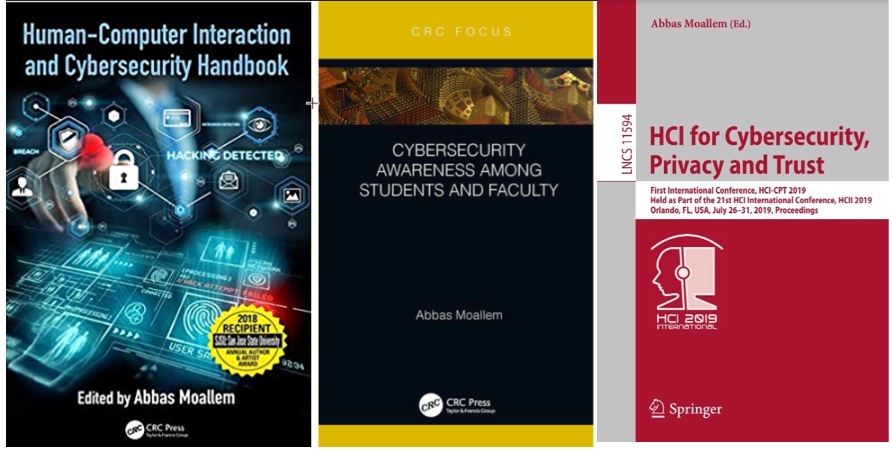
Dr. Abbas Moallem is an Adjunct Professor in the Industrial & Systems Engineering Department at San José State University's College of Engineering, where he teaches Human Computer Interaction, Cybersecurity, Information Visualization, and Human Factors. He also serves as executive director of UX Experts and holds an adjunct position at California State University, East Bay. His professional activities include significant leadership roles in major academic conferences. Education: Ph.D. in Ergonomics/Human Factors, University of Paris Nord (XIII), 1987 M.S. in Ergonomics/Human Factors, University of Paris Nord (XIII), 1982 M.S. in Biomechanics, University of Paris Val-de-Marne(XII), 1980 B.A., University of Tehran, 1978 With over 30 years of experience in human factors, ergonomics, and human-computer interaction, Dr. Moallem's research focuses on the critical intersection between human behavior and cybersecurity. His work examines how interface design, terminology, and user experience impact security outcomes, with particular attention to making security mechanisms more usable and understandable. He has pioneered research in cybersecurity awareness, particularly among students and faculty, and investigates how human factors contribute to both vulnerabilities and solutions in cybersecurity contexts. His research extends to smart systems, AI interfaces, and the human elements in emerging technologies. Dr. Moallem's publication record demonstrates a clear trajectory toward increasingly specialized work at the HCI-cybersecurity intersection. His recent articles and books focus on human factors analysis of cyberattacks, dashboard design for security visibility, terminology in security interfaces, and frameworks for understanding user behavior in security contexts. He has edited multiple conference proceedings specifically dedicated to HCI for Cybersecurity, Privacy, and Trust from 2019 through 2025, establishing this as a distinct and growing research domain. Professional Leadership: Communication and Exposition Chair of HCI International and Applied Human Factors and Ergonomics International conferences Program Chair of HCI-CPT: International Conference on HCI for Cybersecurity, Privacy, and Trust Track Chair of Human Factors in Cybersecurity at AHFEI conferences Editorial board member for multiple professional journals Dr. Moallem has translated his academic expertise into practical applications through his consultancy work. He has served as a senior engineering product manager and usability expert at NETGEAR, and as a UI Architect at PeopleSoft and Oracle Corporation. His industry experience spans over 11 years at companies including Tumbleweed and Axway, where he applied human factors principles to real-world technology products. He has consulted across diverse industries in Europe, Canada, and the USA, bridging the gap between academic research and practical implementation. His laboratory and team activities center around UX Experts, his consultancy organization, and the academic communities he helps lead through conference organization and editorial work. Through these channels, he fosters collaboration between researchers and practitioners working at the intersection of human factors and cybersecurity.
Shachar Kariv is the Benjamin N. Ward Professor of Economics at the University of California, Berkeley. He earned his Ph.D. in Economics from New York University in 2003 and has been a faculty member at UC Berkeley since joining that year. His academic career includes leadership roles as Department Chair (2014-17, 2021-22) and Director of the UC Berkeley Experimental Social Science Laboratory (Xlab) from 2008 to 2014. He co-founded Xmobile, a smartphone-based platform for social science experiments. Ph.D., Economics, New York University (2003) M.A., Economics, New York University (2000) B.A., Economics, Tel Aviv University (1998) Kariv's research focuses on economic theory, experimental economics, and behavioral economics, with particular emphasis on social networks, personal and social preferences, decision-making under uncertainty, and network architecture. His work often combines theoretical models with laboratory experiments to analyze individual and collective economic behavior. Kariv's recent publications explore topics such as social learning , transfer performance of predictive models , and choice under risk and uncertainty . These works employ experimental data to investigate how individuals process information, make spending decisions, and interact within networked environments. UC Berkeley Haas School of Business Cheit Award for Excellence in Teaching (2012) UC Berkeley Division of Social Sciences Distinguished Teaching Award (2008) NYU College of Arts and Science Outstanding Teaching Award (Golden Dozen) (2002) Sloan Research Fellowship (2009-10) Outstanding Dissertation Award, NYU Graduate School of Arts and Science (2003) Kariv has received major grants from institutions like the Alfred P. Sloan Foundation , National Science Foundation , and Center on the Economics and Demography of Aging (CEDA) . His professional activities include editorial roles at prestigious journals such as the Review of Economics and Statistics and Games and Economic Behavior . He has also held visiting professorships at institutions including Stanford University, University of Oxford, and NHH Norwegian School of Economics.
Sean Ahlquist is an Associate Professor of Architecture at the University of Michigan's Taubman College of Architecture and Urban Planning, where he serves as Director of the Master of Science in Digital Material Technologies (DMT) program. He leads the Lab for Socio-material Architectures and is a member of the Cluster in Computational Media and Interactive Systems, connecting architecture with material science, computer science, and performing arts technology. His research centers on developing malleable, sensory-responsive environments that foster social behavior for individuals with disabilities, particularly children with autism spectrum disorder. This work, inspired by his autistic daughter Ara, employs industrial knitting technologies and involves collaborations across disciplines including materials science, civil engineering, kinesiology, psychiatry, and behavioral science. His installations have been featured at the Venice Architecture Biennale, Lincoln Center's Big Umbrella Festival, and various educational and therapeutic settings. Ahlquist's publications and projects explore themes of inclusive design, computational material systems, and neurodiverse spatial experiences. His work demonstrates how architecture can leverage computational design and material technologies to create more inclusive spaces for underserved communities. ACADIA Innovative Research Award of Excellence (2020) Featured in ARCHITECT Magazine as Game Changer (2022) Recipient of U-M Sustainability Catalyst Grants (2024) Ahlquist teaches across all academic programs at Taubman College, from undergraduate to PhD levels. His students engage in multi-year collaborations with the Ann Arbor Center for Independent Living (AACIL), developing design methodologies that integrate disability theory with technical material fabrication skills. His work with the local Ann Arbor community includes partnerships with public schools, children's museums, and disability organizations to create inclusive environments that address real-world challenges.