Dilian Gurov is a Professor in Computer Science at KTH Royal Institute of Technology, associated with the Digital Futures Faculty and the Division of Theoretical Computer Science. He also coordinates the Doctoral Programme in Computer Science at the CSC school. Before joining KTH in 2002, he earned a Ph.D. from the University of Victoria, Canada (1998), and worked at the Swedish Institute of Computer Science (1997-2002). His research focuses on software specification and verification, including contracts, program models, logics, and tools, as well as multi-agent strategic planning involving knowledge-based strategies in imperfect information settings. Key contributions include the CAV Distinguished Paper Award 2023 for 'Automatic Program Instrumentation for Automatic Verification' and an EASST award for 'Checking Absence of Illicit Applet Interactions: A Case Study' (2004). He leads projects funded by VR (SEFROS, ContraST) and Vinnova (AVerT2) and collaborates with industries like Scania on formal verification of C programs. His service roles span over 30 conference committees and organization roles, including PC memberships for iFM, TAP, and ISoLA. Teaching responsibilities include courses such as 'Formal Methods,' 'Program Semantics and Analysis,' and 'Knowledge in Games with Imperfect Information.' His work emphasizes practical applications of formal methods, bridging academic research with industry needs through collaborations and tool development (e.g., CVPP, ProMoVer, TriCo).
Mahdi Fazeli is an Associate Professor at the School of Information Technology, Halmstad University, Sweden, specializing in hardware security and trust, energy-efficient computing, and embedded and cyber-physical systems. His academic journey began with a Ph.D. in Computer Engineering from Sharif University of Technology, Iran, in 2011. His career progression includes positions as Associate Professor at Bogazici University (2019-2021) and Iran University of Science and Technology (2016-2019), and Assistant Professor at the same institution (2011-2016). His research interests focus on hardware security and trust, reliable VLSI circuits and systems, energy-efficient computing, and dependable embedded systems. His work bridges the gap between theoretical security concepts and practical implementations in real-world systems, particularly in IoT and embedded environments. He has established himself as a leading researcher in Physical Unclonable Functions (PUFs), hardware trojans detection, and energy-efficient security solutions for resource-constrained devices. His publication record shows a clear progression and deepening expertise in hardware security, with recent work focusing on cutting-edge applications in edge computing, vehicular networks, and IoT security. His 2023-2025 publications demonstrate significant contributions to magnetic memory-based security primitives, anomaly detection systems, and energy-efficient security mechanisms. Throughout his career, Fazeli has led multiple research initiatives including the Dependable Systems and Architecture Lab (DSA) and the Networked and Embedded Systems Lab at Iran University of Science and Technology. His leadership extends to heading the Hardware Group and serving as Vice Chair for Educational Affairs, demonstrating his commitment to both research excellence and academic administration.
Pedro Roque is a Postdoctoral Researcher at KTH Royal Institute of Technology in Stockholm, affiliated with the Wallenberg AI, Autonomous Systems and Software Program (WASP) and associated with the Division of Decision and Control Systems (DCS). He obtained his Ph.D. in 2024 from the same division under the supervision of Prof. Dimos Dimarogonas, Prof. Mikael Johansson, and Prof. Jana Tumova. His research focuses on practically applicable theoretical results in robotics and control, with emphasis on space and aerial systems. Dr. Roque is particularly interested in developing algorithms that directly contribute to system performance and enhanced capabilities. He currently leads the setup of a Space Robotics Laboratory at KTH, associated with the Space Center and the WASP NEST DISCOWER project. He is an advocate for open-source software and hardware, contributing to NASA Astrobee and PX4 projects, with his research tested on the International Space Station and indoor flight arenas. Dr. Roque's work demonstrates a clear progression from theoretical foundations to practical implementation in space environments. His recent publications show an increasing focus on multi-agent coordination in microgravity, with significant contributions to model predictive control for space robotics applications. The research spans from fundamental control theory to complete system implementation, reflecting his commitment to bridging theory and practice. ICRA 2022 Outstanding Coordination Award for work on decentralized model predictive control for collaborative UAV bar transportation Dr. Roque actively mentors Master's students in Space Robotics, Control, and Vision, with supervision details available on his personal website. He has collaborated extensively with NASA Astrobee and PX4 projects, and his DISCOWER project involves collaboration with 3 Ph.D. students, 2 Master's students, 6 Professors, and one Post-doc. He also completed a 4-month internship at JPL within the Maritime and Multi-Agent Systems group. He leads the Space Robotics Laboratory at KTH, associated with the Space Center and the WASP NEST DISCOWER project, which has already demonstrated capabilities to Digital Futures, SAAB AB, SAAB Inc., and Purdue scholars. The laboratory focuses on weightless robotics, collaborative robotics (Space Cobot), and exploration robotics (MoonHopper), with practical testing on the International Space Station.
Johan Sidén is a Lecturer and Associate Professor at Mid Sweden University , employed in the Department of Computer and Electrical Engineering (DET) . His work focuses on RFID technology , antenna design , and printed/flexible electronics , with a particular emphasis on industrial IoT and welfare technology applications. Research Keywords : Radio Frequency Identification, Antenna Design, Flexible Electronics, Wireless Sensor Networks, Microwave Engineering, Electronic Design Key Projects : DRIVEN (data-driven industrial transformation), SmartArea (functional surfaces), Pressure (ulcer monitoring), MakeSense! (welfare technology) Publications : 15+ recent works on wearable antennas, smart packaging, UWB antenna design, and RFID sensor integration Collaborations include partnerships with industrial and academic institutions, focusing on sustainable electronics, sensor systems, and smart infrastructure. His technical expertise spans antenna optimization , printed circuits , and edge computing for harsh environments.
Gerardo Schneider is a Full Professor in Computer Science at the University of Gothenburg, Sweden, and holds a joint appointment at Chalmers University of Technology. He serves as Head of the Data Science and Artificial Intelligence (DSAI) Division and has previously led the Formal Methods Division and acted as Director of Graduate Studies. University of Gothenburg: 2009–present Chalmers University of Technology: 2009–present Uppsala University: 2002–2003 University of Oslo: 2005–2009 His research focuses on formal methods for software engineering, including contract specification and analysis , privacy policy formalization , model checking , and runtime verification . He works on verification of real-time systems, embedded systems (e.g., smart Java cards), and blockchain-based smart contracts. Key projects include: X-LEGAL (2020–2023): Smart Legal Contracts (Swedish Research Council) PolUser (2016–2019): User-Controlled Privacy Policies (Swedish Research Council) ARVI (2014–2018): Runtime Verification Beyond Monitoring (ICT COST Action) ReMU (2013–2017): Reliable Multilingual Digital Communication (Swedish Research Council) He has supervised numerous PhD and Master’s students in formal methods, blockchain security, and privacy compliance. His tools include SPeeDI (Polygonal Hybrid Systems Verification), CLAN (Contract Normative Conflict Detection), and AnaCon (Controlled Natural Language Analysis).
Per-Erik Hellström is a Professor at KTH Royal Institute of Technology, affiliated with the Department of Electronics and Embedded Systems. His research focuses on semiconductor process technology, particularly the heterogeneous integration of materials like SiGe, Ge, high-κ dielectrics, and metal gates with Si CMOS to advance integrated circuits. He leads KTH's FDSOI CMOS process and circuit technology, emphasizing sequential 3D integration for future CMOS developments. Additionally, he manages the Si and SiC process line at Electrum Laboratory, overseeing tool maintenance, process control, and upgrades. Researcher ID: ORCID Location: Kistagangen 16 Email: pereh@kth.se His work involves developing nanometer-sized transistors through double patterning techniques and studying material integration for enhanced device performance. He teaches courses in electrical circuits, semiconductor devices, and nanotechnology at both Bachelor's and Master's levels, including Electrical Engineering (IF1330) , Embedded Electronics (IE1206) , and Introduction to Integrated Circuits (IL2241) . He also supervises degree projects and exams. Scientific achievements include the 2020 G03 Best Paper Award for gate stack research. His recent publications highlight advancements in Type-II superlattices, 3D integration, and high-temperature sensors. Key collaborators include PhD students working on nanotechnology and process engineering.
Damir Isovic is an Associate Professor and Vice-Chancellor for Internationalization at Mälardalen University's Academy of Innovation, Design and Technology. Previously, he served as Dean of the School of Innovation, Design and Engineering. His roles include leadership in academic administration and participation in national boards. He holds a PhD and has extensive international teaching experience. Research focuses on real-time systems, embedded systems design, and scheduling algorithms. Notable contributions include seminal work in real-time scheduling recognized by the IEEE Technical Community on Real-Time Systems. He has organized major conferences and delivered keynotes globally. His publications emphasize hybrid scheduling approaches, real-time operating systems (RTOS), media processing in resource-constrained systems, and MPEG standards. Recent work integrates memetic algorithms with fuzzy controllers and explores multi-core scheduling fairness. His research bridges theoretical scheduling models with practical embedded system implementations. No scientific awards explicitly listed in the text. Advising activities include supervising PhD students, though specific names are not provided. Lab affiliations include the Division of Networked and Embedded Systems, where he develops frameworks like GENESIS for embedded system engineering. His work emphasizes cross-disciplinary collaboration and industry partnerships in education and technology development.
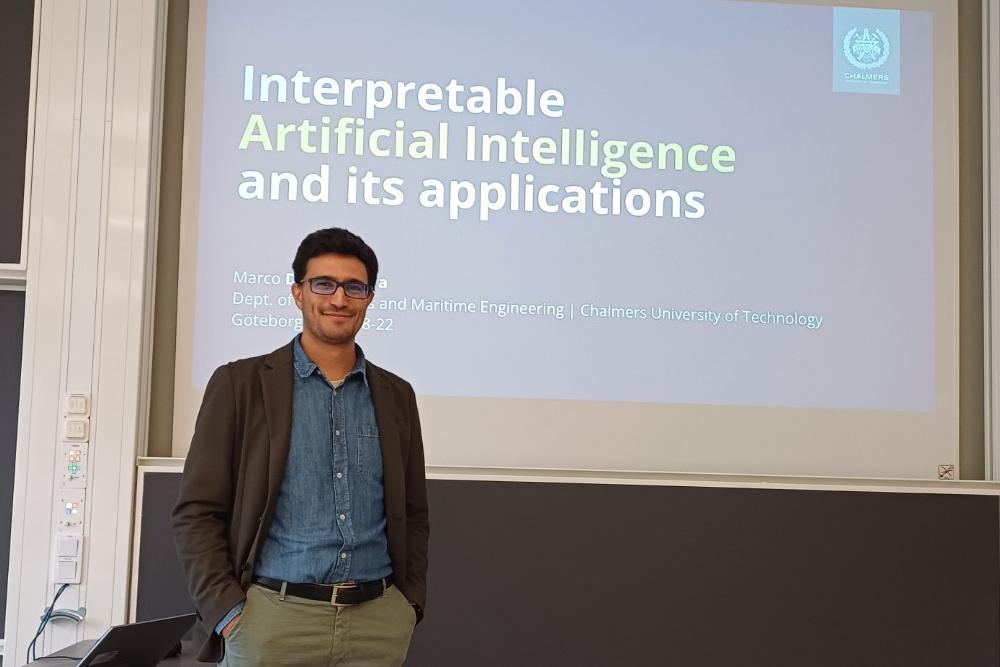
Marco L. Della Vedova is a Senior Lecturer in Applied Artificial Intelligence at Chalmers University of Technology, Sweden. He works in the Vehicle Engineering and Autonomous Systems division within the Department of Mechanics and Maritime Sciences, as part of Prof. Mattias Wahde's research group. Since 2025, he has served as Director of the Data Science and AI master's programme (MPDSC) at Chalmers, where he teaches courses including Introduction to Artificial Intelligence and Digitalization in Sports. Dr. Della Vedova earned his academic foundation at the University of Pavia, Italy, where he completed his BSc (2006), MSc (2009), and PhD (2013) in Computer Engineering. His doctoral research focused on "Real-Time Physical Systems and Electric Load Scheduling" under Prof. Tullio Facchinetti. During his PhD studies, he spent a year at U.C. Berkeley hosted by Prof. Francesco Borrelli at the Model Based Predictive and Distributed Control Lab. His research spans multiple AI domains with a strong emphasis on interpretability. Dr. Della Vedova develops interpretable methods for conversational AI, naturalness evaluation of forests using canopy height models, and geospatial applications. His work bridges theoretical AI with practical societal benefits, particularly in environmental monitoring, transportation systems, and orienteering. He has previously contributed to cloud computing, hate speech detection, and cyber-physical energy systems, demonstrating his interdisciplinary approach to AI research. Dr. Della Vedova's publication record reveals a consistent trajectory of impactful research across multiple domains of artificial intelligence. His recent work shows a strong focus on interpretability in AI systems, with significant contributions to natural language processing, geospatial analysis, and causal inference. The research demonstrates both theoretical depth and practical applications, particularly in environmental monitoring and social media analysis. His methodology often combines traditional machine learning approaches with novel interpretability techniques, creating bridges between complex AI systems and human understanding. Dr. Della Vedova has received several prestigious recognitions for his work: Best PhD thesis award from the Order of the Engineers of Bergamo (2013) Italian champion of Il Cervellone (2012) Top Italian performer in IEEEXtreme 6.0 programming competition (148th overall globally, 2012) Premio Arturo Schena award from Fondazione Credito Valtellinese (2010) With over 50 students supervised through bachelor's and master's theses, Dr. Della Vedova has established himself as a dedicated mentor in the AI community. His current PhD students include Minerva Suvanto working on interpretable NLP and Vivien Lacorre developing AI for railway infrastructure inspection. His supervision spans diverse topics from forest naturalness evaluation to hate speech detection and transportation optimization. Beyond formal supervision, he actively contributes to educational initiatives including serving as Director of Chalmers' Data Science and AI master's program and developing innovative teaching methods that connect theoretical concepts with real-world applications. Dr. Della Vedova is deeply embedded in both academic and professional communities. He leads the Applied Artificial Intelligence research group at Chalmers while maintaining strong connections with European research networks through projects like the ERASMUS+ EUrienteering initiative. His interdisciplinary approach is reflected in collaborations across computer science, environmental science, and social sciences. Notably, he applies his AI expertise to orienteering both as a researcher developing localization methods and as a licensed Event Advisor for the International Orienteering Federation, demonstrating how his professional and personal interests converge in innovative ways.
Kim Hammar is a postdoctoral researcher at KTH Royal Institute of Technology, with affiliations at the University of Melbourne (2025-2028) and Imperial College London. He works under Prof. Tansu Alpcan and Prof. Emil Lupu, focusing on the intersection of game theory, control theory, and large-scale systems for networking and security applications. Previously, he completed his Ph.D. at KTH under Prof. Rolf Stadler and Prof. Pontus Johnson. His research spans cybersecurity, networked systems, and adaptive control mechanisms. Key contributions include applying optimal stopping reinforcement learning conjectural online learning causal modeling to intrusion response and network security. His 2025-2024 publications highlight advancements in automated security through game-theoretic and control-theoretic approaches, with a focus on dynamic environments. Kim received the VR International Postdoctoral Fellowship in 2025. He has served as an assistant for Computer Networks (EP111U) Computer Systems (EP121U) at KTH.
Anton Cervin is a Senior Lecturer (on Leave of Absence) at the Department of Automatic Control, Lund University. He is affiliated with the LTH Profile Area: AI and Digitalization. His roles include Director of First and Second Cycle Studies, Deputy Head of the Department (2019–2022), and Director of the China Profile at LTH (2008–2012). Research focuses on real-time systems, control over cloud platforms, event-based control, and cyber-physical systems. Key projects include the Swedish Research Council-funded 'Event-Based Control of Stochastic Systems' and WASP-supported 'Event-Based Information Fusion for Self-Adaptive Cloud'. Developed software tools: TrueTime (real-time simulator), JitterTime, Jitterbug, and TinyRealTime. Recognized with multiple Best Paper Awards at ECRTS, RTNS, and RTCSA conferences. Supervised over 5 PhD students in real-time control and embedded systems. Teaching includes advanced courses on automatic control, systems engineering, and real-time systems. His work aligns with UN SDG 9 (Industry, Innovation, and Infrastructure) through contributions to smart infrastructure and cloud-based control systems.
Elena Troubitsyna is a Professor of Computer Science with specialization in Software Engineering at KTH Royal Institute of Technology. Her research focuses on developing dependable, autonomous systems that ensure safety and reliability, particularly in complex environments like self-driving cars and drones. She employs rigorous mathematical modeling and verification techniques to address system complexity and real-time adaptability challenges. Her work emphasizes the co-engineering of safety and security in cyber-physical systems, integrating formal methods such as Event-B modeling with AI-driven solutions. Key research areas include cybersecurity for embedded systems, formal analysis of safety-security interactions, and resilient multi-agent systems. Elena has contributed to advancing methods for autonomous system navigation, fault tolerance, and privacy-preserving microservices architectures. Elena has organized international workshops like SENSEI (Safety-Security Interaction) and published extensively on topics such as model-driven engineering, formal verification of critical systems, and optimizing scheduling for distributed computing. Her research bridges theoretical foundations with practical applications, aiming to enhance societal trust in autonomous technologies.
Philippas Tsigas is a Professor at the Department of Computer Science and Engineering at Chalmers University of Technology. He leads the Distributed Computing and Systems Research Group and has held roles as co-leader of research initiatives such as the PEPPHER project. His research spans distributed/parallel computing, information visualization, and fault-tolerant communication mechanisms. He has supervised numerous PhD students, including Yi Zhang, Håkan Sundell, and Farnaz Moradi. Research interests include lock-free data structures, multicore algorithms, secure network services, and visualization tools like Lydian and DataMeadow. Notable awards include Best Paper Awards at IPDPS 2003 and SNS 2012. His work has been published in top venues like IEEE Transactions on Parallel and Distributed Systems and ACM Journal of Experimental Algorithmics. Awards highlight contributions to lock-free algorithms and network modeling. Students have contributed to projects like NBmalloc (memory reclamation) and GPU Quicksort. Collaborations with institutions like SSF and VR have supported his research. Tsigas is also involved in teaching distributed systems and mentoring early-career researchers.
Alejandro Russo is a Professor at Chalmers University of Technology , specializing in Information Flow Control (IFC) , Secure Programming Languages , and Functional Programming . His research bridges theoretical foundations and practical implementations, focusing on mitigating timing channels , covert channels , and data leakage in concurrent systems. Developed novel frameworks for Differential Privacy with provable accuracy bounds Pioneered COWL integration for browser security and instruction-based scheduling to prevent cache timing attacks Led major projects like HIPSTER (hybrid static/dynamic IFC) and AppFlow (practical IFC deployment) His publications reveal expertise in security libraries for Haskell and Python , with a focus on faceted execution , label manipulation , and mechanized security proofs . Students under his supervision have explored topics ranging from secure eDSLs to privacy-preserving compilation techniques . Scientific awards : Google Research Award (2011) for Python taint analysis Advising and grants : Principal Investigator for VR , STINT , and Google Research Award Supervised 12+ PhD and Master’s students in security and functional programming research
Alice Haynes is a Digital Futures Postdoctoral Fellow at KTH Royal Institute of Technology, working on the Felt Connections project under the Division of Media Technology and Interaction Design . She collaborates with Prof. Kristina Höök and Associate Prof. Iolanda Leite to create shape-changing textile interfaces that foster meaningful bodily interactions for children and adults. Education PhD in Engineering Mathematics, University of Bristol (2022) Specialization in Soft Robotics and Haptic Interfaces Her research blends soft robotics, e-textiles, and soma design to develop tactile technologies that prioritize bodily engagement over traditional visual/auditory interfaces. Current work explores: first-person design for scoliosis, symmetry-asymmetry dynamics in bodily interactions, and soma-driven methods that emphasize felt experiences. Key article trends include shape-changing textiles (SMA-actuated smocking, machine embroidery), emotional/therapeutic applications (anxiety relief, social touch), and multisensory integration (audio-tactile mappings, biosignal interaction). Scientific Contributions Recipient of Digital Futures Postdoctoral Fellowship Co-design methodologies for child-centered technology Material-driven evaluation frameworks for e-textiles Embodied interaction paradigms through haptic cushions Alice teaches Human-Computer Interaction Research Seminars (DH2632) and Media Technology and Interaction Design (DM2601) , while actively seeking Master's students for collaborative thesis work.
Kent Bertilsson is a Professor and Director of Studies at the Department of Computer and Electrical Engineering (DET) at Mid Sweden University . He serves as a Deputy Prefect and specializes in Power Electronics , with a focus on Embedded Systems , Power Converters , and Fiber Installation Equipment . His research includes projects like DeHigh (electrification of work vehicles) and STORE (electrical energy storage). His work spans High-Frequency Converters , Planar Magnetics , and Multilevel Inverters , with applications in Electric Vehicles and Renewable Energy Systems . He has extensively published in journals like IEEE Transactions on Power Electronics and Energies , emphasizing component optimization and energy efficiency. Notable projects include 48 V Drive Systems and Smart Industry Sweden .