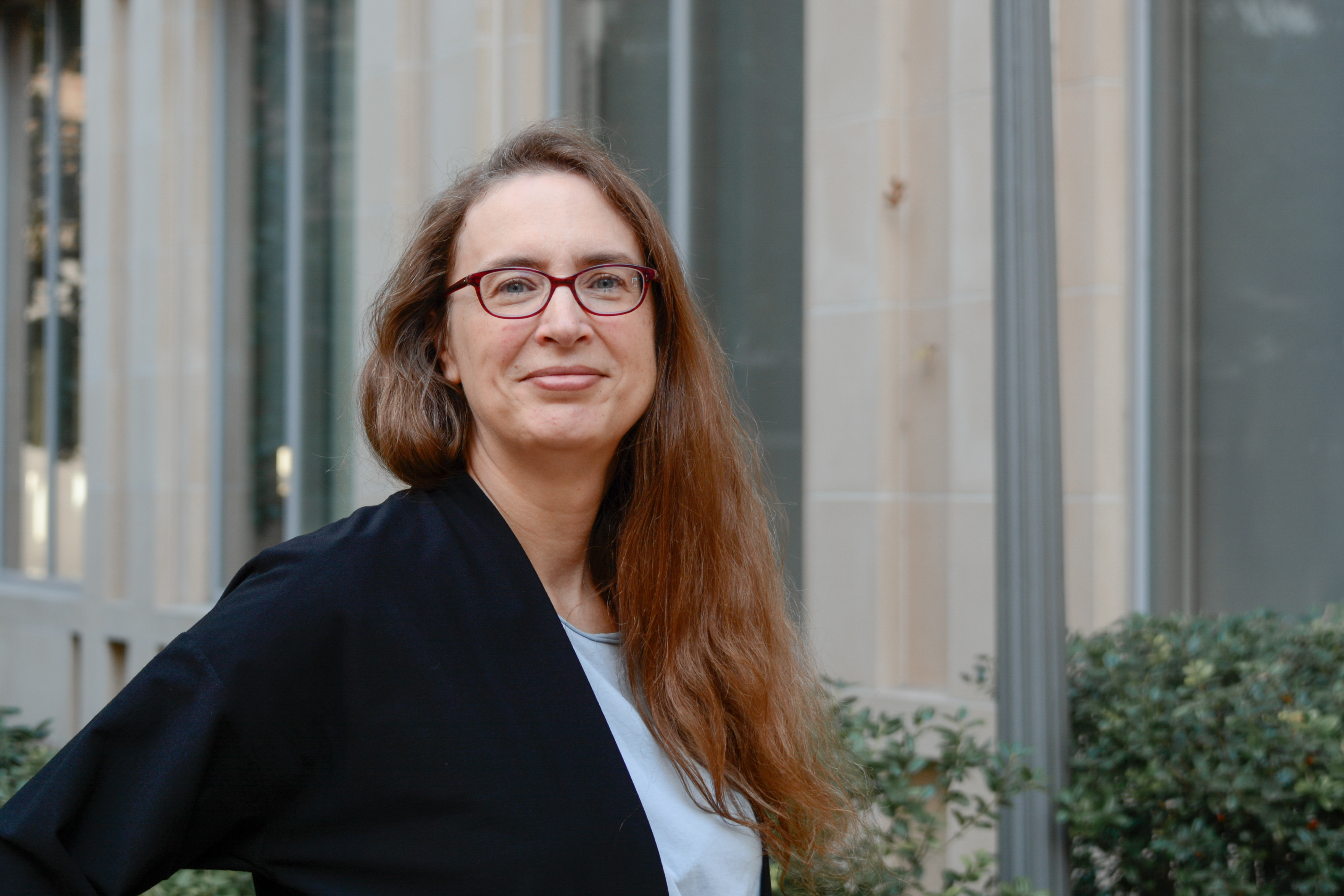
Professor Vadim Kimmelman is affiliated with the Department of Linguistic, Literary and Aesthetic Studies at the University of Bergen. His primary research interests lie in sign language linguistics, with a focus on syntax, nonmanual markers, classifier predicates, and computational methods in linguistic analysis. He has contributed to foundational studies on Russian Sign Language (RSL), Sign Language of the Netherlands (NGT), and other signed languages. Key research areas include the formal analysis of argument structure, transitivity, metaphorical extensions, and the role of nonmanual components in grammatical and pragmatic functions. His work combines corpus linguistics with computational tools, such as computer vision techniques for analyzing nonmanual behaviors in sign language interactions. Published in high-impact journals like Annual Review of Linguistics , Open Linguistics , and Sign Language Studies . Recipient of ERC funding for projects on nonmanual properties and sign language processing. Co-authored a textbook on sign language linguistics with Svetlana Burkova ( Vvedenie v lingvistiku zhestovyh jazykov ). Recent projects involve developing benchmark datasets (e.g., FluentSigners-50) and tools for sign language recognition, reflecting his interdisciplinary approach to bridging linguistics and computational science.
Rosalind Thornton is a Professor in the Department of Linguistics at Macquarie University, affiliated with the Centre for Language Sciences (CLaS). Her research focuses on children's acquisition of syntax, semantics, and morphology within the framework of Universal Grammar, particularly in relation to language delay (specific language impairment). She has contributed significantly to understanding innate linguistic knowledge versus environmental learning through experimental studies with young children. Her research interests include the syntax-semantics interface, cross-linguistic studies (e.g., Mandarin, Turkish), and the implications of child language data for theoretical syntax. Notably, she has explored how children with language impairments process negation, disjunction, and syntactic structures. Rosie has led several funded projects, including 'Unexpected Wide Scope Phenomena in Child Language' (2020–2022) and 'CLaS - MQRC' (2019–2021). Her publications span experimental methods, parameter setting in Universal Grammar, and language disorders. Despite no longer supervising students, her work has shaped understanding of linguistic deficits in children with SLI. Collaborations include studies on MEG systems for child language research and audio-visual tools for clinical applications. She is a key figure in the intersection of formal linguistics and developmental psycholinguistics.
Colin Phillips is a Professor in the Department of Linguistics at the University of Maryland. His research focuses on syntax, psycholinguistics, and neurolinguistics, particularly examining sentence production, parsing mechanisms, and the interface between syntax and processing. He is a Distinguished Scholar-Teacher and affiliated with the Maryland Language Science Center. His work combines experimental methods with theoretical syntax, investigating topics like syntactic category effects in lexical access, anaphora resolution, and the role of memory in language processing. Key contributions include studies on filler-gap dependencies, negative polarity illusions, and the structural sensitivity of memory access in Mandarin Chinese. Phillips has collaborated with researchers such as Shota Momma, Matthew Wagers, and Brian Dillon. His lab utilizes ERP and behavioral experiments to explore real-time language processing. Grants include NSF support for projects in semantics, syntax, and computational linguistics. Awards include the Distinguished Scholar-Teacher title at UMD. His teaching and research span linguistic theory, experimental methods, and interdisciplinary language science. Phillips is actively involved in graduate training and has advised numerous students in the PhD program.
Shalom Lappin is a Professor of Natural Language Processing at the School of Electronic Engineering and Computer Science, Queen Mary University of London. He holds a dual affiliation as Chief Scientific Advisor at the Centre for Linguistic Theory and Studies in Probability (CLASP) at the University of Gothenburg. His research focuses on computational linguistics, deep learning, and probabilistic models applied to syntax, semantics, and grammar induction. He leads research in areas such as neural network architectures for compositional semantics, Bayesian inference semantics, and the application of machine learning to natural language understanding. His work bridges theoretical linguistics and computational models, emphasizing the cognitive plausibility of AI systems. His contributions include foundational texts like Deep Learning and Linguistic Representation and Foundations of Intensional Semantics . He has collaborated extensively on projects exploring gradient acceptability judgments, context effects in language processing, and the evaluation of large language models. Lappin's affiliations include roles in both academic and collaborative research centers, reflecting his commitment to advancing interdisciplinary research at the intersection of computer science, linguistics, and artificial intelligence.
Dr. Damir Cavar is an Associate Professor at Indiana University Bloomington (IU), affiliated with the Luddy School of Informatics, Computing, and Engineering. He holds core faculty positions in the Luddy Artificial Intelligence Center and the IU Quantum Science and Engineering Center. His primary role is in the Department of Linguistics, where he directs the Natural Language Processing Lab and co-organizes the Quantum AI and NLP Study Group. Adjunct roles: Cognitive Science Program, Russian and East-European Institute, Hamilton Lugar School of Global and International Studies. Senior Lifetime Member of ACM and IEEE Senior Member (in process). Research: Focuses on Quantum AI/NLP, Knowledge Graphs, corpus linguistics, and machine learning. Key projects include: Natural Language Qu Kit (NLQK), a quantum NLP library. Hoosier Ellipsis Corpus (THEC) for ellipsis analysis. QM technologies applied to semantic similarity and NLP ambiguity resolution. Teaching: Leads advanced courses in NLP, machine learning, and AI at both graduate and honors college levels. Recent courses include 'Advanced NLP', 'Knowledge Graphs and LLMs', and 'Generative AI & Symbolic Knowledge' at ESSLLI 2024. Awards/Recognition: ACM Senior Membership, leadership in organizing quantum AI/NLP conferences (2024-2025), and contributions to open-source NLP tools. Outreach: Active in professional societies (SIGAI, SIGMOD, ACL) and maintains a robust GitHub presence with over 80 repositories. Organizes the Quantum AI/NLP Conference 2025 at IU and the QNLP study group.
Maria Aloni is an Associate Professor of Logic and Language at the Institute for Logic, Language and Computation (ILLC) and the Department of Philosophy at the University of Amsterdam. She holds dual affiliations with the Formal Semantics & Philosophical Logic (FSPL) research unit as her primary affiliation and the Epistemology & Philosophy of Science (EPS) unit as her secondary affiliation. Her research bridges formal semantics, philosophical logic, and the philosophy of language, with particular expertise in quantification, modality, and the interpretation of indefinite expressions. She currently leads the N∅thing is Logical (NihiL) project, which investigates cognitive tendencies to neglect empty representations and their effects on reasoning and interpretation. Aloni completed her PhD at the University of Amsterdam in 2001 with the thesis "Quantification under Conceptual Covers," which won the prestigious E. W. Beth Dissertation Prize in 2002. Her academic trajectory includes significant research funding: an NWO Veni grant (2004-2007) for "Semantic Structure and Dynamics in Natural Language Interpretation," an NWO Vidi grant (2007-2012) as Principal Investigator for "Indefinites and beyond. Evolutionary pragmatics and typological semantics," and the current NWO Open Competition Grant (since 2023) for the NihiL project. Her research spans formal semantics and pragmatics, with specific expertise in quantification, modals, propositional attitudes, reference, indefinites, disjunction, indexicals, questions, imperatives, and various semantic phenomena including free choice, exhaustification, and presupposition. She employs diverse methodologies including formal modeling, corpus analysis, and experimental approaches to investigate how linguistic meaning is constructed and interpreted across different contexts and languages. Aloni's recent publications demonstrate a consistent focus on the "neglect-zero" hypothesis, examining how cognitive tendencies to ignore empty representations affect interpretation of quantifiers, disjunction, and free choice phenomena. Her work also explores cross-linguistic and diachronic dimensions of indefinites, investigating how pragmatic inferences become conventionalized in language through historical processes. Scientific awards: E. W. Beth Dissertation Prize (2002) for "Quantification under Conceptual Covers" As an educator, Aloni coordinates the MoL Graduation Trajectory for Master of Logic students and teaches courses including "Introduction to Logic" and specialized seminars on semantics and philosophy. She has supervised numerous Master's theses in the Logic program, with recent students exploring topics related to free choice phenomena, perspective shifts, and linguistic semantics. Her research is supported by significant grants from the Netherlands Organisation for Scientific Research (NWO) and previously from the European Union. Aloni is a key member of the Formal Semantics & Philosophical Logic research unit at ILLC and collaborates extensively with international researchers. Her current NihiL project brings together interdisciplinary perspectives from linguistics, philosophy, and cognitive science to investigate the cognitive foundations of logical reasoning and its divergence from everyday reasoning patterns.
PD Dr. Katrin Menzel is an academic researcher at the University of Mannheim’s Department of English (Anglistik IV) within the School of Humanities. Her work focuses on corpus linguistics, translation studies, and historical linguistic analysis. She specializes in examining lexical cohesion, word formation processes, and cross-linguistic contrasts between English and German, particularly in scientific and parliamentary discourse. Her research explores topics such as initialisms in academic writing, the evolution of medical terminology in Late Modern English, and the development of combining forms in scientific texts. She has contributed to key projects like the Royal Society Corpus and the EPIC-UdS simultaneous interpreting corpus. Her studies often involve diachronic analyses of linguistic features and their application in translation pedagogy. Menzel’s recent work highlights the importance of corpus-based methodologies in understanding cohesion patterns, term diffusion, and professional interpreting practices. She has published extensively on English-German contrasts in cohesion devices, such as ellipsis and lexical chains, and their implications for language teaching and translation studies. Her research also addresses methodological aspects of corpus curation, including metadata generation for historical corpora. No specific advising or grant information is available, but her affiliations with the University of Mannheim’s English Studies IV team reflect her active role in interdisciplinary linguistic research.
Ryan Bennett is a Professor of Linguistics at the University of California, Santa Cruz (UCSC), specializing in formal phonology with a focus on syntax-phonology interfaces, morphology, and phonetics. His research emphasizes Mayan languages (e.g., Uspanteko, Kaqchikel) and Irish, exploring topics like tonal systems, gestural timing, and language documentation. He collaborates extensively on projects involving Indigenous language preservation, such as work with the Maya Health Alliance and Cofán Survival Fund. Bennett's work bridges theoretical linguistics with experimental methods, including ultrasound analysis and computational tools for language documentation. His research interests include articulatory phonetics, prosodic structure, and language typology. Notable contributions address secondary articulations in Irish, vowel tenseness in Kaqchikel, and tonal variability in Uspanteko. He has published widely on phonological processes and experimental methods for minority languages. Bennett's articles analyze phonetic and phonological patterns across languages, with recent work focusing on Irish palatalization, Uspanteko prosody, and Mayan language documentation. His research often involves interdisciplinary methods, combining fieldwork with acoustic and articulatory analysis.
Jorge Hankamer is a Professor of Linguistics at the University of California, Santa Cruz . He is affiliated with the Department of Linguistics and has contributed extensively to syntax and morphology research, particularly in Turkish and Danish languages. Contact : hank@ucsc.edu / hank@ling.ucsc.edu Location : Stevenson 264, UCSC His research focuses on syntactic transformations, anaphora, ellipsis, and morphological parsing. He has taught courses like Syntax I , Morphology Seminar , and Structure of Romance since at least 2007. Article trends include Turkish phonology (vowel epenthesis, monosyllabism), Morphological parsing (Danish definiteness, Turkish compounds), and syntactic theory (movement blocking, negation). No scientific awards are explicitly listed. He co-founded the Morphology Reading Group and contributed to the Morphology At Santa Cruz project.
Javier Pérez-Guerra is a full Professor at the University of Vigo , where he coordinates the Research Group Language Variation and Textual Categorisation . His work integrates corpus linguistics , diachronic syntax , and information structure to analyze English linguistic evolution from Early Modern to Present-day English. He has secured significant funding from the Spanish Ministry of Economy and Competitiveness (grants BFF2001-3505 to PID2020-117541GB-I00) and the Autonomous Government of Galicia . PhD in English Linguistics (1999), University of Santiago de Compostela MA in English Language and Literature (1990), University of Santiago de Compostela His research focuses on word order variation , register analysis , and processing preferences in grammatical design. Recent analyses of fragmentary constructions (e.g., why-fragments, Mad Magazine sentences) and syntactic complexity in academic writing (hard/soft sciences) demonstrate his corpus-driven methodology. Collaborative work with Yolanda Fernández-Pena and Elizaveta Smirnova explores causal expressions, L1 influence on Present Perfect usage, and disciplinary stance strategies. He has organized major conferences like the International Workshop on Language and the Brain (2019) and 6th Prescriptivism International Conference (2021). Editorially, he serves as review editor of Folia Linguistica and co-edited SEDERI and Research in Corpus Linguistics . Visiting appointments include Henan University (Adjunct Professor, 2019) and institutions like MIT, Oxford, and Cambridge.
Lotus Goldberg is a Professor of Linguistics at Brandeis University, affiliated with the Interdepartmental Program in Linguistics and Computational Linguistics, and the Benjamin and Mae Volen National Center for Complex Systems. Her research focuses on theoretical syntax, particularly ellipsis and null anaphora, with empirical and computational approaches. Education: Ph.D. in Linguistics, McGill University M.A. in Theoretical Linguistics, University of California, Santa Cruz B.A. (Honors) in Theoretical Linguistics, University of California, Santa Cruz Research Interests: Goldberg’s work emphasizes empirical analysis of syntax-semantics interfaces, VP ellipsis, and null anaphora. She leads the Syntax Research Lab, developing the Brandeis-Simmons Corpus of English VP Ellipsis, a large-scale database for syntactic analysis of natural speech. Awards: 2022 Theodore and Jane Norman Award Scholarship (Brandeis University) 2019 Theodore and Jane Norman Award Scholarship (Brandeis University) Advising/Grants: Goldberg’s research is supported by grants from Brandeis University’s Faculty Research initiatives. Her lab collaborates on corpus construction and syntactic annotation projects. She mentors students in theoretical linguistics and computational methods. Labs/Teams: Director of the Syntax Research Lab, contributing to interdisciplinary work at the Volen National Center for Complex Systems.
Whitney Gegg-Harrison is an Associate Professor in the Writing, Speaking, and Argument Program at the University of Rochester. Her work bridges cognitive science, linguistics, and writing pedagogy, emphasizing how language reflects and shapes thought. She holds a PhD in Brain and Cognitive Sciences from the University of Rochester (2014), with earlier degrees from The Ohio State University (BS in Linguistics/Computer Science and MS in Computational Linguistics). Her teaching spans foundational first-year writing courses exploring language and cognition to advanced seminars on AI and writing. Notable courses include Language as a Window into the Mind (since 2010) and Writing about and with Artificial Intelligence (launched 2023). She designs curricula that integrate critical AI literacy and cognitive science principles. Research interests include cognitive processes in writing, AI's impact on communication, and inclusive pedagogy. She has published widely on reference resolution, discourse processing, and flow in writing. Her 2024 article A Multidisciplinary Exploration into Flow in Writing examines how cognitive states influence writing productivity. In 2023, she received the prestigious Goergen Award for Excellence in Undergraduate Teaching. She is a sought-after speaker, including a 2024 invited seminar at Smith College on generative AI and writing. Her work appears in venues like Taylor and Francis and TextGenEd’s open-access resources. Gegg-Harrison collaborates with faculty across disciplines, offering workshops on AI-informed writing pedagogy and feedback strategies. Her office is in Rush Rhees Library (G121-H), and she emphasizes accessibility and student-centered learning.
Julian Grove is an Assistant Professor in the Department of Linguistics at the University of Florida. Previously, he was a post-doctoral researcher in the FACTS.lab (Formal Approaches to Cognition, Thought, and Semantics laboratory) at the University of Rochester under Aaron Steven White. Prior to that, he was affiliated with the Centre for Linguistic Theory and Studies in Probability at the University of Gothenburg. He completed his PhD in Linguistics at the University of Chicago, where he was also associated with the Language Processing Lab directed by Ming Xiang. Dr. Grove's research program centers on developing type-theoretic approaches to natural language semantics that integrate with Bayesian computational models of human behavior. His work aims to preserve traditional semantic tools like λ-calculus while bridging formal linguistics with experimental approaches. This integrative methodology represents a significant contribution to connecting Montagovian semantics with contemporary computational frameworks. His research interests include: Type-theoretic approaches to natural language semantics Bridging Montagovian approaches with computational models Semantics of presupposition and anaphora Experimental work on ellipsis Probabilistic compositional semantics Rational Speech Act modeling Analysis of his recent publications reveals a consistent trajectory toward integrating formal semantic theory with probabilistic modeling. His work demonstrates particular expertise in reinterpreting presupposition phenomena through scope mechanisms and developing computational implementations of semantic theories. The progression from his 2020 work on algebraic effects in Montague semantics to his 2024 presentations shows increasing sophistication in connecting theoretical frameworks with experimental data. Dr. Grove has collaborated with researchers including Aaron Steven White (University of Rochester), Jean-Philippe Bernardy, and Christine Howes. His work has been presented at major linguistics venues including LEAP, EMG, ELM 3, and SemDial conferences, as well as seminars at institutions like Cornell University and Institut Jean-Nicod. His GitHub activity (juliangrove) shows consistent contributions to projects related to probabilistic dynamic semantics, with repositories like semprag-ppsp containing implementations of his theoretical work. This demonstrates his commitment to making his research computationally explicit and reproducible, reflecting the growing importance of code-sharing in formal linguistics.
Brian Agbayani is a Professor in the Department of Linguistics at California State University, Fresno. He holds a Ph.D. in Linguistics (1998), an M.A. (1996), and a B.A. (1993) from the University of California, Irvine. His research focuses on comparative syntax , clausal architecture , movement phenomena , ellipsis , and the syntax-phonology interface across languages like Japanese, Latin, Greek, and Indigenous languages of the Americas. He also leads language documentation and revitalization efforts for endangered languages such as Chukchansi Yokuts, Hidatsa, and Wikchamni. His recent 15 most recent articles span topics like multiple scrambling in Japanese, prosodic movement in Indo-European languages, and syntactic structures in Indigenous languages. He collaborates with scholars including Toru Ishii , Masao Ochi , and John Boyle on projects involving experimental linguistics, phonological theory, and language preservation. Agbayani is actively involved in programs such as the Indigenous Languages Group (ILG) at Fresno State, the Chukchansi Language Program (with the Picayune Rancheria), and the Central California Ethnobotany Project . He has secured significant grants, including a $1,000,000 award from the Picayune Rancheria for Chukchansi revitalization.
Katrin Erk is a Professor at the University of Texas at Austin , holding joint appointments in the Department of Linguistics and Department of Computer Science . She is actively involved in UT Austin NLP and computational linguistics groups and serves as a faculty advisor in the Natural Language Learning reading group . Education: PhD in Linguistics from Saarland University (2002), dissertation on tree description languages and ellipsis Research Focus: Computational semantics, graded word meaning representations, and integration of distributional models with logic-based sentence semantics Her work takes a distributional approach to lexical semantics, using word embeddings and contextualized representations to study how word meanings are modulated by context without relying on predefined sense inventories. At the sentence level, she develops probabilistic frameworks that combine logical representations with distributed models for weighted inference. Recent research explores narrative schemas and their role in understanding word connotations through typical story patterns. Key article trends show interdisciplinary work at the intersection of machine learning and linguistic theory , focusing on semantic representation challenges. Her publications demonstrate expertise in implicit argument prediction , world knowledge integration , and semantic plausibility modeling through computational methods. Scientific Awards: 2017: CSLI Fellow, Stanford 2013: College Research Fellowship, UT Austin 2009: Big XII Faculty Fellowship, UT Austin 2008: Dean’s Fellowship, UT Austin 2007: Summer Research Assignment, UT Austin 1998-2001: Doctoral Dissertation Scholarship from German Research Foundation (DFG) 1995-1998: Scholarship from Studienstiftung des deutschen Volkes 1994-1995: Scholarship from German Academic Exchange Service (DAAD) She maintains active office hours (Tuesdays 9:45-10:45, Wednesdays 10-11 and 3-4 in Fall 2024) and can be reached at katrin.erk@mail.utexas.edu .