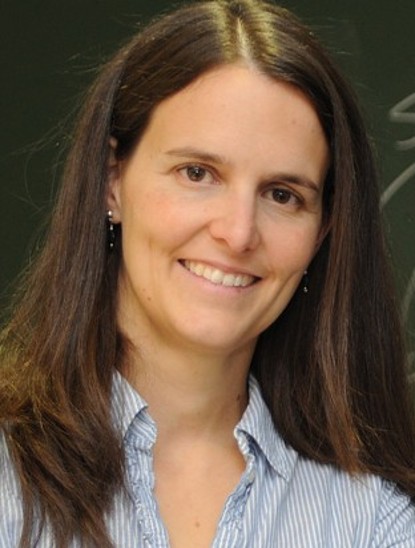
Prof. Almudena Arcones is a Professor in Theoretical Astrophysics at the Technical University of Darmstadt, Germany. She leads an active research group focused on understanding the cosmic origin of heavy elements. Her work bridges nuclear physics and astrophysics, investigating extreme environments like neutron star mergers and supernovae as cosmic laboratories for element formation. Prof. Arcones' research centers on the r-process (rapid neutron capture process) that creates approximately half of all elements heavier than iron. Her group investigates where and when heavy elements are synthesized in the universe and how these elements are produced. This work connects nuclear physics challenges in describing exotic nuclei with astrophysical challenges in identifying high-neutron-density environments in cosmic explosions. Her recent publications reveal a strong focus on r-process nucleosynthesis in neutron star mergers and core-collapse supernovae. The research integrates multimessenger astronomy (gravitational waves and electromagnetic counterparts), advanced simulations of astrophysical environments, nuclear experiments with exotic nuclei, and observations of elemental abundances in ancient stars. Key themes include nuclear physics uncertainties, neutrino-driven winds, and chemical evolution of r-process elements. Prof. Arcones has secured substantial research funding from prestigious sources including: European Research Council (ERC) Helmholtz Association of German Research Centres GSI Helmholtz Center for Heavy-Ion Research Collaborative Research Center 1245 Research Cluster ELEMENTS Federal Ministry for Education and Research Her research group develops computational tools like the WinNet nuclear reaction network to model nucleosynthesis in extreme astrophysical environments. They combine long-time supernova simulations with detailed microphysics, nucleosynthesis calculations, and observational data to determine the cosmic contributions to heavy element synthesis.