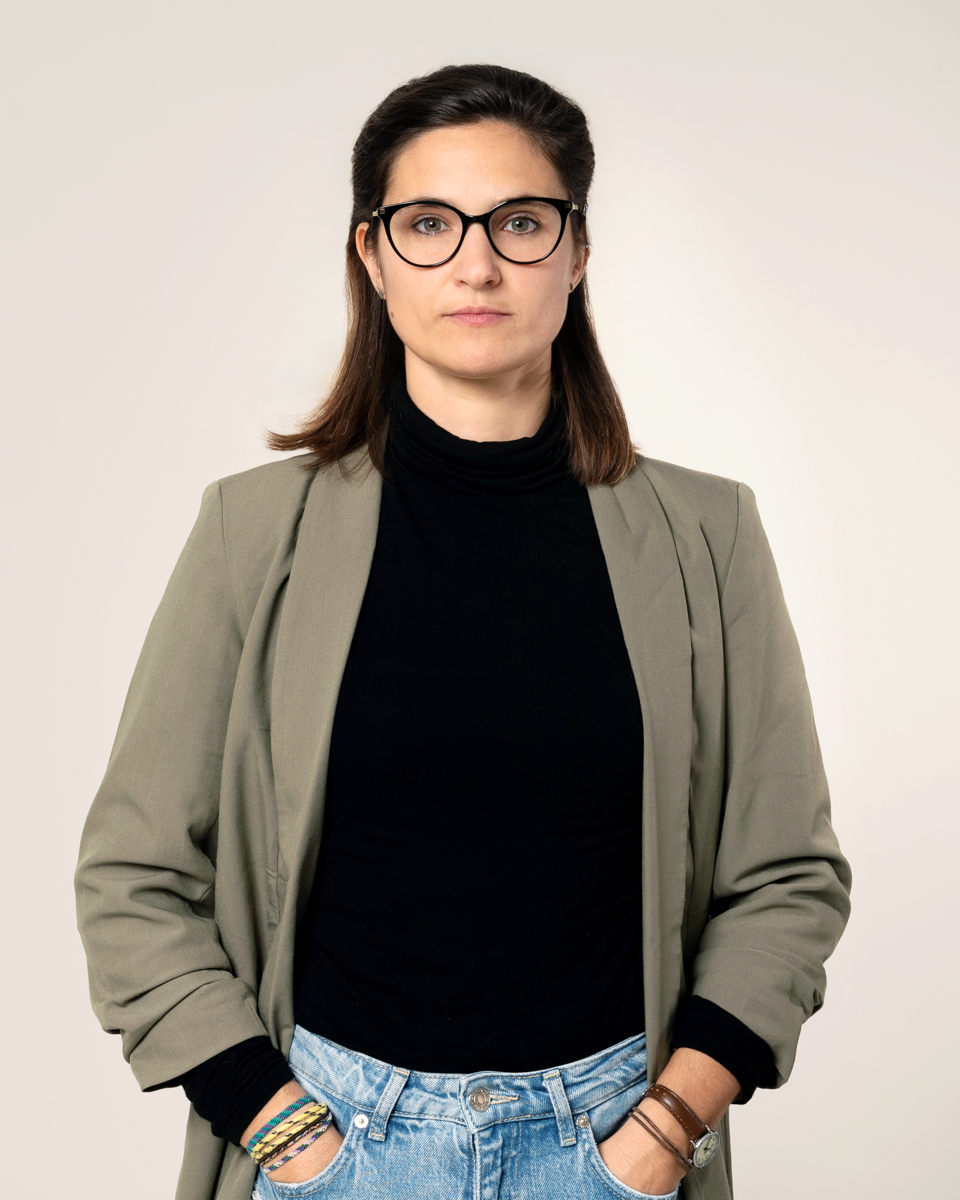
Laura Katharina Mücke is a full-time research associate in the 'Everyday Media and Digital Cultures' research group at the Institute for Film, Theatre, Media and Cultural Studies, Johannes Gutenberg University Mainz. She is concurrently pursuing a doctoral project jointly supervised by the Universities of Vienna and Groningen, examining media immersion through feminist and discourse-analytical frameworks. Previously, she served as a University Assistant at the University of Vienna (2019-2022) and Research Associate at Mainz (2016-2019). Her research explores: Theories of aesthetic experience, media effects, and reception aesthetics Critical phenomenology and metaphenomenology Social media platform politics (especially TikTok), everyday digital practices, and Eastern European video activism Feminist critiques of representation, situated knowledge, and gaze theories Mücke's publications analyze immersion as a politically charged concept, tracing its gendered, classist, and racialized discourses across historical and contemporary media. Recent work investigates videoconferencing agency, TikTok's role in protest movements, and algorithmic discrimination. She co-founded the interdisciplinary research group 'ID*A' and serves on the editorial board of Montage AV .
Amber Lauren Beckley is a Lecturer in the Department of Sociology at Stockholm University, where she conducts research at the intersection of criminology, victimology, and developmental psychology. As a member of the Victimological Research Group established in 2021, she investigates how developmental factors influence criminal offending and victimization across the life course. Her work combines longitudinal methodologies with register data analysis to uncover patterns and predictors of crime and victimization. Dr. Beckley's research interests focus on life-course criminology, victim-offender overlap, and the developmental pathways to crime and victimization. Her work examines how childhood problem behavior, family environment, psychosocial maturation, and genetic factors influence criminal trajectories. She has made significant contributions to understanding how immigration impacts crime patterns in Sweden, using sophisticated methodologies including sibling comparisons to address confounding factors. Her research has shown that human development in home countries serves as a protective factor against criminal offending among immigrants, challenging conventional wisdom in the field. Analysis of Dr. Beckley's publication record reveals a consistent focus on developmental trajectories of crime and victimization, with particular attention to methodological rigor in studying these complex phenomena. Her work bridges criminological theory with empirical evidence from longitudinal studies like the Dunedin Multidisciplinary Health and Development Study. She has made important contributions to understanding the victim-offender overlap, showing it has developmental roots in childhood characteristics and adverse experiences. Her research increasingly incorporates genetic and biological perspectives while maintaining focus on social and environmental factors. Dr. Beckley has secured significant research funding, including a 2.875 million SEK grant from Riksbankens Jubileumsfond for her project "Childhood psychosocial and environmental predictors of crime and victimization across life," and is a co-investigator on a 4.9 million SEK grant from Forte examining immigration's impact on crime in Sweden over 40 years. Principal Investigator: "Childhood psychosocial and environmental predictors of crime and victimization across life" (2.875 mil SEK, Riksbankens Jubileumsfond) Co-investigator: "What happened in Sweden over the last 40 years?" (4.9 mil SEK, Forte) As an educator, Dr. Beckley serves as co-course coordinator for Method II Campus (Crime Prevention) and course coordinator for Method II Distance. Her academic home in the Department of Sociology at Stockholm University provides a strong foundation for her interdisciplinary research that bridges criminology, sociology, and psychology.
Felice Addeo is a Full Professor at the University of Salerno , affiliated with the Department of Political Sciences and Communication (DISPC) . His research spans Social Research Methods , Quantitative Methodology , Communication , and Development Communication . He has led international projects on bioeconomy, active citizenship, and consumer behavior, and his work integrates qualitative and quantitative approaches. Key Roles: Full Professor at DISPC, University of Salerno; active in EU-funded research. Contact: Email faddeo@unisa.it , Office Hours: Tuesdays, Thursdays, Fridays at Fisciano Campus. Research Interests include: Social Network Analysis: Typologies in strategy/organization; social capital as a unifying trait. Web 2.0 and Knowledge: Explored its impact on hotel chains and business intelligence. Ecological Fallacies: Critiqued misapplications in social sciences. Consumer Behavior: Global vs local brands, telecom markets, and tourism-driven economic development. Publications reflect trends in bioeconomy policies , mixed-method social research , and market segmentation . His work often intersects statistics , digital transformation , and cultural analysis .
James Uber is a Professor in the Department of Civil & Environmental Engineering at the University of Cincinnati , where he has held academic appointments from 2007–2016. His career spans roles as Co-Director for the Center for Sustainable Urban Environments (2007–2009) and Director of the Environmental Engineering & Science Program (2002–2006). Ph.D., Environmental Engineering (1988) M.S., Environmental Engineering (1985) B.S., Civil Engineering (1983) Uber's research focuses on water distribution systems , contamination warning , disinfectant residual dynamics , and public health risk assessment . He has pioneered work in real-time water quality modeling , epidemiological studies of waterborne diseases , and feedback control for water systems . His peer-reviewed articles (1986–2014) emphasize multi-species transport modeling , optimization of booster disinfection , and MAUP bias reduction in health studies. These works bridge environmental engineering with public health and systems analysis . Uber has received prestigious scientific awards , including the 2010 WDSA Best Paper, 2009 AWWA Management Division Best Paper, and 2007 Franz Edelman Award finalist. He led federal and private grants totaling over $4 million for projects like EPA-funded pathogen-biofilm modeling and NSF cyberinfrastructure development. Grants include: EPA: Pathogen-Biofilm Attachment Model ($45,754) National Institute For Hometown Security: Distribution Hydraulics ($387,383) Department of Energy: Real-Time Water Modeling ($391,512) NSF: Real-Time Network Modeling ($313,701) DoD: Water Warning System Performance ($68,949)
Professor Martin Bulmer is a Professor of Sociology at the University of Surrey. He previously held roles at the University of Southampton and the London School of Economics (LSE), where he spent 17 years. His career includes membership in the Government Statistical Service and a visiting professorship at the University of Chicago. He directs the Question Bank (a web resource at Surrey) and the ESRC Survey Link Scheme, while also leading the Institute of Social Research. He is an Academician of the Academy of Learned Societies for the Social Sciences. His research focuses on social research methodology, history of social sciences, ethnicity/race studies, sociology of public policy, and social care. Notable projects include ESRC-funded work on electronic questionnaire design and editing major works like Racism (Oxford Readers) and Questionnaires (Sage). He co-edits the journal Ethnic and Racial Studies and serves on editorial boards of American Behavioral Scientist and Sociological Quarterly . Bulmer's recent articles (2020–2022) address topics such as pandemic impacts on race studies, policy analysis, and social research ethics. His work emphasizes applied sociology and interdisciplinary collaboration. Awards or grants are not explicitly listed, but his extensive editorial and leadership roles highlight his disciplinary influence. He has advised on major research initiatives and contributed to public policy frameworks through academic-practice linkages.
Johannes van Ommeren is a Professor at Aalborg University, affiliated with the Department of the Built Environment within the Faculty of Engineering and Science . He leads research initiatives focused on urban development and spatial data analytics. Research Focus: His work centers on evidence-based city planning, leveraging spatial data to address challenges like ecological fallacy and urban sustainability. Notably, he co-leads the urbanLab , a research initiative funded by the Villum Foundation to create a spatial data center for informed urban policy. Grants & Projects: Principal Investigator (PI) of the urbanLab: Spatial data center for evidence-based city planning project (Villum Foundation), emphasizing interdisciplinary approaches to urban analytics. Labs & Teams: Directly involved in the Transformation of Housing and Places Research Group and leads the urbanLab initiative, fostering collaborations across urban planning, data science, and policy analysis.
Glenn Firebaugh is the Roy C. Buck Professor of Sociology and Demography at Pennsylvania State University. He is a renowned methodologist known for his contributions to social research, including his book Seven Rules for Social Research (Princeton, 2008). Research focuses on measuring inequality, segregation, and neighborhood socioeconomic variation Current work examines lifespan variability using cause-of-death data Served as Editor of American Sociological Review (1997-2000) Education: M.A. in Sociology, Indiana University (1974) Ph.D. in Sociology, Indiana University (1976)
Lee Lyman is a Professor Emeritus at the University of Missouri, affiliated with the Department of Anthropology. His research focuses on mammalian faunal history, zooarchaeology, conservation biology, and the history of archaeological methodologies. Lyman has extensively studied the paleoecological implications of faunal remains in Washington state and adjacent regions, emphasizing biogeographic change, morphological evolution, and climatic adaptation. He has also contributed to applying zooarchaeological data to modern conservation efforts, advocating for the use of ancient DNA and trace-element analysis in paleomammalian studies. Lyman teaches courses such as 'Fundamentals of Archaeology,' 'Zooarchaeology,' and 'History of Anthropology.' He emphasizes integrating his ongoing research into classroom instruction to enhance students' analytical and critical thinking skills. His work often bridges paleozoological findings with contemporary ecological challenges, particularly in wildlife management and biodiversity conservation. Lyman's research has explored the historical development of archaeological concepts like 'association,' 'context,' and 'provenience,' alongside critiques of peer review and academic publishing practices. His contributions include over 100 publications, with a focus on methodological rigor and interdisciplinary applications of zooarchaeological data.
Joseph McFall is a current Managing Director of Data & Science at the Children's Institute (University of Rochester, since February 2022). Formerly, he served as an Associate Professor in the Department of Psychology at SUNY Fredonia (2012-2022). His research focuses on everyday problem-solving , decision-making models , and aging-related cognitive processes . His work spans meta-analyses of cognitive-behavioral therapy (CBT) for youth mental health and sunk-cost fallacy in aging populations. He has developed revised assessment tools like the REPSI (Revised Everyday Problem-Solving Inventory) and explored collaborative strategies in interpersonal and instrumental domains across lifespans. Key trends in his 15 most recent publications include meta-process decision modeling , age-differential problem-solving efficacy , and empirical critiques of therapeutic interventions . His studies frequently employ ANOVA and effectiveness ratings from expert panels.
Felix Elwert is the Vilas Distinguished Achievement Professor of Sociology at the University of Wisconsin-Madison, with a joint appointment in Biostatistics. He specializes in causal inference methodologies and investigates social inequality, demography, and health disparities through large-scale experiments, population registers, and survey analyses. His work bridges sociology, statistics, and public health, with notable contributions to understanding peer effects, neighborhood effects, and methodological innovations in causal analysis. Elwert holds a Ph.D. in Sociology (2007) and M.A. in Statistics (2006) from Harvard University. Before his current position, he served as Karl W. Deutsch Professor and Acting Director of Social Inequality and Social Policy at the WZB Berlin Social Center (2014–2016). He currently leads the Sociological Methods & Research journal as Editor-in-Chief. His research focuses on: Contextual drivers of inequality in income, education, and health Causal mediation analysis Experimental designs for estimating peer effects Bias detection in statistical models Elwert has received prestigious awards including the ASA's Causality in Statistics Education Award (first recipient) and the ASA's Leo Goodman Award. His collaborations span institutions globally, emphasizing interdisciplinary approaches to causal questions. He teaches advanced causal inference courses at UW-Madison and international universities, covering topics like graphical models, mediation analysis, and experimental design. His campus affiliations include the Center for Demography and Ecology, Center for Demography of Health and Aging, and Institute for Diversity Science.
Michael Friesenecker is a researcher at the Institute of Landscape Planning , University of Natural Resources and Life Sciences Vienna (BOKU). His work bridges urban planning , climate change adaptation , and social equity , focusing on nature-based solutions for urban heat islands and green gentrification challenges. 2025: Socially equitable climate risk management of urban heat (npj Urban Sustainability) 2024: Strategien allein lassen keine Bäume wachsen – Klimawandelanpassung in Wien (PLANERIN) His research explores the intersection of climate resilience and social justice , analyzing how urban green spaces and sustainability policies affect vulnerable populations. Key themes include: Equity in nature-based solutions Green gentrification dynamics Urban heat vulnerability assessment Integration of climate and housing policies Transformative recovery after systemic shocks Media contributions highlight his expertise in Vienna's climate policy and social impacts of sustainability measures , including 17 lectures on these topics (2022–2024). Contact: michael.friesenecker@boku.ac.at