Prof. Dr. Axel-Cyrille Ngonga Ngomo is a Professor at the University of Paderborn , affiliated with the Faculty of Electrical Engineering, Computer Science and Mathematics and the Institute of Computer Science . He leads the Data Science group at the Heinz Nixdorf Institute and is a member of the Sonderforschungsbereich Transregio 318 (Constructing Explainability). His roles include heading the Informatik Rechnerbetrieb (IRB) team. Research Focus : Knowledge graphs, semantic web technologies, explainable AI, and distributed systems. Selected Projects : SAIL (Sustainable Life Cycle of Intelligent Sociotechnical Systems), TRR 318 (Constructing Explainability), Colide (Co-training for Industrial Data), 3DFed (Dynamic Data Distribution), and SFB 901 (On-The-Fly Computing). Contact : Email axel.ngonga@uni-paderborn.de , Office F1.225 (Fürstenallee 11) and TP6.3.106 (Technologiepark 6), Paderborn. Teaching : Courses include Seminar on Recent Advances in Knowledge Graphs, Project Groups on SPARQL Query Processing, Large Language Model Training, Retrieval Augmented Generation, and Foundations of Knowledge Graphs.
Luo Mai is an Assistant Professor at the University of Edinburgh's School of Informatics , with an upcoming promotion to Associate Professor (UK Reader) in August 2025. He leads the Large-Scale Machine Learning Systems Group and co-leads the UK EPSRC Centre for Doctoral Training in Machine Learning Systems and an ARIA Project on Scaling AI Compute by 1000X . PhD in Computer Science (Imperial College London, 2018) MRes in Advanced Computing (Imperial College London, 2012) His research focuses on the intersection of computer systems , machine learning , and data management . Key contributions include award-winning systems like WaferLLM (wafer-scale LLM inference), Tenplex (elastic ML), and ServerlessLLM (serverless LLM serving), published at top venues (OSDI, SOSP, ICML, NeurIPS, JMLR). Recent publications demonstrate trends in GPU-based distributed systems , LLM optimization , and adaptive machine learning . His team has developed groundbreaking open-source projects including TensorLayer , TorchOpt , and ServerlessLLM . Awarded Microsoft Research StarTrack Scholar (2024) , secured ARIA grant (2024) with Imperial College & Cambridge University, and received Google Fellowship during PhD (2012-2016). As an educator, he designed Edinburgh's popular Machine Learning Systems course (150+ students). His group supervises multiple PhD students including Yao Fu (recognized as 2024 Rising Star in ML & Systems) and Leyang Xue .
Matthew Landry, PhD, RDN, FAND, is an Assistant Professor in the Department of Population Health and Disease Prevention at the University of California, Irvine. He directs the Nutrition Promotion & Disease Prevention Research Lab, focusing on plant-based nutrition interventions for chronic disease prevention and health equity. His work bridges clinical research and public policy, particularly addressing nutrition disparities in underserved communities. Dr. Landry holds a BS in Nutrition and Food Sciences from Louisiana State University (2015), a PhD in Nutritional Science from the University of Texas at Austin (2019), and is a Registered Dietitian Nutritionist (Commission on Dietetic Registration, 2020). His research examines: Optimal dietary patterns for chronic disease prevention Clinical trial methodologies for dietary interventions Behavioral strategies promoting plant-forward diets Nutrition equity in food-insecure populations Policy translation of nutrition science His publications demonstrate consistent focus on plant-based nutrition, health disparities, clinical trial design, and public health interventions, utilizing diverse methodologies from community-based studies to systematic reviews. Honors and awards include: UCDC Presidential Faculty Fellow (2025) Ethan Sims Young Investigator Award (2022) Fellow of the Academy of Nutrition and Dietetics (2022) Nutrition Education and Behavioral Science Early Career Award (2021) He secured a $90,000 grant from Ardmore Institute of Health (2025) to develop OB/GYN nutrition education resources. Leads a research team investigating diet-disease relationships and intervention strategies.
Paul Leadley is a Professor at the University of Paris-Saclay, France, where he directs the Population and Community Ecology group within the Ecology, Society and Evolution Laboratory (IDEES). His research focuses on global change impacts on terrestrial ecosystems, biodiversity, and ecosystem functioning through field experiments and mathematical modeling. His educational background includes a B.S. in Science from Pennsylvania State University (1981), an M.S. in Botany from North Carolina State University (1985), and a Ph.D. in Ecology from San Diego State University and UC Davis (1993). Prior to his professorship, he worked as a research technician at San Diego State University, Smithsonian Environmental Research Center, and New Mexico State University, followed by post-doctoral research at the University of Basel. Leadley investigates climate change and rising CO2 impacts on plant diversity, biodiversity-ecosystem functioning relationships, and nutrient competition between plants and soil microorganisms. His experimental work centers on California and temperate grasslands, examining fire, temperature, CO2, nitrogen deposition, and precipitation interactions. He develops multi-scale models from rhizosphere nutrient fluxes to regional climate change projections, collaborating with institutions like INRA, Stanford University, and Northern Arizona University. His research integrates field experiments with mathematical modeling to quantify uncertainties in global change projections. His recent publications (2008-2012) reveal consistent themes: climate change impacts on biodiversity via species distribution modeling, interactive effects of multiple global change drivers on soil nitrogen cycling, and development of biodiversity scenarios for policy. Key methodological approaches include multi-model comparisons, experimental manipulations of grassland ecosystems, and trait-based biodiversity assessments. Scientific Awards: No specific awards listed in the provided text. Leadley has directed five Ph.D. students: Alexandra Gastine, Romain Barnard, Xavier Raynaud, Audrey Niboyet, and Sandrine Fontaine. He has secured major research grants including QDiv (770 k€, 2005-2009), SCION (470 k€, 2010-2012), and HumboldtCES (450 k€, 2010-2012). Current projects focus on biodiversity modeling (MOBILIS), biome boundary shifts, and climate change impacts on forests. He participates in international assessment processes including IPBES and IPCC. He leads the Population and Community Ecology team at IDEES Laboratory, comprising approximately 30 researchers, engineers, technicians, and graduate students. The team operates experimental sites in California grasslands and collaborates with national networks including FRB, AllEnvi, and GIS Climat, Environnement, Société. Current initiatives include eco-evolutionary approaches to climate change impacts and development of adaptive forest management strategies.
Sneha Das is an Assistant Professor at the Department of Applied Mathematics and Computer Science, Technical University of Denmark (DTU), specializing in Speech and Language Technology, Machine Learning, and Privacy-Preserving AI. Her research bridges technical innovation with applications in mental health and physiological signal analysis. Her work focuses on Speech Emotion Recognition , Distributed Speech Processing , and Explainable AI , with recent publications exploring model interpretability, speaker anonymization, and physiological data analysis for emotion detection. She actively supervises PhD students in projects involving AI for mental health and hydroacoustic modeling of fish behavior. Key Research Areas: Speech Emotion Recognition (SER) Privacy and Fairness in Speech Processing Transfer Learning with Physiological Time Series AI Applications in Health and Aquaculture Notable achievements include earning a DSc (Tech) degree for her thesis on robust distributed speech processing. She also contributes to educational activities, including teaching applied statistics and R programming to PhD students.
Yang Song is an incoming Assistant Professor in Electrical Engineering and Computing and Mathematical Sciences at the California Institute of Technology (Caltech). Prior to joining Caltech, he leads the Strategic Explorations team at OpenAI. He received his Ph.D. in Computer Science from Stanford University under the supervision of Stefano Ermon and completed his Bachelor's degree in Mathematics and Physics from Tsinghua University. His educational background includes: Ph.D. in Computer Science, Stanford University Bachelor's in Mathematics and Physics, Tsinghua University Dr. Song's research focuses on building powerful AI models capable of understanding, generating, and reasoning with high-dimensional data across diverse modalities. He is particularly known for inventing foundational concepts and techniques in score-based diffusion models, which have revolutionized the field of generative AI. His work bridges theoretical advances with practical applications, particularly in image generation, medical imaging, and solving inverse problems. His research has demonstrated how score-based models can achieve state-of-the-art results in image generation while maintaining flexibility for various applications including medical image reconstruction. Analysis of his publication record reveals a strong trajectory in generative modeling, with a particular emphasis on score-based approaches and diffusion models. His work consistently addresses fundamental challenges in generative modeling including sample quality, training stability, computational efficiency, and application to real-world problems. His most recent work on consistency models represents a significant advancement toward making generative models practical for real-time applications. His notable achievements include: ICLR 2021 Outstanding Paper Award for Score-Based Generative Modeling through Stochastic Differential Equations NeurIPS 2021 Spotlight Presentation for Maximum Likelihood Training of Score-Based Diffusion Models Multiple ICLR Oral presentations for his work on consistency models Developing foundational techniques that power many modern AI image generation systems His GitHub repository for score-based generative modeling has gained significant traction in the research community, with over 1,700 stars, reflecting the impact of his work. His research bridges theoretical machine learning with practical applications, particularly in medical imaging where his techniques have shown promise for improving image reconstruction in CT and MRI.
Abhinav Gupta is a Professor of Management and Michael G. Foster Endowed Fellow at the University of Washington's Foster School of Business . His research focuses on business and politics , corporate governance , corporate social responsibility , social activism , and strategic leadership . Education PhD, Pennsylvania State University (2015) PGDM, International Management Institute, New Delhi (2010) BCom, Aligarh Muslim University (2008) Research Interests Dr. Gupta’s work examines how political ideology shapes corporate behavior, including boardroom dynamics, CSR implementation, and responses to social movements. He explores inter-organizational diffusion of governance practices and the role of CEO personality in strategic decisions. His recent publications analyze topics like CEO narcissism and knowledge transfer , shareholder activism and CEO turnover , and peer influence on CSR adoption . Scientific Awards Ascendant Scholar Award, 2019 Western Academy of Management Dean’s Excellence Award for Faculty Research, Foster School of Business Dean’s Excellence Award for Undergraduate Teaching, Foster School of Business Best Symposium Award (OMT Division), 2020 Academy of Management Meeting Best Paper Award (Social & Environmental Impact), 2017 Academy of Management Finalist, 2014 Organization Science/INFORMS Dissertation Proposal Competition Academic Service Dr. Gupta serves as Senior Editor at Organization Science and is on the editorial boards of Strategic Management Journal and Administrative Science Quarterly . He has reviewed for journals including American Sociological Review and Academy of Management Review , and participates in the Strategic Management Society and OMT/BPS Divisions of the Academy of Management.
Christina Elmer is Professor for Digital Journalism and Data Journalism at the Institute of Journalism, Technical University of Dortmund. Prior to her academic career, she held significant positions at DER SPIEGEL as Deputy Head of Development, Member of the Editorial Board of SPIEGEL ONLINE, Head of the Data Journalism Department, and Science Editor (2013-2021). She is recognized as a leading expert in data journalism, AI in media, and digital transformation of journalism. Elmer's research focuses on data journalism, algorithmic accountability, and the integration of artificial intelligence in journalistic workflows. Her work explores how digital transformation affects media production, distribution, and reception, with particular attention to user-centered journalism, ethical dimensions of digital media, and the development of editorial products. She has pioneered approaches to structured journalism and modular content creation that adapt to changing audience needs. Her recent publications examine AI's impact on journalism, methods for combating disinformation, and strategies for maintaining journalistic integrity in algorithmically mediated information ecosystems. Her work shows a clear trend toward investigating how journalism can maintain societal relevance while adapting to technological changes, with increasing focus on AI systems as both tools and challenges for quality journalism. scoop award of the nextMedia.Hamburg initiative, 2023 Helmut Schmidt Journalist Prize (second prize) for 'Blackbox Schufa', 2019 Philip Meyer Award (third place) for 'Hanna and Ismail', 2018 dpa-infografik Award for 'Die Pendlerrepublik', 2018 Journalistin des Jahres, Fachkategorie Wissenschaft, 2016 Deutscher Journalistenpreis Forst & Holz (Print), 2007 Elmer actively contributes to the journalism community as a board member of Netzwerk Recherche (serving as second chair 2021-2023), shareholder of AlgorithmWatch, and member of various advisory boards including Science Media Center Germany and MIP.labor. She frequently collaborates with students through the KURT student editorial team, guiding them in applying design thinking to develop new journalistic formats. Her approach emphasizes the importance of user-centered thinking while maintaining journalistic integrity in the digital age.
Sylvain Lefebvre is a permanent researcher at INRIA (Institut National de Recherche en Informatique et en Automatique) in France, where he leads the MFX research team since 2018. Previously, he was part of the ALICE group at INRIA Nancy (2009-2018) and the REVES team in Sophia Antipolis (2006-2009). His career includes a postdoctoral position at Microsoft Research Seattle (2005) following his PhD at INRIA Rhones-Alpes under Fabrice Neyret. His educational background includes a PhD in Computer Graphics from Université Joseph Fourier (Grenoble) in 2005, preceded by a Master in Computer Graphics from INP Grenoble in 2001. His habilitation thesis focused on Runtime Texture Synthesis. Lefebvre's research centers on simplifying content creation for highly detailed patterns, structures, and shapes with applications spanning Computer Graphics to additive manufacturing. He develops fast, controllable by-example synthesis approaches that generate content while enforcing user-specified constraints. His work addresses computational challenges through novel data structures and algorithms optimized for GPUs and FPGAs, including his Silice programming language. The ERC-funded ShapeForge project (2012-2017) advanced shape generation for 3D printing, leading to the IceSL software for digital modeling and fabrication. Analysis of his 15 most recent publications reveals a strong focus on additive manufacturing optimization, with recurring themes in structural integrity, material efficiency, and geometric algorithms. His work bridges computer graphics theory with practical fabrication constraints, particularly in microstructure design, slicing techniques, and mechanical metamaterials. The interdisciplinary nature spans computer science, materials engineering, and robotics. EUROGRAPHICS Young Researcher Award (2010) ERC Starting Grant for ShapeForge project (2012) Lefebvre has advised over 25 PhD students and interns including Marco Freire, Thibault Tricard, and Jimmy Etienne. His ShapeForge project received significant ERC funding, supporting research in computational fabrication. He serves on numerous program committees including SIGGRAPH, Eurographics, and SIGGRAPH Asia, reflecting his leadership in the computer graphics community. As leader of the MFX team since 2018, Lefebvre directs research in computational fabrication, focusing on IceSL software development for 3D printing workflows. The team integrates computer graphics techniques with manufacturing constraints, developing tools that simplify complex object design and fabrication while addressing real-world challenges in material usage and structural integrity.
Guillaume Pierre is a Professor and research leader at Univ Rennes, affiliated with Inria, CNRS, and IRISA, where he leads the Magellan research team. He is based at the Institute of Science and Technology of Information and Communication (ISTIC), Department of Computer Science and Electronics. His research focuses on fog computing, cloud computing, and large-scale distributed systems, with applications in scalable web hosting and edge intelligence. Research Interests: Fog and Edge Computing Cloud Computing and Resource Management Scalable Web Application Hosting Peer-to-Peer and Decentralized Systems Stream Processing and Kubernetes Orchestration Elasticity and Energy Efficiency in Distributed Environments His recent publications highlight a strong trend in geo-distributed systems, particularly focusing on Kubernetes cluster federation, fog-based environmental monitoring, and elasticity in stream processing. His work bridges theoretical advances with practical implementations in real-world fog and cloud infrastructures. Scientific Awards: Best Paper Award, IEEE International Symposium on Applications and the Internet (2005) Best Paper Award, IEEE International Conference on Cloud Engineering (IC2E 2014) Guillaume Pierre has advised numerous PhD students, many of whom now hold positions at Google, Amazon, Ericsson, and Ansys. He has coordinated major research projects such as the H2020 FogGuru initiative and the DiPET project on distributed data stream processing. His work is supported by EU funding and institutional collaborations. Labs and Teams: He leads the Magellan research team at the INRIA/IRISA lab, which is at the forefront of innovation in fog and cloud computing technologies.
Sean B. Andersson is a Professor in the Department of Mechanical Engineering at Boston University's College of Engineering. His research focuses on optimal estimation, system identification, single particle tracking, robotics, and control theory. He earned his Ph.D. from the University of Maryland, College Park. Education : Ph.D. in Mechanical Engineering (University of Maryland, College Park) His work integrates control algorithms with applications in microscopy, nanofabrication, and multi-agent systems. Recent research trends highlight persistent monitoring, trajectory optimization, MRI reconstruction, and dip-pen nanolithography. He has mentored numerous graduate and undergraduate students, many of whom now hold positions at institutions like MIT Lincoln Labs, University of Pennsylvania, and Juniper Networks. Scientific Contributions : Developed robust multi-agent control policies for data harvesting Advanced single particle tracking with real-time feedback Innovated in non-raster scanning probe microscopy Optimized sensor scheduling via minimax and semidefinite programming His lab team combines theoretical and applied research in robotics and control systems, with alumni contributing to academia, industry, and research labs globally.
Pernille Bjørn is a Professor in Computer Supported Cooperative Work (CSCW) at the Department of Computer Science , University of Copenhagen (DIKU), where she has been since May 2015. Her research investigates collaborative work practices to design cooperative technologies, focusing on domains like healthcare, global software development, startup companies, and digital fabrication. Faculty of Science, University of Copenhagen Human-Centred Computing Section Research Interests : Bjørn’s work spans CSCW , Human-Computer Interaction , and Digital Fabrication , with applications in healthcare systems, cross-cultural software development, and inclusive technology design. She explores collaborative virtual reality training, FemTech, and crisis computing. ACM Distinguished Member (2024) Publications : Published in top venues like ACM Transactions on Computer-Human Interaction , CSCW , and CHI , her recent work examines hybrid work asymmetry, neurodiverse accessibility, and art-driven collaborative research.
Professor Javen Qinfeng Shi is a faculty member at the University of Adelaide, holding the position of Professor in the School of Computer and Mathematical Sciences under the Faculty of Sciences, Engineering and Technology. He serves as Founding Director of the Causal AI Group and as one of the directors at the Australian Institute for Machine Learning (AIML), based at the North Terrace campus location. His research centers on causation, artificial intelligence, mind and metaphysics, with Google Scholar rankings placing him 4th globally in causation and 7th in probabilistic graphical models. Shi develops causal AI methods to identify root causes, discover latent variables, eliminate spurious correlations, enhance cross-domain generalization, model intervention consequences, and solve counterfactual queries. His work focuses on optimizing intervention sequences for desired outcomes under resource constraints, applied to material discovery, agriculture, mining, sports, manufacturing, bushfire prediction, healthcare, and education. Professor Shi's industry impact includes the NOBURN bushfire prediction app (released 2023 with 50+ media coverages), energy material discovery via AI catalysts, and smart manufacturing logistics solutions. His work with the Responsible AI Think Tank (2022-2024) and current AI Industry Forum panellist role (2024 onward) demonstrates active contribution to national and state AI ecosystem development. His scientific awards include: 1st place at Open Catalyst Challenge (NeurIPS AI for Science 2023) Winner of AUS/NZ Bushfire Data Quest 2020 Citizen Science Grant 2021 Finalist in SA Department of Energy and Mining Gawler Challenge 2020 (2k+ participants from 100+ countries), recognized for "The most innovative modelling" 2nd place in Explorer Challenge 2019 (1k+ entries from 62 countries) 1st place at SAIC Volkswagen Logistics Innovation Day 2019 Shi is eligible to supervise Masters and PhD students and has secured research funding including the Citizen Science Grant 2021. His industry collaborations span energy, agriculture, mining, and emergency management, translating theoretical causal AI into practical tools like NOBURN. He leads the Causal AI Group at the University of Adelaide and directs research teams at AIML, focusing on causal inference frameworks for distribution shift resilience and intervention optimization. Current projects emphasize bushfire prediction, material science applications, and AI ethics implementation through the AI Industry Forum.
Lianne Lefsrud serves as Associate Professor and Risk, Innovation, and Sustainability Chair (RISC) in the Department of Chemical and Materials Engineering at the University of Alberta's Faculty of Engineering. Her interdisciplinary research bridges engineering, social sciences, and policy to transform risk management practices across energy, mining, construction, and railroading industries, directly influencing regulations, building codes, and industry operations for sustainable development. Her academic credentials include: BSc in Civil Engineering (Cooperative Program), University of Alberta (1994) MSc in Interdisciplinary Civil & Environmental Engineering and Sociology, University of Alberta (1996) PhD in Strategic Management and Organization, Alberta School of Business (2014) Dr. Lefsrud's research centers on risk management frameworks for sustainability challenges. She examines hazard identification, social license to operate, and technology adoption drivers in high-hazard industries, with emphasis on prospective risk assessment (e.g., hydrogen infrastructure design) and retrospective analysis (e.g., microplastic pollution impacts). Her work integrates circular economy principles into energy systems while addressing unintended consequences across UN Sustainable Development Goals. Recent publications (2024-2025) demonstrate heavy focus on machine learning applications for rail and construction safety, hydrogen infrastructure risk analysis, and science denial mitigation. Key patterns show cross-industry adaptation of AI for incident prediction, regulatory gap analysis for emerging energy systems, and socio-technical approaches to reconcile sustainability goals with operational realities. Scientific recognition includes: Erb Post-Doctoral Fellowship (University of Michigan) Dow Sustainability Research Fellowship (Ross School of Business) Dr. Lefsrud mentors graduate students through industry-integrated projects like her Sustainable Design course where teams generated patents and city solutions. Her research secures Alberta Innovates funding with 1:4 industrial-to-federal matching, collaborating with Suncor, Transport Canada, and Canadian Standards Association. Grants target practical implementations including railcar inspection systems and hydrogen safety protocols. She co-founded Insight Risk Systems and leads the Lefsrud Lab, prioritizing inclusive teams with under-represented groups (women, Indigenous, LGBTQ2S+, neurodiverse) to tackle 'wicked problems' in sustainability. The lab leverages interdisciplinary partnerships across engineering, computer science, psychology, and environmental sociology for real-world risk management solutions.
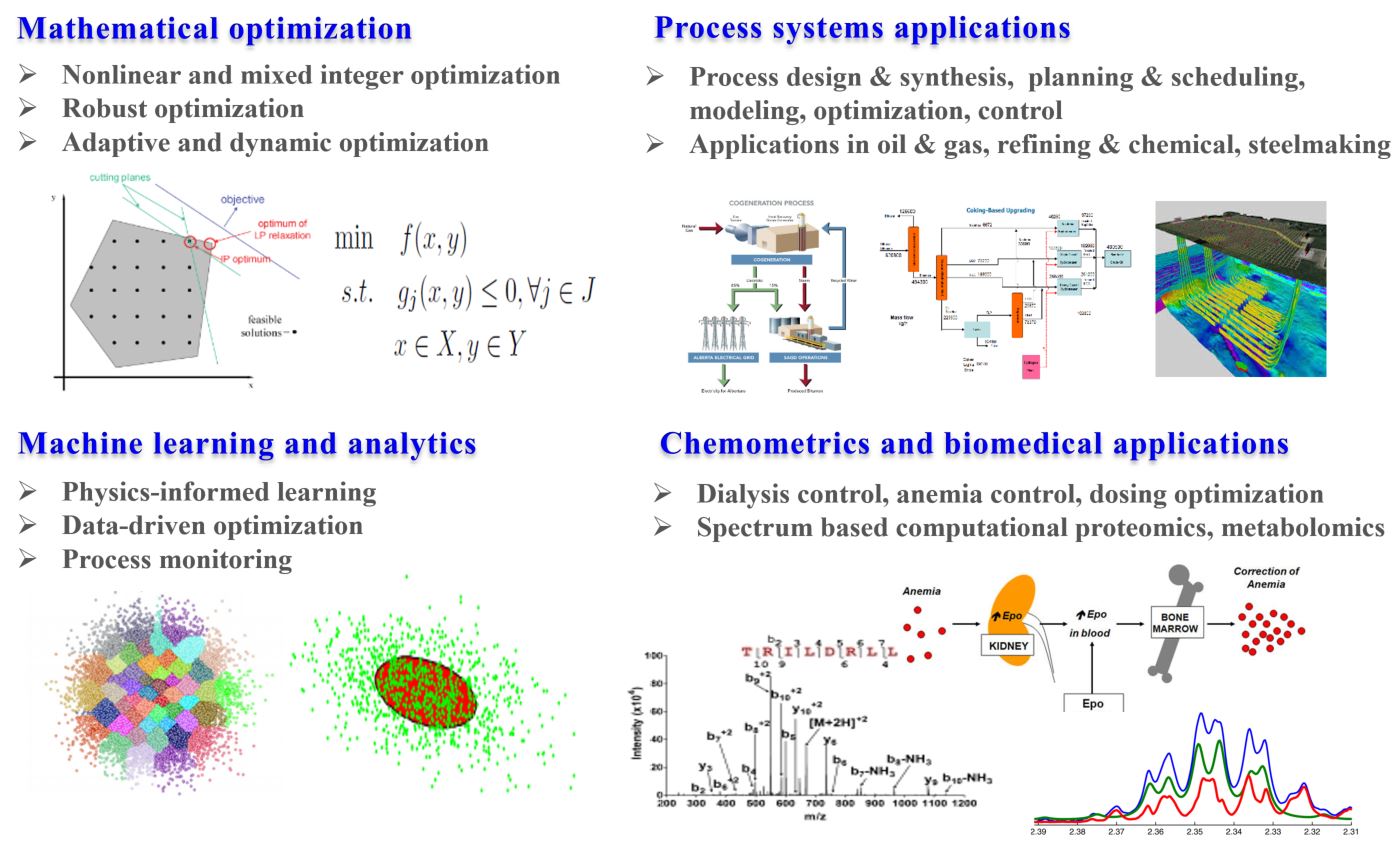
Zukui Li is a Professor in the Department of Chemical and Materials Engineering at the University of Alberta's Faculty of Engineering, where he leads a research group focused on mathematical optimization, machine learning, and process systems engineering. His work spans oil sands extraction, steel production, biomedical applications, and advanced optimization methods. Education: Ph.D. in Chemical Engineering, Rutgers University (2010) M.Sc. in Control Theory and Control Engineering, University of Science and Technology of China (2005) B.Sc. in Automatic Control, University of Science and Technology of China (2002) Postdoctoral Training: Princeton University (2010-2012) Research Focus: Dr. Li's research integrates mathematical optimization and machine learning for complex process systems. His primary areas include: Advanced optimization techniques (robust, stochastic, and distributionally robust optimization) Machine learning applications in process monitoring and biomedical systems Industrial applications in energy, manufacturing, and resource extraction Specific innovations include physics-informed ML for anemia treatment, adaptive optimization for steel production, and distributionally robust methods for uncertainty management. Publication Trends (2019-2023): Recent articles demonstrate a strong focus on uncertainty-aware optimization methods, with increasing integration of machine learning techniques. Dominant themes include distributionally robust optimization, adaptive decision-making under uncertainty, neural network approximations for complex constraints, and applications in industrial process control and biomedical systems. Theoretical advancements are consistently coupled with practical implementations in energy and manufacturing sectors. Research Group: Leads an active team developing optimization frameworks and machine learning solutions for process engineering challenges. Group website: Dr. Zukui Li's Research Group