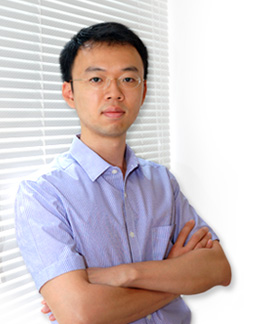
Yang Yuxiang is an Assistant Professor at the University of Hong Kong's School of Computing and Data Science. His research focuses on software security, adversarial machine learning, and AI safety, with a particular emphasis on formal methods and large language models. He holds a PhD from Hong Kong. Research interests include: Automated program repair using LLMs Cybersecurity in open-source ecosystems Adversarial attacks on vision-language models Formal verification of theorem provers Ethical implications of AI systems Recent publications explore cutting-edge topics such as causality-aware safety testing for autonomous systems , smart contract vulnerability detection , and large model safety at scale . His work bridges theoretical foundations with practical applications in secure software development and AI ethics.
Shiqi Wang is an Associate Professor in the Department of Computer Science at City University of Hong Kong. He holds a Ph.D. from Peking University (2014) and a B.Sc. from Harbin Institute of Technology (2008). His career includes postdoctoral and research roles at the University of Waterloo, Nanyang Technological University, and Microsoft Research Asia. He specializes in semantic/visual communication, AI content management, and image/video quality assessment. Education: Ph.D. in Computer Application Technology (2014), Peking University B.Sc. in Computer Science and Technology (2008), Harbin Institute of Technology Research focuses on Large Visual-Language Models (LVLMs) , Generative Face Video Coding , and Information Forensics . Recent work includes video coding innovations, AI-driven quality assessment, and bias mitigation in facial analysis. Awards include the IEEE Multimedia Rising Star Award (2021) , NSFC Excellent Young Scientist Fund (2020) , and multiple best paper awards at IEEE conferences. He serves as Associate Editor for IEEE Transactions on Image Processing and leads MPEG standardization efforts for generative video coding. Professional activities include TPC roles at ICML, CVPR, and ACM Multimedia. His lab actively collaborates on standards for generative AI and multimedia systems, with a focus on ethical AI and cross-domain applications.
Chen Wang is an Assistant Professor in the Department of Statistics and Actuarial Science at The University of Hong Kong. He holds a PhD in Statistics from the National University of Singapore (NUS). His research focuses on Random Matrix Theory, Time Series Analysis, and High-dimensional Data Analysis. His work explores theoretical foundations and applications in econometrics, multivariate statistics, and high-dimensional inference. Key contributions include studies on spurious factor analysis, spectral distribution of time series, and cointegration analysis in large VARs. His teaching includes courses such as STAT2602 (Probability and Statistics II) and STAT3600 (Linear Statistical Analysis). Recent publications highlight advancements in AI-driven methodologies for single-cell biology, molecular modeling, and biomedical applications. Notable trends include integrating AI agents for experimental design, spatial biology analysis, and deep learning for medical imaging. Chen's work bridges statistical theory with practical applications, emphasizing high-dimensional data challenges in diverse scientific domains.
Ken M. L. Yiu is a Professor in the Department of Computing at Hong Kong Polytechnic University , Faculty of Engineering. He received his PhD and Bachelor's degree from the University of Hong Kong in 2006 and 2002, respectively, and was previously affiliated with Aalborg University (2006–2009). He is a leading researcher in databases, with a focus on spatiotemporal data, query processing, and multidimensional data management. PhD, University of Hong Kong (2006) Bachelor of Computer Engineering, University of Hong Kong (2002) His research interests lie at the intersection of database systems and spatial analytics. He investigates efficient indexing, query optimization, and privacy-preserving techniques for large-scale spatial and temporal datasets. His recent work explores learned index structures, GPU-accelerated query processing, and high-dimensional data retrieval. He has made significant contributions to spatial query processing, trajectory analytics, and location-based services. The trends in his recent publications (2021–2025) reflect a strong focus on high-performance database systems, including GPU acceleration (GHive), perfect hashing on GPUs (GPH), and learned cardinality estimation. His work increasingly integrates machine learning with traditional database techniques, as seen in AlayaDB for LLM inference and learning-based query optimization. He also continues to advance core database problems such as spatial indexing, trajectory analysis, and similarity search. SSTD 2025 10-Year Impact Award Ken Yiu has successfully led multiple competitive research projects funded by the Hong Kong GRF, including grants on learned index structures (2024–2026), smart memory for vector data mining (2021–2023), and efficient spatial data management (2017–2019). He has supervised numerous PhD and MPhil students, many of whom now hold academic positions (e.g., Bo Tang at SUSTech, Yu Li at HDU) or work in top tech companies (e.g., Huawei, Alibaba). His professional service is extensive, including roles as PI for major grants, area chair (ICDE 2024), and program committee member for top conferences like SIGMOD, VLDB, and ICDE. He is actively involved in research groups and projects related to database systems, particularly in spatiotemporal data management and efficient query processing. His lab collaborates closely with students and co-supervisors like Bo Tang on topics such as trajectory mining, spatial indexing, and learned databases. The research group maintains strong ties with international institutions and contributes to major open problems in database performance and scalability.
Professor Francis C.M. Lau is a Professor at the University of Hong Kong's School of Computing and Data Science, within the Department of Computer Science. He holds an honorary professorship and has contributed extensively to academia through editorial roles and international society involvement, including pioneering the IEEE Computer Society's Distinguished Visitors Program for Asia/Pacific in 1993. His educational background includes a BSc from Acadia University and MMath/PhD from the University of Waterloo. Professor Lau's research focuses on parallel/distributed computing, wireless networks, operating systems, and computer music, with notable publications in journals like Theoretical Computer Science and Ad Hoc Networks . He has led major research grants, including a $7.5M HKU UGC Special Equipment Grant for interdisciplinary systems research. His awards include the IEEE Golden Core Recognition (1998) and the IEEE Third Millennium Medal (2000). He has served on key committees such as the Research Grant Council's engineering panel and Hong Kong Institution of Engineers' accreditation committee. His work bridges theoretical computer science with practical applications in networking, cloud computing, and cultural heritage through computational approaches to art.
Dr. Anthony T.C. Tam is a Lecturer and Academic Advisor at the School of Computing and Data Science, University of Hong Kong. He holds a BSc (First Class Honors) from Asia International Open University (formerly EAOI), MAppSc from Queensland University of Technology (Australia), and a PhD in Computer Science from HKU (2002). His research focuses on cluster computing, parallel computing, high-speed communication systems, and operating system performance analysis. Over his career, he has been recognized as an outstanding tutor for three consecutive years. His research emphasizes optimizing communication protocols and scheduling algorithms in distributed systems. Recent work includes studies on contention-aware scheduling, gigabit Ethernet-based supercomputing, and realistic communication modeling for clusters. He has contributed to both academic journals and international conferences on parallel and distributed computing systems. Dr. Tam actively advises students in computer science programs and participates in curriculum development. His technical expertise is showcased through his homepage (https://www.cs.hku.hk/~atctam) and publications accessible via institutional repositories. No scientific awards are explicitly mentioned in the provided information.
Professor David Wai-lok Cheung is a Professor in the Department of Computer Science at the University of Hong Kong (HKU) and Director of the Center for E-commerce Infrastructure Development (CECID). He holds a BSc in Mathematics from the Chinese University of Hong Kong and MSc/PhD in Computer Science from Simon Fraser University, Canada. His research focuses on database systems, data mining, e-commerce technologies, and secure computation. Key contributions include pioneering work on privacy-preserving data mining, XML schema design, and e-commerce infrastructure development. He has led numerous prestigious grants totaling over HK$60M and developed widely adopted open-source tools like the ebXML gateway. Professor Cheung has received awards such as the HKU Outstanding Researcher Award (1999) and the Distinguished Contribution Award (2009 PAKDD). He actively contributes to academia through leadership roles in conferences like PAKDD and CIKM. His research spans secure computation, data interoperability, and bioinformatics, with over 150 publications in top venues like SIGMOD, VLDB, and KDD. **Grants & Funding**: Highlighted grants include HK$6.6M for eLogistics Appliance (2007-2008) and HK$9.198M for a service-oriented e-transaction platform (2006-2008). **Publications**: Over 150 papers in areas like privacy-preserving data mining, XML query processing, and spatiotemporal data analysis. **Service**: Member of RGC Engineering Panel, Hong Kong Deposit Protection Scheme board, and Certification Board for IT Professional Certification.
Dr. Kam Pui Chow is an Associate Professor and Associate Director of the Center for Information Security and Cryptography (CISC) at the University of Hong Kong's Department of Computer Science and Information Systems. He holds an MA and PhD from the University of California, Santa Barbara. His academic career began post-doctorate with contributions to establishing HARNET, Hong Kong's first academic research network. His research spans expert systems, Chinese computing, and later shifted to computer forensics, digital investigations, and cybersecurity. He leads the Computer Forensics Research Group (CFRG) and designed tools like the bilingual Digital Evidence Search Kit (DESK) and Lineament systems for piracy monitoring. Dr. Chow has been involved in over 30 publications, including best paper awards in 2008/2011, and serves on committees for digital forensics conferences and societies. Education: MA and PhD from UC Santa Barbara. Research Interests: Digital forensics, computer security, cryptography, and data privacy. His work includes forensic tool development, Bayesian models for evidence analysis, and live system forensics. He contributed to Hong Kong's Customs systems and provided expert testimony in legal cases involving digital evidence. Professional Roles: Associate Programme Director for the MSc in E-Commerce and Internet Computing, instructor for courses on e-Crime and digital forensics, and chairman of the Information Security and Forensics Society (Hong Kong). He has advised law enforcement and provided consultancy on distributed computing and software quality assurance. Awards: Notable recognition includes best paper awards for research on forensic reasoning and privacy-preserving investigations.
Dr. Heming Cui is an Associate Professor at the Department of Computer Science, University of Hong Kong, affiliated with the School of Computing and Data Science. He joined HKU in 2015 after completing his PhD at Columbia University, following bachelor's and master's degrees from Tsinghua University. His research focuses on distributed systems, operating systems, and high-performance computing, with a strong emphasis on reliability and security. Dr. Cui leads projects in distributed AI training systems, blockchain frameworks, and secure execution environments, collaborating closely with industries like Huawei. He has received notable awards including the Croucher Innovation Award (2016), HK$5 million RGC Research Impact Fund (2023), and best paper awards at ICSE and ACSAC. His work has led to commercialized systems such as Huawei's MindSpore integration of Fold3D and TICS' UTEE component derived from his secure systems research. Dr. Cui actively recruits PhD students specializing in systems security and database systems, prioritizing candidates with strong systems-building backgrounds. Key grants include leadership in projects totaling HK$30 million, including flagship collaborations with Huawei and RGC grants targeting transaction/analytical processing in edge computing and cloud security. His research spans over 50 publications in top venues like SOSP, NSDI, and IEEE journals, emphasizing reproducibility and industrial impact.
Dr. Qi Zhao is a Tenure-Track Assistant Professor in the Department of Computer Science at the University of Hong Kong (HKU). His research focuses on quantum information science, including quantum simulations, quantum computing, quantum resource theories, and self-testing quantum information. He holds a PhD from Tsinghua University (2018) and postdoctoral experience at the University of Science and Technology of China and the University of Maryland's QuICS as a Hartree Fellow. His work bridges theoretical advancements and experimental applications, with contributions to quantum algorithms, entanglement detection, and device-independent protocols. Key research interests include Hamiltonian simulation optimizations, quantum resource theory frameworks, and robust self-testing methodologies. Notable achievements include the 'Innovators Under 35 Asia Pacific 2024' recognition by MIT Technology Review and significant grants such as the 2030 National Science and Technology Major Project of China. His team explores quantum differential equation solvers, entanglement acceleration in simulations, and practical quantum algorithm implementations. Dr. Zhao advises a growing team of PhD and MPhil students, focusing on quantum computing and information theory. His research has led to publications in top journals like Nature Physics , Physical Review Letters , and Communications in Mathematical Physics . Current projects include developing efficient quantum algorithms for scientific computation and exploring the theoretical limits of quantum simulation techniques.
Dr. Xiaojuan Qi is an Assistant Professor in the Department of Electrical and Electronic Engineering at The University of Hong Kong. Her research focuses on 3D vision, deep learning, and AI applications in medical imaging and science. She holds memberships in IEEE and CCF. Education: PhD, The Chinese University of Hong Kong (2018) BEng, Shanghai Jiao Tong University (2014) Postdoctoral Researcher, University of Oxford (prior to HKU) Research Interests: Dr. Qi develops scalable deep learning algorithms for medical and natural image analysis, 3D scene understanding, and neural network behavior in out-of-distribution scenarios. Her work emphasizes label efficiency, geometric reasoning, and cross-modal integration. Lab Contributions: As head of the Computer Vision and Machine Intelligence Lab (CVMI Lab), she explores open-world intelligence, 3D reconstruction, and AI applications in robotics, autonomous systems, and healthcare. Recent lab highlights include 10+ ICCV/CVPR/NeurIPS papers in 2023-2025. Awards: ImageNet Semantic Parsing Challenge (1st Place) Outstanding Reviewer Awards (ICCV 2017/2019) CVPR Doctoral Consortium Travel Award Advising & Grants: Supervises ~20 PhD students (listed in detail). Active in securing grants for embodied AI, medical imaging, and edge computing hardware. Lab Collaborations: Focuses on interdisciplinary projects with Intel, Oxford, and Toronto groups, emphasizing 3D vision, neuromorphic computing, and AI-driven medical solutions.
Dr. Edith Cheuk Han Ngai is an Associate Professor in the Department of Electrical and Electronic Engineering at the University of Hong Kong (HKU), where she has been since 2020. Previously, she held an Associate Professor position at Uppsala University, Sweden. Her research focuses on Internet-of-Things (IoT), edge intelligence, data analytics, machine learning, network security, smart cities, and health informatics. She is an ACM Senior Member, IEEE Senior Member, and IEEE ComSoc Distinguished Lecturer (2023-2024). Her research contributions include the Green IoT project in Sweden (2014–2017), recognized in IVA’s 100-list (2020). She has led interdisciplinary projects like the Smart Water Auditing initiative, combining IoT and machine learning to address water conservation. Ngai has received awards such as the VINNMER Fellowship (2009) and a Meta Policy Research Award (2022). Her work on energy-aware edge computing and federated learning has been widely cited, ranking her in the top 1% globally by Clarivate Analytics (2021–2023). Ngai serves as an Associate Editor for multiple prestigious journals, including IEEE Transactions on Mobile Computing and IEEE Transactions on Industrial Informatics. She has organized conferences like IEEE GreenCom 2022 and IEEE IWQoS 2024. Her lab, the HKU IoT Lab, explores AI-driven smart systems, edge general intelligence, and healthcare applications. Recent work includes Radio2Text (mmWave-based speech recognition) and HealthPrism (multimodal health analytics). Ngai advises a dynamic research group with postdocs and PhD students focused on federated learning, edge computing, and wearable health sensing. Notable students include Zhihan Jiang (HKU Foundation PhD Award 2024) and Sukanya Jewsakul (BuildSys 2024 Best Paper Candidate). She collaborates with institutions like the HKU Center for Water Technology and Policy on projects like smart water auditing and health informatics.
Professor Hubert T.H. Chan is an Associate Professor at the Department of Computer Science, University of Hong Kong, and serves as Programme Director for the BEng(CompSc) programme. He holds a PhD from Carnegie Mellon University (2007) and previously worked as a postdoc at Max-Planck-Institut für Informatik in Germany. His research focuses on algorithms, combinatorial optimization, discrete metric spaces, and security & privacy, with applications in graph theory, network analysis, and privacy-preserving mechanisms. Education: PhD in Computer Science, Carnegie Mellon University, 2007 BEng (Computer Science), details not specified in text Research interests emphasize algorithmic design for dynamic systems, privacy in data aggregation, and efficient optimization techniques. His work bridges theoretical computer science with practical applications in network security and distributed systems. Key grants include Hong Kong RGC-funded projects on oblivious data structures, spectral hypergraph analysis, and dynamic metric problems (2012–2018). His publications span top conferences like SODA, FOCS, WWW, and ICML, addressing challenges in clustering, sorting, privacy, and graph decomposition. He oversees research groups exploring hypergraph learning, secure computation, and algorithmic privacy. His lab's work often intersects with real-world systems, emphasizing both theoretical rigor and practical relevance.
Hubert Tsz-Hong Chan is an Associate Professor in the Department of Computer Science, School of Computing and Data Science at The University of Hong Kong. He earned his PhD in 2007 from Carnegie Mellon University under the supervision of Anupam Gupta, followed by post-doctoral research at the Max-Planck-Institut für Informatik (2007-2009). Education PhD in Computer Science, Carnegie Mellon University, 2007 Research Interests Dr Chan's research lies at the intersection of algorithms , combinatorial optimisation , discrete metric spaces , and security & privacy . A recurring theme is the design of provably efficient approximation algorithms for geometric and graph-theoretic problems under realistic or adversarial settings. Representative contributions include polynomial-time approximation schemes (PTAS) for TSP and Steiner Forest in doubling metrics, spectral analysis of hypergraph Laplacians, and foundational work on differential obliviousness and oblivious RAM. Publications & Trends With more than 80 peer-reviewed papers in premier venues such as JACM , SIAM Journal on Computing , Algorithmica , FOCS , SODA , EUROCRYPT , ASIACRYPT , CCS , and WWW , his recent output (2018-2021) demonstrates a shift toward privacy-preserving algorithms, differential obliviousness, and socially-aware optimisation models, often combining rigorous theory with practical datasets like Netflix and Twitter. Scientific Awards IPDPS 2019 Best Paper Award WWW 2018 Honorable Mention Students & Mentoring Dr Chan has successfully graduated 17 PhD and MPhil students and currently mentors 7 PhD candidates and 1 MPhil student. His graduates have secured academic and industry positions worldwide, and their theses frequently build on his funded projects. Research Funding & Labs Since 2012 he has been Principal Investigator on 12 competitive grants from the Hong Kong Research Grants Council (RGC), totalling more than HK$8 million, spanning topics from privacy-preserving aggregation to Byzantine-resilient federated learning. While no dedicated laboratory name is advertised, his group operates within the Security & Privacy and Algorithms Labs in the Department of Computer Science.
The Chinese University of Hong Kong (CUHK)Hong Kong SAR
Prof. Cai Zhenguang is a Professor in the Department of Linguistics and Modern Languages at The Chinese University of Hong Kong (CUHK), where he leads the Language Processing Lab affiliated with the Brain and Mind Institute. His research integrates behavioral, neuroscientific, and computational approaches to investigate language processing mechanisms. His educational background includes a PhD in Psychology from the University of Edinburgh. Prior to joining CUHK, he served as a lecturer at the University of East Anglia and held an ESRC Future Research Leader fellowship at University College London. Prof. Cai's research centers on psycholinguistics and cognitive neuroscience of language, with specific focus on language comprehension, production, and learning mechanisms. His lab investigates how interlocutors influence language processing, Chinese handwriting literacy including character amnesia, and whether large language models exhibit human-like language behaviors. Additional interests include psychophysics of magnitude perception where physical dimensions interact statistically. Recent publications (2024-2025) reveal strong trends in neural correlates of speaker-contextualized comprehension, computational modeling of language adaptation, and AI-human language comparisons - particularly in Chinese language phenomena. Key methodological approaches combine ERP/fNIRS neuroimaging with Bayesian modeling and deep learning techniques. Scientific recognition includes: ESRC Future Research Leader fellowship He has successfully advised multiple PhD students including Zebo Xu, Hanlin Wu, and Xufeng Duan, along with MA students like Tianyi and Yufeng Wu. His research is supported by significant grants: two General Research Fund projects as Principal Investigator (on character amnesia and interlocutor modeling), an Academic Equipment Grant for TMS-EEG systems, and a teaching grant for virtual behavioral research methodologies. The Language Processing Lab maintains active collaborations across disciplines, having organized major conferences including AMLaP Asia and CogSci Hong Kong Meetup, while recruiting researchers with expertise in fMRI, Bayesian modeling, and machine learning for ongoing projects.