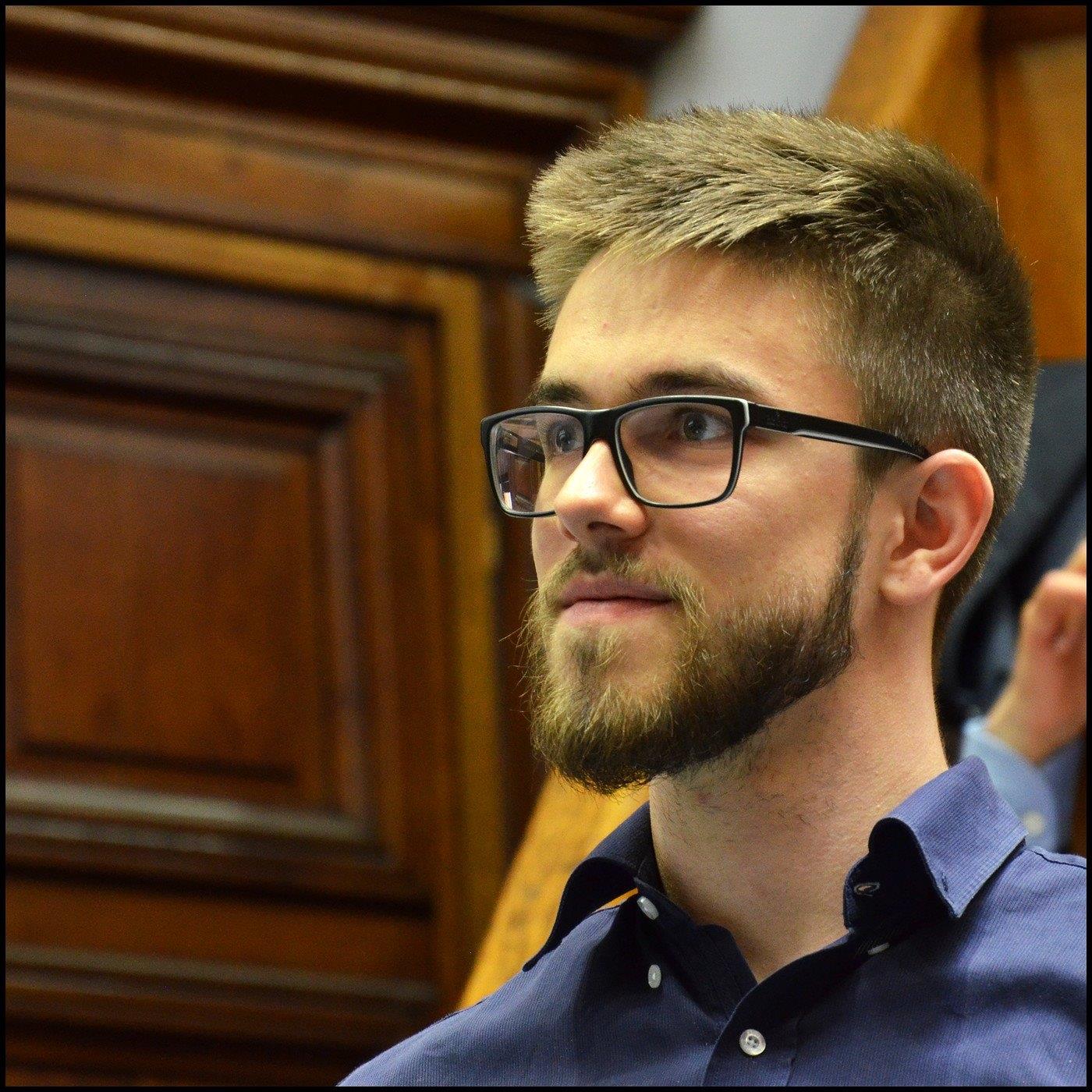
Prof. Oleg Ivrii is a Senior Lecturer in the Department of Theoretical Mathematics at Tel Aviv University's Faculty of Exact Sciences. He earned a B.Sc. in Mathematics from the University of Toronto (2009) and a Ph.D. in Mathematics from Harvard University (2014). Following postdoctoral research positions at the University of Helsinki (2014-2016) and California Institute of Technology (2016-2019), he joined Tel Aviv University in 2019. Research Focus: Complex analysis, conformal geometry, thermodynamic formalism, and geometric function theory. Key Contributions: Studies on analytic mappings of the unit disk, inner functions, quasiconformal homogenization, and Makarov's principle. His work explores critical structures of inner functions, stable convergence, and applications to dynamical systems. He has advised Emanuel Sygal (Master's thesis) and collaborated with Artur Nicolau, Mariusz Urbański, and Vladimir Marković. Ivrii's publications appear in journals like Inventiones Mathematicae , Journal of Differential Geometry , and Analysis & PDE .
Hansjörg Dilger is Professor of Social and Cultural Anthropology at Freie Universität Berlin, where he serves as Director of the Collaborative Research Centre 1171 'Affective Societies,' Deputy Head of the Institute of Social and Cultural Anthropology, and Head of the Research Area Medical Anthropology I Global Health. He is also Co-Coordinator of the DFG-Funded Scientific Network 'Public Anthropology.' His academic career spans positions at the University of Florida and extensive research in Eastern and Southern Africa, particularly Tanzania and South Africa. Professor of Social and Cultural Anthropology (since 2013) Director of Collaborative Research Centre 1171 'Affective Societies' (since 2022) Co-Coordinator of DFG Network 'Public Anthropology' (since 2022) Former Vice Dean for Research at the Department of Political and Social Sciences (2019-2021) Former President of the German Anthropological Association (2015-2019) Dilger's research focuses on how people negotiate notions of a 'good life' during social, economic, and political transformations. His work integrates critical medical anthropology, anthropology of religion, ethics and morality, political anthropology, and anthropology of affect and emotion. He examines the multilayered conflicts and emerging relations involved in social differentiation within urbanization, mediatization, and global connectivity, with particular attention to postcolonial inequalities. His recent publications reveal a strong trajectory toward decolonial approaches, affective studies, and critical examinations of global health. The 15 most recent articles show increasing interdisciplinary engagement with museum studies, collaborative knowledge production, and the intersection of care, migration, and racialization in health contexts. His work consistently addresses power dynamics in knowledge production and the ethical responsibilities of anthropological research. Margherita-von-Brentano award for 'Female Refugees in Berlin' research collective (2017) Senior Fellow of Bayreuth International Graduate School of African Studies (2010-13) Multiple DFG-funded research projects on religion, health, and migration Extensive editorial work including special issues on medical anthropology and religion Dilger has supervised numerous PhD students, with completed projects examining religious conversion in Uganda, zakat distribution in Nigeria, gender in Pakistan, and violence in the Philippines. Current supervision includes research on education in Egypt, Gülen movement housing, schooling in Kenya, Islamic medicine in Turkey, and religious spatial contestation in Nigeria. His recent work shows growing engagement with decolonial debates around ethnographic collections and collaborative research approaches.
Klaus Stein is a part-time lecturer at the Chair of Heritage Conservation , Otto-Friedrich University of Bamberg. His work bridges digital technologies , spatial modeling , and cultural heritage through interdisciplinary research projects. Co-leader of the UrbanMetaMapping project (BMBF-funded) analyzing WWII war damage maps Developed KTF (Wiki-based terminology framework) for SMEs Contributed to COM (Communication-Oriented Modeling) DFG research network Active in EMN-MOVES project for age-friendly mobility solutions His research focuses on digital heritage , social network analysis , and collaborative GIS , with over 20 years of publications in spatial cognition and information systems . While his primary role involves teaching in the Master's program in Digital Heritage Technologies , he also contributes to open-source GIS and web mining methodologies. Key projects include: Find Diversity (BioDiv2Go): Promoting biodiversity awareness via location-based games Virtual Spaces : Digital reconstruction of historical church color schemes
Matthias Keicher is a Postdoc and Research Manager at the Chair for Computer Aided Medical Procedures at the Technical University of Munich , affiliated with the IFL Lab at Klinikum Rechts der Isar. His work focuses on deploying AI for clinical applications, particularly vision-language models and large language models for structured report generation and decision support systems. Education: Dipl.-Ing. in Mechanical Engineering and Management from TUM (2006-2013) Industry Experience: Former CTO and Managing Director at SurgicEye GmbH (2016-2018) Research Interests: Medical Vision-Language Models (VQA, structured reporting) Multimodal Deep Learning for diagnostics Interpretable AI with generative models Decision support systems integrating patient data Article Trends: Over 2024-2014, his publications span surgical phase recognition (TeCNO), vertebral fracture grading (iMIMIC best paper), chest X-ray classification (FlexR), radiology report generation (RaDialog), and toxin prediction (ToxNet). Keywords include Medical Imaging, Graph Networks, Language Models , with subfields like 3D Computer Vision, Federated Learning, Clinical Reasoning . Scientific Awards: MICCAI iMIMIC 2023 Best Paper Teaching: He organizes two lectures ( Computer Science for Medical Students , Innovation Generation in Healthcare ) and tutors courses such as Deep Learning for Medical Applications and Machine Learning in Medical Imaging . Labs & Teams: Works at the IFL Lab (Intelligent Future Lab) in Munich, leading a research team funded by the DIVA project focused on vision-language models in clinical settings.
Prof. Dr. Gerrit Höfker has been Professor of Building Physics at Bochum University of Applied Sciences since 2003, within the Department of Civil and Environmental Engineering. He teaches Building Physics, Fire Protection, Building Climatology, and Room Acoustics at Bachelor and Master levels, focusing on practical applications for residential and commercial buildings. His academic journey began with vocational training as a central heating and ventilation engineer (1987-1990) and paramedic (1990-1991). He then earned a Diploma in Building Physics from Stuttgart University of Applied Sciences (1991-1996) and a doctorate from De Montfort University Leicester (2001) on sorption-assisted building cooling with solar energy. Prof. Höfker's research priorities include thermal building simulation, urban climate adaptation, and thermal/auditory comfort. His work in room acoustics focuses on planning spaces with demanding acoustic requirements, while his thermal research addresses energy-efficient building design across diverse climate zones. He employs advanced simulation tools like EnergyPlus and IDAIce for thermal analysis and ray tracing for complex room acoustics. His publications from 2009-2017 show a consistent focus on building acoustics (nearly half) and thermal comfort. Notable trends include 3D visualization for energy systems, non-auditory noise effects in offices, and bottom-up models for urban energy demand. His research increasingly connects building physics with urban climate challenges. Prof. Höfker is actively involved in the Building Physics Laboratory at Bochum University of Applied Sciences, where he oversees teaching laboratories for heat transport, water vapor diffusion, and acoustics calculations. The lab supports both educational activities and applied research in building physics.
Bin Gao is an Associate Professor at the Academy of Mathematics and Systems Science (AMSS), Chinese Academy of Sciences. He holds a Ph.D. in Applied Mathematics (2019, University of Chinese Academy of Sciences) and a B.Sc. in Mathematics (2014, Sichuan University). His postdoctoral experience includes positions at UCLouvain (2019-2021) and the University of Münster (2021-2022). Research Interests: Riemannian optimization, tensor computation, parallel/distributed algorithms for orthogonality constraints, machine learning applications. Key Contributions: Development of retraction-free methods on Stiefel manifolds, preconditioned Riemannian algorithms, and geometric frameworks for symplectic eigenvalue problems. Article Trends: Recent work focuses on overcoming the curse of dimensionality via manifold-based optimization, including distributed algorithms for Stiefel manifolds, graph-regularized tensor completion, and second-order methods for symplectic structures. Keywords span numerical analysis, quantum information, and machine learning. Scientific Awards: 2021 Zhong Jiaqing Mathematics Award 2018 Best Student Paper Award (CSIAM) 2018 CAS Special President Scholarship 2017 National Scholarship for Doctoral Students (China) 2016 Honor Student Award (International Workshop on Modern Optimization and Application) Advising & Collaborations: Collaborates with researchers from UCLouvain, University of Münster, and AMSS. Mentors students in Riemannian optimization and tensor computation. Leads the popman research group.
Dirk Müller is a Professor of Software Technology/Operating Systems at the Faculty of Computer Science/Mathematics, Dresden University of Applied Sciences (HTW Dresden). He has been in this position since 2016 and is an active member of the Faculty Council since June 2021. He was awarded IEEE Senior Member status in April 2023. His academic journey includes a doctorate in Engineering from the University of Kassel in 2006, habilitation at Chemnitz University of Technology in 2014, and prior research positions at Philipps University of Marburg and Florida State University. 1995-2002: Studies in Medical Informatics at University of Leipzig 2003-2006: Research Assistant/Doctoral Student at University of Kassel 2006-2008: Research Associate at Philipps University of Marburg 2008-2014: Academic Councillor at Chemnitz University of Technology 2014-2016: Private Lecturer at TU Chemnitz 2016-present: Professor at HTW Dresden Professor Müller's research focuses on real-time systems and scheduling, model-driven software development, digitalization in companies and administration, and the concept of information. His work particularly emphasizes Rust language applications in software engineering. He has published extensively on real-time scheduling algorithms, mixed-criticality systems, and embedded systems. His teaching responsibilities include Operating Systems I, Software Engineering I & II, Model-Driven Software Development, and Programming in Rust. His publication record shows a consistent focus on real-time systems, with a clear progression from theoretical scheduling algorithms to practical implementations. His recent work has expanded into public administration digitization and biometric conference systems, while maintaining his core expertise in scheduling theory. The publications demonstrate strong international collaboration, particularly with researchers like Matthias Werner, Alejandro Masrur, and Robert Baumgartl. IEEE Senior Member (2023) Erdős number: max. 4 Strict Erdős number: max. 5 Professor Müller actively supervises student theses, with over a dozen bachelor's and diploma theses completed between 2023-2025. His students work on diverse topics including Rust programming, workflow automation, user experience optimization, and real-time event processing. He serves as a reviewer for multiple prestigious journals including IEEE Transactions on Parallel and Distributed Systems, Real-Time Systems, and The Computer Journal. He also acts as Senior Editor for Computer Science Books at Versita. His laboratory work focuses on practical implementations of real-time systems, often using Raspberry Pi as a platform for traffic analysis and other embedded applications. His research group maintains strong connections with industry, as evidenced by the applied nature of student projects at companies like IntraConnect GmbH.
Prof. Dr.-Ing. Sebastian Esser serves as Group Lead for Information Management at the Chair of Computing in Civil and Building Engineering at Technical University of Munich. His research focuses on advancing Building Information Modeling (BIM) methodologies, particularly in infrastructure and railway applications. He contributes significantly to international standardization efforts including IFC-Road and IFC-Rail projects, and leads research initiatives such as RIMcomb and BauPuls360. Dr. Esser's research spans several critical areas in digital construction: Graph-based version control systems for BIM collaboration Digital twin development for infrastructure management Semantic modeling of built environments BIM-based regulation checking for railway infrastructure Interdisciplinary model coordination techniques Knowledge representation in civil engineering His work bridges theoretical computer science with practical civil engineering applications, focusing on improving data interoperability and workflow efficiency in construction projects. Analysis of his recent publications reveals a strong emphasis on graph-based approaches to BIM challenges. His research has evolved from foundational work on BIM programming interfaces to sophisticated implementations involving knowledge graphs, semantic reasoning, and digital twin architectures. Key trends include increasing integration of semantic web technologies with BIM standards, development of specialized query interfaces like GraphQL for construction data, and application of formal methods to infrastructure modeling problems. Dr. Esser actively supervises numerous bachelor's and master's theses annually, with recent topics covering graph-based entity alignment, BIM-GIS integration for flood assessment, incremental model updates, and digital twin implementations. His teaching portfolio includes courses such as Bau- und Umweltinformatik, BIM.fundamentals, BIM.infra, and Semantic Modeling of the Built World, demonstrating his commitment to educating the next generation of digital construction professionals. He is involved in multiple research initiatives including DFG FOR 5672 (The information backbone of robotized construction), SPP 2187 (Adaptive modularized constructions), and AM2PM (Additive to Predictive Manufacturing). His laboratory work spans the BIM-Lab and related computational infrastructure supporting his research in digital construction technologies.
Prof. Dr.-Ing. Alberto Moreira is the Director of the Microwaves and Radar Institute at the German Aerospace Center (DLR) and a Full Professor in Microwave Remote Sensing at Karlsruhe Institute of Technology (KIT) . He leads pioneering work in synthetic aperture radar (SAR) systems, including the TanDEM-X and TerraSAR-X missions. Born in São José dos Campos, Brazil B.Sc./M.Sc. in Electrical Engineering (Aeronautical Technological Institute, 1984/1986) Ph.D. (summa cum laude, Technical University of Munich, 1993) Research Focus : Innovative SAR system design (polarimetric interferometry, tomography) Digital beamforming and multi-static radar architectures Global Earth observation through TanDEM-X and Tandem-L missions Quantum annealing applications in SAR processing Planetary radar systems for Venus exploration (EnVision, VERITAS) Scientific Impact : Author/co-author of >500 peer-reviewed publications H-index: 66 (Google Scholar) Holder of >40 patents in radar and antenna technology Awards & Leadership : IEEE Dennis J. Picard Medal (2023) IEEE GRSS Distinguished Achievement Award (2014) President of IEEE GRSS (2010) Founding Chair of IEEE GRSS German Chapter Principal Investigator for Helmholtz Alliance Earth System Dynamics (2012-2018) Collaborations : Works with ETH Zurich, TU Delft, and ESA on missions like Sentinel-1, BIOMASS, Harmony, and VERITAS. His institute develops cutting-edge technologies for spaceborne SAR systems.
Dr. Ute Daewel is a Researcher at the Helmholtz-Zentrum Hereon , focusing on marine ecosystem modeling and biogeochemical data assimilation . She leads or co-leads major projects including CoastalFutures , RETAKE II , ECOTWIN , and NECCTON , with recent work emphasizing parameter estimation in coupled physical-biological ocean models.
Gregorio Baldi is a Research Fellow (Chargé de Recherche) at the French National Center for Scientific Research (CNRS), affiliated with the Institut de Mathématiques de Jussieu - Paris Rive gauche. His research centers on Arithmetic Geometry , with expertise in Shimura varieties, variational Hodge theory, and the Zilber-Pink conjecture. He also investigates connections between homogeneous dynamics, Teichmüller dynamics, and geometric Diophantine problems. Baldi has authored significant publications in premier mathematical journals, including: Annals of Mathematics (2023, 2025) Inventiones mathematicae (2024) Ergodic Theory and Dynamical Systems (2025) His recent work (2023–2025) focuses on Hodge loci distribution, non-arithmetic ball quotients, and o-minimality in Hodge theory, demonstrating consistent contributions to foundational problems in geometry and number theory.
Professor Arnd Jenne serves as Professor of General Business Administration with a focus on Retail Management at the Faculty of Commerce and Social Work, Ostfalia University of Applied Sciences, Suderburg Campus since February 2011. Previously, he held a half-time substitute professorship at the Technical University of Dortmund (2008-2009). His academic background includes a doctorate from the University of Münster (2004) with research on strategic controlling in city marketing for inner-city retail, following studies in economic geography, economics, and urban planning at the University of Bayreuth (1993-1996) and preliminary studies at the University of Stuttgart (1990-1993). Professor Jenne's research focuses on retail in transit spaces (airports, train stations), spatial orientation of customers in retail environments, digitalization of stationary retail, and the future of retail in rural areas. His work bridges academic research with practical industry applications, particularly examining how digital transformation impacts traditional retail spaces and rural communities. His recent publications and research projects demonstrate a strong emphasis on practical retail challenges, with significant work on digital retail spaces (DigVerEH project), retail in German airports, and the competitive advantages small and medium enterprises can gain through community engagement like volunteer fire departments. Completed EFRE-funded project 'Digitalisierung von Verkaufsräumen im Einzelhandel' (2017-2019) Research commissioned by Niedersächsisches Ministerium für Inneres und Sport on volunteer fire departments as business advantages (2017) Analysis of retail in German airports (2015) Multiple projects on urban retail development in eastern German cities (2010-2014) Professor Jenne actively supervises bachelor's theses with a preference for topics related to digital retail, multichannel strategies, retail in transit spaces, and experimental market research methods. His industry experience since 2005 as a consultant specializing in retail, urban development, and city marketing informs his practical teaching approach and research direction. His teaching includes required modules in Retail Management, Location and Facility Management, Economic and Transport Policy, Market Research, and Multichannel Management, along with specialized electives and international excursions examining retail and logistics across European metropolitan areas, border regions, and rural communities.
Professor Dirk J. Lehmann is a Professor of Data Science in IoT at Ostfalia University of Applied Sciences, Faculty of Computer Science, where he has been employed since May 2022. He holds significant leadership roles including Deputy Head of the Institute for Information Engineering (since 2024), Research Officer of the Faculty of Computer Science (since 2023), and membership in multiple committees including the Admissions Committee for Digital Technologies and the Digital Technologies Examination Board. Professor Lehmann's extensive academic journey includes: Part-time professorship in Data Science in IoT at Ostfalia University (2020-2022) Senior Specialist for Digitalization, AI, and Visual Analysis at IAV GmbH (2018-2023) Assistant Professor of Visual Data Analysis at Nazarbayev University, Kazakhstan (2017) Visiting professorships at TU Graz, Austria and Universidad Rey Juan Carlos, Spain (2016-2017) Researcher at Otto-von-Guericke University Magdeburg (2009-2017) His research expertise centers on Visual Analytics and Data Science, with particular emphasis on high-dimensional data visualization, categorical data analysis, and IoT applications. Professor Lehmann leads the Data Science in IoT working group, conducting research across three main areas: visual data analysis, distributed data analysis using AI methods, and applied data analysis in geology, climate data, medicine, and industrial processes. His methodological contributions include innovative visualization techniques for complex datasets across multiple domains. Analysis of Professor Lehmann's 15 most recent publications (2017-2025) reveals a consistent focus on advancing visualization techniques for complex data analysis. His work spans categorical data visualization (CatNetVis), biological data analysis (D. Melanogaster research), optimization of star coordinate systems, and interactive exploration methods for large datasets. These publications appear in top venues including IEEE Transactions on Visualization and Computer Graphics and EuroVis, demonstrating both theoretical rigor and practical application across diverse domains from healthcare to environmental science. As an educator, Professor Lehmann teaches a comprehensive range of courses from foundational mathematics to advanced machine learning and visualization techniques. He actively supervises student projects and theses, emphasizing clear project definitions with measurable acceptance criteria. His international collaborations span institutions in Israel, Saudi Arabia, China, Austria, and Spain, reflecting a global research perspective that bridges academic theory with industry applications, particularly through his previous role at IAV GmbH, a Volkswagen subsidiary.
Dr. Michael Dietz is a Researcher at the Chair of Human-Centered Artificial Intelligence ( University of Augsburg , Faculty of Applied Informatics, Institute of Informatics). His work focuses on Human-Computer Interaction , Mobile Assistive Systems , and Signal Processing with Machine Learning applications. Key research trends include: Development of mobile frameworks for real-time affective feedback (SSJ Framework, SenseEmotion) Augmented reality applications for public spaces and ambient media Privacy-preserving machine learning on mobile devices Physiological signal analysis for stress detection in older adults Eye-tracking innovations for visual search detection Explainable AI techniques in facial expression recognition Projects: EmmA (Emotional mobile Avatar) Glassistant (Smart Glasses for MCI patients) SenseEmotion (Multisensorial emotion recognition) SSJ Framework (Social Signal Processing)
Martin Pohl is a Lead Scientist at DESY (Deutsches Elektronen-Synchrotron) and Professor of Theoretical Physics at the University of Potsdam. He works in the field of astroparticle physics, investigating energetic particles in the universe, their origin, interactions with their environment, and decay products. His research focuses on understanding how cosmic sources accelerate particles to very high energies, how jets and energetic particles form around supermassive black holes, and the nature of dark matter. The universe contains systems capable of accelerating particles to energies many orders of magnitude higher than human-built accelerators can achieve. Professor Pohl leads a research group in Theoretical Astroparticle Physics at both DESY in Zeuthen and the University of Potsdam. His group is involved in projects related to: TeV gamma-ray astronomy with VERITAS Science with the Cherenkov Telescope Array (CTA) Kinetic modeling of space plasma with energetic particles Development of publicly available data resources including gamma-ray production matrices and 3D models of galactic gas distribution He is also affiliated with the International Helmholtz-Weizmann Research School on Multimessenger Astronomy, providing international training in this emerging field. At the University of Potsdam, Professor Pohl teaches courses in Astroparticle Physics and supervises graduate research.