
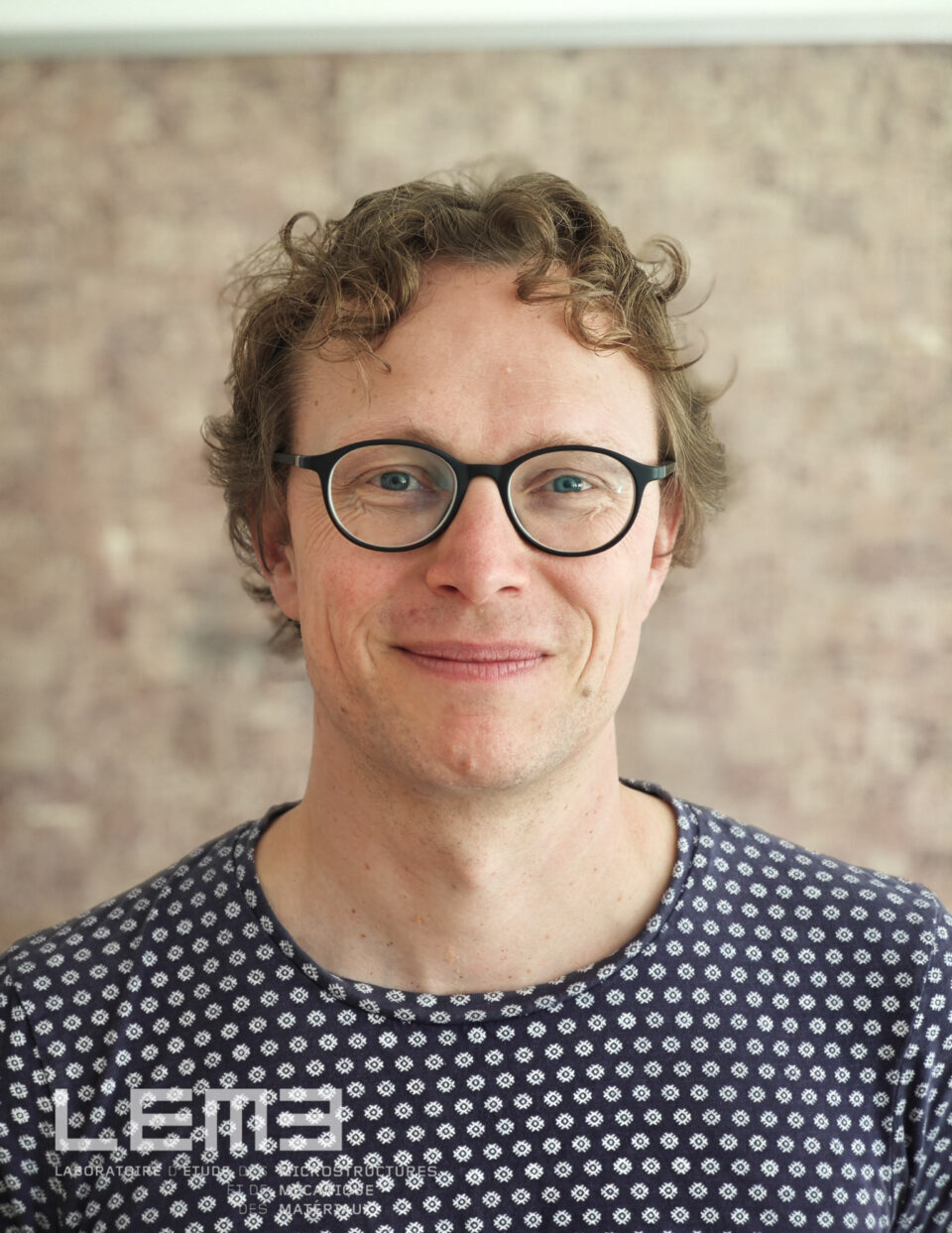
Julien Guenoleمشاهده پروفایل
پژوهشگر
Julien Guenole is a CNRS Research Scientist (Chargé de recherche) at the LEM3 Laboratory (UMR CNRS 7239) in Metz, France, which is a joint research unit of the University of Lorraine, the National Centre for Scientific Research (CNRS), and Arts et Métiers ParisTech. He joined CNRS on January 1, 2020, after previously working at RWTH Aachen's Institute for Physical Metallurgy and Materials Physics (IMM). Guenole serves as Associate editor of Philosophical Magazine and was a Member of CoNRS (section 9) for 2024-2025. He is also Co-leader of Experimental and simulation challenges for the European COST MecaNano network. His research focuses on the plasticity of crystalline materials, complex crystals and their interfaces, multi-scale approaches, numerical nanomechanics, ion irradiation and induced defects . Guenole employs advanced computational methods including molecular dynamics, molecular statics, NEB calculations, and FFT-based approaches to bridge atomic-scale phenomena with continuum mechanics. Recent work includes developing generative machine learning approaches for microstructure design and predicting grain boundary segregation in magnesium alloys. His publication record shows consistent output in high-impact journals including Mechanics Research Communications, Communications Materials, Journal of Magnesium and Alloys, and Acta Materialia. His work frequently combines computational approaches with experimental validation, as seen in studies on metallic nanosponges and magnesium alloy plasticity. Associate editor of Philosophical Magazine Co-leader of Experimental and simulation challenges for European COST MecaNano network Member of CoNRS (section 9, 2024-2025) Supported by cluster IA ENACT (ANR - France 2030 funded project) As a supervisor, Guenole currently advises PhD student Badr LACHKAR on 'Generative Machine Learning for Microstructure Design: An Atomic-Scale-Informed Approach to Interfacial Engineering'. His lab provides opportunities for students to work at the cutting edge of computational materials science, with access to high-performance computing resources and connections to international research networks.
