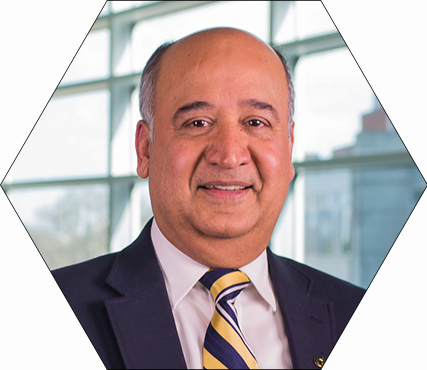
Naresh N. Thadhani is a Professor and Chair of Materials Science and Engineering at Georgia Tech, with an adjunct role in the Woodruff School of Mechanical Engineering. His research focuses on shock-induced material changes, high-strain-rate mechanics, and dynamic compaction of powders. He leads a lab equipped with advanced facilities like gas guns and laser-accelerated systems for studying impacts up to 1200 m/s. Education: Ph.D., New Mexico Institute of Mining and Technology (1984); M.S., South Dakota School of Mines and Technology (1981); B.E., University of Rajasthan, India (1980). Research interests include shock compression of metals/ceramics, phase transformations in metallic glasses, and structural energetic materials. His work combines experimental diagnostics (e.g., VISAR, photonic Doppler velocimetry) with computational modeling (CTH/ALE3D codes). Key awards: APS Fellow (2007), ASM International Fellow (2000). Editorial roles include Associate Editor of Shock Waves and Key Reader for Metallurgical and Materials Transactions . Lab & Group: A team of 1 postdoctoral fellow, 11 PhD students, and 3 undergraduates. Over 30 graduates to date. Active in advisory roles for national/international conferences and industrial consultancies. Future work emphasizes nanocomposite magnets and meso-scale modeling of heterogeneous materials under shock.
Prof. Catherine O'Sullivan is a Professor of Particulate Soil Mechanics at Imperial College London's Department of Civil and Environmental Engineering, part of the Faculty of Engineering. She leads the Geotechnics Section and serves as Editor-in-Chief of the ASCE Journal of Geotechnical and Geoenvironmental Engineering. Her research focuses on particulate soil mechanics, employing Discrete Element Modelling (DEM) and micro-CT imaging to study sand behavior, reservoir sandstones, and internal erosion. Notable recognitions include the 2016 Shamsher Prakash Research Award and the 2021 President’s Teaching Innovation Award. Education : PhD in Civil Engineering, University of California, Berkeley (2002) MEngSc in Civil Engineering, University College Cork (Ireland) BEng (Civil Engineering), University College Cork (Ireland) Research Interests : Prof. O'Sullivan's work integrates computational and experimental methods to explore granular material behavior. Key areas include DEM validation, μCT analysis, and pore network modeling. Her group collaborates across disciplines, involving physicists and mechanical engineers alongside civil engineers. Awards & Recognition : 2015 Geotechnique Lecture Student Choice Supervision Award (nominated twice) 2023 Alert Geomechanics Special Lecture Advising & Grants : She supports PhD and postdoctoral researchers through Imperial scholarships and fellowships. Her students often explore particulate soil behavior, with many securing prestigious awards. Labs & Teams : Leads the Geotechnics Section at Imperial, fostering interdisciplinary research in geomechanics and computational modeling.
John MacLaren Walsh is a Professor in the Department of Electrical and Computer Engineering at Drexel University, where he leads the Adaptive Signal Processing and Information Theory Research Group. He holds BS, MS, and PhD degrees from Cornell University, all completed under Dr. C. Richard Johnson, Jr. His research spans information theory, network coding, distributed computing, and machine learning applications in patent analysis. His work focuses on: Bounding entropic vectors and their impact on communication networks Rate region computation for network coding and distributed storage Information theory for distributed function computation Machine learning-enhanced patent processing systems Publications emphasize entropy geometry, network coding complexity, distributed algorithms, and patent analysis, with consistent themes of optimization and combinatorial methods. Recent work (2016-2019) shows increased focus on probabilistic supports and computational efficiency in network coding. Awards: 2011 NSF CAREER Award for 'Entropy Geometry in Variational Inference Signal Processing' He has advised PhD students on topics like entropy region mapping, network coding, and distributed control. Key grants include NSF CAREER and AFOSR funding for wireless network overhead control. He directs the Adaptive Signal Processing and Information Theory Research Group, which develops algorithms for network coding, distributed storage, and patent analysis systems.
Youssef M. A. Hashash is the Grainger Distinguished Chair in Engineering and a Professor in the Department of Civil and Environmental Engineering at the University of Illinois at Urbana-Champaign (UIUC). He holds a B.S., M.S., and Ph.D. in Civil Engineering from MIT (1987–1992). His expertise spans geotechnical engineering, earthquake engineering, and computational geomechanics, with a focus on deep excavations, tunneling, and soil-structure interaction. He co-developed DEEPSOIL, widely used for seismic soil response analysis. Education: B.S. Civil Engineering, MIT (1987) M.S. Civil (Geotechnical) Engineering, MIT (1988) Ph.D. Civil (Geotechnical) Engineering, MIT (1992) Research Interests: Dr. Hashash's work integrates geotechnical engineering with advanced technologies like AI, visualization, and discrete element modeling. Key areas include: Seismic site response and amplification models for Central/Eastern North America Tunneling and underground infrastructure resilience Geotechnical applications of machine learning and augmented reality Soil-structure interaction and liquefaction analysis Professional Roles: Geotechnical co-leader, NIST investigation of the Champlain Towers South collapse (2022–present) Chair, National Academies' Committee on Geological and Geotechnical Engineering (2024–present) Past President, Geo-Institute of ASCE Awards: Presidential Early Career Award for Scientists and Engineers ASCE 2014 Peck Medal Elected to National Academy of Engineering (2022) Labs/Teams: Leads research groups at UIUC focused on computational geomechanics and geotechnical earthquake engineering. Collaborates with federal agencies like NIST and NSF on large-scale projects.
Quoc Thong Le Gia is an Associate Professor in the School of Mathematics & Statistics at the University of New South Wales (UNSW), Sydney. He holds a PhD in Mathematics from Texas A&M University (2003), an MS in Mathematics from Texas A&M University (2000), and a BSc in Mathematics and Computer Science from UNSW (1998). His research focuses on Numerical Analysis , Approximation Theory , Partial Differential Equations , and Stochastic Processes , with particular expertise in problems on spherical domains. His work bridges theoretical mathematics with practical applications in computational science, data science, and machine learning. Le Gia's recent publications demonstrate a strong focus on numerical methods for PDEs on spheres, stochastic analysis, and machine learning applications. His work shows consistent progression from theoretical foundations to practical implementations, with increasing interdisciplinary applications in recent years. L. F. Guseman Prize in Mathematics, Texas A&M University (2003) As a dedicated academic mentor, Le Gia has supervised numerous PhD, Master's, and Honours students across computational mathematics and data science topics. He has secured significant research funding through ARC Discovery Projects including DP220101811 (2022-2024) and DP180100506 (2018-2020). Professionally, he serves as External Associate Editor for Frontiers in Applied Mathematics and Statistics , Secretary for ANZIAM's Computational Mathematics Group, and Co-chair of Mathematics of Computation and Optimisation (AustMS Special Interest Group).
Vladimir Kazeev is an Assistant Professor at the Faculty of Mathematics, University of Vienna , where he has held a faculty position since 2019. He also held previous academic appointments as a Szegő Assistant Professor at Stanford University (2017–2019), a postdoctoral researcher at the University of Geneva (2015–2017), and research positions at ETH Zurich (2011–2015), Russian Academy of Sciences (2008–2011), and Moscow Institute of Physics and Technology (2009). His research focuses on adaptive, data-driven numerical methods for differential equations, nonlinear low-parametric approximation, and numerical linear algebra. His work intersects computational mathematics, tensor methods, and high-dimensional problem-solving, particularly in the context of partial differential equations (PDEs) and stochastic modeling. The 15 most recent publications reveal a strong emphasis on quantized tensor-structured methods for PDEs, low-rank approximations, and high-dimensional numerical analysis. His research spans theoretical advancements in tensor decomposition, practical applications in chemical reaction networks, and novel discretization techniques for multiscale and degenerate diffusion problems. Scientific awards include the prestigious ETH Medal for outstanding doctoral theses (2016) Russian Academy of Sciences Medal for outstanding student works in mathematics (2011) Advising and teaching activities include supervising Jason Zhu (Stanford, 2019) and Simon Etter (ETH Zurich, 2014), as well as teaching advanced courses in tensor methods, numerical analysis, and PDEs at the University of Vienna, Stanford University, and the University of Geneva. His service to the community includes peer review for 15+ journals and co-organizing minisymposia at SIAM meetings.
Sara Zahedi is a Professor of Numerical Analysis at the Department of Mathematics, KTH Royal Institute of Technology, working within the Division of Numerical Analysis, Optimization and Systems Theory. She serves as an Associate Editor for the SIAM Journal on Numerical Analysis and contributes to the SCI Faculty Board to enhance collaboration and transparency in academic decision-making. Her educational background includes a doctorate from KTH on numerical methods for fluid interface problems followed by a postdoctoral position at Uppsala University. Doctorate: KTH Royal Institute of Technology Postdoctoral Position: Uppsala University Zahedi's research bridges mathematical theory and practical applications, focusing on computational methods for partial differential equations in evolving domains. She pioneers Cut Finite Element Methods (CutFEM) to eliminate re-meshing requirements in multiphase flow simulations, ensuring accuracy and robustness when interfaces separate immiscible fluids. Her work specifically targets challenges in large deformations and time-dependent geometries. Analysis of her recent publications reveals a concentrated research trajectory in advancing CutFEM for diverse applications including Stokes flow, Darcy flow, Maxwell's equations, and hyperbolic conservation laws. Key trends include high-order conservative schemes, divergence preservation, stabilization techniques for unfitted meshes, and extensions to surface PDEs and multi-physics problems. Her scientific recognition includes: European Mathematical Society Prize (2016) for outstanding contributions by young researchers Wallenberg Fellowship (2019) with extension granted in 2024 Zahedi serves as examiner for Degree Projects in Scientific Computing (SF250X, SF259X) and course responsible for Engineering Mathematics projects (SA120X). Her Wallenberg Fellowship provides substantial research funding supporting her work on numerical algorithm development. While specific lab structures aren't detailed, her research operates within KTH's Division of Numerical Analysis, emphasizing collaborative development of simulation tools for industrial and scientific applications. Her current research focuses on extending CutFEM to complex multi-physics scenarios with emphasis on conservation properties and computational efficiency, with potential applications in aerospace, biomedical engineering, and environmental modeling.
Yuri Bazilevs is the E. Paul Sorensen Professor of Engineering at Brown University's School of Engineering and Co-Director of the Mechanics of Undersea Science and Engineering Center. His research focuses on computational mechanics, isogeometric analysis, fluid-structure interaction, and high-performance computing. Prior to Brown, he held positions at UC San Diego, where he advanced to Full Professor in 2014 after a rapid tenure. He earned his PhD in 2006 and postdoc training in computational engineering at UT Austin's ICES. Research interests span computational fluid dynamics, solid mechanics, and advanced discretization methods like isogeometric analysis (IGA) and meshfree approaches. He has developed novel formulations for complex phenomena such as underwater explosions, composite material failure, and hypersonic flow dynamics. His work integrates cutting-edge numerical methods with practical engineering applications in aerospace, energy, and biomedical systems. Recent publications highlight advancements in IGA for architected materials, RKPM-based crack modeling, and stabilized formulations for compressible flows. His contributions bridge theoretical mechanics with computational innovation, addressing challenges in multiphysics coupling and large-scale simulations. Collaborations span academia and industry, emphasizing practical validation and real-world impact. Bazilevs' expertise includes variational multiscale methods, peridynamics for fracture mechanics, and immersive particle methods for fluid-structure interaction. His work has been applied to wind turbine aerodynamics, gas turbine optimization, and cardiovascular flow analysis. He actively contributes to computational infrastructure development, such as the tIGAr software framework for IGA automation.
Dr. Michael Kleeberger is a Researcher at the Chair of Materials Handling, Material Flow, Logistics (FML) at the Technical University of Munich, based at Boltzmannstr. 15 in Garching. He collaborates closely with Prof. Johannes Fottner and maintains an active research profile in crane dynamics and mechanical systems simulation. His research specializes in Materials Handling and Logistics with emphasis on Crane Dynamics, Flexible Multibody Systems, and Control Systems. He develops advanced models for hydraulic actuated cranes, focusing on dynamic behavior during hoisting, slewing, and trajectory operations using port-Hamiltonian formulations and geometrically exact beam theory. His work bridges theoretical mechanics with industrial applications in heavy machinery. Analysis of his 15 most recent publications reveals consistent focus on numerical methods for flexible crane structures, with growing emphasis on optimal control strategies (2020-2025). Key trends include port-Hamiltonian system applications, lunar crane feasibility studies, and vibration mitigation techniques for lattice boom and knuckle boom configurations across diverse operational scenarios. As part of FML, Dr. Kleeberger contributes to TUM's leadership in logistics engineering through industry-collaborative projects and fundamental research in material flow systems, maintaining the chair's reputation for excellence in mechanical dynamics and practical engineering solutions.
Jan de Gier is a Professor at the School of Mathematics and Statistics, The University of Melbourne . He is also the Founding Director of MATRIX , Australia’s residential research institute in the mathematical sciences, and a former Deputy Director and Chief Investigator in the Australian Research Council Centre of Excellence for Mathematical and Statistical Frontiers (ACEMS) . Additionally, he co-founded the Australian and New Zealand Association for Mathematical Physics (ANZAMP) in 2011 and served as its inaugural Chair. His research focuses on solvable lattice models at the intersection of mathematical physics and statistical mechanics . Key areas include the application of quantum integrability , algebraic structures like the Yang-Baxter equation, Hecke algebras, and quantum groups, as well as analytical methods such as complex analysis and elliptic curves. His work bridges pure and applied mathematics through connections between enumerative combinatorics , representation theory , and real-world phenomena like traffic flow modeling via exclusion processes . The 15 most recent articles reflect his expertise in integrable systems , non-equilibrium statistical mechanics , and algebraic combinatorics . Topics span Macdonald polynomials , stochastic duality , quantum spin chains , and traffic modeling , with methodologies involving matrix product forms , exact solutions , and critical phenomena analysis. He has contributed to editorial efforts through the AustMS Gazette and MATRIX Annals, and has been involved in public science communication via opinion pieces on mathematics funding and applications. His work emphasizes the importance of fundamental research in driving technological innovation, as highlighted in media articles discussing pi calculation , zero-knowledge proofs , and mathematics education .
Konstantinos Karapiperis is a Tenure Track Assistant Professor at EPFL's Laboratory of Multiscale Modeling of Materials (LMD), within the School of Architecture, Civil and Environmental Engineering (ENAC). His research integrates mechanics , multiscale modeling , and data science to study geomaterials and structural materials. PhD in Applied Mechanics (minor in Applied Mathematics), Caltech Postdoctoral Researcher & Lecturer, ETH Zürich (Marie Skłodowska-Curie Fellowship) Research focuses on granular materials , architected materials , and nonlocal modeling using techniques like Level-Set Discrete Element Method (LS-DEM) and machine learning . Recent work explores fracture control via graph neural networks and thermodynamics-informed models. Selected scientific award: Marie Skłodowska-Curie Fellowship Teaches courses in Soil Mechanics and Multiscale Modeling . PhD students include Thomas Henzel and Hrishikesh Gopakumar Menon. His Data-Driven Mechanics Laboratory (LMD) develops predictive tools for granular and structured material behavior.
Dr. Arghya Das is an Associate Professor in the Department of Civil Engineering at the Indian Institute of Technology Kanpur (IIT Kanpur), where he has been serving since 2014. He previously held the position of Assistant Professor at IIT Kanpur from July 2014 to November 2020 before being promoted to Associate Professor in December 2020. Prior to joining IIT Kanpur, he completed his Post-Doctoral Research Fellowship at Northwestern University, USA, and served as a Research Associate at the University of Sydney, Australia. Dr. Das earned his educational qualifications from prestigious institutions: PhD in Geotechnical Engineering from the University of Sydney, Australia (2013), M.Tech from IIT Bombay, India (2009), and B.E. from Jadavpur University, India (2006). His research focuses on advanced aspects of soil mechanics and geotechnical engineering, with particular emphasis on constitutive modeling of geomaterials, micromechanics of granular materials, and flow through porous media. His work integrates numerical and physical modeling approaches to address complex geotechnical challenges including bifurcation and instability analysis in geomaterials. Dr. Das teaches several advanced courses including Constitutive Modeling of Frictional Materials, Advanced Geotechnical Engineering, Rock Mechanics, Computational Methods in Engineering, and Soil Mechanics. Dr. Das's publication record demonstrates a consistent focus on discrete element modeling (DEM) applications in geomechanics, particle crushing behavior, and constitutive modeling of soils. His recent work (2020-2022) has particularly emphasized unsaturated soil mechanics, chemomechanical effects on granular materials, and advanced computational approaches to soil behavior. These publications appear in high-impact journals such as Acta Geotechnica, Geomechanics for Energy and the Environment, and International Journal of Geomechanics. PK Kelkar Fellowship - IIT Kanpur (2022-2025) FEIT University of Melbourne Visiting Researcher Fellowship (2022-2023) YGE Award for Best Paper on Computational Geomechanics, Indian Geotechnical Society (2018) SERB - Early Career Research Award (2016-2019) Dr. Das has successfully secured multiple research grants including projects funded by ONGC, CSIR, and SERB focusing on micro-poro-mechanical modeling, experimental assessment of Indian crushable sands, and permeability evolution in deep-reservoir rocks. He serves as a corresponding member of the International Technical Committee TC-105 on 'Geo-Mechanics from Micro to Macro' of the International Society for Soil Mechanics and Geotechnical Engineering (ISSMGE) and is a member of the Indian Geotechnical Society.
Dond Asha Kisan is an Assistant Professor at the School of Mathematics , Indian Institute of Science Education and Research Thiruvananthapuram (IISER TVM). His research focuses on numerical analysis and computational mathematics , particularly in finite element methods for partial differential equations. He can be contacted at ashadond@iisertvm.ac.in or via phone at +91 (0)471-2778247. PhD : Mathematics, Indian Institute of Technology Bombay M.Sc. : Mathematics, K.T.H.M. College, Nashik Kisan's research spans adaptive finite element methods , stabilized formulations for convection-diffusion problems , and optimal control governed by Stokes equations . His work includes convergence analysis, nonconforming discretizations, and hybrid numerical schemes. Recent publications (2023-2025) address stochastic modeling in liquid crystal physics, advanced WENO schemes, and adaptive algorithms for control problems. Scientific Awards : No explicit awards mentioned in the data, though he held prestigious postdoctoral fellowships including National Post-Doctoral Fellowship and NBHM Post-Doctoral Fellowship. Kisan has extensive teaching experience , including MATLAB workshops and undergraduate course assistantships. He has presented at major international conferences like ICIAM and Hyperbolic Problems, demonstrating global engagement in computational mathematics.
Graeme J. Kennedy is an associate professor in the Daniel Guggenheim School of Aerospace Engineering at the Georgia Institute of Technology where he leads the Simulation-based Multidisciplinary Design Optimization (SMDO) research group. His research focuses on developing numerical optimization techniques for structural and multidisciplinary design problems, particularly for fixed-wing aircraft analysis and design. Dr. Kennedy received his PhD from the University of Toronto Institute for Aerospace Studies (UTIAS) in 2012, followed by a postdoctoral research fellowship at the University of Michigan in the Department of Aerospace Engineering. His research spans several critical areas in aerospace design optimization: Development of advanced numerical optimization techniques for structural design Large-scale topology optimization for aerospace structures Aeroelastic and aerothermoelastic optimization of flexible aircraft Optimization of composite structures with manufacturing constraints Electric motor optimization for electric vertical take-off and landing (eVTOL) vehicles He has developed multiple open-source research codes including TACS (parallel finite-element solver), ParOpt (optimization toolkit), TMR (mesh generation tool), and FUNtoFEM (aeroelastic coupling framework). Dr. Kennedy is particularly interested in designing structures that manage heat from battery packs in air taxis while achieving optimal aeroelastic performance. His publications reveal a strong focus on computational methods for solving large-scale optimization problems in aerospace design. The research shows progressive development from fundamental optimization algorithms toward increasingly complex multidisciplinary applications, with particular emphasis on making high-fidelity simulation-based optimization practical for industrial design cycles through high-performance computing approaches. Dr. Kennedy actively mentors numerous graduate students, including six current PhD candidates and multiple former PhD and MS students who have completed their degrees under his supervision. His research group maintains strong connections with industry through various grants supporting the development of computational tools for aerospace design. The SMDO group also engages in educational outreach through 'Optimization through Intuition,' providing accessible learning modules about optimization concepts for middle and high school students, demonstrating Dr. Kennedy's commitment to broadening participation in engineering education.
Xu Jinchao is a Professor of Applied Mathematics and Computational Sciences at King Abdullah University of Science and Technology (KAUST) and the Verne M. Willaman Professor of Mathematics at Penn State University. He has held distinguished roles, including Director of the Center for Computational Mathematics and Applications at Penn State since 1997 and is an Affiliated Faculty member of the College of Information Sciences and Technology at Penn State. His research focuses on numerical partial differential equations (PDEs), multigrid methods, machine learning, finite element methods, and domain decomposition methods. He is renowned for pioneering contributions such as the Bramble-Pasciak-Xu (BPX) preconditioner, Hiptmair-Xu (HX) preconditioner, Xu-Zikatanov (XZ) identity, and Morley-Wang-Xu (MWX) element. His work bridges computational mathematics and machine learning, including the development of MgNet, which unifies multigrid methods with convolutional neural networks. Xu has been recognized with numerous awards, including Fellowships from SIAM, AMS, AAAS, and the European Academy of Sciences. Notable accolades include the 2008 DOE Top 10 Breakthroughs for his HX preconditioner and the 1995 Feng Kang Prize for Scientific Computing. He has organized over 100 conferences and serves on editorial boards of top journals such as Mathematics of Computations and Numerische Mathematik . His leadership includes directing research centers and advancing computational science through collaborative efforts.