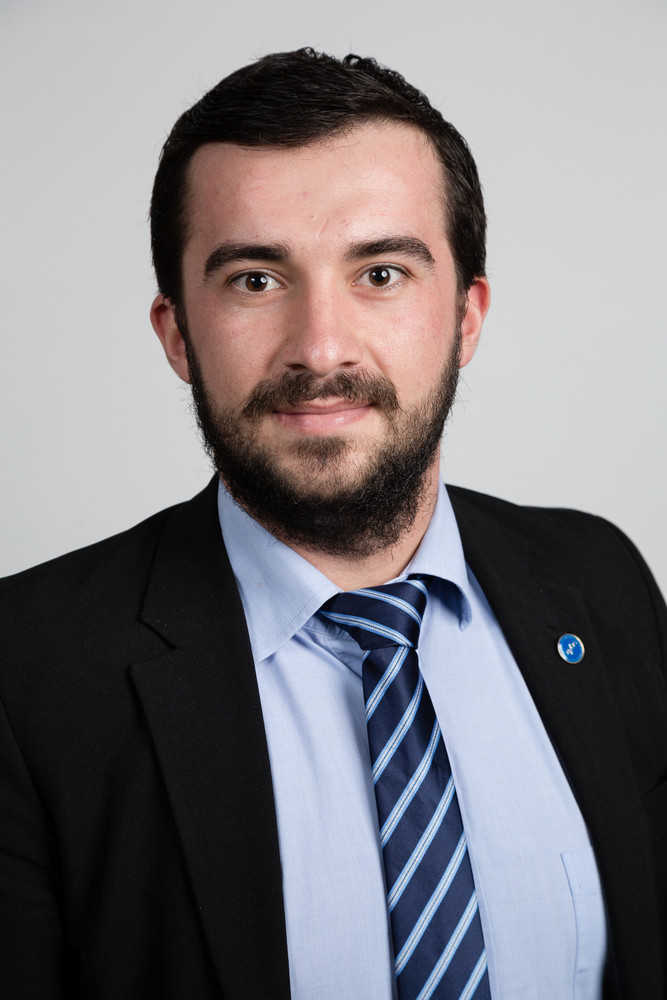
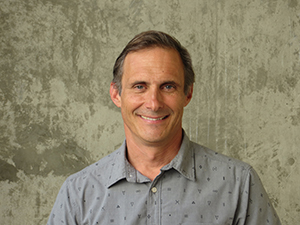
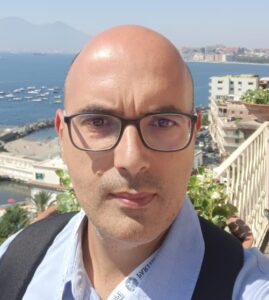
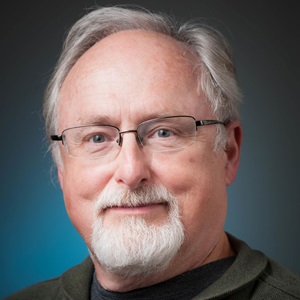
Rus Cosmin is a Professor and Head of Department at the Faculty of Mechanical and Electrical Engineering, University of Petroșani. His expertise spans electric vehicle systems, automation, IoT, and environmental monitoring. As a leading academic, he focuses on interdisciplinary research addressing energy efficiency, smart city technologies, and sustainable manufacturing. His research interests include autonomous systems (e.g., drones, electric vehicles), predictive modeling, and AI applications in environmental and healthcare domains. Notable projects involve smart grid integration, wildfire detection drones, and elderly fall detection using IoT. Rus Cosmin’s work bridges theory and practice, with a focus on real-world solutions for Romania’s industrial regions like the Jiu Valley. His technical contributions include innovative sensor networks, control strategies, and data-driven environmental forecasting systems. His publications reflect a trend toward applying advanced technologies to solve contemporary challenges in transportation, energy, and urban sustainability. Despite prolific output, no awards or student advisement details are explicitly listed in the provided materials.
Jacek Rak is a Professor at the Department of Communications and Computer Networks within the Faculty of Electronics, Telecommunications and Informatics at Gdańsk University of Technology. His research career spans over two decades with continuous contributions to network resilience engineering, evidenced by over 50 publications in top-tier IEEE and Springer journals. He serves as a leading authority in optical network design, vehicular communications, and disaster-resilient systems, frequently collaborating with international institutions including Hungarian Academy of Sciences, University of Lisbon, and Polish-Japanese Academy of Information Technology. Professor Rak's research focuses on network resilience engineering across multiple domains. His work establishes foundational frameworks for protecting communication systems against disasters, with significant contributions to optical network survivability, 5G/6G fronthaul optimization, and vehicular network security. His research methodology integrates mathematical modeling with practical implementation, particularly evident in his development of the κ-Penalty approach for disjoint path calculation and eFRADIR disaster resilience framework. Recent work emphasizes the convergence of wireless and optical technologies for next-generation networks, addressing critical challenges in energy efficiency and cost modeling for 6G infrastructure. His publication portfolio reveals a clear evolution from VANET security (2010-2015) to comprehensive disaster resilience frameworks (2016-present), culminating in the 2020 Springer monograph Guide to Disaster-Resilient Communication Networks co-edited with David Hutchison. Current research examines optical fronthaul optimization for 6G systems, with multiple 2023-2025 publications establishing new methodologies for cost-energy tradeoff analysis in next-generation wireless infrastructure. IEEE Communications Society Distinguished Lecturer (2018-2020) Editor-in-Chief, Optical Switching and Networking special issue on Disaster-Resilient Optical Networks (2021) Technical Program Committee Chair, International Workshop on Reliable Networks Design and Modeling (RNDM 2012-2015) Professor Rak actively mentors next-generation researchers through collaborative projects like RECODIS (Resilient Communication Services Protecting End-user Applications from Disaster-based Failures) and coordinates international research efforts through EU-funded initiatives. His work demonstrates consistent leadership in establishing resilience metrics and validation methodologies for critical communication infrastructure, with increasing focus on climate change adaptation and sustainable network design principles in recent publications.
Pankaj Sharma is a Senior Lecturer at the School of Business, UNSW Canberra . He holds a PhD in Industrial Engineering from Indian Institute of Technology Delhi (2017) and has over 21 years of experience in military logistics and maintenance operations. Prior to his current role, he served as a Senior Research Fellow at the National University of Singapore 's Centre for Next Generation Logistics (2018-2023). Research Interests: His work focuses on Asset Management , Logistics and Supply Chain Management , and Advanced Technologies in Logistics , particularly in digital twins, blockchain applications, and humanitarian supply chain analytics. His recent publications analyze supply chain risk events (2025), circular economy transitions (2025), and climate-resilient inventory systems (2023). Key Contributions: He co-developed frameworks for Time-Separated Lean-Agile Spare Parts Replenishment in military contexts and pioneered Open Source Hardware applications in maintenance systems. His work on Big Data Analytics in Crisis Management (2022) combines information processing theory with multimethod studies.
Professor Hartmut Surmann is a leading academic in robotics at Westphalian University of Applied Sciences, where he heads the Teaching and Research Area for Autonomous Systems and the Robotics Laboratory. With expertise spanning autonomous mobile robots, rescue robotics, machine learning, and 3D computer vision, he has established himself as a key figure in applying robotics to real-world emergency response scenarios. Westphalian University of Applied Sciences, Department of Computer Science and Communication Head of Robotics Laboratory Member of German Rescue Robotics Center (DRZ) Active participant in EU-funded robotics projects Prof. Surmann holds a Diplom in Computer Science from the University of Dortmund (1989) and completed his PhD work on fuzzy systems using genetic algorithms and neural networks. His research interests focus on autonomous systems with particular emphasis on rescue robotics, machine learning, sensor data processing, and 3D computer vision. His work bridges theoretical advancements with practical applications, especially in disaster response scenarios where robotic systems can save lives. His publication record demonstrates a consistent focus on multi-robot collaboration for disaster response, with particular expertise in 3D mapping, sensor fusion, and autonomous navigation systems. His research has evolved from foundational work in neural networks and fuzzy logic to practical implementations of drone and ground robot teams working together in real disaster scenarios. The trend in his work shows increasing sophistication in multi-robot coordination, semantic understanding of environments, and practical deployment of systems in actual emergency situations. Best Paper Award at SSRR 2017 for '3D Registration of Aerial and Ground Robots for Disaster Response' Key contributor to EU-funded TRADR project (2014-2018) Co-founder of German Rescue Robotics Center (DRZ) Active participant in multiple EU robotics projects including NIFTI Prof. Surmann has supervised numerous student projects and theses focused on practical robotics applications. His work has attracted significant research funding through EU projects like TRADR and NIFTI, with practical applications demonstrated in real disaster responses including earthquakes in Mirandola (2012) and Amatrice (2016), as well as industrial fires and flood disasters. His collaborations span academic institutions, emergency services, and industry partners across Europe. The Robotics Laboratory under his direction maintains a diverse fleet of robotic platforms including ground robots (TurtleBot, VolksBot, Baxter), aerial drones, and specialized rescue robots. The lab actively collaborates with emergency services through the German Rescue Robotics Center, providing a bridge between academic research and practical implementation in real-world rescue operations. Current work focuses on AI integration for robotic systems through the AI-Arena project.
Bruce L Rhoads is a Professor in the Department of Geography & Geographic Information Science at the University of Illinois at Urbana-Champaign, affiliated with the School of Earth, Society & Environment. He holds additional roles as a Professor in Natural Resources and Environmental Sciences, and an Affiliate in Earth Science and Environmental Change, Civil and Environmental Engineering. His research focuses on fluvial geomorphology, river dynamics, and watershed science, with an emphasis on field measurements of process-form interactions and collaborations in laboratory experiments and numerical modeling. Education: Ph.D. (Arizona State University), M.A. (Michigan State University), B.A. (Shippensburg University). He teaches courses including Fluvial Geomorphology, Humans and River Systems, and Aerial Photo Analysis. Research interests span river management, sediment dynamics, and the impacts of human activity on river systems. His work integrates hydrology, ecology, and engineering to address challenges in intensively managed landscapes. Notable contributions include studies on meander migration, floodplain processes, and the effects of agricultural development on river morphology. Recent publications (2024–2025) highlight topics such as sediment transport in agricultural watersheds, river confluence dynamics, and the environmental impacts of dam destruction. He is the author of River Dynamics: Geomorphology to Support Management (Cambridge University Press, 2020). Rhoads collaborates across disciplines and institutions, emphasizing applied research to inform policy and river restoration efforts. His work bridges basic science and practical management, addressing both ecological and human dimensions of fluvial systems.
Associate Professor Hoang Dinh is a faculty member at the School of Electrical and Data Engineering, University of Technology Sydney (UTS), Australia. He holds an ARC DECRA Fellowship and leads research in wireless communications, machine learning applications, and cybersecurity. His work includes over 200 publications, 20,000+ citations (h-index 53), and significant industry collaborations with Cisco and Apple Inc. He teaches IoT Security and Cyber Security for Mobile Platforms, achieving high student satisfaction scores. Key awards include the IEEE TCI Rising Star Award (2023), IEEE TCSC Excellence Award (2021), and multiple editorial recognitions from IEEE Transactions. His research focuses on 6G networks, metaverse technologies, federated learning, and blockchain security. Current projects involve secure edge computing, AI-driven communication systems, and digital twin integration. Education: PhD in Computer Science from Nanyang Technological University (2016). Research Funding: AUD 6M+ in external grants, including DECRA (2021). Editorial Roles: Editor for IEEE Transactions on Communications, Network Science and Engineering, Mobile Computing, and Wireless Communications. Industry Impact: Developed IoT security frameworks and contributed to disaster management digital transformation projects recognized in iAWARDS2024.
Professor Graham Taylor is a Professor of Mathematical Biology at the University of Oxford and a Senior Research Fellow at Jesus College. He leads the Oxford Flight Group, focusing on biomechanics, neurophysiology, and bio-inspired engineering. His research combines experimental methods (e.g., virtual reality flight simulators) with computational models to understand animal flight dynamics and translate findings into robotics and AI. He holds a Royal Society University Research Fellowship and has received €1.95M from the ERC. His work spans Harris’ hawks, peregrine falcons, planthoppers, and insects, with applications in drone design and emergency response technology. Education: BA (Zoology, Pembroke College, Oxford), DPhil (Jesus College, Oxford) Key Roles: Deputy Head of MPLS Division, Director of John Krebs Field Station, Wytham Woods Research interests include evolutionary tuning of flight systems, flight control algorithms, and the intersection of physics and physiology. His lab collaborates with industry on spinouts like Animal Dynamics and engages the public through documentaries (e.g., Sky Nature’s Airborne ) and outreach programs. Notable achievements include the Thomas Henry Huxley Medal and ERC grants. Advising & Grants: Supervises doctoral students in biomechanics and robotics. Leads projects funded by the ERC, BBSRC, and industry partnerships. His lab hosts UNIQ program visits and public engagement activities, including a 2022 Oxford Science Festival exhibit.
Renato Figueiredo is a Professor at the University of Florida's College of Engineering, Department of Computer & Information Science and Engineering. His primary research focuses on virtualization, distributed systems, cloud computing, and edge computing. He has expertise in developing cyberinfrastructure solutions for environmental monitoring and ecological forecasting. Notable contributions include the FLARE system for lake/reservoir water quality forecasting and the EdgeVPN framework for edge network virtualization. Education: Ph.D. in Electrical Computer Engineering (Purdue University, 2001), M.S.E.E. (University of Campinas, 1995), B.S.E.E. (University of Campinas, 1994). Research interests emphasize bridging computer science with environmental applications, including real-time ecological modeling, serverless computing workflows, and scalable network architectures. He has received prestigious awards like the IBM Faculty Award (2008) and recognition for influential HPDC papers. Grants include collaborative NSF projects on edge computing, ecological forecasting systems, and cyberinfrastructure development. His work integrates sensor networks, cloud platforms, and SDN technologies to address challenges in water quality management and disaster resilience.
Jinhyung Lee is an Assistant Professor in the Department of Geography and Environment at Western University. His research focuses on transport geography, spatial accessibility, and urban resilience, leveraging GIScience, AI, and big data to address equity and sustainability in urban systems. He teaches courses such as Transportation Geography & GIS and Geographic Data Science with Python. His work integrates real-time transit data, climate change impacts, and generative AI to improve public transit systems and urban planning. He actively supervises graduate students in topics like equity-focused accessibility analysis and AI applications in transportation. Recent publications highlight innovations in measuring urban mobility, climate resilience, and the use of large language models for geographic analysis. Lee's research emphasizes social equity in transportation accessibility, particularly through projects analyzing extreme weather exposure, transit reliability, and Opioid Treatment Program accessibility. He collaborates on interdisciplinary initiatives, including the development of the Spnaf R package for flow data analysis and the OpenGPS platform for reproducible GPS studies. His work bridges methodological innovation with practical policy implications, aiming to create equitable and resilient urban environments.
Dr. Ekin Ozer is an Assistant Professor at University College Dublin's School of Civil Engineering. His research focuses on vibration-based structural health monitoring (SHM), earthquake engineering, and mobile sensor technologies. He holds a PhD from Columbia University (2016) and has prior experience in academia (Middle East Technical University) and industry (Novum Structures). His work emphasizes smartphone and participatory sensing for bridge and building monitoring, with contributions to Bayesian risk assessment and machine learning applications. Education: BSc/MSc in Civil Engineering from Bogazici University, MPhil/PhD from Columbia University. Grants include the FLAME project (UCD SATLE) for 3D learning tools and transnational university initiatives. Key research trends in his articles include smartphone-driven SHM innovations, seismic risk assessment frameworks, and integration of cyber-physical systems for infrastructure resilience. He actively supervises PhD students and teaches modules like Structural Analysis, Bridge Engineering, and Case Studies in Infrastructure Design.
Anna Szostak-Chrzanowski is a Titular Professor at the Department of Geodesy and Geomatics Engineering, University of New Brunswick (UNB), where she has served for over 30 years. She concurrently held a full professorship at Wroclaw University of Technology, Poland (2008–2020), and was Chair of the Department of Geodesy and Cartography there until 2020. She holds a Doctor Habilitatus from the University of Varmia and Mazuria, Poland, and degrees from multiple institutions including UNB and Warsaw Technical University. Her research focuses on interdisciplinary deformation analysis, integrating geodetic monitoring with deterministic modeling. Key areas include dam stability, mining subsidence, and geomechanical modeling. She has contributed to projects globally, such as the Shibuya Dam in China and potash mining in New Brunswick. Anna pioneered the ALERT Deformation Detection System and co-developed the Canadian Centre for Geodetic Engineering at UNB. She has authored seven books and over 300 publications, with notable awards including Poland’s Medal for Merit in Mining and recognition as a Mining General. Her work emphasizes public safety through integrated deformation analysis, particularly in mining and infrastructure projects. Her affiliations include the European MSc program EC-Geo-Sustain and the PhD Evaluation Committee at Wroclaw University. She remains active in projects like Nutrien’s potash mining and KGHM’s copper operations.
Christopher Wong is an Assistant Professor in the Department of Forestry and Environmental Management at the University of New Brunswick (UNB). He holds a PhD in Ecology and Evolutionary Biology from the University of Toronto, an MSc in Earth and Atmospheric Sciences from the University of Alberta, and a BSc in Biology from the same institution. Prior to joining UNB in 2024, he worked as a Postdoctoral Research Scholar and Assistant Project Scientist at the University of California, Davis. His research focuses on leveraging remote sensing and plant ecophysiology to study ecosystem responses to environmental and climate change. He employs techniques across spatial scales—from leaf-level measurements to satellite imagery—and temporal scales to develop monitoring tools for forestry, agriculture, and ecological systems. Dr. Wong teaches courses such as FOR 2416 (Structure and Development of Woody Plants) and FOR 3303 (Remote Sensing). His work emphasizes interdisciplinary approaches, including high-throughput phenotyping, drone-based monitoring, and the integration of spectral data to track plant stress, photosynthetic capacity, and ecosystem resilience. He has contributed to initiatives like the Global Spectra-Trait Initiative and pioneered tools like the TSWIFT platform for frequent timeseries data collection. His research spans topics such as post-fire forest recovery, drought impacts on crop species (e.g., beans), and the use of optical signals to monitor photosynthesis in tropical forests. Notably, he explores the application of Sentinel imagery and hyperspectral sensing to address real-world challenges in conservation and agriculture. While no scientific awards are explicitly listed, his prolific publication record highlights his significant contributions to ecological and remote sensing research. Dr. Wong collaborates on projects involving satellite and drone technologies, and his work often addresses global ecological questions while maintaining practical applications. He is affiliated with UNB’s Fredericton campus and actively engages in advancing methods for ecosystem assessment and climate change mitigation strategies.
Matthew Lauer is a Professor and Chair of the Department of Anthropology at San Diego State University (SDSU), within the College of Arts and Letters. His work focuses on environmental anthropology, Indigenous knowledge, disasters, and marine management in Oceania and San Diego. He has conducted research in the Solomon Islands and French Polynesia for over 25 years. Lauer’s recent book, Sensing Disaster: Local Knowledge and Vulnerability in Oceania , examines the 2007 tsunami in the Solomon Islands and its societal impacts. He teaches courses such as Environmental Anthropology, Sustainability and Culture, and Introduction to Sociocultural Anthropology. His research spans coral reef fisheries, climate change resilience, and community-based resource management. Current projects include studies on San Diego’s spearfishing community and the dynamics of marine governance in Moorea, French Polynesia. Lauer has advised several MA students on topics ranging from marine management ethics to drought adaptation in Paraguay. His academic contributions include over 30 peer-reviewed articles, exploring themes like Indigenous knowledge systems, disaster recovery, and ecological resilience. He leads interdisciplinary projects funded by grants such as the Dynamics of Coupled Natural and Human Systems (CNH) and the National Science Foundation. Lauer’s work emphasizes bridging academic research with practical solutions for environmental and social challenges, advocating for equitable resource management and the integration of local knowledge in policy. Key collaborations include partnerships with the National Center for Scientific Research (CNRS) and the American Museum of Natural History. His research often highlights the interplay between ecological crises and cultural practices, particularly in marginalized communities. Lauer’s teaching and mentorship reflect his commitment to fostering a new generation of anthropologists engaged with contemporary global issues.
Loris Belcastro, PhD, is a researcher in computer engineering at the University of Calabria, Italy, affiliated with the Department of Electronics, Computer Science and System Sciences (DIMES). He earned his PhD in Information and Communication Engineering from the same institution and serves on editorial boards for journals like the Journal of Supercomputing and SN Computer Science. In 2024, he obtained the Italian National Academic Qualification as Associate Professor in Computer Engineering. His research focuses on cloud and edge computing big data analytics machine learning social media analysis high performance computing parallel/distributed data analysis His recent publications highlight trends in edge-cloud continuum integration, distributed machine learning, and scalable big data analysis. He has contributed to frameworks for urban mobility prediction, industrial IoT applications, and HPC optimization through libraries like ParSoDA-Py. He has served as guest editor for journals such as Future Generation Computer Systems and Sensors, reflecting his expertise in distributed systems and data analysis.
Robert Heckendorn, Ph.D., is an Associate Professor in the Department of Computer Science at the University of Idaho, part of the College of Engineering. His research interests span machine learning, evolutionary computation, robotics, optimization algorithms, computational biology, and transportation systems. He holds a Ph.D. and has contributed extensively to interdisciplinary areas such as autonomous systems, traffic simulation, and bio-inspired algorithms. His work often bridges theoretical foundations with practical applications, including developing high-fidelity traffic modeling tools, optimizing manufacturing processes, and advancing robotic control strategies. Notable contributions include neuroevolution techniques for crowd behavior prediction and fuzzy logic-based crowd management systems. He also explores evolutionary algorithms in biological fitness landscapes and disaster management scenarios. He has authored over 50 publications since 1997, focusing on algorithmic efficiency, population diversity in evolutionary systems, and multi-agent coordination. His research has implications for smart cities, healthcare, and autonomous vehicle technologies. Despite no listed awards here, his prolific output underscores his impactful contributions to computer science and engineering. As an educator, he contributes to curriculum development in computational thinking and web-based learning systems (e.g., vTutor platform). His lab likely focuses on real-world problem-solving through computational methods, though specific lab names aren’t mentioned. Collaborations with industry and interdisciplinary teams are implied through his research topics like connected-vehicle systems and cancer modeling via cellular automata.