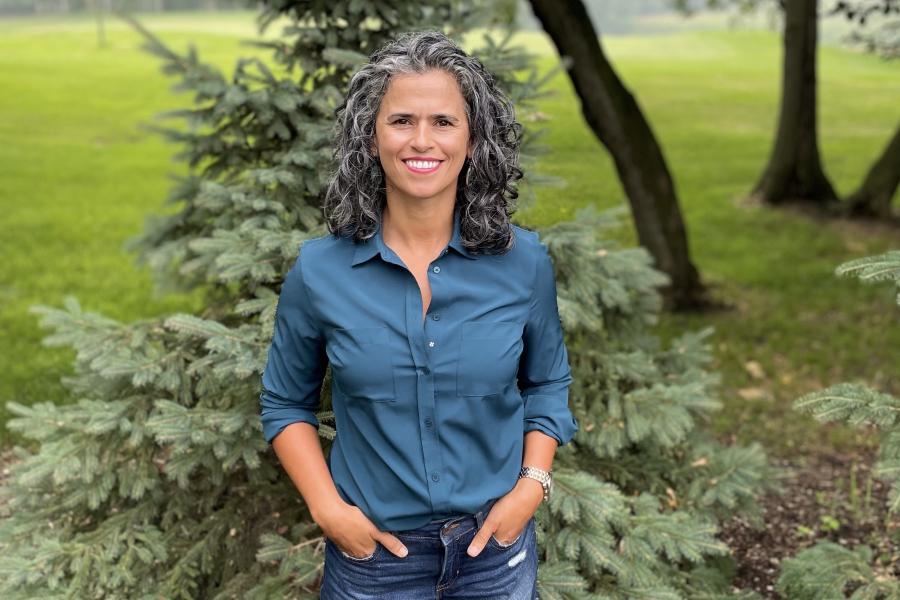
Emma Trentman is an Associate Professor of Arabic at the University of New Mexico (UNM) and Director of the Language Learning Center. Her research focuses on Applied Linguistics, particularly on language learning during study abroad programs, virtual exchange, and the impact of language ideologies on multilingual approaches. Research Interests: Multilingualism, Language Ideologies, Study Abroad Programs, Intercultural Communication, Arabic Language Education, and Curriculum Development. Key Publications: Co-editor of Language Learning in Study Abroad: The Multilingual Turn (2021), with works featured in The Modern Language Journal , Foreign Language Annals , and Critical Multilingualism Studies . Teaching: Offers Arabic language courses and the Languages Capstone class, integrating critical perspectives into language pedagogy. Editorial Work: Co-editor for Critical Multilingualism Studies Journal , advocating for plurilingual practices in education. Publications: Explores topics such as translanguaging, sociolinguistic competence, and decolonizing language learning frameworks across diverse contexts (Egypt, Tanzania, China). Advocacy: Engages in critical discussions on equity, identity, and sociocultural dimensions in language education.
Leigh Oakes is Professor of French and Linguistics in the Department of Modern Languages and Cultures within the School of Languages, Linguistics and Film at Queen Mary University of London. He has held progressive academic positions at the institution since 2000, advancing from Lecturer to his current professorship. His international academic background includes a PhD from the University of Melbourne and research at Stockholm University's Centre for Research on Bilingualism. His educational qualifications include a PhD (2001) and BA (Hons) (1996), both from the University of Melbourne. Oakes specializes in language policy and planning, with particular focus on language and national identity in France, Quebec, and Sweden. His research has expanded into linguistic justice debates in political theory, advocating for normative and interdisciplinary approaches to language policy. Oakes' publication trends reveal a consistent focus on ethical dimensions of language policy, with increasing emphasis on pluricentric justice and linguistic integration since 2016. His work bridges sociolinguistics and political philosophy, demonstrating strong interdisciplinary connections between language attitudes, national identity construction, and policy implementation across Francophone contexts. The 2018 co-authored monograph 'Normative Language Policy' represents a significant theoretical contribution to the field. 2008 Pierre Savard Prize for 'Language, Citizenship and Identity in Quebec' Leverhulme Trust Research Project Grant for 'The Ethics of Linguistic Integration' project Co-editor-in-chief of Sociolinguistica: European Journal of Sociolinguistics Co-editor of Multilingual Matters book series Member of editorial boards for Language Policy and Modern Languages Open Oakes actively supervises PhD candidates in sociolinguistic topics, with current research focusing on linguistic integration in Quebec and adaptation among mobile French speakers. His major Leverhulme-funded project 'The Ethics of Linguistic Integration' examines moral implications of language requirements for immigrants across England, Quebec, and Wales. He serves on several international academic committees including the Association internationale des études québécoises and the British Association of Canadian Studies. He leads the interdisciplinary 'Ethics of Linguistic Integration' research team, which combines expertise from applied linguistics, sociolinguistics, and political theory to investigate language integration policies. His work connects with broader university initiatives through Queen Mary's research highways in social justice and global challenges.
Andrew Ollett is an Associate Professor and Director of Graduate Studies in the Department of South Asian Languages and Civilizations at the University of Chicago , where he has taught since 2019. His research focuses on the literary and intellectual traditions of South and Southeast Asia, particularly through works in Sanskrit, Prakrit, Apabhramsha, and Kannada from the first millennium CE. Co-founder and editor of NESAR (New Explorations in South Asia Research) Director of NEH-funded edition/translation of the Kavirājamārga (earliest Kannada literary manual) Expert in Prakrit and Kannada literary traditions His work explores the 'question of language'—examining how language choice shaped cultural production and change in premodern India. Current projects include a monograph on context-sensitivity in Indian language theories and a study of manuscript technology's impact on early South Asian knowledge communities. He has authored The Mirror of Ornaments (Naples: Unior Press, 2025) and Language of the Snakes (UC Press, 2017), and co-authored Lilavai (Harvard, 2021). Recent publications include interdisciplinary studies on: Sanskrit-Prakrit campū genre reevaluation Pragmatics in Mīmāṁsā interpretive concepts Manuscript literacy's influence on literary forms Historical linguistics of Middle Indic syllable reduction Philosophy of language in Śālikanātha and Kumārila Bhaṭṭa Awarded the NEH 'Scholarly Editions and Translations' grant , he teaches classical South Asian literature courses covering Sanskrit, Prakrit, and Tamil traditions. He maintains digital resources including a Prakrit Digital Texts Project and Mīmāṁsādigdarśinī digital text repository, and actively contributes to open-access scholarship.
Mohammad T. Alhawary is Professor of Arabic Linguistics and Second Language Acquisition at the University of Michigan's Middle East Studies department within the College of Literature, Science, and the Arts. He serves as Director of both the MA Program in Arabic for Professional Purposes (APP) and the MA Program in Teaching Arabic as a Foreign Language (TAFL). His educational background includes a Ph.D. from Georgetown University (1999). Prior to joining the University of Michigan, he contributed to developing Arabic and Middle Eastern Studies programs at various US institutions. Professor Alhawary's research spans both theoretical and applied Arabic linguistics, with particular focus on second language acquisition processes. His work examines how factors like age, input quality, output practice, and first language transfer affect Arabic language learning. He has made significant contributions to understanding Arabic language pedagogy, curriculum design, proficiency testing, and the application of technology in language learning. His research also extends to bilingualism, multilingualism, language impairment, and Arabic medieval grammatical traditions. His publications reflect a strong trajectory in Arabic linguistics research, with recent works focusing on practical language teaching applications, reading comprehension mechanisms, code-switching patterns in digital communication, and multilingual acquisition processes. The 2023 publication 'Teaching Arabic as a Foreign Language' represents his latest contribution to language pedagogy methodology. 2019 AATA Book Award for 'Arabic Second Language Learning and Effects of Input, Transfer, and Typology' As an academic leader, Professor Alhawary serves as Executive Director of the American Association of Teachers of Arabic and edits both the Journal of Arabic Linguistics Tradition and Al-'Arabiyya journal. He continues to develop empirical research on Arabic second language acquisition to inform teaching practices both in America and globally.
Peter Gordon is an Associate Professor of Neuroscience and Education and Cognitive Science in Education at Teachers College, Columbia University. He directs the Language and Cognitive Neuroscience Lab and holds affiliations with Biobehavioral Sciences, Human Development, and other departments. His research focuses on language acquisition, developmental neuroscience, cross-cultural numerical cognition, and MRI-based studies of language processing. Dr. Gordon earned a B.A. (Hons) in Psychology from the University of Stirling (Scotland) and a Ph.D. in Psychology from MIT. His fieldwork includes extensive studies with the Piraha in Amazonia, Brazil, and the Kadiweu in Mato Grosso do Sul, Brazil. His research interests span infant event representations, behavioral genetics of language, and the interplay between language structure and cognitive development. Notable contributions include work on anumeric cultures and the linguistic relativity hypothesis. Publications highlight cross-cultural studies, morphological processing, and cognitive neuroscience of language. He has conducted influential research on numerical cognition in Amazonian cultures and the genetic influences on language acquisition. Contact: pg328@tc.columbia.edu | Office: 1152 Building 528 | Lab: [Link Provided].
Kay James is an Associate Professor of Neuroscience and Education at Teachers College, Columbia University, and serves as Director of the Graduate Program in Neuroscience and Education and the Neurocognition of Language Lab. Their work focuses on neural mechanisms underlying language disorders, second language acquisition, and cognitive processes in schizophrenia. Key affiliations include Biobehavioral Sciences, Neuroscience and Education, Human Development, and Cognitive Science in Education. Research interests emphasize the neural basis of language processing in pathological contexts such as developmental speech disorders and schizophrenia, alongside second language acquisition in adults. Their interdisciplinary approach bridges cognitive neuroscience with clinical and educational interventions. Publications span studies on mismatch negativity in speech disorders, syntactic development in Arabic diglossia, and brain-behavior asymmetry in schizophrenia. Ongoing work explores voice-related cortical potentials and emotional face processing through electrophysiological methods. Labs and teams include the Neurocognition of Language Lab, focusing on language neurobiology and clinical applications. Grants and advising roles are not explicitly detailed in the provided materials.
Prof. Dr. Henning Klöter is Professor of Modern Chinese Languages and Literatures at Humboldt University of Berlin (HU Berlin) and serves as Dean of the Faculty of Culture, Language and Education. He is affiliated with the Institute of Asian and African Studies and the Department of East Asian Studies. He has been a faculty member since 2015 and leads significant research in sociolinguistics, language planning, and Sinophone studies. His educational background includes studies in Sinology, German Studies, and Linguistics at the University of Trier, Capital Normal University (Beijing), Leiden University, and National Taiwan University. He earned his doctorate from Leiden University in 2003 and completed his habilitation at Ruhr University Bochum in 2010. Henning Klöter's research focuses on multilingualism, language planning, the history of Chinese linguistics in Europe—especially missionary and colonial linguistics—historical sociolinguistics, Overseas Chinese communities, and Taiwan Studies, with regional interests spanning the PRC, Hong Kong, Macao, Singapore, the Philippines, and Taiwan. His work often explores the ideological and political dimensions of language standardization and visibility in public space. Since 2023, he has been Chief Editor of the Journal of Asian Pacific Communication. His recent scholarly output reveals a strong trend in historical and sociopolitical aspects of Chinese language use, particularly across Sinophone regions. Themes include language policy divergence between Taiwan and the PRC, linguistic landscape analysis in Taipei, missionary lexicography, and the evolution of Chinese linguistic standards. His publications bridge historical documentation with contemporary sociolinguistic theory, emphasizing pluricentricity and ideological influences on language. Chief Editor, Journal of Asian Pacific Communication (since 2023) Principal Investigator, ChinGram (Erasmus+ project) Principal Investigator, EMHo (DFG Weave project) He has not received any explicitly mentioned scientific awards in the provided texts. Prof. Klöter is actively engaged in major research initiatives and editorial leadership, contributing significantly to the academic understanding of language in Chinese-speaking societies. He is involved in the Mori-Ōgai Memorial and contributes to the academic community through research projects, publications, and institutional leadership. His work often intersects with cultural memory, colonial history, and linguistic identity in East Asia.
Verónica Loureiro-Rodríguez is an Associate Professor in the Department of Linguistics at the University of Manitoba's Faculty of Arts. Her research focuses on sociolinguistics, language identity, and code-switching, with special attention to global hip hop and multilingual communities. She holds a PhD from the University of California, Davis, an MA from the University of Colorado at Boulder, and a BA from the Universidade de Santiago de Compostela. Dr. Loureiro-Rodríguez's work examines language attitudes across diverse contexts, including French-English dynamics in Manitoba, Spanish-Valencian bilingual processing, and code-switching in music. She has also explored language use in robotics and cultural hybridity among Puerto Rican and Mexican communities. Her teaching excellence was recognized with the 2021 Faculty of Arts Teaching Excellence Award. Education: PhD (UC Davis), MA (CU Boulder), BA (USC) Awards: 2021 Teaching Excellence Award (Established Faculty) Research Focus: Language policy, digital sociolinguistics, and cultural identity She currently supervises graduate students in Master's and PhD programs, focusing on sociolinguistic methodologies like the matched-guise technique. Her research often intersects with music studies, robotics, and diaspora linguistics.
Elaine M Shenk is a Professor of Spanish and Chair of the Department of Languages and Linguistics at Saint Joseph's University. Her work focuses on sociolinguistic phenomena in language contact settings, emphasizing language ideologies, bilingualism, and policy debates across Puerto Rico and the United States. Education : PhD in Spanish-Linguistics from the University of Iowa; MA in Spanish-Linguistics from the University of New Mexico; BA in Liberal Arts from Eastern Mennonite University. Her research explores the symbolic values and political dimensions of language contact, with a focus on Puerto Rican communities, U.S. legislative discourse, and educational contexts. She examines metaphors in language-status dynamics, sociolinguistic variation in intermediate classrooms, and the historical evolution of language policies in Congressional bills. Recent publications address language ideologies in Puerto Rican migration, metaphors in language debates, and policy frameworks. These works span sub-fields like language legitimation campaigns, bilingual education strategies, and discourses on protectionism versus receptivity in language officialization. Scientific Awards : 2019 Ed Brady SJ Faith in Action Award 2019 Alpha Sigma Nu Teaching Award 2016 Honorable Mention, AATSP Outstanding Scholarly Publication Award Multiple research grants including the Michael J. Morris Grant (2014) Service-learning and curriculum development grants (2012-2010)
Lucia Avallone is an Associate Professor at the University of Bergamo, teaching Arabic language and literature. She holds a PhD in 'Near Eastern and Maghreb Studies. Cultural Specificities and Intercultural Relations' from the University of Naples 'L'Orientale' (2011) and graduated from the University of Turin (1989). National Scientific Qualification for Full Professor in Cultures of the Ancient Near East, Middle East, and Africa (2024-2035) Member of AIMA (International Association for the Study of Middle and Mixed Arabic) Advisor for Master's Degree in Modern Languages for International Communication and Cooperation (LM-38) Member of PhD programs in Philological and Linguistic Studies (Bergamo) and Linguistic Sciences (Bergamo-Pavia) Her research focuses on modern and contemporary Arabic language and literature , especially linguistic variation , code switching between standard and vernacular Arabic , and Arabic-European language contact . She analyzes political discourse and develops methodologies for Arabic language teaching, with particular attention to dialect-standard dynamics in literary and pedagogical contexts. Recent publications examine: Linguistic creativity in contemporary Egyptian fiction Sociolinguistic aspects of modern Arabic narratives Translation challenges between Arabic dialects and Standard Arabic Historical connections between Arabic and Mediterranean cultures She supervises master's theses and participates in doctoral committees, emphasizing: Intercultural communication Postcolonial Arabic literature Language pedagogy innovations
Lenore A. Grenoble is the John Matthews Manly Distinguished Service Professor at the University of Chicago , specializing in linguistics. Her research focuses on multilingualism, language contact/shift, and sustainability of Arctic Indigenous and Slavic languages. She works with communities in the Russian Far North and Greenland. Recipient of Guggenheim Fellowship, ACLS Fellowship, and Fulbright Arctic Distinguished Chair Member of American Academy of Arts & Sciences NSF grants for linguistics and endangered language documentation Her recent work explores language vitality in Arctic regions, bilingualism dynamics , and language policy in former Soviet territories. Publications span topics like tactile metaphors, spatial language in Kalaallisut, and the impact of urbanization on Indigenous languages. She co-authored Reconstructing Non-Standard Languages (2022) and edited volumes on language contact and revitalization. Her teaching includes courses on multilingualism theory and practice.
Professor Marco Tamburelli is a faculty member at Bangor University's School of Language, Culture and the Arts , specializing in Linguistics with a focus on bilingualism, language policy, and linguistic diversity. He holds a PhD in Linguistics (Bilingualism) and a BA in Linguistics from University College London. Education PhD in Linguistics (Bilingualism), University College London BA in Linguistics, University College London Research Interests His work explores contested languages, bilingual acquisition in diglossic contexts, intelligibility measurements, and the sociopolitical dimensions of language attitudes. He investigates how language policies impact linguistic diversity and the role of implicit/explicit attitudes in language vitality. Recent publications examine Welsh-English bilingualism, Lombard-Italian communities, and Moselle Franconian-German dynamics, emphasizing methodological innovations like the L'ART Research Assistant app for standardized data collection. His studies highlight the interplay between early exposure, language policy, and spontaneous linguistic behavior. Scientific Awards Santander Scholarship donation (2012-2015) Supervision PhD students: Conor Glackin, Judit Vari, Mara Leonardi, Abigail Ruth Price, Lissander Brasca (part-time), Athanasia Papastergiou Outreach & Collaborations Active in public engagement, he presented at international conferences on language contestation, participated in Italian regional policy discussions for Lombard, and served on advisory boards for projects like CIRCE (Counteracting Accent Discrimination Practices in Education). He collaborates with institutions across Italy, Belgium, Germany, and the UK.
Munther A. Younes is the Reis Senior Lecturer of Arabic Language and Linguistics at Cornell University , affiliated with the College of Arts and Sciences, Linguistics Department, Near Eastern Studies, and the Religious Studies Program. He is also a Stephen H. Weiss Provost Teaching Fellow. PhD, University of Texas at Austin (Linguistics, 1982) Diploma, University of Jordan (English as a Second Language, 1975) B.A., University of Jordan (English Language and Literature, 1974) His research focuses on Arabic linguistics , including phonetics, phonology, morphology, sociolinguistics, and comparative/historical dialectology. He specializes in teaching Arabic as a foreign language , Qur'anic Arabic , and comparative Semitic linguistics , with a particular emphasis on integrating colloquial Arabic with Modern Standard Arabic (Fusha) in pedagogy. His publications, including books like Charging Steeds or Maidens Performing Good Deeds: In Search of the Original Qur’an (2019) and The Integrated Approach to Arabic Instruction (2015), highlight his work on Arabic language instruction and Qur'anic exegesis. His recent articles address CEFR guidelines, dialectal integration, and historical linguistic analysis. Stephen H. Weiss Provost Teaching Fellowship Sophie Washburn French Instructorship
Stefan-Michael Newerkla is a University Professor of West Slavic Linguistics at the Department of Slavonic Studies, Faculty of Philology and Cultural Studies, University of Vienna. He has served as Head of the Institute of Slavic Studies since 2022, following previous leadership roles as Deputy Head (2018-2022) and Head (2005-2008). His academic leadership extends to significant positions including Member of the Academy Council of the Austrian Academy of Sciences (2022-2026), Member of the International Board of Palacký University Olomouc (2022-2026), and Member of the Scientific Council of the Czech Academy of Sciences (since 2013). Professor Newerkla earned his doctorate in 1998 with a dissertation on "Intended and actual linguistic reality in Bohemia. Diglossia in the school system of the Czech-speaking countries of the Habsburg Monarchy 1740–1918 using the example of the West Bohemian district town of Plzeň (Pilsen)" and completed his habilitation in 2003 on "Language Contacts Czech – German – Slovak. German Loanwords in Czech and Slovak: Historical Development, Evidence, Previous and New Interpretations." His academic journey began with studies in Slavic Studies, English Studies, and American Studies at the University of Vienna from 1992-1998. His research focuses on West Slavic linguistics with particular emphasis on contact linguistics, areal linguistics, linguistic geography, and historical sociolinguistics. He investigates the development of linguistic contacts between German, Hungarian and Slavic languages, examining Central Europe as a linguistic area with special attention to Austriazisms and Internationalisms research. His work also explores the school system and language teaching in the Habsburg Monarchy, analyzing language legislation versus language reality and diglossia or polyglossia in the educational system. Additional research interests include the National Renewal in the Bohemian Lands, Vienna's role in the Czech National Renewal, the Slovak national awareness process, and the grammatology and grammarography of West Slavic languages. Analysis of his recent publications (2023-2025) reveals a continued focus on historical language contact in Central Europe, particularly examining multilingualism in the Habsburg Monarchy and linguistic heritage. His work increasingly incorporates interdisciplinary approaches, connecting linguistic analysis with historical, educational, and cultural studies perspectives. Recent publications show particular attention to Czech language in Austria, language teaching methodologies, and the reconstruction of historical language contact phenomena, with several multilingual publications reflecting his expertise in cross-cultural communication. Professor Newerkla's scientific achievements have been recognized with numerous prestigious awards: Medal of the Minister for Foreign Affairs of the Czech Republic (August 7, 2024) for Services to Diplomacy Premia Bohemica for 2023 for outstanding contribution to promoting Czech literature abroad Josef-Dobrovský-Ehrenmedaille of the Czech Academy of Sciences (April 25, 2017) Full member of the Austrian Academy of Sciences (since 2018) Corresponding Member of the Austrian Academy of Sciences (since 2014) Member of the Academic Assembly of the Czech Academy of Sciences (since 2010) Award from University of Vienna for Innovative Teaching (June 22, 2001) As an academic leader, Professor Newerkla has supervised numerous theses across various levels of study. His research is supported by significant grants, most notably his role since 2016 as consortium member and board member of the Special Research Programme "German in Austria. Variation – Contact – Perception" (SFB F 60-G23), where he heads Task Cluster C and subprojects 05 and 06. He also led the research project "Slavists in Exchange: Austria and Russia 1849-1939" (2021-2025). His administrative roles have included Chairman of the Curricular Commission of the Senate of the University of Vienna (2010-2016) and Member of the Senate of the University of Vienna (2009-2016). Professor Newerkla is actively involved in multiple international research teams and collaborations, including the Permanent Conference of Austrian and Czech Historians on Common Cultural Heritage (SKÖTH), which he has co-chaired since 2009. His research group at the University of Vienna's Institute of Slavic Studies focuses on West Slavic linguistics, with particular expertise in historical language contact phenomena and the linguistic heritage of Slavic languages in Central Europe. He has also served as editor for numerous publications including the Vienna Slavic Yearbook (New Series) since 2013.
Bernhard Brehmer is a Professor of Slavic Linguistics at the University of Konstanz since 2020, holding a W3-professorship in Slavic Linguistics. He previously held academic positions at the Universities of Greifswald, Hamburg, and Tübingen, including a Juniorprofessur and W2-professorship. His research focuses on multilingualism, language attrition, heritage languages, and sociolinguistic aspects of Slavic languages. He earned his doctorate in Ostslavische Philologie from Eberhard Karls University of Tübingen in 2004 with a dissertation on politeness expressions in Russian. Brehmer has led numerous interdisciplinary research projects, including the DFG-funded 'Russian in Germany across Generations' (2021–2024) and the EU-funded 'Nachbarspracherwerb' initiative. His awards include the 2012 Junior Fellowship at FRIAS and the 2018 Sparkassen-Förderpreis for German-Polish collaboration. His scholarly contributions span monographs, edited volumes, and over 50 peer-reviewed articles. Key works include Politeness between Convention and Creativity (2009) and co-edited collections like Lost in Transmission (2020). He actively participates in academic governance, serving as director of Slavistik institutes and developing interdisciplinary programs like the Baltic Sea Region MA program. His research integrates corpus linguistics, sociolinguistics, and applied language policy, addressing contemporary issues such as minority language maintenance and digital language behavior.