John Armour is a Professor of Law and Finance at the University of Oxford, serving as Dean of the Faculty of Law and Chair of the Law Board. He holds fellowships at the British Academy and the European Corporate Governance Institute. His research focuses on integrating legal and economic analysis, particularly in corporate governance, financial regulation, and corporate insolvency law. He previously held roles at the University of Cambridge and has been a visiting scholar at institutions such as the University of Chicago and the Max Planck Institute. Armour’s educational background includes an MA and BCL from the University of Oxford and an LLM from Yale Law School. He has contributed to major policy projects for the UK government, the World Bank, and the European Commission. His editorial roles include Executive Editor of the Journal of Corporate Law Studies and Journal of Law, Finance and Accounting . Research Interests: Corporate law, financial regulation, insolvency frameworks, and the real-world economic impacts of legal changes. Policy Engagement: Advised UK regulators (BEIS, FCA) and international bodies on corporate governance and financial stability. Awards: Fellow of the British Academy and European Corporate Governance Institute. Armour teaches courses such as Company Law, Principles of Financial Regulation, and Comparative Corporate Law. His recent work explores climate-related corporate commitments and AI’s role in legal practice, including initiatives like the Unlocking the Potential of AI for English Law project.
Catherine Guastavino is a Professor at McGill University's School of Information Studies (within the Faculty of Arts) and an Associate Member at the Schulich School of Music. She also contributes to the Centre for Interdisciplinary Research in Music Media and Technology (CIRMMT). Her roles include leading research projects and supervising graduate students in music technology and related fields. She holds a PhD in Psychoacoustics from Université Pierre et Marie Curie (Paris VI), an MSc from IRCAM (France), and a BSc in Mathematics from McGill University. Her research focuses on auditory perception, soundscape analysis, human-computer interaction, and urban acoustics. Notable projects include the 'Sounds in the City' partnership addressing urban noise policy and the development of immersive soundscape simulation tools. She leads or co-leads grants from SSHRC, NSERC, and MITACS, emphasizing interdisciplinary approaches to sound in urban environments. Guastavino's work bridges academic research with practical applications, such as designing sound installations for public spaces and improving acoustic environments in transportation and performance venues. She collaborates with city planners, musicians, and engineers, reflecting her commitment to making cities sound better through evidence-based strategies. Key Projects: SSHRC Partnership Grant for urban soundscape management (2018-2023) NSERC Discovery Grant on auditory localization (2019-2024) MITACS projects on Montreal festival soundscapes and noise policy Labs & Partnerships: Multimodal Interaction Laboratory (MIL) Collaborations with Ville de Montréal and Quartier des Spectacles Education: PhD: Psychoacoustics (Paris VI) MSc: Computer Science & Music Technology (IRCAM) BSc: Mathematics (McGill) Her teaching includes courses like Music Information Retrieval, integrating computational methods with artistic and scientific applications.
Quan Zhou is a Professor leading the Robotic Instruments Group at the Department of Electrical Engineering and Automation, School of Electrical Engineering, Aalto University, Finland. He holds an M.Sc. in Control Engineering and a Dr.Tech. in Automation Technology from Tampere University of Technology. His research focuses on miniaturized robotics, robotic manipulation using contact, acoustic, magnetic, interfacial, and fluidic methods, integrating physics, mechatronics, and machine learning to address challenges in dexterous manipulation with applications in biomedicine, materials science, and industrial technologies. He directs the Master’s Programme in Automation and Electrical Engineering (AEE) at Aalto and coordinates the European Robotics Association’s Topic Group on Miniaturized Robotics. He has led the EU FP7 project FAB2ASM and chaired international conferences like MARSS 2019. Notably, he received the 2018 Anton Paar Research Award for Instrumental Analytics and Characterization. His research spans fundamental methodologies and practical applications, emphasizing interdisciplinary innovation. Recent work includes advancements in fluid-driven manipulation, biomimetic robotics, and acoustic particle control. His contributions bridge theoretical frameworks and real-world automation solutions, with publications in journals like Advanced Intelligent Systems , Nature , and Physical Review E . Prof. Zhou’s leadership roles include coordinating the EIT Digital Master's Programme in Autonomous Systems and chairing IEEE Finland robotics chapters. His work has been recognized through grants and awards, reflecting his impact on robotics and automation research and education.
Olof Bälter is a Professor in Computer Science at KTH Royal Institute of Technology, affiliated with the Division of Media Technology and Interaction Design within the School of Electrical Engineering and Computer Science. He is the founder of the Technology-Enhanced Learning research group and holds a focus on learning engineering and human-computer interaction. His research interests center on technology-enhanced learning , question-based learning , learning analytics , AI in education , and inclusive pedagogy . A consistent theme in his work is improving efficiency in education and daily life through digital tools. He developed the Pure Question-Based Learning (Pure QBL) methodology, a digital Socratic approach that enhances student engagement and learning outcomes. His work extends to wellness in education through initiatives like walking seminars, and he investigates digital interventions for mental health, such as online Cognitive Behavioral Therapy (CBT) courses. His recent publications highlight trends in AI-generated educational content , learning efficiency , digital pedagogy , and inclusive course design , with applications in computer science education, language instruction, and global development. His research often employs experimental and data-driven methods, including randomized controlled trials and learning analytics. Teacher of the Year at the Surveying program KTH's Pedagogical Prize Higher Education Hero STINT Excellence in Teaching Scholarship (2008 and 2013) Olof Bälter has supervised numerous courses in programming, computer science, media technology, and learning engineering. He has collaborated with institutions such as Stanford University, Williams College, Region Stockholm, Stockholm University, and organizations like Promobilia and Begripsam. His projects aim to scale effective learning methods globally and make education more accessible and efficient. He leads research on the effectiveness of Pure QBL for students with ADHD and is involved in developing digital tools for health literacy and professional development in Ethiopia and Rwanda. His work bridges theory and practice, aiming to transform educational delivery through innovation and evidence-based design.
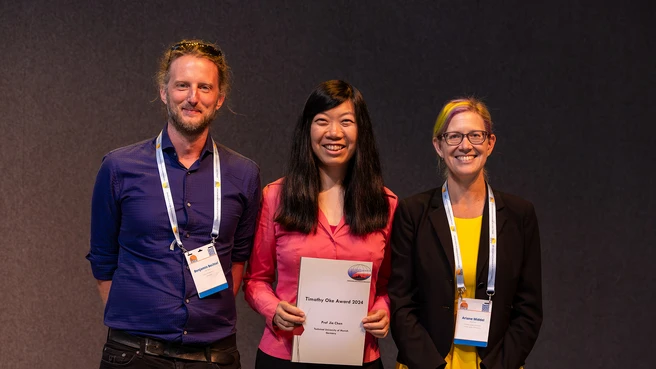
Professor Jia Chen is a Professor of Environmental Sensing and Modeling at the Technical University of Munich (TUM), holding positions in both the TUM School of Computation, Information and Technology (CIT) and the Department of Electrical and Computer Engineering, as well as the Department of Civil, Geo and Environmental Engineering. She also maintains an affiliation as an Associate at Harvard University. Her pioneering work focuses on developing novel optical sensors and atmospheric models to monitor and quantify greenhouse gas emissions in urban environments. Professor Chen's most significant contribution is the development of the differential column measurement method and the establishment of MUCCnet, the world's first permanent urban column sensor network. This groundbreaking work enables continuous, city-wide monitoring of greenhouse gases. Her research team has made notable discoveries, including quantifying methane emissions from events like the Munich Oktoberfest and identifying previously underestimated urban emission sources. Her research spans atmospheric science, environmental engineering, and climate change mitigation, with particular emphasis on: Urban greenhouse gas monitoring systems Advanced atmospheric modeling techniques Sensor network development for environmental monitoring Integration of machine learning with emission quantification Urban air quality assessment methodologies Professor Chen has received numerous prestigious awards including: Timothy Oke Award (2024) for original research in urban climatology ERC Consolidator Grant (2022) Arnold Sommerfeld-Award (2021) Germany's "Top 40 under 40" recognition by Capital Magazine (2020) Membership in the Global Young Academy (2021) She leads an extensive research group with numerous PhD students and postdoctoral researchers, and her work is supported by major funding from ERC, EU Horizon 2020, United Nations Environment Programme, NASA, ESA, German Federal Ministry of Education and Research, and German Research Foundation. Professor Chen has authored over 180 publications and 12 patents, with an h-index of 35.
David De Roure is Professor of e-Research at the University of Oxford and Academic Director of both the Digital Scholarship initiative and the Laboratory for AI Security Research. He is also an Honorary Research Professor at the Royal Northern College of Music (RNCM), where he serves as Technical Director of the Centre for Practice & Research in Science & Music (PRiSM). His work bridges computer science, digital humanities, cybersecurity, and music through his distinctive interdisciplinary approach. De Roure received his PhD in 1990 supervised by David W Barron and Peter Henderson, with research in Lisp and distributed systems. Prior to joining Oxford in 2010, he was Professor of Computer Science at the University of Southampton and Director of the Centre for Pervasive Computing in the Environment. His career spans multiple institutions and research domains, reflecting his commitment to interdisciplinary work. De Roure's research focuses on new methods of digital scholarship, innovation in knowledge infrastructure, cybersecurity, and computational approaches to music. His work uniquely combines humanities (digital musicology), social sciences (social machines and web science), engineering (Internet of Things), and computer science (distributed systems, AI). A key theme is empowering human creativity through technology rather than replacing humans with AI. He emphasizes co-creation between humans and machines, particularly in music composition where he explores how algorithms can generate fragments for human assembly. His recent publications reveal a strong focus on AI security in IoT systems, digital scholarship methods, and the intersection of music with computational approaches. There's a clear trajectory from foundational work in social machines and web science toward current applications in cybersecurity and music-AI co-creation. His publications consistently bridge technical domains with humanistic inquiry, demonstrating his commitment to interdisciplinary scholarship that addresses real-world challenges. Fellow of the British Computer Society (FBCS) Fellow of the Institute of Mathematics and its Applications (FIMA) Fellow of the Royal Society of Arts (FRSA) Chartered IT Professional (CITP) Turing Fellow at The Alan Turing Institute (2018-2024) De Roure has co-founded three major interdisciplinary initiatives: PETRAS National Centre of Excellence for IoT Systems Cybersecurity (the world's largest socio-technical research center focused on IoT security), the Software Sustainability Institute (dedicated to improving research software), and PRiSM at RNCM. He was Director of the Oxford e-Research Centre from 2012-17 and has led numerous research projects including SOCIAM (The Theory and Practice of Social Machines), FAST (Fusing Audio and Semantic Technologies), and Transforming Musicology. The Laboratory for AI Security Research, which he directs, took its first PhD students in 2024. At Oxford, De Roure chairs the Digital Research Cluster at Wolfson College and oversees the Laboratory for AI Security Research. The PRiSM team at RNCM has produced numerous musical works and performances, including six premieres in New York in 2024. He has been involved in designing gesture recognition software used in many performances and has collaborated on public engagement projects including the Science Together project which released a Hip Hop album. His current work includes exploring Chladni Plates for new musical instrument design and developing algorithmically enhanced instruments.
Dominic Thibault is an Assistant Professor at the Faculty of Music, Université de Montréal . His research-creation explores human-machine interaction in musical contexts, focusing on embodied cognition through electroacoustic compositions, audiovisual performances, and musical software development. Co-director, Laboratoire Formes·Ondes Active member, CIRMMT (Centre for Interdisciplinary Research in Music Media and Technology) Research axis leader, Expanded Musical Practice (CIRMMT) Member, Québecor Millénium entrepreneurship committee Scientific committee member, ACFAS
Mark d'Inverno is a Professor in the Department of Computing at Goldsmiths, University of London, where he has established himself as a leading researcher at the intersection of artificial intelligence, multi-agent systems, and creative applications. His academic journey began with foundational work in formal methods and agent-based systems, culminating in his 1998 PhD thesis 'Agents, Agency and Autonomy: A Formal Computational Model' from University College London, and has evolved toward practical applications in music technology and ethical AI systems. Professor d'Inverno's research interests span multiple interconnected domains, with a particular focus on computational creativity, multi-agent systems, and the application of AI in musical contexts. His work explores how artificial intelligence can enhance creative processes, particularly in music composition and performance, while maintaining ethical considerations in social AI systems. He has made significant contributions to understanding how agents can interact meaningfully in social contexts, how ethical frameworks can be embedded in online systems, and how technology can support creative learning experiences. His recent scholarly output demonstrates a clear trajectory toward applied research with social impact, as evidenced by his 2021-2024 publications which increasingly address ethical considerations in AI, human-AI collaboration in creative domains, and educational applications of technology. These works reveal a researcher deeply engaged with both theoretical foundations and practical implementations, bridging the gap between abstract computational models and real-world creative and educational applications. Professor d'Inverno maintains an extensive collaborative network, frequently working with Matthew Yee-King on music technology applications, with Pablo Noriega on ethical AI frameworks, and with Jon McCormack on computational creativity. His research has been supported through various projects that connect theoretical computer science with practical creative applications, particularly in the development of systems that facilitate human-AI creative collaboration.
Patrick Mitran is a full-time Professor at the University of Waterloo's Department of Electrical and Computer Engineering, within the Faculty of Engineering. His research focuses on advanced wireless communication systems, including 5G/6G technologies, millimeter-wave and sub-THz communication, digital predistortion techniques, MIMO systems, and beamforming architectures. He leads projects addressing challenges in transmitter linearization, network resource allocation, and hardware-efficient signal processing. Key research interests include optimizing frequency multiplier-based transmitters, mitigating inter-cell interference in massive MIMO networks, and developing algorithms for reconfigurable intelligent surfaces (RIS). His work often intersects hardware design, signal processing, and network optimization, with applications in next-generation wireless infrastructure. Recent publications highlight innovations in ultrawideband signal generation for 6G testing, practical RIS configurations, and FPGA-based real-time digital predistortion implementations. His contributions emphasize both theoretical advancements and practical system-level solutions. Dr. Mitran's research group collaborates on cutting-edge topics such as hybrid NOMA in multi-cell networks, adaptive coding modulation for Gaussian channels, and interference decoding strategies. His work has been published in top-tier journals and conferences, reflecting a sustained impact on modern wireless communication technologies.
Dr. Jan Christoph Munck-Rieder is a Lecturer at EBS Business School in Oestrich-Winkel, Germany. He serves as Co-Head of the Strascheg Center for Impact in Innovation & Entrepreneurship (SCIIE) and leads the Gründungsfabrik Rheingau , a joint initiative with Geisenheim University. In addition to his academic role, he is the managing director of varISO GmbH in Mainz, a consultancy firm. Education: Business Administration studies at Johannes Gutenberg University Mainz Business Administration studies at Karlstad University, Sweden Research Interests: Dr. Munck-Rieder’s research focuses on innovation management , entrepreneurship , and innovation controlling . He explores how organizations can systematically manage innovation processes through effective control systems, balancing creativity with efficiency. His work also delves into the implications of digital transformation on budgeting, management accounting, and organizational development. He has contributed extensively to understanding how Industry 4.0 technologies reshape business models and control mechanisms in manufacturing and service sectors. Publications Overview: His recent publications span peer-reviewed journals and industry-focused outlets, with a clear emphasis on innovation control systems , new product development , and digital transformation . Topics include the performance effects of control instruments in innovation stages, bibliometric evolution of innovation control as a field, and empirical studies on digital budgeting. His work often bridges theoretical frameworks with practical applications in corporate and startup environments. Books and Editorial Contributions: Controlling von Start-Ups & Start-Up-Initiativen (2019, co-authored with R. Gleich) Co-editor of Kennzahlen optimal nutzen (2018) Multiple chapters in edited volumes on controlling, innovation, and digital transformation Industry Engagement & Consulting: Dr. Munck-Rieder has extensive consulting experience with firms such as INVENSITY , Volkswagen Consulting , Horváth , and SGP Management Consultants . His dual role in academia and industry allows him to integrate practical insights into research and teaching, particularly in innovation and entrepreneurship education.
Wes Hartmann is the John G. McCoy-Banc One Professor of Marketing at the Stanford Graduate School of Business. His research focuses on the intersection of marketing, economics, and policy, with emphasis on pricing strategies, brand advertising, social interactions, and conservation. He has advised numerous PhD students who have secured academic and industry positions globally. Key research interests include understanding frequency in brand advertising, preference externality estimators, and the economics of harm reduction through conservation experiments. Hartmann’s work bridges theoretical econometric models with real-world applications, such as dynamic pricing in retail and the impact of digital cinema on market dynamics. His publications have been recognized with prestigious awards, including finalist nominations for the John D.C. Little Award and the Paul Green Award. Notable contributions include groundbreaking studies on Super Bowl advertising effectiveness and the implications of social networks on consumer behavior. Hartmann’s advising record spans over 15 students, many of whom have secured tenured positions or roles at top institutions like Harvard, Columbia, and NYU. His research collaborations include projects on conservation field experiments, internet vs. TV advertising efficacy, and the role of social interactions in targeted marketing.
Dr. Robert Pickle is a Postdoctoral Fellow at the Research School of Earth Sciences (RSES), Australian National University (ANU), specializing in Geophysics. His work focuses on seismic network design, machine learning applications in seismology, and tectonic studies in active seismic zones. He contributes to projects like the Southwest Australia Seismic Network (SWAN) and the Australian Passive Seismic Server, advancing understanding of crustal dynamics and seismic hazard assessment. Education: PhD (specific details not provided in texts). Research Interests: Dr. Pickle’s expertise spans seismic instrumentation, regional seismic monitoring, and the integration of machine learning for improving earthquake catalog accuracy. His studies address critical areas such as the Banda Arc–Australian Plate collision zone and the seismicity of southwest Australia. Projects: Principal investigator on the Australian Passive Seismic Server and researcher on the Enhanced 3-D seismic structure of Southwest Australia (SWAN) project. Collaborates with institutions like the ANU’s RSES and international seismological networks. Labs/Teams: Active in ANU’s Geophysics research groups, contributing to collaborative efforts in seismic data acquisition and analysis.
Prof. Dr. Soeren Lienkamp is an Assistant Professor at the Institute of Anatomy , Faculty of Medicine , University of Zurich . His work bridges digital education and genetic research , focusing on enhancing medical teaching through innovative formats. Research Interests : Genetics, developmental biology, kidney disease modeling, CRISPR applications, digital medical education, and advanced microscopy. Methodologies : Combines Xenopus tropicalis models, deep learning , and bioengineering to study genetic kidney disorders and improve diagnostic tools. Publication Trends : His recent articles highlight predictable genome editing , 3D imaging technologies , and mechanistic insights into kidney and eye development. Earlier works focus on ciliary function , Wnt signaling , and metabolic stress in renal cells.
Thomas Pasquier is an Assistant Professor in the Department of Computer Science at the University of British Columbia, affiliated with the Systopia Lab and UBC Security & Privacy Group. His research focuses on digital provenance, system auditing, intrusion detection, and performance optimization. He investigates systems security through provenance graph analysis, developing practical frameworks for intrusion detection (including PROVNET and Kairos) and provenance summarization tools. His work combines machine learning with systems research to enhance cybersecurity transparency. Recent Publications (2022-2025) Provenance-based intrusion detection systems analysis Whole-system provenance for practical security eBPF kernel extension security enhancements LLM-driven provenance summarization Research code quality assessment Scientific Awards Incredible Instructor Awards Amazon Science Research Award He supervises graduate students in systems security research and teaches courses on security & privacy and operating systems. His lab welcomes diverse students for thesis-based research opportunities.
Max H. Bazerman is the Jesse Isidor Straus Professor of Business Administration at Harvard Business School, specializing in negotiation, decision making, and behavioral ethics. His academic career spans several decades during which he has become a leading authority on how cognitive biases and ethical considerations influence organizational decision processes. Professor Bazerman's primary research interests include negotiation strategies, ethical decision making, judgment heuristics, and bounded awareness. His work explores how individuals and organizations can recognize and overcome cognitive limitations to make more ethical and effective decisions. He has pioneered research on blind spots in ethical judgment, the psychology of complicity, and decision architectures that promote better choices. His publications reveal a consistent focus on practical applications of behavioral science to real-world business challenges. Recent work examines resource allocation during crises, ethical leadership frameworks, and the role of experimentation in improving organizational decision making. The research shows increasing emphasis on systemic ethical failures and how individuals contribute to complicity in unethical behavior. Honorary doctorate from the University of London Life Achievement Award from the Aspen Institute's Business and Society Program Distinguished Educator Award from the Academy of Management Academy of Management Career Award for Scholarly Contributions to Management Lifetime Achievement Award from the Organizational Behavior Division of the Academy of Management Ethisphere's 100 Most Influential in Business Ethics Daily Kos' Heroes recognition for whistleblowing on the Bush Administration's corruption of the RICO Tobacco trial Bazerman has advised numerous organizations including Abbott, Aetna, AIG, Alcoa, Allstate, Amgen, and many others across 30 countries. His work bridges academic research and practical application, with significant influence on how businesses approach ethical decision making and negotiation strategy. He has trained doctoral students who now hold positions at leading business schools worldwide, including Harvard, Wharton, Kellogg, and Stanford.