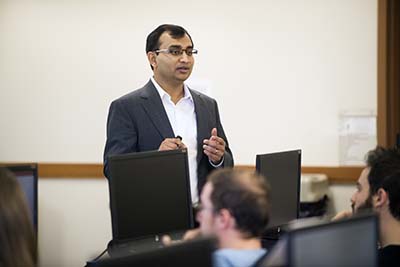
Abhijit Banerjee is a Professor in the Department of Economics at the Massachusetts Institute of Technology (MIT). His research focuses on development economics, public health policy, and social protection programs, particularly addressing poverty and inequality in low- and middle-income countries. He has conducted large-scale experiments evaluating interventions such as conditional cash transfers, universal basic income, and healthcare policies. Key areas of interest include the design and implementation of anti-poverty programs, behavioral economics, and the long-term health impacts of infectious diseases like COVID-19. His work often integrates experimental methods to assess policy effectiveness, with contributions to global health studies and economic development strategies. Notably, his research on the RECOVERY trial evaluates treatments for hospitalized COVID-19 patients, while other studies explore financial spillover effects of electronic government transfers in Indonesia and savings behavior interventions in Chile. Banerjee has collaborated on projects analyzing post-COVID-19 health outcomes, labor market dynamics in India, and the role of trusted messengers in public health communication during crises. Despite the breadth of his contributions, specific details about his educational background, grants, or lab affiliations are not explicitly provided in the source text.
Prof. Srdjan Capkun is a Full Professor in the Department of Computer Science at ETH Zurich and Director of the Zurich Information Security and Privacy Center (ZISC). He holds a Dipl.Ing. from the University of Split (1998) and a Ph.D. from EPFL (2004). His research focuses on system and network security, including wireless security (e.g., secure positioning), trusted computing, blockchain technologies, and privacy-preserving systems. He co-founded 3db Access (acquired by Infineon) and Sound-Proof, addressing secure distance measurement and authentication. Notable achievements include an ERC Consolidator Grant (2016), ACM Fellowship, and IEEE Fellowship. Education: Dipl.Ing., Electrical Engineering / Computer Science, University of Split, 1998 Ph.D., Communication Systems, EPFL, 2004 Research Interests: Wireless security (e.g., UWB, GNSS, cellular) Trusted execution environments (TEEs) Blockchain and cryptocurrency systems Privacy-preserving technologies Awards & Grants: ERC Consolidator Grant (2016) ACM Fellow and IEEE Fellow Leadership of ZISC Advising & Labs: Leads the System Security Group at ETH Zurich Guided postdoctoral researchers and graduate students in security and privacy Companies: 3db Access (secure distance measurement) Futurae (online authentication)
Gilbert Fridgen is Full Professor in Digital Financial Services and holder of the PayPal-FNR PEARL Chair at the University of Luxembourg's Interdisciplinary Centre for Security, Reliability and Trust (SnT). He leads the FINATRAX research group focusing on blockchain, digital identity, and sustainable digital solutions. His research explores decentralized technologies in finance, energy systems, and public administration. Current projects investigate blockchain applications in industrial demand response, NFT markets, EU digital identity wallets, and DeFi institutional adoption. Prof. Fridgen examines the intersection of technology with regulatory frameworks and user behavior in energy and financial systems. He collaborates extensively with industry partners including PayPal and Spuerkeess. Prof. Fridgen actively contributes to EU digital policy discussions, particularly regarding the European Digital Identity Wallet framework and decentralized finance governance.
Rizwan Ahmed is a Senior Lecturer in Accounting and Finance at the University of Kent 's Kent Business School . He serves as Director of Studies for the Department for Accounting and Finance, with prior experience as an Assistant Professor at institutions like the University of Birmingham, Cardiff Business School, and Birkbeck University of London. His research focuses on Sustainable Finance , FinTech , and Corporate Governance , with funding from the Economic and Social Research Council (ESRC) for collaborative projects. Fellowship of Higher Education Academy (HEA-UK) Associate Fellow Member, Chartered Institute of Securities and Investment (CISI-UK) His publications in journals like Energy Economics and International Journal of Finance and Economics examine intersections between climate risk, financial markets, and regulatory frameworks. He supervises PhD research in areas including Sustainable Finance, Climate Finance, and Corporate Governance in the financial sector. Research Trends Recent articles analyze climate change impacts , energy market spillovers , and ESG performance under sanctions, utilizing empirical methods and data from the UK, China, and emerging economies. Methodological innovations include cross-quantilogram analysis and portfolio optimization frameworks. Scientific Awards Fellowship of Higher Education Academy (HEA-UK) Associate Fellow Member, Chartered Institute of Securities and Investment (CISI-UK) Rizwan also acts as a peer reviewer for journals including International Review of Financial Analysis and Technological Forecasting & Social Change .
Mohammad Saifur Rahman is the Daniels School Chair in Management and a Professor of Management Information Systems at the Mitch Daniels School of Business, Purdue University. Previously, he was an Associate Professor at the Haskayne School of Business, University of Calgary. His academic journey includes significant leadership roles such as co-chairing the Conference on Information Systems and Technology (CIST) in 2013 and serving as president of the INFORMS eBusiness Society in 2014. Currently, he serves as an associate editor for both Management Science and Information Systems Research (ISR). Ph.D. in Management Information Systems, Krannert School of Management, Purdue University (2008) MBA in Management Information Systems, Southern Illinois University (2004) BS in Computer Science, Southern Illinois University (2002) Rahman's research primarily focuses on the economic implications of digital transformations. His work examines how digitization affects consumer behavior, market structures, and business strategies across various industries. He investigates the value of digital traces in driving consumer behavior and improving decision-making, particularly in omnichannel retail environments. His research on the sharing economy has revealed important insights about economic disparities, showing how platforms like Airbnb provide economic benefits to predominantly white neighborhoods while failing to generate similar spillover effects in predominantly Black or Hispanic neighborhoods. His recent publications reveal a consistent focus on the intersection of technology, economics, and social impact. Rahman's work frequently examines how local market structures interact with digital platforms to create or exacerbate economic inequalities. His research spans multiple disciplines including information systems, economics, marketing, and operations management, with a particular emphasis on empirical studies using real-world data from major companies like Walmart and Cisco. CICP Faculty Commercialization Award (2020) INFORMS Sandy Slaughter Early Career Award (2018) World's Top 40 Business School Professors Under 40 by Poets and Quants (2017) Jay N. Ross Young Faculty Scholar Award (2015) Dean's Award for Outstanding Research Achievement (University of Calgary, 2014) Rahman has secured substantial research funding from organizations including Social Sciences and Humanities Research Council (SSHRC), Adobe Systems ($50,000 grants in 2017 and 2020), Trask Innovation Fund ($21,218), and NSF I-Corps ($50,000). He has advised numerous PhD students and collaborated with industry partners to translate research into practical applications. Rahman co-founded RightFit Analytics, a precision health analytics solution that utilizes AI to learn success patterns in healthcare. He has organized significant academic events including the Krannert-Walmart Data Dive (believed to be the first data dive on a college campus) and the Dawn or Doom Data Dive in cooperation with Cisco. Rahman actively engages with industry through consulting and collaborative research projects. His work with Walmart, Cisco, and other major corporations demonstrates his ability to bridge academic research with practical business applications. He has been particularly active in studying how AI and big data analytics can be leveraged to improve business decision-making while addressing potential negative consequences like algorithmic bias and economic inequality.
Dr. Anna Dubiel is a Senior Lecturer in Marketing at King's Business School, King's College London. Her research focuses on the intersection of innovation and R&D management with international markets, particularly in emerging economies. She teaches a broad range of Marketing topics in postgraduate and executive programmes covering International Marketing and Digital Marketing. Dr. Dubiel obtained her PhD from WHU – Otto Beisheim School of Management, Vallendar, Germany, where she previously served as Assistant Professor of International Innovation Management. Her academic journey includes visiting researcher positions at Boston College, Judge Business School, and London Business School, as well as a Visiting College Research Associate position at Wolfson College, University of Cambridge in 2017. Her research expertise centers on Innovation Management , New Product Development , R&D Management , International Marketing , and Emerging Economies . Dr. Dubiel's work particularly examines how businesses can develop better products and services for consumers and businesses at the subsistence market ends. Her current research project focuses on 'Risk Management in Emerging Economies: A Marketing Perspective. The Context of Human-Wildlife Conflict (HWC) Insurance,' which studies how to reach buyers of complex new services in subsistence marketplaces and raise insurance literacy. Dr. Dubiel's publications reveal a consistent focus on innovation in emerging markets, with significant contributions to journals such as the Journal of Product Innovation Management, Industrial Marketing Management, Journal of Business Research, European Journal of Marketing, and International Marketing Review. Her work often explores frugal innovation, new product development strategies, and international market adaptation, demonstrating how businesses can succeed in resource-constrained environments while creating social impact. Her notable scientific achievements include: Highly Commended Paper Winner of the Journal of Indian Business Research (2014) Finalist for the Thomas P. Hustad Best Paper Award for the Journal of Product Innovation Management (2016) Academy of Marketing Teaching Excellence Award (2020) British Academy of Management Early Career Education Practice Award (2021) Finalist for the Academy of International Business Teaching Innovation Award (2021) HEA Fellowship (2019) Multiple Case Writing Competition awards from AESE Business School (2010, 2011) Dr. Dubiel has received research funding from several intramural grants as well as the British Academy/Leverhulme Trust. Her teaching methodology emphasizes practical application through managerial guest lectures and consulting projects conducted by students for real organizations. While she is not currently accepting new PhD students, her research group focuses on marketing financial services to first-time buyers in emerging markets, with evidence from Human-Wildlife Conflict (HWC) Micro-Insurance in Kenya.
Peter Seele is a Full Professor at the Faculty of Communication, Culture and Society at Università della Svizzera italiana (USI). He is affiliated with the Center for Climate Finance and Sustainability (CCFS), Ethics and Communication Law Center (ECLC), and the Luxury Observatory Lugano (LOLugano). His research focuses on Corporate Social Responsibility (CSR), Business Ethics, Digital Ethics, Greenwashing, and Machinewashing. Dr. Seele holds dual PhDs in Economics (University of Witten/Herdecke, Germany) and Philosophy (University of Düsseldorf, Germany). He previously served as an Assistant Professor at the University of Basel and conducted post-doctoral research at the Institute for Advanced Studies in the Humanities (KWI) in Essen. His educational background includes studies at the University of Oldenburg and Delhi School of Economics, followed by two years as a business consultant in Frankfurt. His research explores ethical challenges in digitalization, sustainability, and technology. Notable themes include AI ethics governance, ethicswashing in corporate communication, and the interplay between blockchain and business ethics. Recent work addresses greenwashing trends, the ethical implications of algorithmic systems, and sustainable practices in luxury industries. Publications highlight critical analyses of digital ethics frameworks, sustainability backlashes, and the societal impact of emerging technologies. His interdisciplinary approach bridges philosophy, business studies, and environmental science, with a focus on practical solutions for ethical dilemmas in modern organizations. Peter Seele collaborates across academic and industrial sectors, emphasizing real-world applications of ethical theories. He advises on CSR strategies, digital transparency, and regulatory frameworks for sustainable business practices.
Erik Bohlin is a Professor at Western University's Ivey Business School in the Business, Economics and Public Policy department. He holds the Ivey Chair in Telecommunication Economics, Policy and Regulation and serves as Editor-in-Chief of Telecommunications Policy . Currently on leave from Chalmers University of Technology, he combines economic theory with telecommunications policy analysis. PhD in Economics of Technology from Chalmers University of Technology (1995) BA in Business Administration and Economics from Stockholm School of Economics (1987) Masters and Bachelor in Theology from Community Chapel College (1984-1985) His research focuses on telecommunications policy, digitalization's socioeconomic impact, broadband regulation, and technology diplomacy. He examines network effects, market entry strategies, and digital infrastructure's role in economic growth. Recent publications analyze 5G regulation, AI's societal impact, digital technology adoption strategies, and broadband's economic effects. These works span telecommunications economics, policy analysis, and technology's macroeconomic influence. Scientific Affiliation : Member of Swedish Royal Academy of Engineering Past Chair of International Telecommunications Society Teaching activities include developing and instructing graduate courses on Digital Strategy and Policy. The Chair receives funding from Ivey Business School, Bell Canada, and TELUS.
Dr. Livia Pancotto is a Senior Lecturer in Banking at the Department of Accounting and Finance, University of Strathclyde. She serves as Director of the MSc in International Banking and Finance and Deputy Director of the Responsible Business Institute (ReBI). She holds a PhD and MSc from Bangor University and degrees from Sapienza University of Rome. Her research focuses on European banking regulation, financial stability, and gender diversity's impact on climate finance. She chairs the International Accounting & Finance Doctoral Symposium and edits The European Journal of Finance. Awards include the 2014 Best Banking and Finance Master’s dissertation. She leads research on negative interest rates, non-performing loans, and green lending through EU-funded projects. Education: PhD Banking & Finance (Bangor), MSc (Sapienza), BSc (Sapienza) Research explores empirical banking dynamics, regulatory frameworks, and sustainable finance. Key topics include EU banking union evolution, climate change mitigation via gender-diverse bank boards, and market reactions to policy shocks. Recent work analyzes negative interest rate impacts on bank efficiency and Italy's NPL crisis. She has secured £153k in research funding (2023-2025). Grants: Research Excellence Awards (Strathclyde SRSS) Led workshops on Responsible Business and AI, presented at FSB Financial Innovation Network, and peer-reviewed for top journals. Supervises doctoral candidates through IAFDS. Active in editorial and advisory roles enhancing academic rigor in finance disciplines.
Tyler Wry is an Associate Professor of Management at the Wharton School, University of Pennsylvania . His research focuses on hybrid ventures and social enterprises that balance conflicting commercial and social goals. He has published in top-tier journals such as Academy of Management Annals , Academy of Management Journal , and Organization Science . He serves on the editorial boards of Administrative Science Quarterly , Academy of Management Journal , and Academy of Management Review . Research Highlights : Hybrid organizations, social entrepreneurship, nanotechnology startups, disaster philanthropy, microfinance dynamics, institutional logics, and strategic adaptation during crises. Teaching : Courses on entrepreneurship, social impact, venture creation, and research methods, including project-based learning and hands-on venture development. Scientific Awards include the IACMR Presidential Award, ONE/NBS Research Impact Award, Carolyn Dexter Award, and multiple best paper recognitions. His work has also been recognized through fellowships and teaching awards. Notable Contributions : Demonstrated how corporate disaster involvement accelerates recovery, how patriarchal societal logics affect microfinance lending to women, and how contextual factors shape social-financial tradeoffs in hybrid organizations.
Professor Michael C.L. CHAU serves as Professor and Deputy Area Head of Innovation and Information Management at The University of Hong Kong's Faculty of Business and Economics. He also holds the position of Associate Director at the HKU HKJC Centre for Suicide Research and Prevention, and serves on the HKU Senate and Court. His academic journey includes a Ph.D. in Management Information Systems from the University of Arizona and a B.Sc. in Computer Science (Information Systems) from the University of Hong Kong. Dr. Chau's research spans business analytics, artificial intelligence, web mining, fintech, smart health, and security informatics. His work focuses on applying data/text/web mining techniques to business, education, and social domains. He leads the Artificial Intelligence Research Group at HKU Business School, which has secured significant funding from the Hong Kong Research Grants Council, Food and Health Bureau, and other agencies for projects including 'The Invisible Hand in Crowdfunding' and 'Factors Moderating the Predictive Power of Social Media Sentiment on Stock Returns'. His publication portfolio includes over 150 articles in premier journals like MIS Quarterly, JMIS, and IEEE Transactions, with recent work exploring large language models, hate speech detection, and disaster-related social media analysis. His research demonstrates strong interdisciplinary connections across computer science, information systems, and business applications. INFORMS ISS Design Science Award (2020) IEEE ITSS Leadership Award in Intelligence and Security Informatics (2020) AIS Sandra Slaughter Service Award (2016) HKU Outstanding Young Researcher Award (2014) Faculty Research Postgraduate Supervision Award (2020 & 2025) Cited over 9,400 times (h-index = 47) Dr. Chau actively mentors doctoral students and has supervised numerous PhD graduates who now hold academic positions at institutions including Fudan University, Xi'an Jiaotong-Liverpool University, and the University of Maryland. His research grants portfolio demonstrates sustained funding success across diverse areas including blockchain, mental health applications, and social media analytics. The Artificial Intelligence Research Group he leads maintains strong industry connections through projects with Hong Kong Red Cross and the Hospital Authority.
Marc-Antoine Dilhac serves as Associate Professor in the Department of Philosophy at the University of Montreal's Faculty of Arts and Sciences, where he also directs governance and international collaboration initiatives. He holds leadership roles as Scientific Director of Algora Lab and leads the Ethics and Politics research axis at the Centre de recherche en éthique (CRÉ). His academic affiliations extend to the Centre d'études et de recherches internationales (CÉRIUM) and the Canada Research Chair in Public Ethics and Political Theory (2014-2019). Education: PhD in Philosophy and Political Science, University of Paris I: Panthéon-Sorbonne (2009) Master 2 in Philosophy and Political Science, University of Paris I: Panthéon-Sorbonne (2003) Agrégation in Philosophy, University of Paris I: Panthéon-Sorbonne (2002) Dilhac's research spans ethics, political philosophy, and AI governance, with particular focus on democratic tolerance, multiculturalism, and the ethical implications of artificial intelligence. His work bridges theoretical political philosophy with practical applications in AI policy development, sustainable finance, and democratic institutions. He has contributed significantly to UNESCO's Recommendation on the Ethics of Artificial Intelligence and leads initiatives examining AI's impact on French-speaking culture and democratic values. His recent publications reveal a clear trajectory from foundational work on tolerance and justice theory toward contemporary AI ethics challenges. The thematic evolution shows increasing engagement with practical governance frameworks, particularly in finance and education sectors, while maintaining strong philosophical grounding in democratic theory and institutional design. Key Awards and Recognition: Canada Research Chair in Public Ethics and Political Theory (2014-2019) Banting Postdoctoral Fellowship (2011) Contributor to UNESCO's Recommendation on AI Ethics (2021) Dilhac has supervised over 15 graduate students across philosophy, political science, and interdisciplinary AI ethics programs. His research is supported by multiple grants from FRQSC, FRQNT, SSHRC, and MITACS, totaling over $2 million CAD. Current projects include the Generative AI Ethics Framework for Educational Technology (2024-2025) and the Sustainable Finance AI Tools project examining ESG/DEI disclosure analysis. He co-founded and leads the CORDÉ research group on corruption and democracy, and directs Algora Lab's work on AI governance. His upcoming February 2025 panel at Université Laval will address AI and Francophone cultural perspectives ahead of the Paris AI Action Summit.
Dr. Maud Borie is a Senior Lecturer in Environment, Science & Society at King’s College London’s Department of Geography, within the School of Global Affairs. Her work bridges Human Geography and Science and Technology Studies (STS), focusing on biodiversity governance, environmental policy, and green finance. She holds a PhD from the University of East Anglia and has held visiting fellowships at Harvard Kennedy School. Borie’s research explores the politics of environmental knowledge and its societal implications, including nature-based solutions and green finance mechanisms. She has contributed to global initiatives like the Intergovernmental Platform on Biodiversity and Ecosystem Services (IPBES) and co-founded the Mediterranean Alliance for Wetlands. Her recent projects include analyzing green finance’s reliance on scientific legitimacy and mapping resilience strategies in cities. She teaches courses on environmental policy, qualitative methods, and geographies of financialization. Borie has been awarded grants for interdisciplinary projects such as ‘deep listening with machines for equitable environmental futures’ and ‘forestscapes’ immersive soundscapes. Her research outputs span over 18 peer-reviewed articles, with topics ranging from climate change framing to urban resilience in the Global South. Awards: Planetary-scale interpretation (2023), Rethinking environmental policy (2022), Forestscapes collaboration (2023) Grants: Creative Collaboration Seed Fund (2023), EU/PEARL disaster resilience projects Labs/Teams: KingsCAT (Social Media Research), Political Ecology, Biodiversity & Ecosystem Services (PEBES) group
Professor Markos Zachariadis is the Chair in Financial Technology (FinTech) and Full Professor of Information Systems at Alliance Manchester Business School (AMBS), University of Manchester. He also directs the Centre for Financial Technology Studies (CFTS) and holds roles such as FinTech Research Fellow at the Cambridge Centre for Digital Innovation and member of the World Economic Forum’s Global Future Council on Financial Systems. His research focuses on the intersection of digital innovation, financial technology, and network economics, with notable studies on payment systems (e.g., SWIFT), Open Banking, and blockchain. He has authored/co-authored influential works like The Society for Worldwide Interbank Financial Telecommunication (SWIFT) (2014) and co-edited The PAYTECH Book (2020). Education: PhD in Management (Economics of Payment Systems) from the London School of Economics (2011), MSc in ADMIS (2004), and BSc in Economics from the University of Patras (2003). Prior academic roles include Associate Professor at Warwick Business School and Visiting Professorships at Ivey Business School and Cambridge Judge Business School. Industry experience includes roles at UBS Investment Bank and Hewlett Packard. Research Interests: Economic impacts of ICT adoption in banking, diffusion of payment networks, data standards, Open Banking, blockchain, and regulatory frameworks. Awards include the NET Institute Award and SWIFT Institute Awards for research on payment systems and digital transformation. He advises global organizations like the Hellenic Competition Commission and frequently engages with media outlets such as BBC, CNN, and The Financial Times. Key Projects: Organized an international PayTech conference funded by Gates Foundation and MasterCard. Co-led the Centre for Digital Trust and Society (2021–present) and the Fintech and Financial Crimes project (2021–2022). His work contributes to UN SDGs related to innovation and financial inclusion. Labs/Teams: Founded the Centre for Financial Technology Studies (CFTS) at AMBS, part of interdisciplinary initiatives like the Centre for Digital Trust and Society.
Professor Khaled Hussainey is a Professor of Accounting at Bangor Business School, appointed in April 2024. He previously held academic roles at Portsmouth, Plymouth, Stirling, Manchester, and Ain Shams Universities. With over 25 years of teaching experience, his research focuses on corporate narrative reporting, XBRL, and sustainability. He has published over 200 peer-reviewed articles and secured grants from ESRC, Qatar National Research Foundation, and others. His qualifications include a Ph.D. in Accounting & Finance from the University of Manchester (2004), an M.Sc. from the University of Birmingham (2000), and a B.Com. from Ain Shams University (1994). He has supervised 56 PhD and 7 DBA theses. Research interests include corporate governance, earnings management, Islamic accounting, and big data. He serves as Co-Editor of the Journal of Financial Reporting and Accounting and Editor of the International Journal of Emerging Markets . His work has been recognized in Stanford University's Top 2% Researchers list (2023). Grants include £60,000 from ESRC (2005), $120,000 from Qatar NFR (2014), and £48,412 from the British Council (2019). He has held visiting professorships at King Khalid University, Tunis University, and others. He actively participates in international conferences and serves as an external assessor for promotions and research funds globally. His recent articles address sustainability reporting, FinTech disclosure, and climate governance. He emphasizes interdisciplinary research linking accounting practices with technological and environmental trends.